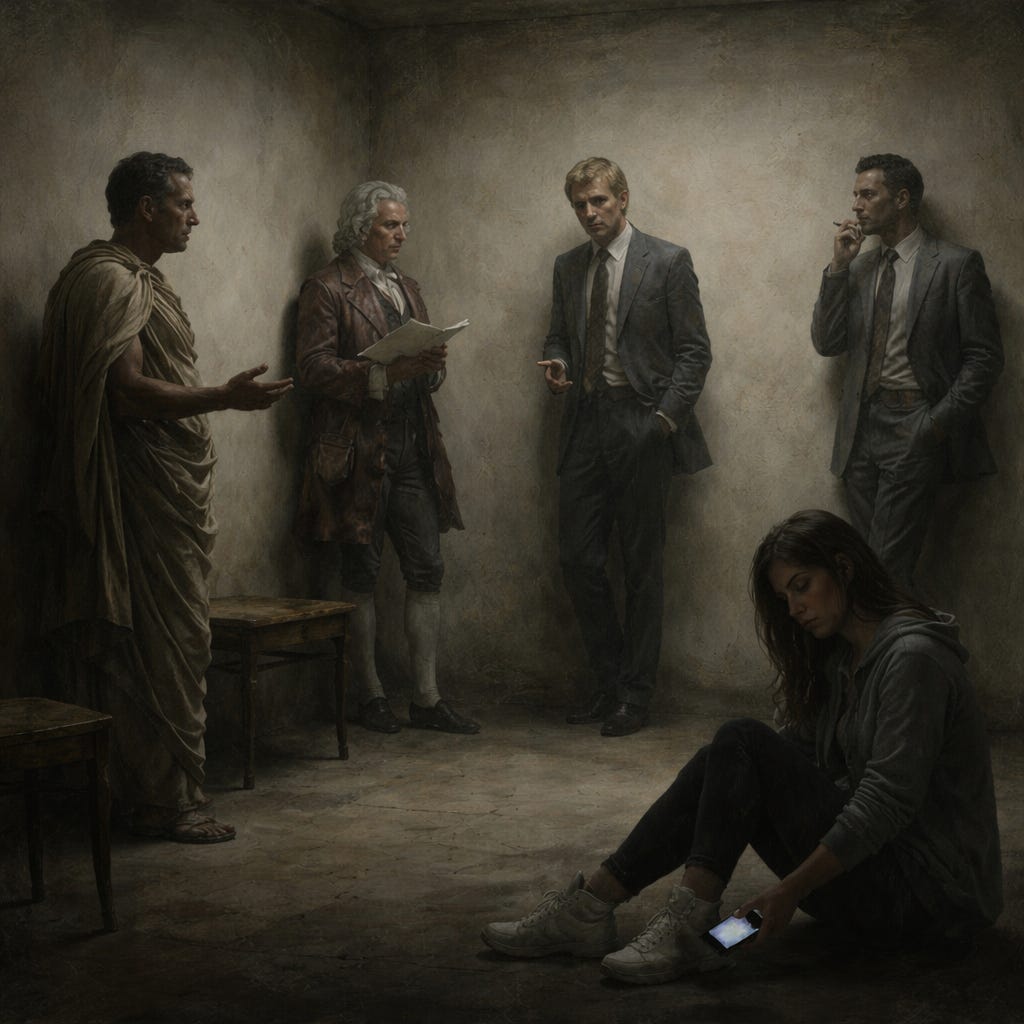
Preface – The Room After Sartre
Jean-Paul Sartre gave us one of the most honest images of damnation the twentieth century produced: three people in a Second Empire drawing room, condemned to spend eternity as each other’s mirror and torment. No pitchforks, no flames, just the unbearable weight of being seen by those you cannot escape. His line—“Hell is other people”—has been misquoted into banality, but the structure was sharp: we are punished not by monsters but by the way our selves ricochet off other selves once all excuses and exits are sealed. This essay begins in the same place: a room in hell. But it is not Sartre’s room. His characters were private cowards and liars, guilty of ordinary betrayals. This room is for a different species of soul: performers of late empires, people whose primary medium was not the intimate gaze of a few others but the roar of crowds and the infinite scroll. They are not mass murderers or tyrants in the classical sense. They are men and women whose lives were spent turning conflict into currency and calling it courage.
Empires do not just build armies and roads. They build attention economies: forums, pamphlets, coffeehouses, beer halls, broadcast networks, feeds. Every era has its own version of the stage where moral language and spectacle fuse, where we learn what counts as bravery, truth, and betrayal by watching who gets rewarded for what they say. In early, ascending phases, serious people—builders, thinkers, disciplinarians—still have some claim on that space. In late phases, when institutions are hollowed and legitimacy is cheap, the ecosystem shifts. Performance outruns responsibility. Outrage outbids argument. The system begins to select, with cold efficiency, for those who can hold attention by antagonizing others and baptize that antagonism with the language of virtue.
The five figures in this room are fictional composites drawn from such moments: a Roman demagogue in the last days of the Republic, a Parisian pamphleteer under the ancien régime, a Weimar propagandist, a late-Soviet satirist, and a twenty-first-century Twitter woman whose fame lives entirely in the feed. None is a direct portrait of any single historical person. All are engineered to carry traits their eras rewarded: the ability to weaponize grievance, to turn resentment into rhetoric, to transform structural pain into personal glory. Their punishment is precise. They are not whipped or burned. They are simply deprived of the one thing that has always justified their excesses to themselves: an audience.
What follows is a parable in five chapters. It is not meant as a subtle allegory. It is a blunt instrument. The room is the same across centuries because the pattern is the same: late-stage systems elevate a certain kind of moralized performer, then discard them when they are spent. We like to imagine that hell is reserved for obvious villains. I am more interested in what happens to those who helped degrade the public sphere by doing exactly what their time rewarded, while convincing themselves they were saving it. If Sartre’s insight was that hell is being trapped in the gaze of others, this version updates it for an age in which the gaze itself has been industrialized: hell is being trapped after the gaze is gone, left alone with the habits you built for an audience that no longer exists.
Chapter 1 – The Room Without an Audience
The door closed without drama. No flames, no pitchforks, no judgment throne. Just the muffled sound of a latch turning in a corridor that did not exist a moment earlier. The room was rectangular, with walls the color of old teeth and a ceiling too low to be noble and too high to be comforting. No windows. No visible lamps. The light came from nowhere in particular, as if the air had decided, reluctantly, to glow. If this room has a debt, it is to Sartre. His hell also began with a closed door and bad furniture. Consider this an update: the upholstery has been stripped out, the bronze eyes on the wall replaced by something more efficient. Sartre gave us hell as other people. This is hell as other people without an audience.
There were five of them. They did not arrive so much as flicker into being, like browser tabs unmuted all at once. Publius Varro came first, or thought he did. He stood by the far wall in a stained tunic and the remnants of a senator’s toga, its border once a rich purple, now dried-blood brown. His hair was cropped in the Roman style, his face broad and made for public weeping and public rage. One sandal strap had snapped and been tied back together with a strip of cloth. He looked around not with curiosity but with the practiced wariness of a man expecting rivals, informers, a crowd. His right hand twitched at his side, fingers curling as though curling around an invisible podium.
Closer to the center was a man in powder and lace, the perfume of old Paris leaking off him like a dying memory. Émile de Rochefort adjusted his wig with fastidious irritation, as if hell were primarily an affront to his grooming. His coat was a shade of blue that had once meant something at court. The cuffs were frayed, the lace yellowed by ink and sweat. His fingers were finely stained, the way only a man who has spent his life dipping quills into poison acquires. His eyes did a quick inventory: walls, corners, potential exits, the social hierarchy of the other bodies. His mouth settled into a half-smile that had ruined reputations for sport.
Near the door stood Otto Weiss, who could have been any angry son of Weimar: cheap brown suit, white shirt gone gray at the collar, tie knotted with more force than skill. On his left arm the cloth was a shade lighter where an armband had lived for years. The bare strip of fabric looked indecent, like a tan line from a marriage ring suddenly removed. His shoulders were squared as if waiting for a hall, a stage, a mass to answer him back. He listened, as if for distant shouting, and heard only the contained silence of the room. His jaw tightened. Without a crowd, standing still felt obscene.
At the opposite wall, leaning against nothing in particular, Sergei Antonov dragged on a cigarette that refused ever to reach the filter. The ash grew but never dropped. His suit had that late-Soviet sheen, the texture of things produced by a system that no longer believed its own promises. The knot of his tie was loose, the top button undone, as if he had just escaped a meeting that would never end. His face held the practiced weariness of a man who had smuggled truth in jokes for so long he no longer trusted either. He watched the others with a detached, almost scientific boredom, the way a man in a queue watches those ahead of him shuffle and lie.
The last arrival was the only one whose clothes fit the century you know. Leggings, oversized sweatshirt, immaculate sneakers. Hair staged-but-natural. Face in full camera-ready arrangement, a screen-optimized kind of beauty: harsh lines softened just enough to pass for candor. In her right hand, Callie Hart held her phone the way a swordsman holds a blade, like an extension of the body. When she appeared, she did not look at the room. She looked at the phone, thumb flicking up on a screen that did not change, hunting for a notification bar that never loaded. Then she looked up and saw the others. For a moment the contempt on her face was clean and uncomplicated: four freaks at a bus station. Then training reasserted itself. Any gathering was a potential audience.
“Okay, what is this?” she said, automatically pitching her voice to the invisible microphone. “Some kind of… weird LARP? Did I get pranked into a live show?”
No one answered. There was still the expectation, in each of them, that the real conversation was happening elsewhere. Publius was waiting for the roar of a forum just past the wall. Émile expected the rustle of readers in salons beyond the door. Otto kept listening for boots, for chairs dragged back, for the anticipatory cough of a packed hall. Sergei waited for the clink of teacups and the low murmur of kitchens where his jokes were currency. Callie expected the subtle haptic buzz of the feed waking up to her presence. The fact that none of these sounds arrived did not yet register as metaphysical. It just felt like a delay.
They tried to fix it by doing what they always did. Publius Varro cleared his throat with the gravity of a man who believes history begins when he speaks. “Citizens,” he boomed into the empty air, his voice shaped for stone and open sky. “I see before me the agents of decadence, the—” His sentence trailed off as the acoustics betrayed him. The room swallowed his volume. There was no echo, only a dulling of force. It is hard to be a tribune of the people when the walls refuse to play along.
Émile watched this with delicate disgust. “Mon Dieu,” he murmured, loud enough to be heard. “A provincial, without even the decency of marble behind him.” He stepped forward a little, pivoting so that the Roman and the others could catch his best profile. “If this is a play, I hope it is not a tragedy. I have always preferred comedies. One can tell the truth more merrily.” He waited, instinctively, for laughter—the sharp intake of breath that means a remark has landed, the ripple of approval that confirms the cut is clean. Nothing. Only Otto’s scowl deepening.
Otto pushed off the wall with a movement that carried the memory of marching behind it. “Enough,” he snapped. “Where are the organizers? Who put us here? This is chaos. I was told—” He stopped. He hadn’t been told anything. He had been in a room with smoke and slogans, and then he had been here. His mind filled in a story about arrest or abduction or political theater, but the plain fact sat in front of him: there was no corridor, no guards, no supervising authority. Only these other… what were they? Rivals? Relics? He took a breath and did the only thing his nervous system understood. He began to shout. “You think this will break me? You think you can silence the voice of a nation? I have shouted you people into dust before!” But “you people” was four strangers with bad lighting, and his voice died against the blank wall.
Sergei exhaled smoke that went nowhere and did not dim the air. “It seems, comrades,” he said, “that the revolution has been downsized.” His accent rounded the consonants, but the sarcasm cut clean. “They have finally aligned resources with outcomes.” He gestured vaguely with the hand holding the eternal cigarette, encompassing toga, wig, suit, phone. “We are the entertainment budget.”
Callie pulled her focus inward, to what mattered. Thumb. Screen. No signal bars, no battery icon, no time. The glass was not blank—it showed a frozen home screen that did not respond to her touch, as if it were a painting of a phone, not a phone. Panic crawled up her chest, then embarrassment at the panic. “Okay,” she said, louder, performing composure. “Seriously, is this being filmed? Because if it is, you should know you cannot use my likeness without an agreement. I have counsel. Also, this lighting is, like, atrocious.” She lifted the dead phone and angled it out of habit, seeking the lens. Even without power, the glass caught her reflection: the little smirk, the eyes tuned to the distant imaginary viewer, that particular look that says I know I’m pissing you off and I’m enjoying it. It bounced back at her in the silence.
No one laughed. No one booed. That was the first hint, small but real, that this was not a prank. For all their differences, they felt the same wrongness: the missing pressure of the crowd. They were used to resistance, to hatred, to adoration, to fear. They were not used to indifference. A heckler is fuel. A censor is proof. A rival is narrative. But a room that simply absorbs you and gives you nothing back—that is something else.
The rules of this place were never written on the walls. There were no plaques, no commandments. The room did not need to tell them what it was. It would let them discover it the way all of them had discovered their own empires were dying: by trying the tricks that used to work and watching them fail in slow motion. They would learn, in time, that they could not leave; that they could not die; that they could not make a sound heard beyond these four walls. They would learn that their punishment was not torture, but the removal of the only thing that had ever made them feel real: the echo.
Callie was the first to feel the itch of withdrawal in a way she could name. Her thumb kept moving on dead glass, tracing interfaces that were not there. She had never thought of herself as religious, but the phone had been altar, oracle, confessional, throne. It had always answered, even if the answer was cruel. Now it gave her nothing. With the feral improvisation of the chronically online, she pivoted to the next best thing: manufacture a moment. If there is no audience, invent one. If there is no camera, assume one. She turned, scanned the faces, and selected her mark. The Roman. Too obvious, too earnest, too analog. Perfect.
“So,” she said, voice brightening into her broadcast register, “are you, like, cosplay Julius Caesar or just generic fascist?” The line had the right shape: insult plus wokeness-adjacent buzzword, plausible deniability if needed. “Just asking questions,” she almost added by reflex. Her eyes narrowed in that familiar way, pupils locking on as if a million others stood behind his shoulder, waiting for the clip. It was a good opener. It would have done numbers.
Publius Varro stared at her for a moment, parsing the strange words, the casual contempt. He understood the posture if not the vocabulary. He had seen it before in marble halls and marketplaces: the gleeful shove of someone who believes the crowd is already on their side. He looked around the room, slowly, taking in the absence of tiers, of steps, of exits. There was no sky above them, no forum beyond the wall, no distant hum of people. There were only the five of them and the low, stubborn light. He turned back to her, to the woman addressing air as if it were multitude. When he spoke, his voice was softer than before, edged not with theatrical indignation but with genuine confusion.
“Who,” he asked, “are you talking to?”
Chapter 2 – Conflict as Currency
For a moment Callie didn’t understand the question. “Who are you talking to?” was the kind of thing a boomer would write in the replies before being ratioed into silence. The correct response was either mockery or mute. But there was no mute button here, and the Roman’s face was not a handle she could block. He looked genuinely puzzled, like a man staring at someone preaching to an empty square. His confusion broke her rhythm in a way hate never had. Hatred she knew how to metabolize. Indifference was new.
“To them,” she said, with an exasperated sweep of her hand, as if gesturing at a stadium. “To everyone. To the people.” It felt stupid the second it left her mouth, because there was no “everyone” within sight, just four badly dressed men and a dead room. She tried to rescue it with aggression. “What, did your empire not have an audience? Did you just scream at marble for fun?”
Publius squinted. The words were scrambled by centuries, but he understood enough: everyone, people, audience. He had been many things—brawler, tribune, client of greater men—but all of them required bodies pressed together in sun and smoke, breath rising as one mass. “The people,” he said, slowly, “are there.” He jabbed a thumb toward a wall that did not exist in his time, toward a forum long pulverized into tourist dust. “They stand shoulder to shoulder. They sweat. They stink. They can tear you apart if you misjudge them. That is why they matter. They are not… somewhere in the air.” His hand waved vaguely upward, as if trying to swat the concept of the cloud. “If they are not in front of you, they are not the people, they are a rumor.”
“Jesus,” Callie muttered. “You sound like a podcast.” Then, louder, aiming again for the imaginary mic: “Okay, grandpa, here’s the thing. We don’t need them in front of us anymore. That’s kind of the whole point. You don’t need to smell ‘em for them to count. Eyeballs are eyeballs. Attention is attention. If you trigger the right ones, you win. That’s how it works.” Her voice tightened on the last sentence. The present tense held out of habit, but the verb hung there without a referent. There was no number now, no dashboard to prove she still “worked.”
It is worth pausing here. What Callie is trying to explain to a man of stone plazas is the central discovery of late empires: that conflict is portable. In the Roman forum, outrage requires bodies: the weight of sandals on stone, the roar bouncing off columns, the visible risk of a mob turning. With pamphlets, rage can travel in sacks of paper from city to city, but it still requires eyes, hands, someone to pick it up from a stall. With radio, anger is a voice carried in waves, but it still needs a family gathered around a box. With television, fury is framed and scheduled, but you still sit in front of it at a certain hour and absorb. What Callie grew up inside is different. The antagonism she sells does not need a date, a place, or even a face on the other side. It is a stream. The platform discovers, through blind iteration, that nothing spreads faster, nothing loops more, nothing binds more tightly, than moralized conflict. Conflict becomes not the residue of politics but the currency of presence itself. Publius thinks of “the people” as a mass that can kill him. Callie thinks of “the people” as a number that can disappear. Both are right about their own time.
Otto had been listening with increasing impatience, eyes flicking between Callie and Publius like a man watching two street performers fight over a corner that belonged to him. “You talk about the people as if they are a resource,” he said finally, his voice dropping into the harsh cadence of the beer hall. “As if they are sheep to be counted. The people are wounded. Humiliated. Angry. They need a voice.” He thumped his chest with a closed fist. “They chose me. They answered me. When I spoke, the hall roared. You”—he pointed at Callie’s dead phone—“you never heard them. You saw only little numbers on a toy.”
Callie rolled her eyes. “Okay, fascist karaoke, calm down. The ‘wounded nation’ chose you? Or did you just yell loudest in front of the cheapest microphones? Hall, feed, whatever. Same thing. You hit their pain points and you get that rush back. You’re not special. You’re just analog.” Her contempt was too smooth, too practiced to be entirely thought through. She wasn’t arguing a thesis; she was running a script: delegitimize, reframe, win the clip. But there was no clip. Her words hit the air and dropped. She felt it physically, like a stand-up comic delivering a line into a soundproofed room.
Émile, who had been hovering at the edge of the exchange, seized the gap. “Messieurs, Madame,” he said, slipping between them with a half-bow that had once played well on Rue Saint-Honoré. “You argue over whose mob loved them best, as if love were the correct word. Let us be honest. You did not seek love. You sought appetite.” His eyes gleamed. “Hatred has always been more nourishing. The rabble in my time bought my pamphlets because they wanted to see a duchess stripped naked in print. The pious wanted to see a bishop flayed. The patriots wanted to see a king’s head served cold. The more I poured bile on the page, the more copies moved. I did not shout in halls or… press buttons. I simply slid the knife in exactly where I knew they wanted it.” He smiled, pleased with his metaphor, and waited for the appreciative murmur that used to follow. Silence met him again, as if the room were deliberately refusing to be charmed.
What he says is not wrong. It is merely incomplete. The appetite is real; it has always been there. The crowd in the forum wanted enemies. The café readers wanted scandal. The beer hall wanted blame. The kitchen where Sergei’s jokes circulated wanted someone, anyone, to puncture the official story. But what changes over time is the speed and tightness of the loop between provocation and affirmation. Publius hurls an insult at an aristocrat, the crowd roars or stones him. Feedback is immediate, embodied, and dangerous. Émile inks a slander, it travels through the postal network, and a month later he hears that a certain duchess won’t show her face in public. Feedback is delayed, social, real. Otto tests a slogan on a restless hall and hears the sound hit a particular pitch—a certain sharpness when the word “traitor” lands—and he files that frequency away for reuse. Feedback is emotional, group-physiological. Callie presses “send” and within seconds numbers tick upward across continents, comments appear, rivals quote, enemies denounce, allies congratulate, all visible in one place. Feedback is global, quantified, and addictive. The underlying psychology—negativity bias, tribe-locking moral fury—has not changed. The amplification has.
Sergei took one last drag on his immortal cigarette and spoke without moving from the wall. “You are all romantics,” he said. “You think the people chose you. They chose what you fed them. And you fed them what fed you back.” He waved the cigarette in a vague circle, tracing an invisible loop. “The anger goes out, the applause comes in, yes? In my time we called it ‘laughing instead of crying.’ We thought we were very clever. The joke on us was that the system did not care if we laughed or wept, so long as we did it quietly and kept the factories working.” He looked at Callie. “Your system is more elegant. It does not need factories. It produces rage and attention directly, like a perpetual motion machine that burns only time and sanity.”
Callie felt the urge to clap back, to quote something, to invoke screenshots, algorithms, “the discourse.” Her brain reached for familiar terrain: “Actually, studies show—” But studies were links, and links lived behind the dead glass in her hand. Without sources to throw like grenades, she was left with experience. “Rage pays,” she said, finally, flatly. “You say something that hits enough people where it hurts, they can’t stop thinking about you. They hate-follow, they subtweet, they make videos tearing you apart. But they’re still… orbiting you. They can’t let you go. And there’s another side that loves you for making them mad. They pump you up for it. ‘So brave. So based. So whatever.’ Their likes pay for the hate. That’s the game.” She almost added, and I was good at it. She swallowed the last clause.
“Game,” Publius repeated, tasting the word with disgust. “You speak of the people’s anger as a game.” In his time, a miscalculated speech could end with blood on the stones. There had been games too—the circuses, the gladiators—but he had not thought of himself as part of that machinery. He was a tribune, a voice of plebs, a necessary counterweight to patrician rot. It is one of the consolations of every demagogue to believe he is an exception to the entertainment industry he fuels. “When I stirred them, it was for Rome,” he said. “For justice.”
Otto snorted. “For power,” he said. “Don’t dress it up.”
Émile smiled without heat. “For copy,” he added.
Sergei lifted a shoulder. “For survival,” he said. “We all had reasons. The loop does not care about reasons. It cares that it can close.”
This is the heart of it. In every era, some variation of moralized conflict functions as an attention engine. The human nervous system is tuned to threat. A neutral stimulus barely registers. Praise is pleasant but fleeting. Insult, betrayal, the spectacle of enemies exposed—these lodge in memory, circulate in conversation, demand response. A forum speech denouncing a corrupt consul spreads faster than a sober accounting of grain prices. A pamphlet hinting at the queen’s lovers outruns a treatise on tax reform. A shouted accusation about “November criminals” drowns out a detailed explanation of reparations. A thread accusing some enemy faction of destroying the nation’s children gets more clicks than any patient description of policy. There is nothing mystical about this. The biochemistry of outrage—adrenaline, cortisol, the strange little dopamine hit of being in the right against the wrong—is simply more intense than the biochemistry of understanding. The platform does not need to know this in theory. It learns it empirically by rewarding whatever keeps you from closing the tab.
Callie’s voice dropped into a confessional register she rarely used outside private messages. “You learn fast what works,” she said. “You test something mild, nobody cares. You push a little harder, say something that makes even your own side flinch—suddenly you’re getting quote-tweeted into the stratosphere. Half of them are calling you a witch, a monster, whatever. The other half are like, finally someone said it. You don’t need everyone to love you. You just need enough people to not be able to ignore you.” She gave a small, humorless laugh. “If they’re mad, they’ll never shut up about you. That’s the real loyalty.”
“That,” Sergei said quietly, “is how a late empire prays.” He let the line hang. In the silence that followed, the room itself seemed to press in, as if listening. In earlier ages, prayer was directed upward, toward some imagined ear beyond the sky. In theirs, the direction had inverted: petitions went outward, toward the faceless mass whose reactions conferred reality. What had once been a cry to heaven became a provocation to the feed. The hope was the same: answer me; make me real; show me that I am seen. The content of the creed changed. The structure did not.
Callie, who did not think of herself as religious, bristled. “It’s not prayer,” she said. “It’s strategy. It’s not like I believed the crowd loved me. I just knew how to move them.” But the denial felt thin even to her. Strategy still rests on faith: faith that the system will respond, that the metrics will obey the pattern, that outrage will come when summoned. In hell, that faith goes unrewarded. She had never considered the possibility that the crowd might vanish, not as a shift in branding or a temporary suspension, but as metaphysical condition.
Publius leaned back against the wall, suddenly tired. He could feel, beneath his anger at this woman’s flippancy, a strange kinship. He too had learned young that certain phrases made men’s eyes light up: liberty, corruption, blood, honor. He too had watched expressions change like a weather front when he pointed at an enemy and spat a name. He too had known the rush of being the mouth through which a formless mass became a “people.” The difference was that his feedback had teeth. If he misjudged them, they could tear him limb from limb. The crowd’s love was indistinguishable from its capacity to kill. Maybe that was why he still called what he did “service” with a straight face.
“What is this place?” he asked at last, not to anyone in particular. “If the people are not here, if we shout and they do not answer, what are we supposed to do?”
No one had an answer. Otto could not organize a march with four men. Émile could not print with no presses, no public, no scandal sheets to carry his ink. Sergei’s jokes, dropped into this air, hung there without the twisted smile of someone who needed them to stay sane. Callie’s clean, weaponized provocations sank like stones into still water. The loop was broken. The engine had no exhaust, no intake.
If hell for murderers is the presence of their victims and the impossibility of undoing what they did, hell for these particular souls is simpler and more exact. It is the loss of scale. They are trapped at the size of a room. They cannot scale conflict into spectacle, cannot convert irritation into trend, cannot turn resentment into rising numbers. Their audience has been reduced to peers who know the trick and are exhausted by it. The crowd, the true object of their obsession, is gone. What remains is only the habit of antagonism, firing against bare walls.
Callie looked down at the phone one more time, as if sheer will might shock it back to life. The screen stayed frozen, a portrait of a god that no longer answered. She thought of the millions of times she had watched numbers climb, wildfire threads, replies she couldn’t even read all of because there were too many. She thought of all the faces she had sneered at through glass, secure in the knowledge that for every one of them there were ten more cheering her on from behind their own screens. For the first time, she wondered what would be left if all of that were stripped away. The thought made her stomach flip. She shoved it aside.
“Fine,” she said, squaring her shoulders, trying to reignite the old posture. “If this is the room, then you guys are the crowd now. So listen up. I’m still not wrong.” It was the reflexive move: restate dominance, assert correctness, keep the show running. It was also, in this room, powerless. Publius watched her with the dull recognition of a man seeing his own young self in someone else’s mistake. Émile smirked, but without much conviction. Otto looked away. Sergei simply exhaled.
Later, when they had been here long enough to understand that nothing they said would travel beyond the walls, they would begin to realize what was being taken from them and why. For now, they only felt a thin, unfamiliar hunger: the absence of the roar that had always followed their blows. They did not yet know that they were in a room built for one purpose: to show what remains of a performer when the conflict no longer pays.
Chapter 3 – Cowardice in Costume
They discovered, after some unknowable number of hours or days, that the light in the room never changed. There was no morning, no evening, no cues from elsewhere to mark time. Only the cycles of their own arguments, which rose and fell in patterns that felt disturbingly like a schedule. At some point after Callie’s declaration that she was “still not wrong,” the room slipped into a long, flat silence. No one had anything new to perform. Publius stopped rehearsing speeches under his breath. Émile ran out of fresh insults. Otto’s slogans sounded thin even to him. Sergei’s jokes dried up. Callie stared at the dead phone until her eyes ached and she shoved it into her pocket, as if hiding a relic of a failed god. Into this silence, because he could not bear the weight of his own stillness, Otto finally spoke.
“Since we are stuck,” he said, pacing a line along one wall, “we might as well settle something. All this talk about games and strategy and appetite.” He shot Callie a look, then Émile, then Publius. “You throw words around—‘brave,’ ‘speaking for the people,’ ‘saying what others were afraid to say.’ Who among us actually risked anything? Whose words could get them killed, imprisoned, ruined? If nothing was truly at stake, then this”—he gestured at the room, at their outfits, their postures—“was all just noise.” There was an edge of desperation under the challenge. He needed his danger to have been real, or everything he had done collapsed into theater.
Émile drew himself up at once. “My dear Otto,” he said, savoring the formality, “if we are to measure courage by danger, I will not be found wanting.” He tilted his wig back with a flick that might once have drawn appreciative smiles. “In my time, a libelous pamphlet could deliver you to the Bastille. I had censors to evade, informers to misdirect, printers to bribe. I signed nothing. My enemies included bishops, financiers, the friends of the king. A wrong phrase in the wrong hands and—” He mimed a blade at his neck, elegant fingers drawing a line across powdered skin. “I walked a tightrope above a pit of very sharp instruments.” He paused, letting the image ripen. “And I did not fall.”
Sergei snorted softly. “You did not fall because your rope was attached to the ceiling of your class,” he said. “They hang pamphleteers when they are poor or unlucky. You were neither, until the end. But yes, you faced metal. Congratulations.” He did not sound impressed, but there was no jealousy in it, only a kind of tired accounting. He tapped ash onto the floor that never accumulated ash. “In my world, the rope was invisible. You never knew who held it. A joke with the wrong double meaning, told to the wrong cousin of the wrong colonel, and you found yourself in a basement discussing literature with men who preferred confessions to comedy. So we hid our courage in ambiguity. We said what we could, swallowed the rest, and pretended to ourselves that irony was resistance.”
Publius had listened with growing irritation. “You talk of ropes and jokes,” he said, “as if words were accidents. I went before the people with my name and my body. When I denounced a consul, he knew exactly who I was. His clients knew. His hired thugs knew. The men whose grain bills I blocked knew. We threw stones. We bled. There were no basements where things happened in secret. If I misjudged the mood, I would be carried out of the forum on a shield or not at all. Do you know what it is to feel a crowd turning against you, to see hands that one day applauded curled around knives the next?” He laughed once, without humor. “You did not have courage. You had hide-and-seek.”
“You had an audience,” Otto shot back. “Courage is easy when the roar is behind you. I spoke when the state was weak and the enemies were many. There were raids. Broken bones. The other side had iron bars, pistols. We did not know, at the beginning, that we would win. We shouted anyway. We organized in hall after hall, with men who might not see morning. You think that is hide-and-seek? The police knew exactly who I was. So did the rival gangs. I walked into fists every week.” His voice slipped into its old preaching rhythm, the self-mythologizing tempo of the radical who has rehearsed his own legend. “Say what you like now. Without men like me, no one would have heard the nation’s scream.”
They all looked, whether they wanted to or not, at Callie. There was an unspoken consensus that her case would be different. Her enemies had never worn uniform boots. Her punishments had not been exile, prison, or death. But she had called herself “brave,” “unafraid,” “speaking truth at great personal cost.” The phrases hung around her like cheap perfume. She could feel their regard, their contempt and curiosity braided together. She bristled before anyone spoke. “Oh, I get it,” she said. “Here we go. I wasn’t ‘real’ brave because I didn’t have cops at the door or mobs at the gate.” Her laugh was sharp. “Just doxxing, rape threats, stalkers, platforms cutting my income overnight. But sure, tell me more about how easy it is to have your face and name out there for millions of people who hate you.”
This is the point where the modern mind protests with some justice. It is true that reputational and psychological risks can be savage. A person whose livelihood depends on platforms can be ruined in a week by a coordinated campaign. A woman who becomes a lightning rod for online hatred can end up with her address posted, her family harassed, her mentions filled with explicit fantasies of her torture and death. The body does not easily distinguish between the cortisol spike of a knock at the door and the cortisol spike of thousands of hostile messages. The amygdala was not designed with an “it’s only digital” filter. But there is still a difference between the risk of actual disappearance and the risk of losing status in a never-ending argument. The question is not whether the latter can hurt. It is whether it justifies the same heroic language as standing in front of men with truncheons and guns.
The room, whose justice was impersonal, solved the argument in its own way. Without warning, the dull light thinned and sharpened. The walls seemed to retreat, not physically but in the way sound behaves when space changes. Each of them felt a slight vertigo—as if the floor had tilted—then found that their eyes were no longer in the room at all. They were in their bravest moment, or what they had told themselves was bravest, watching from above as if looking down a theater balcony at their own play.
Publius saw himself on the rostra, the curved stone platform in the forum, toga thrown back, arm raised. The crowd below him was a pressed, noisy animal, all rough tunics and sweat and curses. He was shouting that the grain had been stolen, that the consul had lied, that the debts of the poor were a noose pulled by the fat hands of the Senate. He named names. He pointed at mansions on the Palatine. From his balcony vantage point, he could see details he had never registered before: the flinch of an ally when a particular family was mentioned, the way the men on the edge of the crowd shifted uneasily toward the alleys, hands on knife hilts. He saw, for the first time, the young man in the fifth row whose brother would die in a riot that same night. Award-winning rhetoric, he had once called that speech in his mind. Now, from the ceiling, it looked less like courage and more like a man in a dangerous game, playing pieces he could not control.
Émile saw his own pale fingers sliding a freshly printed pamphlet into a stack at the back of a crowded café. The title was obscene, the subtitle clever, the contents designed to dissolve a minister’s respectability in a single afternoon. He watched himself hand a coin to the bookseller, exchange a glance. In the corner sat two men in wigs he had always taken for harmless gossip-mongers. From above, he saw the signet ring one of them wore and understood, too late, what office it represented. He had told himself, for years, that this was his most daring act: that in that moment he had risked prison for the sake of the nation’s enlightenment. But the eye from the balcony saw something else: a man carefully playing the margins of power, relying on his connections and his wit to keep him out of real danger, never quite crossing the line he knew would break his world.
Otto’s bravest moment was a night when the hall was packed to the rafters, a hundred men squeezed onto benches, the air thick with smoke and desperation. He watched himself take the makeshift podium—a crate—after a comrade had finished a clumsy speech about unemployment. He launched into his own routine: the rhythm of “we,” the pounding denunciations of traitors and parasites, the story of betrayal and rebirth. There were police informers in the crowd, rival party men ready to start a brawl if he misstepped. He had really been hit, more than once, for what he said. From the balcony, he saw his own face lit by the men’s eyes, saw the way their fear turned into something harder, saw one particular man in the back who had come only to listen and would leave believing that violence was inevitable and necessary. He had called that courage. Now he saw how much of it was intoxication. The real risk, he realized with a sick lurch, had been borne by those listening, not by the man on the crate.
Sergei’s scene was smaller and quieter: a smoky kitchen in a Moscow apartment, five friends hunched over tea and vodka. He watched himself deliver a joke about the General Secretary—never using the name, of course, only the title, with a twist that turned it from honorific into punchline. The laughter had been sharp and conspiratorial. Someone had shushed them, glancing toward the door. He had told that story later as evidence of his bravery: “I mocked them to their faces,” he would say, meaning “I allowed the truth to exist in terror’s air.” From the ceiling, he saw something more ambiguous: the care with which he chose words that could be walked back, the way everyone present weighed the risk and decided, collectively, that this much was safe enough. It was not nothing. But it was not martyrdom.
Callie found herself watching a darkened bedroom from the ceiling. Her own body lay propped up on pillows, blue light on her face, phone in hand. The tweet on the screen was already composed, a neat little grenade that combined a moral accusation, a cheap shot at a rival, and a sentiment she knew her followers would call “brutally honest” and her enemies would call “violent.” The draft had sat in her notes for days. Posting it meant moving into a new tier: more visibility, more hate, more love, more everything. She watched herself hesitate, thumb hovering, then press “Tweet.” Her heart had raced. She had closed her eyes and waited for the notifications to explode. She had told herself later that she had been brave that night, that she had “finally said what needed to be said despite the consequences.” From the ceiling, it looked like a woman touching glass in a dark room. The only potential immediate consequence was the next vibration. No door could be kicked in within seconds. No hand could strike her across the face from the other side of the screen. The danger was real but diffused, filtered, slotted into the machinery of the next few weeks. It was courage at the speed of serotonin.
The visions snapped off, and the room returned. Their bodies were in the same positions. No time had actually passed, or all the time had; in this place, the distinction was academic. No one spoke for a while. It is difficult to resume boasting immediately after seeing your own legend from a neutral angle. The room had not mocked them. It had not punished them. It had simply refused to edit. That was enough.
If Aristotle had been dropped into this room, he would have recognized some of what he saw and recoiled from much of the rest. For him, courage was a mean between cowardice and rashness: fear rightly felt, rightly controlled, for the sake of a noble end. To stand firm in battle when any reasonable animal would flee, to endure pain in order to protect the city—these were paradigmatic. What none of these five shared with his hoplite or his citizen is the clarity of the risk. Their fears were real but often displaced: fear of humiliation, of obscurity, of being forgotten, of living in a reality entirely scripted by others. In late empires, the battlefield moves inside language. The line between physical and symbolic danger blurs. It becomes possible to experience the adrenaline of mortal risk while never leaving a chair. The body keeps the score badly. It starts calling any intense social feedback “danger.” Once that happens, it is easy—even for the intelligent, even for the cunning—to mistake theatrical exposure for actual bravery.
“You see?” Sergei said at last, filling the gap because no one else could. “We all told ourselves stories. We needed to. Without them, what we did would look like what it was: moving air around to keep a machine running.” He glanced at Otto. “You were hit, yes. That is not nothing. You too,” he nodded at Publius, “played with knives. I sat in rooms with men who could have marked my file and ended my life. And you”—he looked straight at Callie—“opened a channel to millions of strangers who could have destroyed your reputation and your income.” He shrugged. “There is danger in all of it. But do you feel how hard we are working to call it courage?”
Callie bristled again, but the usual counter-arguments felt stale in her mouth. She had always described her risks in contrast to the imagined comfort of her enemies. They were “cowards hiding behind institutions, legacy media, tenure, whatever.” She had told herself she was exposed, vulnerable, sacrificing safety to say what they would not. Watching herself in that bedroom from the ceiling, she had to admit that no one had been able to hit her that night except through a screen. The terror had been real because her nervous system treated the feed as a physical space. But the actual danger had been refracted through dozens of buffers: terms of service, moderators, distance, the fact that anyone truly violent would have to step out of the digital world into the analog to reach her. That step is the one her courage narratives never mentioned.
The evolutionary machinery underneath all this was not built for abstraction. In a small band of hunter-gatherers, speech and body are fused. If you insult the wrong person at the wrong time, you may be struck or exiled. Reputation, risk, and survival are tightly coupled. Courage in that context is easy to calibrate: you know when your neck is actually on the line. As societies scale, as states grow, as institutions mediate between words and blows, that coupling loosens. You can denounce a king from a safe province and never see his soldiers. You can mock a general secretary in a kitchen and hope the walls have no ears. You can call for metaphorical war online and never see a literal battlefield. The brain, still wired for the village, interprets social stakes as if they were physical. We get the endocrine surge for free. The danger is that we start awarding ourselves medals for every spike of adrenaline, regardless of whether anything was truly at stake beyond our status in a conversation.
“Maybe courage,” Publius said slowly, “is not just that someone might hurt you. Maybe it is that you act even when you cannot be sure you will be praised. That you do not know which way the crowd will go, and you speak anyway.” He was thinking of times he had gone against his own allies, of days when the forum had glared instead of roared.
Callie almost said, That’s what I did, but the memory of waiting for the notifications undercut the claim. She had posted with a very clear model of the reaction in her head. She had designed the tweet to trigger exactly the pattern she wanted: enemy outrage for reach, ally praise for fuel. It had been a gamble only in the sense that drug use is a gamble: you assume the hit will come, but you also know it might come with a hangover. She had never truly contemplated the possibility that nothing would happen. Hell, she was discovering, was not the worst version of the reaction. It was the absence of reaction altogether.
Sergei flicked the unending ash. “Courage,” he said, “might be simply this: doing the dangerous thing when you have the option to stay quiet. When you could have gone home, shut up, preserved yourself, and you didn’t.” He smiled without warmth. “None of us did that very often. We liked our slots. We knew how to get our little rushes. We dipped our toes into danger and called it swimming.” He glanced at Callie’s pocket, where the phone lay heavy and useless. “Real courage now would be logging off and living with the silence. No numbers. No proof you exist. Try that and see how your hands shake.”
No one volunteered. In the room without an audience, there was no feed to leave, no stage to step down from. Their only possible courage now would have been something they were entirely unpracticed in: admitting, without witnesses, that much of what they called bravery had been costume, that they had decorated their cowardice with the language of risk because the loop rewarded that story. The closest any of them came that day was not a dramatic confession, not a tearful renunciation, but a small, almost invisible hesitation. The next time Callie reached for a boast about what she had “risked,” the words caught in her throat. In hell, that counted as progress.
Chapter 4 – The Inverted Virtue
It was Émile, inevitably, who proposed the trial. Boredom and vanity conspired: he could not bear another hour of formless bickering, and he could not resist the prospect of playing advocate in a room where every soul believed itself historically important. “Since we are condemned to each other’s company,” he said, smoothing an imaginary wrinkle in his coat, “why don’t we at least impose some structure? We argue in circles. Let us instead hold a tribunal. Each of us will answer one question: were we on the right side of history?” He let the phrase hang, pleased with himself. “We present our case, the others interrogate, we deliberate. If we are damned, we should at least know for what.”
Otto agreed at once. The very idea of a tribunal awakened old instincts: hearings, show trials, commissions, all scenes in which he could posture as the persecuted truth-teller. “Good,” he said. “Finally something serious.” Publius, who distrusted any process not conducted in open air with stones nearby, hesitated, but the prospect of stating his honor formally appealed to whatever part of him still believed in senatorial rituals. Sergei shrugged, which in his case meant consent. Callie didn’t like the framing—“right side of history” was a phrase she had used often enough to know how slippery it was—but she sensed that refusing to participate would only confirm their contempt. “Fine,” she said. “Let’s go.”
They needed a judge, which posed a problem, because none of them believed anyone else qualified to judge them. In the end they chose a compromise: there would be no judge, only questions, and the room itself would respond. They had all noticed by now that the light had moods. When they lied to themselves too hard, there was a faint dimming, a slight flattening of sound, as if the air were tired. When they stumbled close to something unvarnished, the edges of things sharpened for a moment. It was not moral approval; it was clarity. The room did not reward goodness. It rewarded lucidity, and it punished, in its small, persistent way, self-deception. That would be their only arbiter. Sartre’s hell had no mirrors. This one was made of nothing else.
Émile insisted on going first, naturally. He positioned himself as if behind a lectern, even though there was none. “I,” he began, “was the enemy of hypocrisy in an age built on it. The court drowned the nation in debt and flattery. The Church sold indulgences and bedded children. The nobles preened while peasants ate grass. I used the only weapon available to me—language—to bring them down. My pamphlets mocked the pious who were not pious, exposed the devout who were not devout, stripped the powerful of the clothes they did not deserve. If heads rolled, it was because they had been held too high for too long. I did not kill. I unmasked. I served the people’s hunger for justice, even if they consumed it in the form of scandal.”
As he spoke, the room’s light wavered. The first sentences came out crisp, each word etched. Hypocrisy, debt, indulgences—these were real things, concrete injustices. But as he slid into the comforting cadence of his own righteousness—“only weapon,” “bring them down,” “served the people”—the illumination dulled, not dramatically, just enough that the others noticed. His face blurred at the edges, like a portrait too heavily retouched. He did not see it; he was inside his performance. They did.
Sergei asked the first question. “How many pamphlets did you write about the poor that did not mention the rich?” he said. “I mean not as backdrop, not as props in the drama of the court, but as subjects. As people with lives you actually cared to describe.” Émile blinked, thrown off his script. “That was not my—my métier,” he said. “Others wrote sentimental novels. I wrote knives. One cannot do everything.” The light dimmed a fraction further. “And when the heads rolled,” Otto pressed, leaning in, “when the nation ‘awoke,’ as you like to say, and the scaffold took over the city—did you stop? Did you say, ‘Enough, this is not what I meant’?” Émile smiled a brittle smile. “By then the machine was larger than any one pamphlet,” he said. “We were all swept along. Besides, many of those heads deserved to fall.” The room, bored by the dodge, flattened him almost to silhouette. Only when he added, almost under his breath, “I was afraid to become one of them,” did the light pick up again around his mouth. Fear was real. It did not excuse him, but it anchored his speech in something other than vanity.
Next came Otto, who did not need prompting. “I was not playing at politics in salons,” he said. “My country was broken. Defeated, humiliated, carved up. Men who went to the front came home to beg. Children went hungry while those in Berlin drank champagne. Weimar democracy was a joke, a puppet show run by those who had betrayed us. I spoke the truth of what people felt but were not allowed to say. I named the parasites, the traitors, the ones who profited from our loss. I gave men their dignity back. If some used my words for violence, that was war. War was already there. I did not invent it. I simply told the truth loudly enough that no one could pretend otherwise.”
The room tolerated most of this. The facts of trauma, of hunger and humiliation, were solid things. When he spoke of men begging, of children thin as sticks, the air sharpened; even Publius and Émile fell quiet, recognizing the universal. But when Otto hit “parasites” and “truth” in the same breath, when he framed his targets as inevitable objects of necessary violence, the light dulled again. The story was too convenient. In his mouth, the “truth” always aligned perfectly with who it was safe to hate in retrospect. Sergei asked, “When you say ‘dignity,’ what did you mean? That they felt proud? Or that they regained work, bread, a future?” Otto hesitated. “Pride is the first step,” he said finally. “Without pride there is no action.” The room dimmed. Pride was part of it. But what he had offered them was not dignity in Aristotle’s sense—honor rooted in having done something worth respect. It was a feeling of righteousness unmoored from responsibility.
This is where Nietzsche would have nodded from his grave. The German philosopher saw, earlier than most, how easily morality bends into a tool of resentment: the powerless re-describe their powerlessness as virtue and their enemies’ strength as wickedness. In Otto’s rhetoric, the men in the hall were not complicated subjects, capable of both cruelty and kindness. They were “the people,” wounded and pure. Those he targeted were not individuals with histories. They were “parasites,” abstract and interchangeable. By framing his enemies as vermin, he made any act against them feel like hygiene. That is the trick of ressentiment: it weaponizes moral language to justify revenge while calling it justice. The room did not care whether he had read Nietzsche. It recognized the move by its taste.
When it was Sergei’s turn, he tried to refuse. “I was just a clown,” he said. “You should put the big sinners on trial. I wrote jokes. They drank blood.” But there was no way to sidestep; evasion dimmed the light faster than self-serving rhetoric. “Fine,” he sighed. “I told myself I was preserving sanity. The official language was madness. You could not believe the newspaper, the speeches, the slogans. So we made a second language under the table, in kitchens and smoking rooms. We used jokes to say, ‘We all know this is a lie.’ It felt like resistance. In a way it was. A man who laughs at power is less afraid, if only for a moment.” The light brightened a little; that was true, and not nothing. “But,” he added, and here his eyes dropped, “we also used jokes to live with things we should not have lived with. We laughed about the camps. Not approving. Not delighting. But we made them manageable in our minds. We turned horror into dark humor so we could sleep. And the machine rolled on.” The room held him in a harsh clarity. No dimming now. Shame, honestly named, pulls everything into focus.
He glanced at Callie. “You have your own version of that,” he said. “The memes, the irony. You make everything a joke. How else could you stare into the collapse every day and keep scrolling?” She stiffened. “It’s not the same,” she said. “We were calling out the collapse. We weren’t smoothing it over. We were blasting it out to everyone.” Her turn came next, and she seemed to sense that repeating her usual speech about “calling out” wouldn’t quite hold. Still, when she started, muscle memory took over. “I pushed back on lies,” she said. “The media, the elites, the institutions—they were gaslighting everyone, telling them the sky wasn’t falling when we could all see the cracks. I said what decent people were thinking but were afraid to say. I took the hits. I got banned, demonetized, smeared. But I kept going because someone had to. They called it hate; it was truth. They called it harassment; it was accountability. They called it bigotry; it was defending our way of life.”
The room went almost gray. The others saw it; she half-felt it as a heaviness on her skin. Her words had no texture here. They were pure algorithmic output, honed by a thousand interviews, monologues, threads. There was no risk, no specificity, no blood in them. Publius, blunt as ever, cut in. “Name one,” he said. “One man or woman you defended, whose life became better because you spoke. Not a ‘people,’ not a ‘way of life.’ A face. A name.”
Callie opened her mouth and closed it again. She could think of dozens of campaigns, hashtags, moments where she had “defended” this or that archetype: the canceled teacher, the silenced doctor, the poor forgotten worker. But the more she chased them, the more they smeared into content. Each case had been a story arc, a pile of links, an opportunity to rack up engagement. She had rarely followed up to see whether the person she “defended” had wanted her defense, whether her attention had helped them or merely turned their life into another episode in her feed. “There was a girl,” she said finally, grasping at a memory. “College student. Posted a video of campus police… I boosted it. It blew up. She got a lawyer.” The light brightened slightly, then dimmed again as she rushed to add, “See? That’s what I did. I helped people.” She was trying to force the story back into heroic shape. The room refused.
Nietzsche again: in the world Callie inhabited, moral language had been cheapened into a stance. “Brave,” “toxic,” “problematic,” “literally violence,” “on the right side of history”—these phrases functioned as identity markers, not descriptions of costly action. To be “good” was to hold the right opinions in public, perform the correct contempt for designated enemies, and be seen doing it. Virtue became visible anger toward the correct targets. Vice became nuance, reluctance, silence. The old moral philosophies—Greek virtue ethics, Christian emphasis on inner transformation, even Kantian duty—assumed that goodness involved becoming a certain kind of person, not just appearing as one. Late empires do not have patience for slow formation. They reward visible signals: the tweet, the clap-back, the denunciation. Callie was not unique. She was simply efficient at the available game.
It was Publius’s turn, and he found, to his surprise, that he no longer wanted to give the speech he had prepared in his head about “defending the plebs” and “saving the Republic.” Something in the room’s responses had frightened him. He had watched it flatten Émile’s bravado, dim Otto’s pride, brighten around Sergei’s reluctant self-indictment. He did not yet know what to call that intelligence, but he sensed that it could not be fooled by marble phrases. “I thought I was righteous,” he said, more slowly than usual. “The Senate was corrupt. Everyone knew it. They enriched themselves, twisted the laws, treated those who fed the army as a nuisance to be managed. When I spoke, men cheered because I said aloud what they grumbled at home. I called that justice.” He paused.
“And?” Sergei prompted.
“And,” Publius said, “I also liked the sound. The cheers. The way enemies flinched when I named them. I liked the power of walking into a market and seeing men straighten as if I carried their hope. I told myself I was the voice of the people. I was also the man who figured out which names, when shouted, would make a crowd boil. When the boil spilled over and someone died, I said it was tragic but necessary. ‘They struck first,’ I would say. ‘Rome must be cleansed.’” He swallowed. “The truth is, I did not care enough who that someone was.” The light, which had dimmed at “Rome must be cleansed,” flared just enough to cut lines into his face. In the new clarity he looked older, and for the first time genuinely ashamed.
This, finally, was what the room had been waiting for them to see: that none of them were monsters in the fairy-tale sense, born uniquely twisted. They were, each in their own setting, talented at a certain kind of moral performance that their systems rewarded and their crowds craved. They had all told themselves—and been told by others—that they were courageous, principled, necessary. Some had risked flesh and bone. Some had risked safety and sanity. All had used the language of virtue to lubricate the machinery that fed them back their own importance. In an intact culture, there are elders, teachers, institutions that push back against this drift, that insist that real virtue involves cost without applause, restraint without spectacle, loyalty to truth over loyalty to faction. In late-stage systems, those counterweights weaken. The show takes over. Moral talk becomes currency in an economy of attention, and those best at spending it rise.
As the tribunal wound down, no verdicts were declared. There was no booming voice from above, no scales, no flames intensifying for the guilty. Only the persistent, quiet calibration of the light, brightening in rare moments when someone spoke against their own myth, dimming whenever they slid back into slogan. It was not forgiveness. It was measurement. They were learning, slowly, how little of their self-description survived in that light.
Callie sat down hard against the wall, the phone in her pocket a dead weight. In her world, morality had always been public—followers, enemies, proof. Saying the right thing to the right audience at the right time had felt like the core of being a good person. Now she was trapped in a place where no one outside this ugly, cramped room would ever hear her again. Her moral language—“brave,” “honest,” “speaking out”—bounced back at her without purchase. What good was being on the “right side of history” when history no longer had ears?
That, of course, was the point. Hell for them was not fire, not even the presence of those they had harmed. It was the stripping away of the only metric they really trusted: reaction. Virtue, if it existed here at all, would have to be something done with no audience, no proof, no guaranteed narrative. Courage, if it ever appeared, would not be the courage of a tweet sent or a slogan shouted, but the quieter, more alien courage of renouncing the self they had spent a lifetime performing. The room did not tell them this. It simply waited, its light poised between dimness and clarity, to see whether any of them would discover it on their own.
Chapter 5 – Selected by the Fire
They did not sleep, because the room did not offer sleep as an option. They could close their eyes, slump, drift into something like a daze, but there was no drift down into forgetfulness, no loss of self. Their thoughts simply grew slower and more repetitive until some minor discomfort—an itch, a shift in the light—pulled them back. It was less like resting than like idling. Time, if it existed, was a loop, not a line. After the tribunal, they spent a long while in that half-state, too tired to argue, too awake to escape. In the absence of the crowd, of tasks, of events, there was nothing for their instincts to hook onto except each other and the room itself. That, as it turned out, was enough.
It was Sergei who named what none of them had yet said aloud. He was sitting cross-legged on the floor, back against a wall, cigarette between two fingers, gazing at the ember with the concentration of a monk. “Has it occurred to you,” he said, not looking up, “that we are here because we worked?” The others turned toward him. The sentence was ambiguous enough to mean anything: because they had labored, because they had succeeded, because they were functional components. He let the ambiguity hang for a moment before clarifying. “Not in the sense of ‘we did our jobs,’ though we did. In the sense that… if our systems were machines, we were parts that fitted perfectly. We moved in the grooves we were carved for. We made things go.”
Publius frowned. “I opposed the machine,” he said. “I fought the rot. I did not ‘fit’ it.” The word offended him. It sounded like calling a gladiator a gear.
Sergei finally lifted his eyes. “Of course you opposed it,” he said. “So did I. So did he.” He nodded at Otto. “So did all of us, in our own stories. ‘I spoke against the Senate, the court, the traitors, the Party, the elites.’ We were all very proud of being sand in the gears. But look at the outcomes. Rome did not cease expanding because you shouted. The monarchy did not crumble merely because he mocked a bishop’s mistress. The republic did not fall because he shouted in a hall, or at least not alone. My empire did not either live or die based on whether my jokes were told. Your feed”—he nodded at Callie—“did not stop spinning because you said it was corrupt. In every case, the machine found us useful. It used our noise. It routed power through our performances. It made us into part of how it moved.”
The phrase selection pressure was not one any of them would have used in life, but that is what he was describing. Systems—empires, economies, platforms—do not need to think in order to choose. They simply reward what sustains them and starve what does not. Over time, the traits that mesh with the incentives survive. Others get ground down or spat out. Publius had been elevated not because he represented some timeless ideal of republican virtue, but because he discovered, perhaps unconsciously, how to channel popular anger in a way that kept the Republic’s conflicts inside its own institutions instead of exploding into a different order. Émile’s pamphlets had sold because they turned structural injustice into consumable scandal, a release valve that made people feel they were striking back without yet striking at the foundations. Otto had prospered because his rhetoric fused personal humiliation with a story that pointed downward and outward, away from those who were actually consolidating power. Sergei’s jokes allowed people to endure a state they might otherwise have resisted more dangerously. Callie’s provocations kept millions scrolling, arguing, feeding data into a commercial-political machine that metabolized outrage into profit. None of them invented their empires. They perfected a role within them.
Callie, who disliked any framing that made her sound like a cog, pushed back automatically. “If we were such perfect parts,” she said, “why are we in hell? If the system loved us, shouldn’t we be upstairs somewhere with the winners?” The word upstairs betrayed something about her inherited metaphysics. Heaven was above; better people sat higher.
Sergei smiled thinly. “First, there is no upstairs,” he said, glancing at the bare ceiling. “Second, machines do not love their parts. They simply run them until they burn out.” He tapped ash that never fell. “You burned out. We all did. And so we are here.”
Otto bristled. “I did not burn out,” he said. “I would have kept speaking until the end.” His end, of course, had arrived early: a purge, an internal feud, a bullet or a rope depending on whose faction had won. Men like him are rarely allowed to retire quietly.
“Exactly,” Sergei said. “They killed you when you were no longer needed. The system had absorbed your energy, your slogans, your ability to move crowds. Once it no longer required your specific voice, it got rid of you. You call that martyrdom, but it is just maintenance. New parts, same machine.” He turned to Publius. “You were stabbed in a street because your patron had already used you as far as you were useful. Your death was theatre for another man’s rise. That is what selection looks like from the inside.”
If this sounded cruel, it was only because it refused the flattering narratives they had all wrapped around their biographies. We prefer to believe that we are agents first and products second. Late empires reverse the ratio. Their complexity, their sheer scale, means that no individual, however charismatic, can govern the direction of the whole. What the system can do, and does, is amplify certain behaviors, certain psychological profiles, into positions where they can be seen, heard, emulated. It does not need to plan this. Reward and punishment do the sorting. Those who are too reflective, too slow to speak, too unwilling to simplify, find themselves ignored, sidelined, or crushed. Those who are quick to name enemies, willing to lie a little if the story feels right, comfortable with attention and unbothered by the mismatch between their moral language and their actual risk—these float upward. The system then uses their faces as its mask.
Callie stared at the floor. There had always been part of her that believed, sincerely, that she was different from other influencers: more honest, more principled, less willing to bend. She had built a brand around “saying what others were afraid to say” and prided herself on rejecting certain sponsorships, refusing to mouth certain lines. But the broad pattern was still there. The algorithms had rewarded her particular brand of disdainful courage; networks had booked her because she could hold viewers through a segment; donors had backed her because she could move votes or at least shift the Overton window. She had thought she was riding the beast. Listening to Sergei, she felt an unwelcome possibility: the beast had been riding her.
“What about the ones who didn’t play?” she asked suddenly. “The ones who stayed quiet? The ones who did the boring, good things. Kept families together. Built… I don’t know. Schools or something. Where are they?” There was a waver in her voice she hated.
“Not here,” Publius said, more gently than she expected. “This is not their room.”
He was right. This room was not for the anonymous decent, the unremarkable faithful, the ones whose names never trended in any era. Hell for them, if it existed at all, would not be this. This was a chamber designed specifically for performers whose main crime was not that they had sinned more flamboyantly than others, but that they had allowed their societies to use their hunger for attention and righteousness as fuel. They were not the architects of their empires’ declines. They were the recognizable faces on the posters taped over the cracks.
Outside the room—if the word outside meant anything here—the world continued. Rome’s stones were walked by tourists. Émile’s Parisian streets hosted fashion boutiques where starving printers once sweated. The Weimar halls had become apartment blocks, corporate offices, memorials. The Soviet kitchens had refurbished themselves as open-plan living rooms with large televisions. Callie’s studio backdrops were still being used by other faces, newer and fresher, spitting lines into newer lenses with slightly different slang. The machines had not stopped because these five had been removed. Some other Publius was already learning which words made his era’s equivalent of the forum roar. Some other Émile was writing knives on a screen instead of parchment. Some other Otto had found a digital beer hall. Some other Sergei was memeing his way through the cognitive dissonance of a lying system. Some other Callie was flicking her thumb on a phone that still had service.
The room did not show them this directly. There were no vision screens, no newsreels, no windows. But they could sense, with the animal intuition that had once guided them through crowds, that the loop was still operating beyond their reach. The absence of the crowd here implied its presence elsewhere. You do not create a special hell for a pattern that has stopped. You create it for a pattern that must be interrupted, somewhere, even if only in a few souls.
“Then what is this for?” Otto demanded. “If we are all just… parts. If someone else would have done what we did. Why us? Why this?” He thumped his fist against the wall. It did not echo.
“Selection,” Sergei said. “The fire selects. First out there, now in here.”
He did not mean literal flame. The only fire in the room was the ember at the tip of his cigarette, steady and contained. But hell, in their case, was not a place of physical torment. It was concentration. A distillation. Out there, the fire had been the heat of attention: the way the system had burned away subtlety and rewarded only what could survive the glare—provocation, certainty, spectacle. In here, the fire was different: it burned away justification. Every time they tried to tell their stories the way they used to, the light dimmed, the air thickened, their words lost solidity. Every time they spoke against themselves, the room sharpened. It was not mercy, exactly. It was simply the application of a different selection pressure. They had been chosen outside for their ability to inflame others. Here they were being selected for something else: the capacity, however small, to see themselves without applause.
Publius stood and paced, hands clasped behind his back like a general in a tent. “In my world,” he said slowly, “we believed hell was the place where traitors were punished with fire. We pictured men who had broken oaths, who had sold the city for silver, being roasted for eternity. I never imagined a place for… us.” He gestured vaguely, including all of them. “I never thought of what happens to those who shout the city toward its own ruin while believing they are saving it.” He looked up at the unseen source of the light. “Is that who we are? Traitors?”
The room did not answer. The light neither dimmed nor brightened. Moral categories from one age rarely map cleanly onto another. They had not taken coin to betray their people in the narrow sense. They had, more often, told their people exactly what the people wanted to hear, in ways that deepened fractures, simplified enemies, and made real solidarity harder. Some of them had been more cynical than others. Some had started in good faith and only later realized what they had been used for. The room was not here to assign them classical labels. It was here to strip away the flattering stories until they could see the pattern plainly: that in times of institutional decay, the loudest moralists are often those the decay itself selects.
Callie pushed herself to her feet. Sitting felt too much like capitulation. “You make it sound like we had no choice,” she said. “Like the system picked us, trained us, and what, we just followed? That’s too easy. That means nothing is anybody’s fault, and I don’t buy that. I chose. I decided to post, to go on shows, to double down instead of backing off. No one forced me.”
Sergei nodded. “You chose,” he said. “We all did. The machine did not move our hands. It offered us paths. It made some easier, some harder. We walked the easy ones that still let us feel noble. That is the part that is ours. That is why we are here and not the ones who said no, or who got spat out early because they refused to fit.”
This is the distinction late empires blur and that hell, in this story, insists on recovering: the difference between structural explanation and moral exoneration. To see that one is a product of forces larger than oneself is not to be absolved of responsibility. It is to understand the terrain on which responsibility must be claimed. Publius did not cause Rome’s decline; he amplified certain tensions within it. Émile did not invent French decadence; he monetized its gossip. Otto did not create German humiliation; he harnessed it toward a disastrous direction. Sergei did not build the Soviet state; he helped people live with it longer than perhaps they should have. Callie did not design the platforms; she learned how to use their worst tendencies to her advantage. None of this makes them demons. It does make them complicit. Hell, for them, is being locked long enough in a room without distraction that complicity can no longer be pushed to the margins of their attention.
There is a question that hovers over any such depiction: Is there a way out? Does hell, even metaphorical hell, allow for exit? Sartre’s original room offered none. “Hell is other people” was meant to be a final diagnosis: you are trapped forever in the gaze of those whose judgments you cannot escape, unable to escape yourself. This room is cruel in its own way, but its cruelty is strangely open-ended. The door does not open. The light does not tell them what to do. There is no obvious ladder of redemption. But there is a variable: the clarity of the light. They have seen, over what may be days or years, that how they speak changes how the room receives them. When they cling to their own legend, it suffocates them. When they cut into it, however slightly, they can breathe. That is not salvation in the religious sense. It is simply the introduction of a new selection pressure: toward truth.
Publius sat back down, this time without dramatics. “If the fire selects,” he said, “what is it selecting for now?”
Sergei shrugged. “Maybe nothing,” he said. “Maybe this is just… the way they store us. Broken tools in a warehouse.”
Émile, who had been quiet longer than was natural for him, spoke up. “Or perhaps,” he said, “they are seeing whether we can be made into something else.” He did not dare say what. The idea of being reused, reforged, was both appealing and terrifying. He had no imagination for virtue that did not involve words sharpened to a point.
Callie put a hand in her pocket and wrapped her fingers around the dead phone. Its shape was familiar, comforting, the way a rosary is comforting to fingers trained to it. For the first time, she did not pull it out when she felt anxious. She did not hold it up to see whether the imaginary audience had returned. She simply held it, feeling its useless weight. “What would that even look like?” she asked. “Being ‘something else.’ All I know how to do is talk into a void and hope it answers.”
“Maybe,” Sergei said, “it looks like talking when you know it won’t.”
The sentence fell into the room and settled there. It was the inverse of everything they had built their lives on. For each of them, speaking had always been an act aimed at response: the crowd’s roar, the Café’s buzz, the hall’s chant, the kitchen’s laughter, the timeline’s flood. Their moral language had been shaped in that crucible: right and wrong were inseparable from visible reaction. To say something that no one would reward or punish, that would not travel, that would not become content—that hardly counted as speech at all. In this room, it was the only speech left.
The light brightened, just a little. Not into some heavenly blaze, not into revelation. Just enough that the scuffs on the walls became more visible, the lines on their faces more finely etched, the cigarette ember a sharper point. It was, for once, not responding to a rationalization or a confession of failure. It was responding to the articulation of a possibility: that courage and virtue might exist without an audience. Hell’s fire, in that moment, selected for that thought.
No one delivered a grand vow. There was no chorus, no sudden solidarity. They remained what they were: tired, vain, frightened, proud, clever. But something small had shifted. The next time Otto felt the urge to shout “the people” and “the truth” in the same breath, he heard, faintly, the echo of his own trial and softened the line. The next time Émile reached for a perfectly cutting remark that turned another’s shame into entertainment, he hesitated and said something merely accurate instead. The next time Publius felt the familiar surge of righteousness at the thought of naming an enemy, he remembered the young man in the fifth row whose brother never came home and let the name die on his tongue. The next time Sergei framed a joke that would have turned atrocity into a coping mechanism, he kept it to himself and sat in the discomfort. The next time Callie opened her mouth to say, “I was just brave enough to say what everyone was thinking,” she stopped, swallowed, and said nothing at all.
Outside, the machines continued to spin. New faces rose. Feeds refreshed. Halls filled and emptied. The world went on in its mixture of magnificence and stupidity, its rebellions and its compromises. Inside the room without an audience, five people who had once been very good at moving others slowly learned to sit with the fact that they had been moved, all along, by forces they barely understood. They were not forgiven. They were not condemned again. They were simply seen—by no one, by nothing, by a light that had no eyes.
If there is a lesson here, it is not the comforting one that the world will be saved when such people repent, nor the despairing one that everything is determined by systems and no one is responsible. It is simpler and harder: in times when attention has become the highest good, the greatest danger comes from those most willing to do whatever attention demands while calling it virtue. Late empires select for them. Hell, if it exists, may simply be the place where they are finally deprived of the one thing that made their lies feel true: the roar.
Callie, at some point that could have been the end of a day or a century, took the phone out of her pocket and looked at it one last time. The screen was still frozen, icons dead. There would never be another notification, another count, another proof. She turned it over in her hand, studying its blank back, and then set it gently on the floor beside her, face down. It did not break. It did not vanish. It simply lay there, a piece of inert matter, a tool that could no longer summon gods. She rested her head against the wall and closed her eyes, not to escape, but to listen to the silence she had spent a career drowning.
The light above her did not change dramatically. It held steady, as if waiting. The show was over. What came next, if anything did, would not be content.
Coda – After the Roar
When you close the door on the room without an audience, the temptation is to sigh in relief and say: those are the villains; we have named them; we can move on. But the point of a parable is not to confine guilt to its characters. It is to make a pattern visible. The Roman, the pamphleteer, the hall-ranter, the Soviet ironist, the Twitter provocateur—they are not aberrations in their worlds. They are, in a precise sense, model citizens of late-stage attention economies. They simply lacked the luck or skill to stay on top until the end. They show you where the system tugs, what profiles it favors, what it pays for. Every time a society lets attention outrun authority and performance outrun responsibility, it begins, quietly and ruthlessly, to breed more of them.
If you want to know whether you are living in such a phase, you don’t look first at GDP or military strength. You look at who can command the public gaze and on what terms. When “bravery” can be claimed from a bed with a phone, when “truth-telling” is indistinguishable from profitable cruelty, when moral vocabulary is spent mainly on marking friends and enemies rather than binding anyone to sacrifice, you are not in a neutral moment. You are in a culture that has allowed its amplification machinery to float free of its formation machinery. That is what this hell-room dramatizes: not the freakish corruption of a few loudmouths, but the entirely predictable result of a system that has learned to monetize human resentment more efficiently than it can cultivate human character.
The room offers no heroic exit. No angel appears with a key. That, too, is deliberate. Late empires do not usually get saved by a single virtuous outburst. They erode, fragment, harden, stumble into something else. But down in the small human scale where history is actually lived, there are decisions that matter. In the story, the only thing that changes the quality of the light is not grand repentance but tiny refusals: the boast left unsaid, the joke not made, the enemy’s name not shouted for easy applause. Those gestures do not “go viral.” They do not trend. They do not even, in the room, open the door. They simply mark a different axis of selection: one in which truth has some claim on a person that is not entirely mediated by reaction.
In the world outside, you are not locked in with four other archetypes and a dead phone. You still have exits. You still have the option to log off without narrating it, to withhold a take, to speak to someone whose response will never be measured in numbers. You still have the possibility of courage that is not instantly cashed out as content. The empires you inhabit may be hollowing; the feeds you swim in may be optimized to inflame exactly what is weakest in the human animal. None of that is under your direct control. What is under your control, in humiliatingly small but real ways, is whether you let those incentives become the skeleton of your own soul. Hell, for the characters in this essay, is finding that out too late, when the roar is gone and there is nothing left to perform for. You are not there yet. The door is still open.
—Elias WinterAuthor of Language Matters, a space for reflection on language, power, and decline.