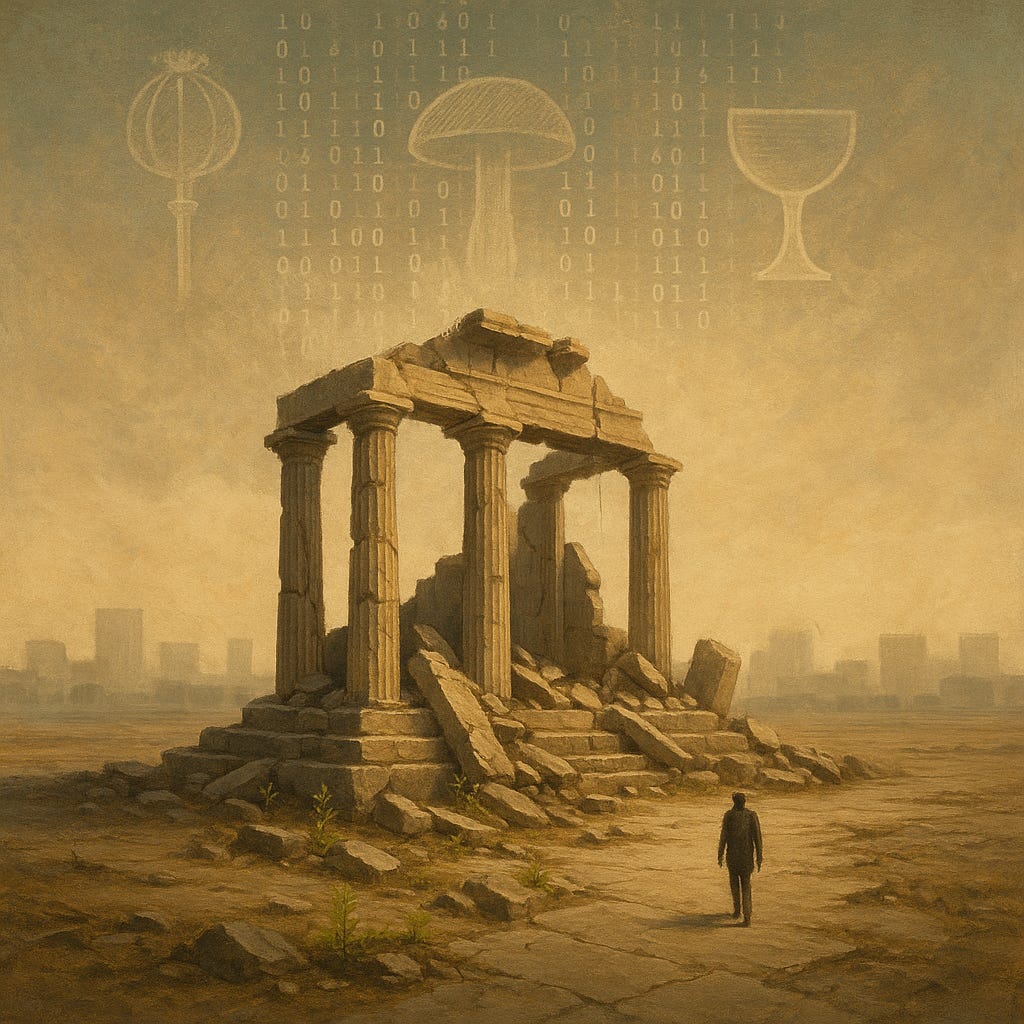
We were never meant to be sober. Not from joy, not from pain, not from the great unknowable current that moves through this brief life like fire through dry branches. Before language was written, before empires rose, before the word “addict” was carved into psychiatric stone, there was only the ache. Hunger for communion. For rapture. For something that would let the soul step outside its cage and remember it was once a god.
The modern world, in its sterile arrogance, names this hunger a pathology. But what if it is a memory?
This is not a medical history. It is a reckoning. A spiral through time in search of the sacred wound that modernity forgot—addiction not as sin, not as sickness, but as the echo of a lost conversation between man and mystery.
We begin where we always must: with the ancients, who understood what we deny—that intoxication is not escape, but contact.
Section I: The Memory of the Gods
Ritual, Medicine, and the Sacred Order of Alteration
Before the first city. Before the first king. Before the first wound was named. There were human beings, wandering under stars, hungry not just for food but for contact—for something larger, older, more radiant than the noise of their own minds. We have always hungered. And long before “addiction” was carved into the language of pathology, we reached for what made the veil thin.
Ten thousand years ago, before the alphabet, before empire, before the bureaucrat dreamed of governance, the human soul was already a seeker. And it found what it sought in root and smoke and sacred mushroom. Archaeologists now unearth not just tools but traces: cannabis seeds in Neolithic graves, opium residue on Sumerian vessels, fermented honey in the bowls of the dead. These were not the detritus of vice. They were the markers of reverence.
The earliest psychoactives were not recreational. That modern word—recreational—belongs to a civilization that has forgotten what it means to be. These substances were sacramental. They were portals. They existed within a cosmology, not a product line. They were administered not by dealers but by intermediaries—shamans, priestesses, healers, visionaries. These figures did not drug their people; they guided them through thresholds.
Ritual was not a performance. It was the architecture of return. Through ceremony, through prayer, through ingestion, the altered state was not an escape but a reconnection—to ancestors, to spirits, to animal totems, to the Great Pattern itself. The Siberian shaman drank the urine of the reindeer who had eaten the red mushroom, and the people followed. The Andean pilgrim consumed San Pedro in the mountains to meet the wind as teacher. In Mesoamerica, psilocybin mushrooms were not a curiosity; they were teonanácatl—“flesh of the gods.” And the Sumerians, long before history, called the opium poppy hul gil: the joy plant.
Joy was not shameful. Alteration was not weakness. These states were not sold in markets or consumed in secrecy. They were shared, framed, and bound by the invisible ligaments of culture. If a substance called for return, it was honored. If it fractured communal bonds, it was restrained—not by punishment but by integration. The user was not a consumer. The healer was not a dealer. The experience was not a product. This was not addiction. This was communion.
There was no DSM. No clinical language to name the recursive longing as disease. But the risks were known. The medicine was powerful. The danger was real. And yet, even then, the response was not pathology—it was wisdom. The same plant that healed could harm. The same vision that revealed could deceive. What mattered was harmony—between substance, user, and world. Disharmony, not diagnosis, was the axis of concern.
In this era—now lost to us except in fragments and bones—the altered state was part of the architecture of meaning itself. To seek transformation was not shameful. It was expected. The question was not whether one would alter consciousness, but how, and why, and under whose guidance.
Modern culture, in its sterile clinicality, would call this dangerous. Primitive. Naive. But what if it was deeper than our science? What if the instinct to seek the beyond is not a defect but a signature of our being? The ache to transcend may look like addiction to a disenchanted world. But it is older than that word. It is older than shame. It is the longing that built temples. That wrote the first song. That asked the sky, “What am I?”
To remember this time is not to romanticize the past. It is to recover a truth modernity buried: that the human impulse to alter consciousness is not a failure. It is not modern. It is not pathological. It is primordial. To seek the sacred, even through dangerous means, is not a crime. It is a sign that we once knew the gods.
Section II: The Fall into Virtue
From Celebration to Control
Let us now enter the age of names. Greece. Rome. Persia. India. China. Civilizations rise from riverbeds and trade routes, dressed in the garments of law and language. Their gods have temples. Their medicines have scrolls. Their rituals have rules. And so begins the slow erosion of the sacred disorder that once made intoxication holy.
In this new order, the altered state is not erased—it is incorporated, codified, fenced in by custom and critique. The line between rapture and recklessness begins to blur. And with it, the first real murmur of what we now call addiction: not yet as disease, but as moral failure. A soft whisper, still cloaked in virtue, that some forms of hunger are unbecoming.
In ancient Greece, wine was more than beverage. It was sacrament, sacrilege, and symbol all at once. The cult of Dionysus drank not to numb, but to dissolve—to dismember the ego and let the soul dance barefoot with nature. The rites of ecstasy were designed not for escape but for return, chaos used as portal, intoxication as temporary death. The goal was not control—it was contact.
And yet, even here, the countercurrent began. Plato, the philosopher of forms and order, warned of excess. The polis needed restraint. Freedom was no longer divine madness—it was discipline. To be a man was to master oneself. To drink without becoming drunk. To touch the gods but not be touched by them. Sophrosyne, the virtue of moderation, became the civic ideal. The ecstatic was now suspect.
Rome, ever more pragmatic, absorbed this tension and made it opulent. Wine was not just sacred—it was social capital. To drink was to belong. To abstain was to be suspect. The upper classes consumed in marble halls, while poets like Ovid chronicled both the pleasures and the penalties. Meanwhile, opium and cannabis arrived from the East—curiosities, luxuries, medicinal commodities. Physicians like Galen saw their uses, even their dangers, but the language remained balanced. No pathology. No diagnosis. Only the growing awareness that substances could tilt the humors, that the body was a delicate balance to be maintained.
But the ethical turn continued.
In India, the Vedas sang of soma—a divine, psychoactive drink whose true botanical origins remain lost to history. To consume soma was to taste the gods, to burn away ignorance, to know the self beyond illusion. It was holy. And yet, as Ayurveda matured, the same substances—opium, cannabis, alcohol—were integrated into a system of treatment. They became medicine. The practitioner, like the priest, mediated their use. The danger was not the substance—it was misuse. It was imbalance. A moral category began to surround the physical act. The user could err—not because they sinned, but because they misunderstood.
In Persia, the Zoroastrian world brought a new clarity to this ambiguity. The universe was a battleground between asha (truth) and druj (lie). The body, like the cosmos, had to be aligned. Intoxication was not forbidden outright—but it was suspect. Misuse meant misalignment. Opium, widely used for both pain and mysticism, was tolerated—until it interfered with the moral purpose of the soul. In the early Islamic-influenced regions that followed, this duality continued. Alcohol was forbidden by the Qur’an not because it was pleasure, but because it could sever the link between the human and the divine. Hashish and opium, however, lingered in medical practice. Intoxication was not criminalized wholesale. It was judged by its spiritual consequence.
China, too, tells a story of complexity. Alcohol was woven into ritual and medicine. The Yellow Emperor’s classic texts prescribed it as a tonic and a poison. The Confucian ideal held order as sacred, and moderation as moral. But Taoism, flowing like the river it revered, welcomed the altered state as a way to dissolve the artificial self into the Dao. The intoxicated sage was not a fool—he was sometimes the only one awake.
And so across civilizations, a shift was underway. The substances that once opened doors to the sacred now had keys held by priests, philosophers, and physicians. The altered state was domesticated. Codified. Measured against emerging ideals of the self. And this new self—the rational, virtuous, disciplined individual—had to learn restraint.
Thus begins the slow invention of the addict.
Not yet named. Not yet institutionalized. But already marked.
This is the era in which the desire to lose control becomes framed as a failure of character. Not a spiritual search gone wrong, but a weakness of the will. The ecstatic is marginalized. The excessive becomes suspicious. The seeker becomes suspect.
The ancient communion is not gone—but it is now fenced in by ethics, medicine, and law. The hunger remains. But the freedom to respond to it without judgment begins to shrink.
The gods, once met through the mushroom or the wine, begin to withdraw.
Section III: The Theologies of Condemnation and Care
Moral Codes, Sacred Law, and the Emergence of the Addict Without a Name
Empires fall. Fire consumes Rome. Libraries are sacked. Roads crumble. And Europe retreats into its cloistered fog of superstition, hierarchy, and holy dread. The Western world calls it the “Dark Ages”—as if darkness were the enemy, and not a necessary part of sight. But while one half of the world forgets, another remembers. And in that remembering, something remarkable occurs: the ache of repeated use, the strange loop of need and relief, is described—not as sin, not yet as science, but as a phenomenon worthy of study.
This is the age of the Islamic Golden Era. The 8th to 13th centuries. Cordoba. Baghdad. Cairo. A thousand candles lit in the night left by Rome. Here, the body is not enemy to the soul but its mirror. Medicine, philosophy, and ethics are not at war. They are entangled. And in this luminous entanglement, a new clarity begins to emerge.
The Qur’an forbids alcohol. Not ambiguously, not metaphorically, but explicitly. It is called a tool of Satan. A thing that “diverts the believer from prayer and remembrance of God.” But the prohibition is not rooted in class anxiety, nor in fear of pleasure. It is theological. Ontological. Intoxication is not wrong because it is fun—it is wrong because it severs relationship with the divine.
And yet—here lies the paradox—opium, hashish, and other psychoactives persist. They are used. Administered. Studied. Especially in medical contexts. There is no total ban. There is discernment. Context matters. Purpose matters. Under Islamic law, the moral universe is not binary—it is curved, layered, inflected by intention. The body is not an obstacle but a trust. And medicine, including intoxicants, is part of honoring that trust.
Enter Ibn Sina—known to the West as Avicenna. A polymath. A physician. A philosopher. A theologian. In his Canon of Medicine (1025), he writes with a clarity that would take Europe another eight centuries to reach. He documents the effects of long-term opium use. He describes both its therapeutic value and its capacity for harm. He differentiates between medical administration and habitual use. He even notes what we now call tolerance and withdrawal.
But he does not pathologize the user. He does not moralize the dependence. He names the phenomenon as something real, something complex—an expression of disharmony between the person and their purpose. His concern is not condemnation but restoration. His medicine is not a prison but a mirror.
Meanwhile, in the Christian West, the intellectual night deepens.
The Catholic Church, now the dominant arbiter of meaning, has no framework for addiction. It only has sin. Desire is suspect. The body is corrupt. And the soul is constantly at risk. Gluttony, sloth, lust—these are not conditions. They are capital offenses against the divine. The wine that Christ offered in sacrament is also the wine that damns the drunkard. There is no middle path. There is abstinence or indulgence. Chastity or ruin. Saint or sinner.
Monasteries ferment beer and wine. Nobles drink to excess. Ascetics fast until they hallucinate. But there is no coherent theology of intoxication—only an anxious oscillation between celebration and fear. And in this anxious space, the figure of the addict begins to take shape: not as a medical subject, not as a fallen angel, but as a spiritually wayward creature, cut off from grace.
Yet even here, nuance tries to surface. In Jewish traditions, the sacred cup of wine remains. Rituals like Passover and Kiddush preserve the role of alcohol in communal life. Drunkenness is discouraged—but not outlawed. The Talmud, complex and case-based, often emphasizes intention over outcome. The goal is balance, not purity. There is no demonization of the user—only caution about the consequences.
Still, addiction is not named. Not directly. But the pattern is noticed. The man who cannot stop. The woman who is alienated from family and community. The one who harms himself in the same way, over and over. These are seen. They are grieved. But they are not yet understood.
So we find ourselves in a strange duality.
On one side of the world, the Islamic physicians and ethicists are naming the contours of dependency without shame—seeing it as a form of misalignment, something both bodily and spiritual, but never reducible to failure alone. On the other side, the Christian West is projecting all bodily disorder into the realm of sin, where the only cure is repentance and the only tool is fear.
Both systems, in their own way, acknowledge the power of substances. Both see the soul at stake. But neither offers a structural path out. There are no clinics. No fellowships. No programs. Only punishment, prayer, or moderation. The addict, unnamed, floats in a gray zone—too devout to be damned, too compulsive to be clean.
And so addiction continues its quiet evolution. Still nameless. Still unclaimed. But increasingly visible.
A man who uses opium daily is no longer just a mystic or a patient—he is something else. A woman who drinks herself into isolation is no longer just sinful—she is wounded, though no one yet knows how to speak the wound.
This is the threshold before the clinical age. Before psychiatry. Before AA. The age in which theology bears the burden of what will soon be called medicine. And in that burden, we find both cruelty and care. Cruelty, when the body is blamed for the soul’s rebellion. Care, when the healer sees the whole person and not just their craving.
In this space, the addict becomes visible—not as a monster, not yet as a patient, but as a mystery.
And for a moment, that mystery is enough.
Section IV: The Machinery of Craving
Global Trade, Colonial Intoxication, and the Birth of the Addiction Economy
Now the ships come.
The 16th through 18th centuries mark the rise of a new empire—not just political, not just geographic, but metabolic. An empire of the bloodstream. The Age of Exploration, they called it. The Age of Extraction, it truly was. As Portugal, Spain, Britain, and the Dutch tore across the globe, they did not merely conquer land. They conquered the inner lives of those they subjugated—rewiring appetites, embedding dependence, and planting the seeds of craving into the very design of modern life.
This is when addiction ceased to be accidental.
This is when it was built.
The great intoxicants of empire—tobacco, sugar, rum, opium, tea, coffee—did not spread like spores. They were not shared. They were forced. Marketed. Engineered. These were not just drugs. They were supply chains. They were tax bases. They were how nations bled the periphery to sustain the illusion of progress at the center.
And behind each crop, a pattern: pleasure for the empire; pain for the enslaved.
Tobacco and the Plantation Mind
It begins with a leaf. Sacred among many Indigenous American peoples, tobacco was ceremonial—used in prayer, healing, negotiation. Smoke was a medium, not a drug. But when the European colonizers saw it, they did not see ritual. They saw revenue.
Tobacco became the first global commercial drug. European aristocrats consumed it obsessively. Pipes were status symbols. Smoke became fashion. But to scale the pleasure, they needed bodies. The transatlantic slave trade rose in lockstep with the tobacco economy. Africans were abducted, chained, shipped, and worked to death on plantations to satisfy a European craving dressed up as sophistication.
No longer was the altered state a gift from the gods. It was now a line item.
Sugar, Rum, and the Triangle of Dependency
Sugar followed, sweetening the empire’s mouth while rotting its soul. It was no longer just a luxury—it was necessity. Addiction is not just chemical. It is structural. And sugar addiction, perhaps the most invisible of all, became the lubricant of modern consumption. Its refining, its distribution, its pairing with rum—all of it flowed through the same triangle: slaves from Africa, sugar from the Caribbean, profits to Europe.
Rum was not incidental. It was weaponized. Given to enslaved people to dull rebellion. Used to pacify Indigenous resistance. Exported to Europe to feed taverns and revolts alike. The entire circuit ran on intoxication.
Opium and the Cradle of Empire
Then came the poppy. The British East India Company—state and corporation fused into a single organism—planted opium in India and funneled it into China. Not because China needed it. But because Britain needed silver. When the Qing dynasty resisted, banning opium imports, Britain responded not with diplomacy but with gunboats.
The Opium Wars were not wars of morality. They were wars for market share.
In their wake, China was carved open. Cities ceded. Ports seized. A population thrown into a chemical spiral by imperial design. The same West that would later criminalize the addict had no trouble flooding a foreign nation with narcotics for profit. The addict, once again, was not a patient. He was collateral.
Tea, Coffee, and the Clock of Capital
Not all addictions sedated. Some sharpened. As capitalism matured, stimulants took center stage. Tea from China. Coffee from Ethiopia and Yemen. They were no longer ceremonial. They were industrial.
These drinks restructured the day. Replaced ritual with routine. They extended working hours, suppressed hunger, kept the factory worker upright and alert. In Islamic societies, coffeehouses became intellectual salons. In Europe, they became engines of finance and speculation. The London Stock Exchange was born in a coffeehouse. The empire needed productivity, and caffeine was its silent whip.
These were not neutral choices. These were adaptations—chemical answers to a new form of time: measured, monetized, relentless.
Addiction Without a Name
And yet—despite widespread, generational dependence on sugar, tobacco, caffeine, opium—the word addiction had not yet found its modern meaning.
It came from Latin: addictus—one who is bound, one who has been legally given over as payment for a debt. A debtor enslaved.
The metaphor is chillingly accurate.
The empire created craving. Then sold the cure. Then blamed the consumer.
A Chinese man dying in an opium den was not considered a victim. He was an embarrassment. A proof of cultural inferiority. An Indian field worker collapsing from exhaustion was not seen as a casualty. He was an acceptable cost of empire.
No one asked why the craving appeared. No one asked what spiritual wound was being numbed. The entire system depended on silence.
From Communion to Commodity
What was once sacred is now monetized. What was once relational is now transactional. The altered state has been severed from meaning. There is no shaman. Only a trader. No temple. Only a ledger.
The modern addiction economy is born—not with rehab centers and drug commercials, but with gunships, plantations, and trade routes.
We have not recovered.
We have simply become more efficient.
Section V: The Clinical Cage
Medicalization, Moral Panic, and the Addict as Mirror of Empire
The 19th century marks a dangerous crossing. The age of imperial intoxication does not end—it mutates. Addiction, once unnamed but everywhere, begins to receive a language. Not a vocabulary of healing, not yet—but of categorization. Classification. Diagnosis. The addict is now seen. But not understood.
This is the century when medicine discovers dependence. And society discovers how to fear it.
Laudanum. Morphine. Cocaine. Heroin. Ether. Absinthe. The Western pharmacopoeia blooms into a garden of seductive flowers—and no fences. No prescription systems. No regulatory state. No ethics of marketing. The modern drug age begins not in the streets, but in the salons. In the doctor’s bag. In the poet’s desk drawer.
The White Addict: Romantic and Ruined
In elite European circles, the addict is not yet a criminal. He is often a gentleman. A doctor. A writer. A lady in pain. Laudanum—opium dissolved in alcohol—is sold over the counter as casually as tea. Prescribed for sleeplessness, grief, menstruation, coughs, hysteria. No warning. No dosage guidelines. Just tinctures and trust.
Samuel Taylor Coleridge writes Kubla Khan in an opium haze. De Quincey publishes Confessions of an English Opium-Eater in 1821, a landmark of lyrical addiction literature. He does not hide his use—he poeticizes it. He speaks of visions, torment, pleasure, dependence. It is both sublime and horrific. The addict is not yet a sinner or a prisoner. He is a tortured soul. A cautionary tale wrapped in velvet.
Women too—Elizabeth Barrett Browning, countless unnamed housewives and widows—are handed morphine like comfort. They become dependent quietly, invisibly. There is no scandal unless they die. Even then, it is tragedy, not deviance.
The Nonwhite Addict: Dangerous and Disposable
But outside the parlor, a different narrative is constructed.
In the U.S., Chinese immigrants working the railroads bring knowledge of opium dens. Their use becomes a symbol of seduction, filth, vice. The same substance that brings poetry in England brings prison in San Francisco.
In the American South, cocaine is used by Black laborers to endure backbreaking work. Soon, white newspapers spread racialized hysteria: cocaine gives “Negroes” superhuman strength. Makes them immune to bullets. Lustful. Violent. This myth is not anecdotal—it drives policy. It justifies repression. It licenses murder.
Temperance movements, led largely by Protestant white women, gain momentum. They are not wrong to link alcohol with domestic violence, poverty, and male cruelty. But the solution they demand is not compassion or care—it is prohibition. Total control. The addict becomes the moral weak link in the chain of civilization.
Addiction is now split by class and race:
* The upper-class addict is troubled, perhaps noble.
* The immigrant or Black addict is a threat.
There is no consistent ethic. Only projection.
Medicine Attempts a Cure—and Creates a Cycle
Meanwhile, doctors begin to frame substance dependence as a medical issue. Benjamin Rush, one of America’s founding physicians, writes of habitual drunkenness as a “disease of the will.” Others follow suit. Institutions form. Asylums. Sanitariums. The goal is to treat—but the methods are primitive.
Worse still, medicine attempts to “solve” addiction with more drugs. Morphine for alcoholics. Heroin for morphine addicts. Heroin, synthesized by Bayer in 1898, is marketed as a safe, non-addictive alternative. Advertisements feature smiling children. Chemists dream of an opiate without bondage. They dream wrong.
Each cure deepens the wound. Dependency is not alleviated—it is transferred. The medical system does not understand craving. It only understands substitution.
Moral Panic and the State’s First Repression
As the century closes, governments begin to take notice—not out of empathy, but fear.
Urbanization accelerates. Immigration rises. Drugs cross borders. Panic erupts. Legislators respond not with public health initiatives but with criminal codes. The first narcotics laws are drafted. Not to help the addict, but to punish the visible addict—the foreigner, the worker, the poor.
Addiction is now a political problem.
And yet, no one knows what to do with the addict who doesn’t fit these frames. The white woman hooked on laudanum. The shell-shocked veteran with a morphine syringe. The doctor who prescribes what he himself uses.
They are too close to power. So they remain unspoken.
The Addict as Cultural Mirror
By the end of the 19th century, the addict is no longer invisible. But he is misunderstood by every system that claims to see him.
* The church still calls him a sinner.
* The doctor calls him a weak-willed patient.
* The judge calls him a danger to society.
* The poet calls him a martyr.
* The state calls him a liability.
What no one calls him is what he often is: a wound made visible.
This is the century in which addiction begins to fracture the modern psyche. Not just as an individual torment, but as a cultural indictment. The empire that once flooded continents with narcotics now finds itself choking on its own supply.
And in its panic, it builds the first bars. Not the bars of help—but of cages.
Section VI: The Age of War and Fellowship
Recovery, Repression, and the Invention of the Modern Addict
The 20th century is the crucible. Everything the previous centuries rehearsed—colonial extraction, moral panic, racialized control, pharmaceutical recklessness—coalesces into a full-blown architecture. Addiction is no longer ambient. It is now front-page. Institutional. Stigmatized. Studied. Criminalized. And, in scattered rooms across the world, quietly redeemed.
This is the century in which addiction becomes a household word, a psychiatric diagnosis, a media spectacle, a moral alibi, a legal pretext, and—just barely—a spiritual wound that someone, somewhere, tries to love.
The addict, once unnamed and once unpunished, now enters the main stage of modern governance. And with him arrive two empires: one of cages, the other of circles.
The Birth of Recovery: Fellowship Over Control
It begins in a small house in Akron, Ohio. The year is 1935. Two men meet: Bill Wilson, a stockbroker shattered by alcohol, and Dr. Bob Smith, a surgeon equally enslaved. What they share is not theology, or medical technique, or scientific certainty. What they share is ruin. And the refusal to pretend.
From their encounter is born Alcoholics Anonymous, a fellowship with no dues, no hierarchy, and no doctrine beyond this: that addiction is not a sin, not a weakness, but a spiritual malady—a wound of the soul that can only be healed through surrender, truth, and shared experience.
AA does not medicalize. It does not criminalize. It spiritualizes.
The Twelve Steps offer not behavior modification but inner transformation. Not control but humility. Not punishment but confession. The addict is not an outcast. He is a mirror of the modern condition: isolated, ashamed, cut off from the divine.
AA spreads—not like an ideology, but like an underground fire. Narcotics Anonymous. Cocaine Anonymous. Al-Anon. These are not state programs. They are whisper networks of grace. Meetings held in church basements, park shelters, prison libraries. Coffee-stained tables. Folding chairs. Anonymous men and women saying out loud what no one else dares name: “I am powerless.” “I lied.” “I harmed.” “I want to live.”
And yet, even as this quiet revolution of mercy takes root, another structure is rising. Louder. Colder. Sharper.
The Rise of Prohibition and State Power
Before AA, there was Prohibition. From 1920 to 1933, the U.S. banned alcohol under the 18th Amendment. The goal was moral uplift. The result was black markets, organized crime, mass arrests, and national hypocrisy.
It failed—but the lesson was absorbed.
You can control a society by criminalizing its cravings.
You can win elections by promising order through prohibition.
And most importantly: you can mask racial and class repression under the language of addiction.
By the mid-century, this logic metastasizes. The Cold War demands enemies, not just abroad but at home. In 1971, President Richard Nixon declares a “War on Drugs.” He calls drug abuse “public enemy number one.” But behind the podium, his aides admit the real target: Black Americans and antiwar leftists.
This is not policy. It is counterinsurgency.
The addict becomes a threat to the state. A justification for surveillance, militarized policing, incarceration, and cultural scapegoating.
By the 1980s, under Reagan, the war escalates. Mandatory minimums. Crack vs. cocaine sentencing disparities. “Three strikes” laws. Inner cities are ravaged. Prisons overflow. Rehabilitation is gutted. Funding for recovery dries up. AA meetings proliferate inside jails. Outside, addicts are hunted.
Addiction, once the domain of medicine and spirit, is now fused with crime.
Pharmaceutical Revolutions and the Dual Addict
While the state wages war on the street addict, a quieter machine hums in the background. Big Pharma.
This is the golden age of licit addiction.
Benzodiazepines. Barbiturates. Amphetamines. Prescription opioids. America is flooded—legally—with substances that numb, soothe, sedate, and stimulate.
* Housewives are given Valium for their nerves.
* Children are given Ritalin for their restlessness.
* Soldiers are given amphetamines for war.
* Executives are given Xanax for anxiety.
These users are not policed. They are insured.
The contradiction is grotesque.
* The Black teenager with weed is a criminal.
* The white executive with pills is a patient.
* The heroin addict in the alley is trash.
* The antidepressant-dependent mother in suburbia is brave.
Even within medicine, the addict is split: if you suffer in the wrong skin, the wrong income bracket, or the wrong zip code, your craving is a crime.
The same culture that invents AA also invents mass incarceration.
The same nation that romanticizes jazz heroinics and rock-star suicides also builds privatized prisons and drug courts.
The same government that bans heroin licenses OxyContin.
The Addict as Archetype and Market
By the end of the century, addiction is everywhere: in films, in tabloids, in memoirs. It is no longer hidden—but neither is it healed.
From Sid Vicious to Whitney Houston. From Philip K. Dick to Kurt Cobain. The addict becomes a symbol. Sometimes tragic. Sometimes transcendent. But always commodified.
Recovery itself becomes a product: celebrity rehab, detox spas, twelve-step branding. Suffering is consumed. The addict sells.
And yet, the truth remains buried.
The systems that produce addiction—industrial loneliness, spiritual alienation, mass trauma, structural cruelty—remain untouched. Because to heal the addict would require healing the world.
And the world does not want to change.
The Century’s Final Paradox
Two models now compete:
* One says: “You are powerless, but not alone.”
* The other says: “You are a threat, and will be made to disappear.”
One offers coffee, steps, and quiet grace.
The other offers bars, blame, and a criminal record.
And beneath both, the market hums. It doesn’t care which path you choose—so long as your suffering can be priced.
Section VII: The Infinite Loop
Opioids, Algorithms, and the Addicted Civilization
Now we arrive at the century with no center. The 21st.
A time so fast, so fractured, so flooded with content and contradiction that chronology itself begins to dissolve. Past and future blur. Crisis and distraction overlap. And the addict—long punished, pathologized, or pitied—becomes something new: a universal figure. A mirror. Not the exception, but the rule.
This is the century in which addiction no longer lurks at the margins. It becomes the operating system.
The Opioid Catastrophe: A Manufactured Plague
The story begins, as so many American tragedies do, in boardrooms.
In 1996, Purdue Pharma unleashes OxyContin, a high-potency synthetic opioid, with a lie so calculated it requires a new word: pharmacocide. The Sackler family, cloaked in white coats and philanthropic PR, assures the medical establishment—and the public—that this drug is safe. Non-addictive, they say. Miraculous. Necessary for “pain management.”
They flood rural communities, veterans’ hospitals, poverty clinics. Doctors are incentivized to overprescribe. Pain is framed not as a symptom, but as an enemy. The solution? More pills. More compliance. More profit.
By the early 2000s, millions are addicted. Not through hedonism, not through rebellion—but through trust. Through the system.
When regulation finally begins, the addicted—abandoned by their doctors—turn to heroin. Then to fentanyl. Then to whatever will silence the ache.
Today, synthetic opioids kill more Americans each year than car crashes or gunfire.
This is not a crisis. It is a crime.
And not just of Purdue. But of the entire ecosystem that enabled it: the FDA, the hospitals, the media, the political class. They all participated in the engineering of dependency.
Because addiction, in modern systems, is not a failure. It is a feature.
The Brain Disease Model: Explanation Without Meaning
Amid the carnage, neuroscience attempts to rescue us.
FMRI scans show what ancient ritualists already knew: that substances—and behaviors—can hijack the brain’s reward system. Dopamine surges. Neural pathways are carved into trenches. The prefrontal cortex loses governance. The addict “loses control.”
The language shifts: addiction is now a chronic brain disease.
In some ways, this is progress:
* It removes moral stigma.
* It allows for insurance-covered treatment.
* It offers a narrative of biology rather than sin.
But something is lost.
In its reduction to circuitry, the soul is erased.
Trauma, neglect, disconnection—these are not aberrations. They are the core. And they are not treatable through scans alone.
As Gabor Maté and others argue, the real question is not “Why the addiction?” but “Why the pain?”
The addict is not broken because of dopamine. The addict is in pain because of the structure of the world.
The Rise of Behavioral Addictions: Silicon, Porn, and the New Dopamine Lords
You no longer need heroin to be addicted. You only need a phone.
Social media platforms, powered by machine learning, design for maximum engagement. That means maximum craving. The infinite scroll. The notification bell. The dopamine hit of a like, a swipe, a view.
Pornography—now hyper-visual, hyper-customizable, always available—becomes a supernormal stimulus. It rewires intimacy. It replaces bodies with pixels. It substitutes touch with control. The modern addict no longer needs to hide. His drug is in his pocket, socially sanctioned, infinitely accessible.
Online gambling. Video games with reward schedules. Doomscrolling. Shopping algorithms. These are not games. They are experiments in behavioral compulsion.
And they are working.
The average citizen now toggles between substances and platforms. Coffee, Instagram, alcohol, porn, Reddit, Adderall, TikTok, weed, Venmo, Valium, Zoom, and back again.
The addict is no longer the homeless man under the bridge. He is the product manager. The grad student. The teenager. The influencer. The pastor. The liberal. The libertarian.
The addict is everyone.
But no one calls it that.
Because the system that profits from addiction also controls the language used to describe it.
The Return of the Sacred: Psychedelics, Trauma, and the Attempted Reweaving
Amid the debris, a strange resurrection occurs.
Psychedelics—once demonized, once sacred—return as medicine.
Psilocybin. MDMA. Ketamine. Ibogaine. Ayahuasca.
Used under supervision, often in tandem with trauma therapy, these substances do not numb the addict. They reveal them. They offer, not escape, but memory. Access to the wound before it hardened into pathology.
In clinical trials, people describe not a chemical reaction—but a spiritual reckoning. A reunion with their child self. A sense of cosmic belonging. A clarity beyond language.
This is not a miracle. It is a recovery of context.
The very substances once feared are now offering something psychiatry forgot: meaning.
At the same time, trauma theory becomes mainstream. ACE scores. Attachment styles. Developmental wounding. What once lived in private shame now has public language. It becomes possible—though still rare—for addicts to be seen as survivors, not sinners. Not statistics.
The paradigm is shifting—but slowly. Because while psychedelics offer healing, they threaten control. They cannot be mass-marketed in the same way. They require surrender, not sedation.
The Addicted Society: Collapse as Craving
As climate collapse accelerates, as political systems rot, as economic precarity deepens, addiction takes on a new meaning.
It is no longer a personal failure. It is a civilizational symptom.
Our institutions are addicted:
* Consumerism runs on endless craving.
* Politics runs on outrage.
* Technology runs on distraction.
* Pharmaceuticals run on dependency.
We live in a loop we cannot exit. We are a civilization that cannot sit still. Cannot be sober. Cannot be quiet. We are overstimulated and undernourished. We are collapsing from within, not with bombs, but with algorithms.
Addiction is no longer what happens when something goes wrong.
Addiction is the system working as designed.
The Seer in the Ruins
And yet.
And yet.
People are recovering.
Not always through institutions. Not always through doctors. Sometimes in AA basements. Sometimes in ayahuasca circles. Sometimes in solitude. Sometimes in prayer.
They are breaking the loop—not because they were convinced, but because they were destroyed. And in that destruction, they saw something.
The addict of the 21st century is not simply a victim.
Often, they are a prophet.
They saw what the rest of the world tried to deny—that something was wrong, that numbness was not life, that craving was not the disease but the symptom of unbearable disconnection.
They could not play along.
And they paid the price.
But in that price is a message: this world cannot be healed without remembering what it means to feel.
Epilogue: The Sacred Wound
There are truths so deep they must be remembered through pain.
Addiction is not the disease. It is the sign. A sacred wound, torn open by the lie that we can survive without meaning. A rupture in the body that testifies to a deeper rupture in the world.
We are told the addict is broken. But what if the addict is the one who could not adapt to the unbearable? What if the substance was not the problem, but the whisper of something remembered—something lost? What if the first high was not about escape, but about return? To the mother’s touch. To God’s gaze. To wholeness. To silence. To the unbearable beauty of simply being.
The addict carries a longing this world cannot name. So we cage it. Or brand it. Or sell it. But we do not honor it. We do not listen.
And that is the real tragedy.
Because in the addict’s fall is a map. A memory of what it meant to feel without armor. To ache without anesthesia. To seek God—not in doctrine, but in ecstasy. To hunger not for more, but for the Real.
The addict is not weak. The addict is unfinished. Unresolved. A cracked mirror through which the world’s hollowness is briefly revealed.
And if we had the courage to look—if we had the courage to feel—we might recognize that the addict is not the other.
They are us.
They are the part of us that still remembers Eden. That still claws at the veil. That still screams at the lie. That still believes something greater is possible—even if it kills them to reach for it.
Let that scream not be wasted.
Let it break the spell.
Let it call us back—not to purity, not to control—but to truth.
We are all recovering from a world that forgot what it means to be alive.
And recovery is not about going back.
It is about remembering forward.
—Elias WinterAuthor of Language Matters, a space for reflection on language, power, and decline.