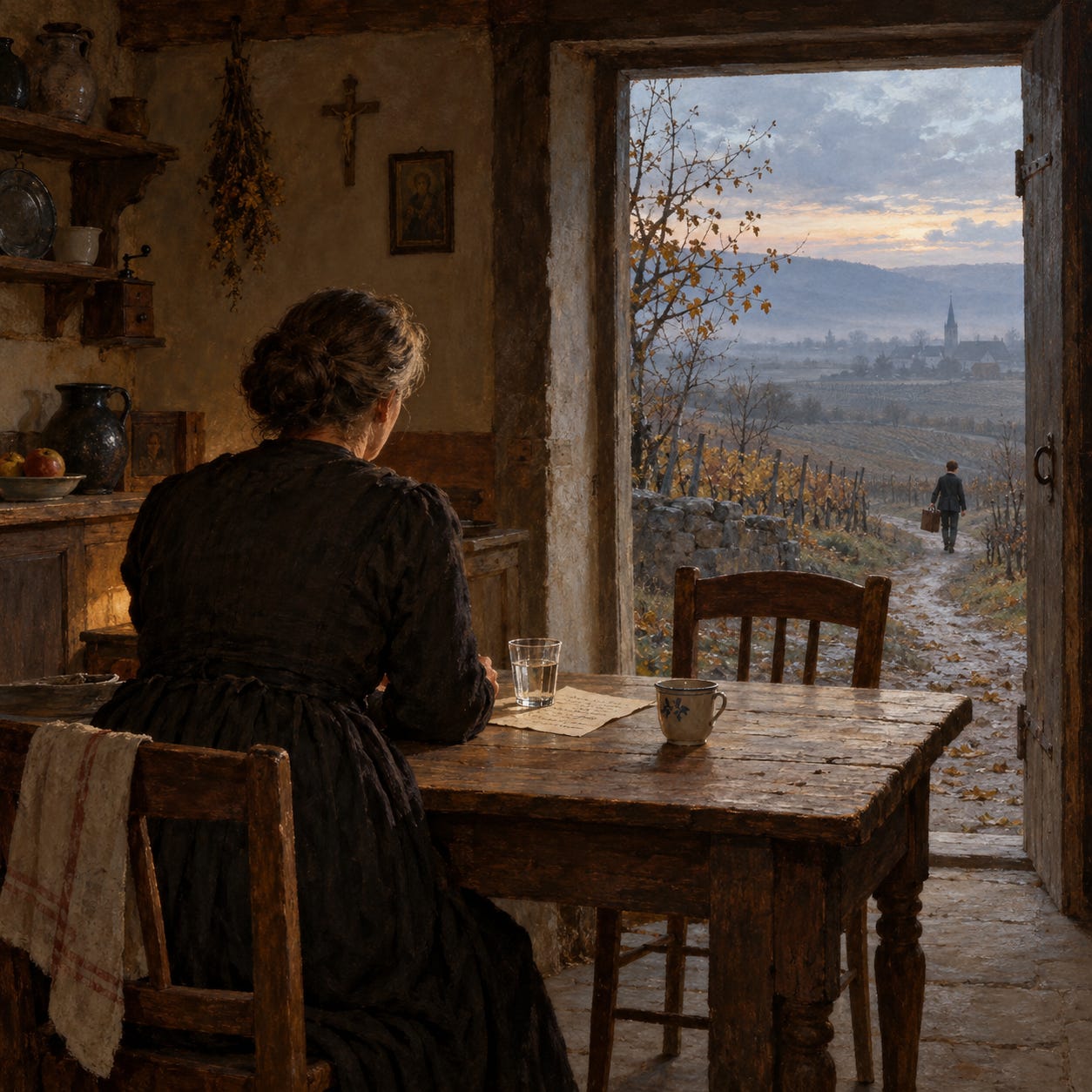
I. The Morning He Was Gone
Kallstadt, October 1885 — Katharina
The bread had not yet risen when I found his letter.
It was lying on the kitchen table, beneath the little glass we kept for drinking water. At first I thought he had left me some instructions, perhaps something about his clothes or the money I had given him. He was always writing things down, that boy. Numbers, mostly. What things cost. What they might fetch somewhere else.
I recognized his handwriting before I understood the words.
He had gone to America.
I read the note standing up. Then I sat down and read it again. I remember noticing that the table needed scrubbing. There was flour caught in a crack near the edge, and I pressed my thumbnail into it while I read.
It is strange what the mind chooses to occupy itself with when the heart has been struck.
He had taken his coat, his good trousers, and the little case in which he kept his barber’s instruments. The blanket at the foot of his bed was folded. His pillow lay crooked against the wall.
I touched it. It was cold.
I had known he wanted to go. We had spoken of America so often that the word had begun to live in the house like another member of the family. His sister was already there. There was work, she wrote, and money to be made by anyone willing to labor. Friedrich had listened to these things with an attention that frightened me.
Still, I had imagined there would be a morning when we would know it was our last together. I had imagined making him breakfast. I had imagined walking him to the road.
A foolish thing, perhaps, for a woman of forty-nine to imagine that the world would allow her the small ceremony of a goodbye.
His father had been dead eight years.
Johannes was not an easy man to replace, though God knows I had tried to replace what he provided. I had worked the vineyard, baked bread for other families, calculated debts by candlelight, and learned which creditors could be persuaded to wait until the harvest.
The children helped when they could. But Friedrich was never strong enough for the vineyard. His body was thin, his hands better suited to small instruments than the hard work of tending vines.
When he was little, he would watch his brothers working and grow quiet.
Once, after his father’s death, he asked me whether he would ever be a useful man.
I told him a man could be useful in a hundred ways.
He did not believe me.
So I sent him away to learn barbering. I told myself that a trade was something nobody could take from him. I watched him depart then, too, but I knew the town to which he was going. I knew the roads. I could imagine his days.
And he came home.
Now he had gone somewhere I had never seen.
There had been eight children. Two had died so young that I sometimes wondered whether the world had ever properly noticed their arrival. People tell mothers that God takes children for reasons beyond our understanding. I had stopped asking for those reasons.
But Friedrich was alive. That was the unbearable thing. He was alive and moving farther away while I sat in the kitchen.
I tried to picture him on the road to Bremen.
Had he eaten? Had he brought enough money? Was he cold? What if somebody robbed him? What if he became ill aboard the ship?
What if he never came back?
One of the children entered and asked where Friedrich was.
I said he had gone to America.
The words sounded absurd in my own mouth.
Outside, the vineyards were beginning to lose their leaves. The hills beyond Kallstadt stood in the pale morning light, and the village bell rang as it always had.
I thought then of all the ordinary things that would continue without him. The baking. The washing. The price of flour. The approach of winter.
I wanted to be angry.
For leaving a note. For sparing himself the sight of his mother crying. For making a decision that would alter both our lives and then slipping away while I slept.
But I knew the life he would have had if he stayed.
I had seen him return from his apprenticeship with his instruments and his newly acquired skill, only to discover that Kallstadt had no need for another barber.
I had seen the disappointment settle upon him.
I could not ask him to remain poor because I was afraid to be lonely.
That was the cruel arithmetic of motherhood. You raised a child so that he might live, and then, if you succeeded, his life could carry him beyond your reach.
I put the note beside the stove.
I kneaded the bread, though my hands would not move properly. I fed the fire. I swept the floor.
Then I took down his cup from the shelf.
For a long time I stood holding it.
At last I washed it and put it away.
Before noon, I took it down again.
II. The Boy Who Crossed the Sea
Bremen and the Atlantic, October 1885 — Friedrich
I had expected to feel free.
Instead, when the wagon carried me beyond the last familiar fields, I felt terribly small.
The road was long. I had never traveled so far alone. I kept counting my money, though each time I counted it the amount remained the same.
Sixteen years old, and I had already learned that money was not merely something one possessed. It was the difference between having a choice and waiting for someone else to make one for you.
My mother understood money better than anyone I knew.
She could make a loaf last longer than it ought to. She knew which shoes could survive another winter and which repairs would cost more than replacing them. I had watched her turn a few coins over in her palm as though, by examining them carefully enough, she might discover another coin hidden among them.
I hated that sight.
It was not her poverty that shamed me. It was my inability to do anything about it.
After my father’s death, I had tried to help in the vineyard. My arms tired quickly. The work was heavy, and there were always stronger hands available. My mother said I was not made for such labor.
At Frankenthal, where I learned barbering, the master had no sympathy for tired boys. I swept hair from the floor, prepared the shop, carried water, cleaned blades, and watched carefully until he trusted me to work.
I liked the precision of it. A good razor did not care whether a man was strong. It cared whether his hand was steady.
When I returned to Kallstadt, I imagined I had become someone.
But there were already barbers in the village.
A man cannot earn his bread by cutting hair that does not need cutting.
I knew what lay ahead if I stayed. More waiting. More obligation. Military service. More years in which my mother would grow older and I would remain dependent upon her.
My sister had written from New York. There was room for me, at least at first.
So I decided to go.
My mother knew. We had discussed it. But knowing that a thing will happen and watching it happen are not the same.
In the days before I left, she talked about the weather. She asked whether I had packed a heavier shirt. She told me to write as soon as I arrived. I had never told her which morning I intended to go.
I could not bear the way she avoided looking directly at me.
After everyone had gone to bed, I sat at the table with a piece of paper.
I meant to write a proper farewell. I began several times. Each sentence sounded like an excuse.
Finally, I wrote that I had gone, that I would work hard, that I would send word.
I put the paper beneath her glass.
I left before dawn because I knew that if I woke her, she would embrace me.
And I was afraid that if she embraced me, I would stay.
In Bremen, I saw more people in an hour than I had sometimes seen in a week at home. Carts rattled across the streets. Porters shouted. Men argued in languages I did not recognize. Ships stood at the harbor like immense buildings that had somehow learned to float.
The Eider was larger than anything I had imagined.
Below deck, the air smelled of damp clothing, unwashed bodies, and sickness. I found my place among strangers who were carrying the remnants of entire lives in sacks and boxes.
There were families, children, old men, young women holding bundles close to their chests.
I had brought very little.
One evening, a man asked …