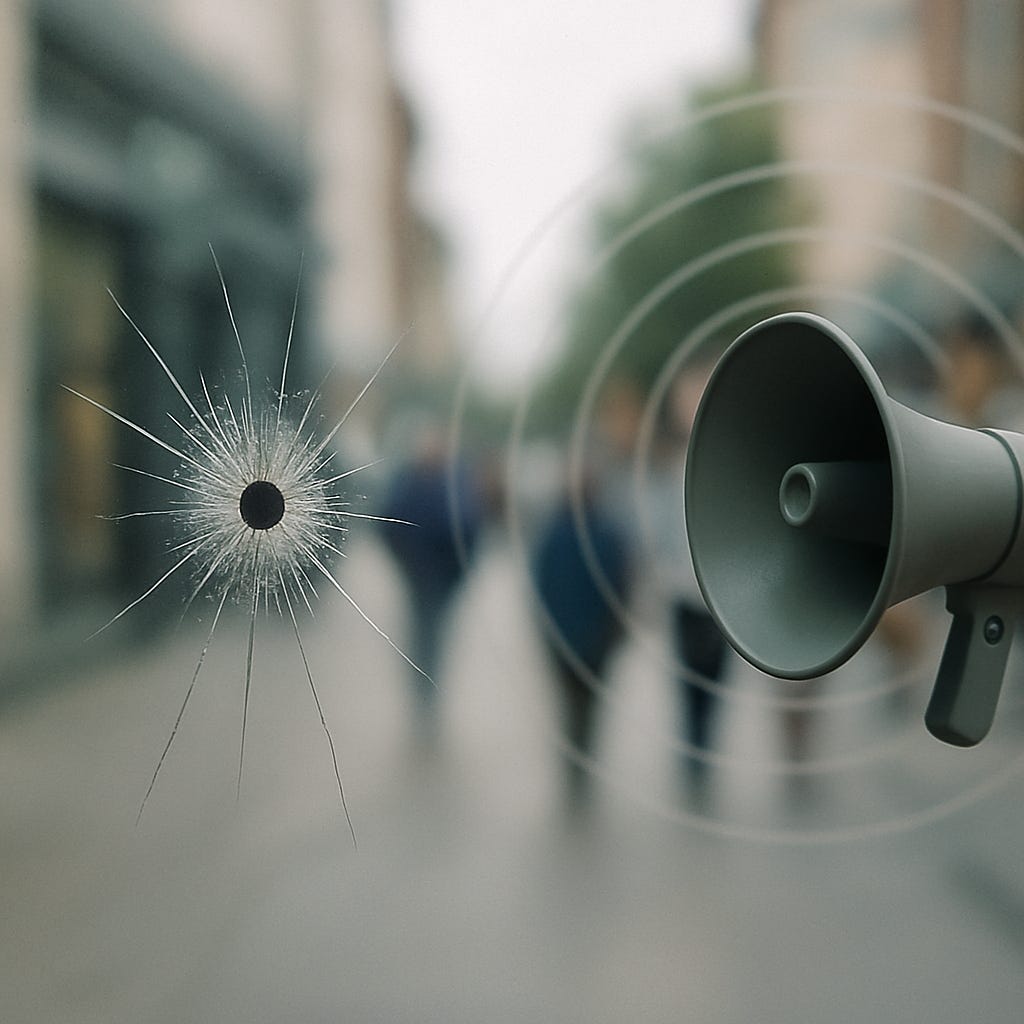
I. The First Wound: The Crime Itself
Before the hashtags, before the press conferences and the choreographed outrage, there is something brutally simple: a person walks into a space other people believed was safe, and turns it into a crime scene. That is the first wound.
In America, this is not an exotic occurrence. The country is a continuous low-grade gunfire, a vast terrain where bullets function almost like weather: some days clear, some days storm, but never a world in which rain is impossible. Schools, churches, nightclubs, grocery stores, parades, office parks, military bases—there is no category of human gathering that hasn’t already been initiated into this liturgy.
Most people alive here now cannot remember a year without at least one headline in which an ordinary location becomes a memorial overnight. The language is standardized: lone gunman, authorities are investigating, no known motive yet, thoughts and prayers. The vocabulary itself is an anesthetic—rehearsed phrases that blunt the edges of what actually happened: flesh torn, children hiding in closets, grown men bleeding out under fluorescent lights while someone’s ringtone keeps playing from a pocket that will never be answered.
This is the first wound: the sheer fact that you can be choosing cereal or walking past a government building or sitting in a classroom, and a stranger’s private madness or grievance or ideology can end your life in less than a minute. That vulnerability is not distributed equally across the world. It is a specifically American form of exposure, normalized by repetition and defended as freedom.
The events that trigger the national spectacle each year are not, in themselves, new. A man with a weapon and a grievance is among the oldest human archetypes. There have always been loners, fanatics, men whose minds fracture under pressure and decide that their private catastrophe must be made public. What is distinct about the United States is not that such people exist, but that the infrastructure for their catastrophe is always within reach: the rifle, the handgun, the extended magazine, the cultural script that says, If you are invisible, the quickest path to visibility is to become a headline.
So the first wound is both obvious and somehow still unbearable: someone you have never met decides that your life and the lives around you are expendable collateral for their breakdown. Your safety becomes retroactively fictional. The street corner you walked down yesterday is now evidence. The subway station you passed through is caution tape and flashing lights. A single choice, made by one person, rearranges the emotional map of thousands.
Ordinary people understand this on a level politicians do not have to. Anyone who has sat through an active shooter drill, or watched their child practice crouching in a silent classroom, knows that the line between “regular day” and “mass casualty event” is indecently thin. You can feel that thinness in your body: the quick scan when you enter a crowded space, the casual note of where the exits are, the way a loud sound in a shopping mall makes the nervous system lurch before the mind catches up.
In that moment—when the news breaks, the sirens wail, the push alerts go out—there is a brief interval where the country shares a single emotion: shock. Before anyone knows the name, the nationality, the immigration status, the religion, the timeline, there is a simple human recoil: not again. That unity is fragile and short-lived, but it exists. For perhaps a few minutes, everyone can agree that the man with the gun is the problem.
It should be enough. The crime itself is already a full catastrophe. There is already more than enough to grieve, enough to investigate, enough to argue about in policy terms: background checks, mental health, weapons of war in civilian hands, the architecture of public spaces, the culture that produces men who choose spectacle over survival.
In a sane country, the first wound would command all the attention. The cameras would stay on the victims, the emergency rooms, the investigators, the families who have to identify bodies. The work of the state would be: secure the scene, understand what happened, prevent repetition. The work of citizens would be: mourn, support, and argue about concrete remedies.
Instead, the first wound has become merely the opening act. The bullet is no longer the end of the story; it is the inciting incident for a second, more diffuse violence that will not be confined to one street corner or one building. The crime scene is still smoldering when the country’s most powerful adults reach for their phones, not to sit in the silence that should follow, but to turn one man’s crime into fuel.
Before we can talk about that second wound, the one that travels further and lasts longer, we have to be honest about the first: a society that has accepted a permanent baseline of lethal randomness, and still pretends to be surprised each time the coin lands on blood.
II. The Second Wound: The Blame Machine
If the first wound is the shot itself, the second wound is what happens once the shooter’s name hits the feed.
It starts almost immediately. The bodies are still on the ground, the scene isn’t even cleared, and somewhere a political consultant, a cable producer, a movement influencer is asking one question, and it is not “How do we keep this from happening again?” It is:
“What can we make this mean?”
The country barely has time to feel the raw fact that a man has killed people before the meaning factory switches on. The details that matter to investigators—trajectory, caliber, access points—are quickly overshadowed by the details that matter to the blame machine:
* birthplace
* immigration status
* religion
* race
* prior posts
* any thin thread that can tie this one man to a category.
The point is not to understand him. The point is to indict them.
Suddenly the shooter is no longer just a person with a gun and a pathology; he is a convenient bridge from individual act to collective guilt. The Afghan becomes Afghans. The Muslim becomes Muslims. The trans woman becomes trans people. The foreign-born becomes all “Third World migrants”.
It is an elegant cruelty: take an act committed by one mind and stretch it over millions of lives who had nothing to do with it—not just innocent of the crime, but innocent of ever even imagining the crime. People who were at work, on a bus, making lunch for their kids, suddenly wake up in a world where they are being spoken about as if they are all co-defendants in a trial they never knew was happening.
This is the second wound.
The first wound is physical and local: a specific street, specific victims, specific families. The second wound is psychological and national: it radiates out through speeches and posts and headlines, landing on people who share nothing with the perpetrator except some trait that can be extracted and weaponized.
The tone is always the same:
* “We warned you about these people.”
* “This is what they do.”
* “How many more [insert group] will you let in before you admit the truth?”
It is not analysis; it is incantation. The goal is not to understand why this man did this thing on this day. The goal is to shore up a story that was written long before the crime: a story in which certain humans are always on trial, and every bad act by anyone who looks like them is retroactive proof of their inherent danger.
The cruelty is almost childish in its structure. Something frightening happens, and instead of bearing the fear like an adult—sitting in it, investigating it, arguing soberly about what might reduce it—the child in the room throws a tantrum. He points wildly at the nearest symbolic enemy and screams:
“See? It’s them. I told you it’s them.”
But this child is holding the microphone of a presidency, a cable network, a movement. His tantrum is not confined to one living room. It floods every screen in the country.
So the sequence becomes predictable:
* A man chooses violence.
* A country absorbs the shock.
* A small group of very loud people rush to ensure that the shock is not allowed to resolve into grief or policy, but is instead converted into permission—permission to hate more, exclude more, deport more, surveil more.
By the time the facts catch up—if they ever do—it’s too late. The impression has already set. The base has already been fed. The innocence of entire communities has already been publicly questioned.
What makes this a wound and not just an annoyance is that it lands on nervous systems that are already carrying the first wound. People are not processing the crime in a vacuum. They are trying to absorb the horror of what one man did while simultaneously being told, explicitly or implicitly, that they are part of the problem.
You can feel the split:
* One part of you is just a human being watching something terrible happen.
* Another part of you is suddenly on defense, forced to silently argue with a country that has decided you are somehow adjacent to the gunman.
That is the theft. The second wound steals your right to be simply horrified. It recruits you, without consent, into a drama where you are cast either as the culprit or as the acceptable collateral damage of whatever “solution” the blamers are selling.
The shooter ends a handful of lives. The blame machine turns that act into a generalized suspicion that can linger for years, staining everyday interactions, border crossings, job interviews, policy debates. The first wound is an act of violence. The second is an ongoing atmosphere in which whole populations are asked, again and again, to justify their existence every time a stranger pulls a trigger.
III. From Lone Gunman to Collective Suspect
The mechanism is simple enough that a child could follow it, and childish enough that a serious country should be ashamed to use it.
It goes like this:
* A man commits a crime.
* We learn one or two biographical details about him.
* Those details are inflated until they cover millions of people.
The lone gunman becomes a kind of conceptual inkblot. The system looks at him and says: What can we smear with this? If he is Afghan, it becomes a referendum on Afghans. If he is a refugee, it becomes a referendum on refugees. If he is trans, it becomes a referendum on trans existence itself.
You can see the template in the language:
* “These people.”
* “People like this.”
* “We’ve been importing this problem.”
The grammar is always plural, even when the facts are singular. One man with a gun is too small, too contingent, too human. A plural is cleaner. You can legislate against a plural. You can fundraise off a plural. You can write laws and bans and executive orders against a plural.
The distance between the act and the accused grows absurd very quickly. A man in Washington picks up a weapon and shoots. Within hours, a Somali nurse in Minnesota, a Sikh engineer in New Jersey, a Colombian dishwasher in Texas, an Iranian data scientist in Austin all feel the air change just slightly around them. Nothing in their day has altered, but the story being told about people who “look like” them has darkened a shade.
The logic is not causal; it’s symbolic. No one is seriously claiming that the Somali nurse whispered instructions in the shooter’s ear, or that the Iranian coder loaded the magazine. The accusation operates at the level of essence: people like this are dangerous, unstable, incompatible, a bad bet. The shooter is not an individual so much as an excuse to move entire categories from “tolerated” to “suspect.”
Sometimes the scapegoating is explicit. Politicians stand at podiums and say the quiet part out loud: Third World migrants, non-compatible with Western civilization, we’re importing terrorists. The lone crime becomes retroactive proof that an entire policy—refugee resettlement, asylum, green cards from certain regions—was a mistake from the start.
Other times it is more passive, almost bureaucratic. Instead of a speech, you get a review: we will now “re-examine all green cards” from nineteen “countries of concern.” The rhetoric is softer, the action is colder. No one needs to say they are all suspects now; the policy says it for them. Millions of lives get quietly relocated in the mental map of the state from “accepted neighbors” to “provisionally allowed.”
Underneath it is a very old habit: the refusal to let violence stay particular. Particularity is uncomfortable because it forces you to look at real causes—access to guns, mental health, ideology, loneliness, online radicalization, policy failure. It is easier to smuggle the discomfort onto a group that was already half-suspect in the imagination.
So the mechanism runs:
* Start with a knotted, difficult reality.
* Refuse to face it.
* Find a group you already dislike or fear.
* Redraw the crime as a property of that group.
It is effective because it distributes guilt and concentrates power. Guilt flows outward: anyone who shares the shooter’s birthplace, language, faith, visa category is quietly invited to carry a piece of the stain. Power flows upward: only the blamers claim the authority to decide which essences are dangerous and which are safe.
The people caught in the middle live in a kind of permanent cross-examination they can never finish. Every time someone from a familiar category commits a crime, they feel the invisible question pressed against their skin again:
“Are you one of the good ones?”
The absurdity is that most of those asked this question have never even had the thoughts that led to the crime, let alone the intent. They are not just innocent of the act; they are innocent even of the fantasy. They are busy working, driving, cooking, texting, buying groceries, paying rent, scrolling, trying to stay sober, trying to keep their families together.
But in a scapegoat system, innocence is not the point. Availability is. The lone gunman is useful precisely because he can be made to stand in for those who never picked up a weapon at all. The less connection you have to the act itself, the more violently the accusation lands, because it reveals what was already true: the society did not see you as fully separate from “people like that” in the first place.
The path from lone gunman to collective suspect is not an accident. It’s a choice. Someone is deciding, over and over, that the purpose of a crime is not just to be solved and punished, but to be harvested for narrative. In that narrative, there are always two roles: the person who pulls the trigger, and the people who get quietly moved, yet again, into the category of “maybe them.”
IV. The Petulant Child with the Pulpit
If the scapegoat mechanism is the machinery, the petulant child is the operator. The pattern only works because a certain kind of personality has been given the largest microphones in the country and encouraged to treat every crisis as a chance to scream.
Watch the emotional sequence. A man shoots two National Guard members on a street corner in Washington. Before the families have even absorbed the news, before the investigation has a chance to breathe, you have a grown man with state power logging into social media near midnight and typing like a wounded teenager: Third World, parasites, non-compatible with Western civilization, end their benefits, review every green card. The tone is not solemn, not even angry in a principled way. It is sulking, taunting, needy.
This is the petulant child: someone whose interior world has never progressed past the stage where all pain is license to lash out. Something happens “to him”—an election result, a court ruling, a shooting in a city he barely understands—and his first instinct is not to steady the room but to slam cupboards, throw dishes, point at whoever he already hates and howl, “Look what you made me feel.”
In a functional household, that child gets gently contained. An adult says: enough. The tantrum is acknowledged but not rewarded. No one rewrites house rules because a six-year-old is shrieking in the hallway.
In this country, the child was handed the keys and told the tantrum is the job.
The result is almost unbearably undignified. Each time there is a public horror, the nation is forced to sit through two performances: the emergency response of actual professionals, and the emotional theater of a man-child who experiences every event primarily as an opportunity to reassert his wounded supremacy.
He does not speak to calm; he speaks to be adored. He does not name reality; he auditions grievances. The crime is raw material. The victims are props. The gunman is a casting director’s dream, because his biographical details can be bent into whatever shape the tantrum requires.
Underneath the insults and the threats, the posture is weirdly self-pitying. The language is always tinged with the idea that he has been proven right, he has been wronged, he is vindicated. Even when other people are dead on the pavement, the emotional center of the story is still his bruised ego and the base’s hunger to feel as if their pain has been finally recognized and weaponized.
The petulant child does not know how to inhabit grief. Grief requires you to admit that something terrible has happened that you did not control, did not foresee, cannot undo. It forces you into contact with your own limits. Tantrum is the opposite. Tantrum is the illusion that if you shout loud enough, you can turn vulnerability into dominance.
So when a lone gunman acts, the child cannot simply say: This is horrifying. We will investigate. We will protect. We will not rush to blame those who had nothing to do with it. That would require a separation between “them” and “him,” between the crime and his preexisting obsessions. Instead, he fuses everything into a single emotional gesture: rage channeled into the safest available target—migrants, Muslims, queer people, “Third Worlders,” critics, whoever already lives in his mind as an offense.
What makes this more than just embarrassing is that the tantrum is amplified at industrial scale. Social media gives every outburst instant reach; cable networks replay it in loops; friendly outlets clip the most inflammatory lines and feed them to millions of people looking for confirmation that their fears and resentments are righteous. The petulant child is not screaming in a corner. He is screaming through a stadium sound system, and the country has to live in the echo.
For people already in the line of fire—immigrants, minorities, those whose existence is perpetually up for debate—the effect is suffocating. It is not just that they are blamed; it is that they are blamed in a tone that makes adult conversation impossible. You cannot reason with a child mid-tantrum. You cannot present data to someone whose main project is not truth but catharsis.
The whole political culture gets dragged to that emotional age. Policy becomes an afterthought to vibes. Serious questions—about guns, about social disintegration, about mental health, about the economic machinery that breeds despair—are shoved aside by a simpler thrill: the joy of watching someone you identify with verbally smash people you have been taught to resent.
There is a temptation, especially among the educated, to psychologize this away: to speak of narcissism, arrested development, daddy issues, media addiction. All of that might be true, but it misses the core: whatever his interior diagnosis, the man is sitting atop a structure that rewards tantrum as governance. The base is not merely tolerating the petulance; it is demanding it. They do not want a parent; they want a louder, more shameless version of their own woundedness.
This is why the metaphor of the child has to be handled carefully. It is not that he is powerless and needs gentle understanding. It is that he is powerful and has chosen to rule at the emotional level of a child. The danger comes from the mismatch: a six-year-old’s impulse control combined with the toolkit of a head of state, a party, a media ecosystem.
In that dynamic, every isolated crime is irresistible. The first wound is an injury to the body of the country. The second wound is an injury to its capacity for adulthood. A healthy leader would say, Pause. We don’t know yet. We will not use this to inflame hate. We will protect the innocent even in our language. The petulant child says, Finally. Proof. Fuel. Content.
There is a quiet obscenity in having to watch this every time. Ordinary people are trying to process the fact that someone just died for no reason. They are trying to call friends, check on loved ones, absorb yet another blow to their sense of safety. While they are doing that, the man with the pulpit is using their shock as a trampoline, bouncing higher and higher, shouting down at whole communities he has decided to turn into villains of the week.
At some point, the question has to be asked plainly: Who is actually destabilizing the country?
Is it the occasional lone gunman, whose acts are devastating but isolated, or is it the permanent tantrum at the top, which converts every horror into an opportunity to terrorize millions of innocents? The shooter holds a weapon for minutes. The petulant child holds a microphone for years.
The cruelty of the second wound is that it forces the already-traumatized to parent the tantrum from below. People who had nothing to do with the crime are the ones required to stay calm, to keep going to work, to file their papers, to not overreact, to not “make it political,” while the man who is literally in charge of the country behaves like a boy whose toy was taken.
It is not just unjust; it is upside down. The people whose lives are actually on the line are expected to be the adults in the room, while the person with the least to lose is paid, applauded, and empowered to keep screaming.
V. The Fear Economy: Turning Threat into a Product
If the petulant child is the emotional engine, fear is the fuel—and in this country, fear is not just an emotion, it is an industry. The second wound doesn’t just soothe one man’s ego; it feeds an entire ecosystem that has learned how to convert anxiety into power, money, and attention.
On paper, the job of politics is to reduce unnecessary fear. In practice, a large part of the political and media apparatus has discovered that it is far more profitable to cultivate fear than to calm it. A frightened public watches more television, refreshes more feeds, clicks more links, donates more money, shares more clips, and tolerates more extreme “solutions” than a public that feels fundamentally safe.
An isolated crime is valuable here not primarily because of its horror, but because of its flexibility. It can be repackaged into whatever narrative a given entrepreneur of fear is already selling. The same shooting can be:
* a story about “Third World migrants” for one audience,
* a story about “urban crime” for another,
* a story about “failed elites” for a third.
The specific victims and the specific perpetrator are almost incidental. What matters is that something happened that can be edited into a thirty-second clip and paired with the right voice-over.
You can almost feel the timing. Within hours of an incident, fundraising emails go out: “We warned you. Donate now so we can finally stop this.” Talk shows book guests to rehearse their outrage. Influencers cut quick monologues for their followers, mixing shaky footage with slogans. At no point is anyone required to demonstrate that their preferred crackdown would actually have prevented this particular act. The crime is not treated as a problem to be solved; it is treated as a marketing asset.
Fear is the perfect commodity because it doesn’t have to be accurate to be effective. It only has to feel plausible enough to the already-worried. If your life is precarious, if your rent is high, if your town feels unfamiliar, if you’ve been told for years that people like “them” are the reason why, it does not take much to convince you that each new atrocity is part of the same pattern—and that the only adults in the room are the ones screaming loudest about it.
In that sense, the second wound is not a bug but a feature. If you were allowed to feel only the first wound—this specific person did this specific thing—you might eventually calm down enough to ask hard questions about guns, health care, social collapse, economic policy, the algorithms that radicalize men in their bedrooms. Those are expensive questions. They threaten donors and industries. They might even require people who currently profit from chaos to give something up.
It is cheaper to point at a foreign passport and say, “We must review all of these.” It is cheaper to gesticulate at a hijab and intone, “We never should have let them in.” It is cheaper to treat an entire class of green-card holders as defective merchandise that slipped past quality control than to ask why a society this wealthy produces so many broken men in the first place.
The fear economy rewards that shortcut. Politicians get to look decisive without doing anything that might upset the actual machinery of harm. Media companies get a steady supply of content. Activists get viral clips. Everyone in the supply chain of outrage gets what they need, except the people who have to live in the atmosphere this creates.
For them—and you know this in your body—the second wound is not abstract. It is the low-grade nausea of waking up to yet another incident and knowing that, before the facts are even known, someone will find a way to make you or people who look like you the moral of the story. It is checking the news not only with dread for the victims, but with a quiet, shameful dread for yourself: Please don’t let it be someone from my group. Please don’t let this turn into another excuse to review our papers, question our loyalty, “pause” our existence.
The true perversity is that this fear is then folded back into the justification for more of the same. A country full of anxious, traumatized people is easier to govern through threat. When everyone is jumpy, when everyone feels that something terrible could happen at any moment, the figure who promises ruthless action—against whomever—looks comforting, even when he is the one turning up the volume.
At that point, the lone gunman has done his part and vanished from the story. The fear economy doesn’t need him anymore. The second wound has taken on its own life: a permanent suspicion of whole populations, a willingness to treat their legal status, their safety, their dignity as negotiable elements in an endless marketing campaign for “security.”
The country tells itself that the problem is “out there”: unstable foreigners, dangerous cities, pathological cultures. But the more you watch the pattern, the clearer it becomes that another problem lives much closer to the center: a leadership class and a media apparatus that has staked its survival on keeping everyone afraid, especially those who have done nothing except try to live an ordinary life in a nation that refuses to be ordinary about its fears.
VI. Life Under the Second Wound: Living as a Perpetual Suspect
For the people inside the story, this isn’t a theory. It’s a weather report.
You learn to live with two parallel channels running in your head. On one channel, you are just a person in a country: answering emails, buying groceries, worrying about money, scrolling through a broken attention span, trying to figure out why your back hurts. On the other channel, you are quietly tracking the odds that today’s headline will try to turn you into a symbol.
It’s a specific feeling. You see the breaking-news push alert: shooting, explosion, attack, plot. Before you even click, some part of you tightens and whispers, Please don’t be one of us. You don’t mean “us” in any deep spiritual sense. You mean: the box the country has put you in. Brown. Muslim. Immigrant. “Third World.” Queer. Foreign name. Wrong passport once upon a time.
You do what everyone else does. You open the article. You watch the footage. You feel the human recoil. Someone is dead who did not need to be dead. Someone went out for work or errands and did not come home. That response is clean and uncomplicated.
But layered on top of that first response is a second, dirtier one: calculating how close the facts will land to your own biography. Birthplace. Religion. Accent. Visa category. Every new detail about the perpetrator is a small verdict on how much shrapnel will hit your life.
If he turns out to be a white man from Ohio with no foreign ties and a history of domestic violence, the wound stays local. You can mourn, argue about guns, move on. If he turns out to be Afghan, Somali, Arab, Iranian, Muslim, refugee, asylum-seeker, “Third World,” then you know what’s coming. You can almost hear the gears of the blame machine engage.
Most people in the majority never have to experience this doubling. They get to be horrified as citizens, then bored as consumers, then distracted as users. The story passes through them. For you, the story passes into you. It reopens something that never fully healed.
You start to live in a posture of anticipatory defense. You go to work already braced for the offhand comment, the sideways glance, the “joke” someone feels licensed to make. You rehearse answers to questions that haven’t been asked yet: No, of course I don’t support that. No, that’s not my culture. No, that’s not my politics. No, I haven’t been near a gun in my life. You build little legal arguments in your head for a trial that hasn’t started, because the system has trained you to expect that the trial will come.
Over time, this does something corrosive to a nervous system. It keeps you in a mild but chronic state of threat: not acute enough to collapse you every day, but strong enough that your baseline never really settles. You startle easier. You sleep worse. You check the news too often and hate yourself for checking. You become, as a matter of survival, an amateur analyst of events that have nothing to do with you, because the country insists on linking your fate to strangers with guns.
It also distorts your relationship to your own life. You start editing yourself preemptively, not just in what you say but in how you move. You overperform harmlessness. You smile more in certain spaces. You mute certain opinions if you think they’ll be read through the lens of your passport. You avoid certain places at certain times because you know that when the temperature is high, anyone who looks like you is statistically more likely to be stopped, questioned, “randomly” searched.
All of this is a tax on attention, on joy, on the simple animal right to exist without constantly strategizing around other people’s fantasies about you. It’s a second job you did not apply for: managing the projection field of a country that has decided your presence is provisional.
And it’s not just conservatives or overt racists. Once a group has been rhetorically moved into the suspect category, the suspicion seeps sideways. Liberals who would never share a speech about “Third World parasites” still absorb some of the framing. They may treat you as a brave exception to a quietly believed rule, or as a fragile creature who needs to be spoken over, or as a walking argument in someone else’s debate.
The most honest part is the shame. Not moral shame—you’ve done nothing wrong—but the shame of being dragged, again and again, into a story you did not write. The shame of having to prove your innocence on mornings when you were just trying to make coffee and figure out why your body hurts. The shame of knowing that, in some abstract quadrant of the national mind, you are always one bad headline away from being pushed back across an invisible line.
At some point you realize that the second wound is no longer occasional. It has become climate. The country you live in teaches you, by repetition, that your belonging is contingent on the behavior of people you’ve never met and cannot control. That is the definition of a hostage condition.
What makes it worse is that you are expected to handle this with grace. You must not be “too sensitive.” You must distinguish sharply between The Good Ones and The Bad Ones in your own group, as if you were hired as an in-house critic of your own existence. You must be willing, in public, to join in the denunciation of “extremists” who share some accidental trait with you, to prove that you are on the right side. It is never enough simply to be yourself, living an ordinary life. You must also be a volunteer spokesperson for the defense, every time someone else pulls the trigger.
Life under the second wound is not just dangerous; it is exhausting. And exhaustion is strategically useful to the people who benefit from the fear. Exhausted people withdraw. They don’t organize. They don’t run for office. They don’t file FOIA requests or launch lawsuits or write the books they’re capable of. They focus on survival, which is understandable and, from the perspective of those in power, ideal.
The truth, quietly, is that millions of people in this country are living as if they are already on probation for crimes they did not commit and would never dream of committing. They go to work, pay taxes, raise children, fall in love, relapse, recover, watch sitcoms, write essays, stand in line at the DMV—while knowing that every few months, someone with a pulpit will use the worst actions of the worst men to suggest that their right to stay here, to feel at home here, to walk down a street without apology, is a question still open for debate.
VII. The True National Security Risk: A Country Paralyzed by Blame
If you listen to the way these events are narrated, the danger is always elsewhere. It lives in the “bad neighborhoods,” the border, the refugee camp, the airport arrivals hall, the mosque, the shelter, the “Third World.” The threat is always imagined as something imported, smuggled in, granted a visa it didn’t deserve.
But after a while, if you pay attention to the pattern, a different picture emerges. The most consistent source of destabilization is not the stranger with a foreign passport. It’s the leadership class and media ecosystem that have made permanent emotional blackmail their governing style.
A country where anyone might be shot in public is unsafe. A country where everyone is kept in a state of low-grade terror for political profit is ungovernable.
The first is a security problem.The second is a nervous system problem.
The first can, in theory, be addressed with laws, training, infrastructure, regulation.The second is harder, because it masquerades as politics.
Look at what the second wound actually does to collective capacity:
* It erodes trust. If whole groups are regularly rehearsed as suspects, trust between citizens corrodes. People move through the same streets and institutions but experience them as hostile terrain. No society can coordinate on anything difficult when large chunks of it are busy defending their right to be there at all.
* It short-circuits problem-solving. Every time an incident occurs, the conversation skips over the adult questions and rushes straight to the blame ritual. Instead of asking What would actually reduce the chance of this happening again? the system asks Who is it most useful to blame this time? You cannot fix what you refuse to describe accurately.
* It normalizes extralegal thinking. Once millions of people are spoken about as fundamentally incompatible, defective, or parasitic, the idea that their rights should be contingent stops sounding shocking. Reviewing their papers, curtailing their benefits, policing their speech, making their status precarious—these start to feel like reasonable “precautions” instead of quiet assaults on the rule of law.
* It drains resilience. A population living under constant rhetorical threat becomes jumpy, cynical, numb. In that state, even minor shocks feel catastrophic. A resilient country needs people who can absorb bad news without immediately translating it into existential panic. Fear politics produce the opposite: citizens who are always one headline away from a nervous breakdown.
If you cared about national security in any meaningful sense—about the ability of a country to remain coherent, sane, and capable of long-term action—you would treat this fear industry as a critical vulnerability. You would recognize that a government which responds to every crisis by menacing segments of its own lawful population is eating its own muscle.
Because that is what is happening. Every time the blame machine spins up, it is not just targeting “them.” It is quietly teaching everyone that:
* Law is flexible.
* Belonging is conditional.
* Today’s neighbor can be tomorrow’s problem.
That lesson does not stay neatly contained. Once internalized, it makes it easier to turn on anybody: journalists, judges, political opponents, dissenters inside the majority. Today the target is “Third World migrants.” Tomorrow it is whoever stands in the way.
At that point, the lone gunman is no longer the central figure in the story. He is a symptom. A society that has decided to live off fear will generate him eventually, out of loneliness, grievance, ideology, untreated illness, and easy access to weapons. But it is the people who metabolize his act into permanent suspicion and permanent threat who determine whether the wound stays local or becomes a chronic national disease.
There is a quiet, unglamorous version of national security that almost no one sells because it does not trend. It sounds like this:
* We will hold individuals responsible for what they do, not millions of strangers.
* We will look hard at the systems that keep producing these acts—the guns, the grievance machines, the isolation—not at the passports that are easiest to vilify.
* We will not use tragedy as leverage against people who had nothing to do with it.
That kind of security does not give you the rush of a tantrum. It does not produce satisfying enemies. It does not allow the base to marinate in the pleasure of watching someone else be punished on their behalf. It simply makes the country less insane over time.
Which is, for the fear merchants, precisely the problem.
So we arrive at the uncomfortable conclusion: the main threat to American stability right now is not that there are “dangerous people” in the population. There have always been dangerous people in every population. The main threat is that a critical mass of powerful figures have decided to build their careers on keeping the entire population in a state of permanent, targeted dread.
The world can survive lone gunmen. What it cannot survive indefinitely is a political culture that has turned every gunshot into an opportunity to tell millions of already innocent, overworked, exhausted people that their place in the only home they have left is a question that can be reopened at any time.
VIII. Saying No to the Second Wound
There is no world in which we can guarantee that no one will ever pick up a gun again. There is no policy that can erase every broken mind, every fanatic, every man who decides that the fastest way to matter is to turn other people’s lives into scenery for his exit. The first wound is, in that sense, an old human problem.
The second wound is not inevitable. It is a choice. And if it is a choice, it can be refused.
The refusal does not start in Congress or in a newsroom. It starts at the level of what we will and will not allow an event to mean.
It is a simple discipline:
* A man did this.
* This man did this.
* These people, in this room, on this day, did not.
That sounds almost insultingly obvious, until you watch how quickly the obvious is abandoned when the cameras go live. The work of saying no to the second wound is the work of dragging the conversation back to this basic grammar every time someone tries to pluralize guilt.
It begins with language. You stop saying “these people” when you mean “this person.” You stop nodding along when a commentator leaps from a single passport or surname to a category. You refuse the lazy phrases—“Third World,” “those cultures,” “they don’t share our values”—that are designed to let millions of lives blur into one manageable enemy.
You don’t have to be heroic about it. You can start in the smallest, least glamorous places: a comment thread, a family conversation, a meeting where someone makes that sideways remark about “imported problems.” You don’t have to deliver a speech. It is enough to plant one stake in the ground: No. That man chose this. We are not putting this on everyone who looks like him.
The refusal is also emotional. It means guarding your nervous system from being used as raw material. When the breaking-news banner appears, you give yourself a moment to feel the first wound before you go anywhere near the second. You let yourself be simply horrified, simply sad, simply tired. You resist the pull to immediately slot yourself into the roles offered—outraged spectator, anxious suspect, armchair juror of entire populations.
You can still argue about policy. Saying no to scapegoating does not mean saying yes to passivity. It is entirely possible to be ruthless about guns, about enforcement, about security, without turning every tragedy into a referendum on unrelated lives. In fact, that is what adulthood looks like: the capacity to distinguish between what is relevant and what is merely satisfying to blame.
At some point, someone has to speak the sentence that almost never gets said out loud in moments like this:
“Keep your country safe however you think you must—within the law, with evidence, with debate. But stop threatening people who are simply living here. Stop using their existence as leverage every time you need content. Stop telling millions of innocent human beings that their right to be left alone is contingent on the behavior of strangers.”
That sentence is not radical. It is the bare minimum of ethical governance. Yet in the current climate, even articulating it feels like an act of resistance.
The deeper refusal is structural. It is the decision, over and over, not to let your life be organized around their fear script. To keep building friendships, work, art, families, communities, even as you know that somewhere, someone with a pulpit is treating you as a variable in their next outrage cycle. To insist that your days will not be structured primarily by what they have decided to be afraid of.
There is a kind of quiet courage in going on with your life under those conditions that the country almost never honors. The immigrant who opens his shop the morning after a speech that paints people like him as parasites. The queer teacher who goes back into a classroom after a week of being described as a predator by strangers who have never met her. The Muslim doctor who walks into the hospital knowing that half the country has just been told that “people like him” do not belong. None of them have solved gun violence or dismantled the fear industry. But they have refused to let the second wound finish its work.
The loudest forms of resistance will always be marches, lawsuits, campaigns. They matter. But underneath them is a quieter, harder work: millions of people silently declining to internalize the accusation. Millions of people declining to become what the fear merchants need them to be—terrified, self-erasing, grateful for conditional mercy.
The first wound asks: How do we stop men like this from killing again?The second asks: How do we live as decent human beings in a country where other people’s crimes are constantly hung around our necks?
To say no to the second wound is to decide that your existence is not up for negotiation every time a stranger pulls a trigger. It is to insist that guilt stays particular, that policy stays tethered to fact, that leadership acts like an adult even when it is tempted to tantrum.
It won’t make the sirens stop. It won’t silence the petulant child overnight. But it will, slowly, redraw the lines of responsibility. It will make it harder, each time, for those who rule by threat to pretend they speak for you. And it will leave you with something they cannot use and cannot confiscate: the knowledge that you did not join them in adding a second wound to the first.
—Elias WinterAuthor of Language Matters, a space for reflection on language, power, and decline.