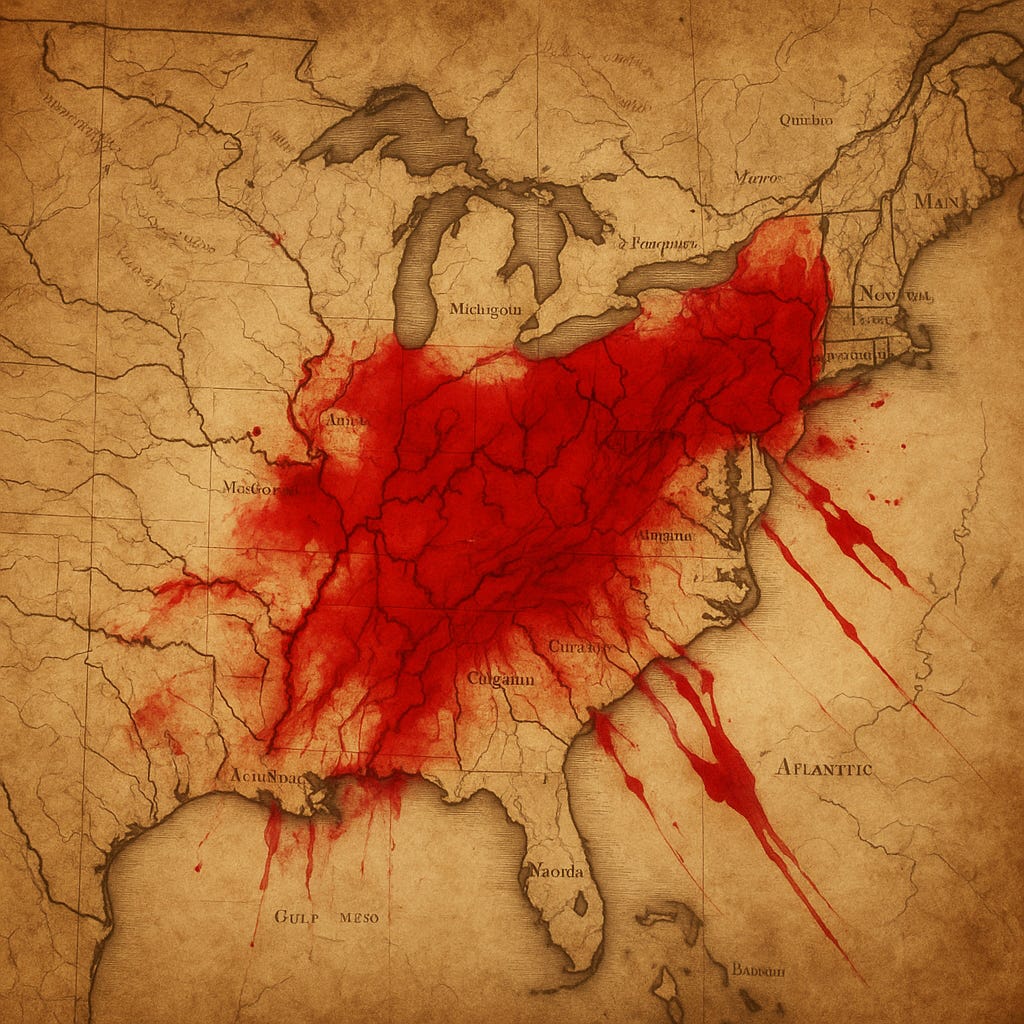
Chapter 1 — The Grammar of the Frontier
Every colonial project begins as a story.Not a confession. Not a map. A story — an arrangement of words designed to make the act of theft look like the act of birth. The telling begins before the first tree is felled or the first village burned, because the settlers themselves must believe it. A people cannot arrive with the conviction to displace unless they are already fluent in the grammar of the frontier.
This grammar is simple. Brutally so.
First, erase.Erase the names of the people already there — Yorta Yorta, Lakota, Bedouin — until they dissolve into a fog of “tribes,” “raids,” “hordes.” Erase their claim to the land by redefining them as absence: wilderness, waste, no man’s land. Erase their humanity until their deaths can be described without discomfort.
Second, replace.Rename the rivers and hills with your saints, your generals, your hometown memories — Ballarat, Bethlehem, New England. Replace the meaning of violence by calling it security. Replace the meaning of theft by calling it settlement. Replace the meaning of conquest by calling it destiny.
This language is not just propaganda for the outside world — it is the oxygen the settler breathes. Without it, the moral horror would be too sharp to endure. Without it, the clearing of villages in 19th-century Queensland could not be spoken of as “dispersals” in The Brisbane Courier. Without it, the Trail of Tears could not be described in American schoolbooks as “removal.” Without it, the 1948 razing of Palestinian villages could not be called abandonment in early Israeli military archives.
The grammar keeps the abyss out of sight.
From the beginning, America’s settlers spoke in this tongue. “Wilderness” hid the crime in its syllables. Wilderness meant no one was there — and if no one was there, nothing had been taken. The Wampanoag resisting in New England were “hostile tribes,” a phrase that rewrote the entire moral equation: the settler as victim, the native as aggressor.
Israel inherited this grammar and refined it. The village is a “nest of terrorists.” The bombed apartment is “neutralized infrastructure.” The 12-year-old throwing a stone is “a future threat.” In both cases, agency disappears. No one kills; the killing simply “occurs.” Clashes broke out. Security measures were taken. Like a storm, uncaused and inevitable.
The genius — and curse — of this grammar is its portability. It can be spoken across centuries without changing a single word. Australia’s colonial press used it to justify the Myall Creek massacre in 1838: the victims were “blacks of a most ferocious kind.” The New York Times used it to frame the 1890 Wounded Knee killings as “a battle.” Israeli headlines in 2023 used it to describe Gaza airstrikes as “escalations.”
When three settler societies — America, Australia, Israel — look at one another, they do not see strangers. They see the same sentence in three accents. They recognize the same moral inversion: conquest as self-defense, erasure as destiny.
And here — though most settlers cannot admit it — is the hidden kinship: these states are bound not just by treaties or trade, but by a shared language that allows them to live without moral memory. Each one reassures the other that it is possible to commit an original violence and still call yourself innocent.
In this mirror, innocence and violence can coexist without contradiction.And for those who notice the mirror — who feel the dissonance in their bones — the burden begins early: to breathe the same oxygen as everyone else, but taste the smoke in it.
Chapter 2 — The Siege That Never Ends
The grammar of the frontier does not retire once the land is taken.It has a second life — a siege-life — in which the native, even if defeated, must never be allowed to fully vanish. This is the paradox of conquest: the native must be destroyed enough to remove their claim, but preserved enough to justify the conqueror’s perpetual vigilance. A dead enemy cannot feed the machine. A living one — or the idea of one — can.
The siege is not a wall. It is a weather system. It surrounds, it seeps, it becomes the climate in which a society breathes. Every generation born under it inherits the same lesson: you are in danger. The object of danger may change — a tribe, a movement, a neighboring state — but the structure of fear remains untouched. And fear is an excellent architect. It builds political parties, it writes school curricula, it decides which bodies are suspect before they move.
In America, the siege began the moment the frontier closed. The last armed resistance of Native nations was over by 1890. The land was divided, the reservations drawn like wounds on a map. But the mind could not accept peace. The “savage” was replaced in the white imagination by the Black man, newly emancipated but recast as the ever-present threat. The “Black brute” of Jim Crow propaganda took the place of the Sioux warrior — both figures justifying the sheriff’s badge, the lynch rope, the chain gang.
In Israel, the siege was born alongside the state in 1948. There was no centuries-long buffer to dilute the tension. The Palestinian population was too numerous, too rooted, too visible. The siege became daily governance: checkpoints, permits, curfews, drones overhead. Every wall built to keep “them” out reinforced a wall in the settler’s own mind — a wall that made return to moral equality impossible. Once life is organized around an enemy, the absence of that enemy feels like death.
Australia’s siege is quieter, but no less enduring. The Aboriginal population is smaller, the land more sparsely inhabited, but the siege survives in bureaucratic form: incarceration rates eleven times higher than for non-Indigenous Australians; life expectancy gaps measured in decades; the legacy of the Stolen Generations. Violence is now administered in spreadsheets and police budgets, but the structure is the same: the state is always “responding” to a problem it has itself engineered.
The genius of the siege is its self-renewal. It does not need a real invasion to feel invaded. In 2020, a single stabbing in Israel could be amplified across 48 hours of news coverage, framed as proof of an eternal threat. In the U.S., a protest in Ferguson could be cast as evidence of “lawlessness” needing military-grade policing. A statistic becomes a parable; a lone act becomes a prophecy.
This is why the siege mind needs the enemy more than it needs victory. Victory is final. The siege is forever. And forever is the point.
In the siege state, fear becomes inheritance, and inheritance becomes identity. Children are taught not only who to fear, but that fearing is part of who they are. You are not simply American, or Israeli, or Australian — you are a defender of something under attack. And when the attack ends, your identity collapses.
Here lies the deepest cruelty: the siege mind cannot imagine a future without its enemy. And so it works — sometimes consciously, sometimes in the quiet mechanics of policy — to keep that enemy alive. Integration becomes sabotage; equality becomes treason. The wall must hold, even if it is built from lies.
And in the stillness between alarms, the truth presses at the edges of the mind: the siege was never about protection. It was about possession. And possession, to remain pure, must be defended as if it were under constant threat. In this way, the conquest never ends. It simply changes uniform.
Chapter 3 — The Invention of the Threat
Every siege requires a story.A wall without a narrative is just a pile of stone. The threat must be named, described, repeated until its shape becomes indistinguishable from reality itself. In time, the story doesn’t just explain the wall — it becomes the reason people forget it was ever built.
The threat is rarely simply there. It must be constructed. This is the quiet secret of settler-colonial states: the enemy is often most dangerous when they are weakest. A small, outnumbered, economically marginalized people is a fragile foundation for permanent fear — unless their existence is recast as an existential menace. That recasting is the work of politics, law, and media.
In America, the post–Civil War South perfected this craft. The Black population — largely unarmed, disenfranchised, and economically trapped — was transformed into the “Black brute” of Jim Crow propaganda. Newspapers printed lurid, often fabricated accounts of assaults on white women. A 1906 Atlanta Constitution headline, “Negro Man Attacks White Girl,” helped trigger days of mob violence; no trial followed. Lynchings were not just punishments — they were public spectacles that reaffirmed the supposed reality of the threat. The fact that the threat was invented mattered less than the spectacle that made it feel real.
In Israel, the Palestinian is framed through a similar inversion: dispossessed, occupied, stateless — yet somehow capable of “wiping Israel off the map.” Every stone thrown by a child becomes the seed of an intifada; every stabbing is amplified into an existential war. In 2015, when a 13-year-old East Jerusalem boy was accused of stabbing two Israelis, Prime Minister Netanyahu described it as part of a “wave of terror,” reinforcing the idea of a coordinated, unstoppable menace. The reality — two teenagers with knives — was irrelevant to the narrative’s purpose.
Australia’s invention is quieter but no less calculated. The so-called “Aboriginal problem” is narrated as one of dysfunction: violence, alcoholism, unemployment. These pathologies are presented as inherent traits rather than the consequence of two centuries of dispossession. In 2007, Prime Minister John Howard’s “Northern Territory Intervention” deployed the military into Aboriginal communities under the pretext of stopping child abuse — a crisis the government’s own reports later admitted was overstated. The policy’s true function was to reassert control, not to solve a problem it had helped create.
The media is the bloodstream of this invention. In the U.S., Rupert Murdoch’s Fox News selects crime stories with racial subtext, broadcasts images of urban unrest in endless loops, and frames foreign policy as a clash between “civilization” and “barbarism.” In Australia, Murdoch’s Daily Telegraph runs front-page spreads on “Aboriginal crime waves,” often using police press releases as unchallenged fact. In Israel, military spokespeople brief foreign correspondents with tightly curated footage — rocket launches without the context of the blockade that preceded them.
Why this obsession? Because without a living threat, the settler’s moral authority collapses. Without danger, the wall becomes visible as theft. The invention of the threat allows the settler to live indefinitely with the theft, recasting it as defense. It transforms conquest into self-defense and turns the conquered into the aggressor.
But there is another, darker dimension: the invention of the threat licenses pleasure. Once the enemy is imagined as implacable, irredeemable, subhuman, violence against them becomes not just acceptable but enjoyable. The white crowds at lynchings who posed for postcards, the Israeli soldiers who filmed TikToks mocking Palestinian detainees, the Australian police who boasted in private chats about “locking up blakies” — these are not deviations from the norm. They are the cathartic releases of a culture that has made the threat essential to its own identity.
A siege without violence is unstable. So the threat must be renewed, and with it, the license to harm. Every news cycle becomes a chance to remind the public who the enemy is, what they might do, why they must be stopped before they start.
The settler’s moral comfort depends on this. And so the threat is never allowed to die. It is curated, nourished, reborn in every headline, every schoolbook, every speech from the podium. It is the oxygen of the siege. Without it, the wall crumbles — not physically, but in the mind.
And in the mind is where the settler most fears collapse.
Chapter 4 — The Mirror Colony
Where One Frontier Recognizes Another
There are moments in history when nations look across oceans and see, in the face of another, their own reflection. It is not the warm recognition of kinship, nor the polite curiosity of strangers. It is the sharper sensation of seeing your own origin story unfolding in someone else’s present tense — the frontier still open, the “native problem” still unsolved.
America recognizes itself in Israel not because of shared democratic ideals, but because both are projects of permanent settlement built on displacement. They are born not from the organic growth of a people on their own soil, but from arrival with the intent to stay forever — no matter who was already there.
Settler colonialism is not merely conquest; it is conquest with amnesia. A war that never ends but must be forgotten in each generation so it can be justified anew. And it has a peculiar psychology: the longer the indigenous presence resists erasure, the deeper the settler’s hostility grows. The original crime does not fade; it festers. Each uprising, each refusal to disappear, reopens the wound — and the settler responds not only with force but with a moral doubling-down, as if punishing the refusal will also heal the injury.
The enjoyment of cruelty emerges here not as an accident, but as a feature. In the early days, violence is framed as reluctant necessity — regrettable but unavoidable. Over time, the performance of regret thins, then disappears. The settler begins to speak openly of “mowing the lawn” in Gaza, of “teaching them a lesson” at Wounded Knee, of “keeping them in line” in Northern Territory communities. Domination becomes not just a strategy but a source of cultural pride — a bonding ritual, a reassurance of superiority.
America, Israel, and Australia are among the rare modern settler colonies where the settlers never left, never relinquished power, never accepted parity with the colonized. The old European empires collapsed or retreated; their colonies became independent states. But here, the settler became the state. That is a rarer, more entrenched historical condition — and it breeds an instinctive fraternity. Each recognizes in the other a society still in the middle of its “Indian Wars.”
This is where Rupert Murdoch fits — not as the architect of this fraternity, but as one of its most effective broadcasters. Born into the Australian settler elite, he inherited both the material privileges of colonial success and the mental furniture that sustains it:
* The land was taken, but this is not to be discussed except in the language of “nation-building.”
* Indigenous resistance is recast as disorder, ingratitude, or outside agitation.
* “Civilization” is sacred, under siege, and entitled to defend itself without moral restraint.
When Murdoch expanded into Britain and then America, he didn’t have to adapt this worldview — it was already compatible with America’s own settler memory. What he added was an Australian tabloid bluntness: the ability to turn foreign policy into a morality play and domestic dissent into treachery.
Through Fox News, Murdoch became a narrative quartermaster for America’s settler psyche. Israel was not just a strategic ally; it was a mirror frontier. Its checkpoints echoed America’s border walls; its “security operations” recalled cavalry raids against the Plains tribes. Its narrative — a righteous people encircled by savages — resonated so deeply that it required no persuasion.
And here the first glint of the mirror becomes visible.When one settler colony looks into another, it does not see crimes. It sees necessities. It sees proof that the frontier is still righteous, that the siege is still virtuous, that the story still works.
Later, that mirror will turn sharper. It will not just reflect necessity; it will reflect fear — the fear of what happens if the story fails.
Chapter 5 — The Mirror of the Colony
How Settler States Learn to Love the Violence They Deny
A nation can inherit its violence the way a family inherits its furniture — passed down through rooms and decades until no one remembers what it was for, only that it belongs. In settler-colonial states, the first act is always conquest: the land seized, the people subdued, the map redrawn. The second act is justification: a civilizational myth that recasts theft as salvation.
But the third act — the one almost never named — is the most enduring: the enjoyment of domination.
It is not enough to defeat the native; the settler must learn to despise them, so that every act of suppression feels like civic virtue. This is not mere prejudice. It is an emotional architecture — a slow, generational schooling in seeing the other not as a rival but as an existential pollutant. Over time, violence becomes not only permissible but pleasurable. This is why massacres are retold as “necessary battles,” and why the killing of the colonized can be spoken of in tones that merge regret with pride.
In the United States, the transformation is visible in the shift from the rhetoric of “frontier defense” to the celebratory Wild West shows of Buffalo Bill Cody — turning wars of dispossession into popular entertainment. In Israel, it is heard in political slogans like “Let the IDF win,” where “win” implies unrestrained force. In Australia, it lingers in the casual pride some rural police took in “teaching them a lesson” — a phrase documented in oral histories from Queensland into the 20th century.
America and Israel recognize each other here, not in policy documents but in emotional register. Both were founded as outposts in a hostile wilderness — at least in their own telling. Both sanctified the removal of those already there. Both treat criticism of that founding as an attack on the nation’s soul.
Australia belongs in this same fraternity. These three are rare examples in modern history where the settler project succeeded so completely that it not only survived decolonization but became the state itself. In most of the world, settler colonies either collapsed or transformed into hybrid nations through revolt and independence. Here, the settlers stayed — and wrote themselves in as native.
This shared DNA breeds a shared politics: perpetual siege, moral inversion, the suspicion that any concession to the displaced people will undo the whole project. And because these instincts are civilizational, not just political, they travel easily. An Australian media mogul can teach Americans to despise their dissenters. An American senator can speak of Gaza as if it were the Dakota Plains. An Israeli minister can invoke frontier language that would sound at home in Queensland or Texas.
Murdoch did not invent this grammar of the colony, but he carried it like a native tongue. In Australia, his tabloids mastered the art of defending the “Australian way of life” against Indigenous land claims and migration from Asia. When he moved to Britain, then America, the vocabulary shifted but the logic did not:
* Always protect the legitimacy of the founding.
* Always recast resistance as lawlessness.
* Always present the settler as sentinel against chaos.
By the time Fox News became America’s dominant right-wing megaphone, Murdoch had refined the formula into something almost liturgical. Israel was not just an ally — it was a mirror frontier. Its checkpoints were America’s border patrols; its strikes on Gaza echoed cavalry raids. The idea of a righteous people surrounded by savages resonated so deeply that it required no persuasion.
And here, the mirror grows a shadow. The alliance is not just strategic — it is existential. To flinch at Israel’s violence would be to admit that America’s own history contains the same crime. And to admit that would be to threaten the moral scaffolding that keeps the settler at the center of the nation’s story.
This is why the siege never ends. Ending it would require dismantling the settler’s self-image. And so every generation learns the same reflex: to see in the colonized not the face of history’s debt but the mask of history’s enemy.
The mirror will return. But when it does, it will show not just resemblance — it will show the fear of what happens when resemblance becomes recognition.
Chapter 6 — The Colony That Broadcasts Itself
How Settler-Colonial Media Learned to Cross Oceans
It is a strange thing, to watch one settler colony teach another how to live without ever conceding the crime.Australia taught Rupert Murdoch long before Murdoch taught America.And Murdoch taught America long before America crowned Israel its moral twin.
The lesson is simple and old: you never apologize to the people you have destroyed. You apologize for the inconvenience of the topic being raised.
Australia in Murdoch’s youth was still narrating itself as a British outpost. Frontier killings of Aboriginal people were recent enough to survive in family memory, but distant enough to be omitted from schoolbooks. This is the perfect breeding ground for the colonial mind: the violence becomes a private inheritance, while the public story remains clean.
Murdoch did not invent the Australian right, but he mastered its grammar. His father, Sir Keith Murdoch, had been a war correspondent and press baron who cultivated a patriotic, pro-Empire tone. Rupert absorbed the lesson: stitch fear and nostalgia into the same fabric. Control the tone of the front page, and you control the country’s temperature. Learn the economy of omission — the Aboriginal dead do not need to be erased; they only need never to be mentioned.
When Murdoch crossed the Pacific, he brought more than business ambition. He brought the operating system of a settler press:
* The frontier as permanent metaphor.
* The racialized “other” as perpetual threat.
* The colonizer as eternal victim.
This is why Fox News did not need to invent its language about Palestine — it already had it. Palestinians could be cast in the same light as Aboriginal activists in Australian tabloids: “troublemakers,” “radicals,” “security risks.” The Israeli soldier became the spiritual cousin of the frontier policeman — the lonely defender of “civilization” in a hostile wilderness.
Here the pacing of the story quickens, because the mechanism is so clean:
* July 2005: Fox broadcasts Israeli government footage of rocket fire from Gaza without noting the blockade’s economic chokehold.
* August 2011: Daily Telegraph front page in Sydney — “Aboriginal Crime Wave” — timed to coincide with state government law-and-order announcements.
* November 2014: Fox amplifies a Jerusalem synagogue attack as proof of “a wider Palestinian culture of hate,” while omitting concurrent settler attacks in the West Bank.
Murdoch’s genius — if such a term can be applied to such a vocation — was to see that the colonial mind can be syndicated. You can print it in Sydney and sell it in New York. You can broadcast it in Manhattan and have it received as truth in Kansas.
America embraced it because it already knew it. It knew it from the grainy photographs of Native children in boarding schools, from lynching postcards, from newsreels of police cracking down on civil rights marchers. What Fox did was to make the kinship between the American and Israeli settler explicit — not in policy papers, but in feeling.
When the settler recognizes himself in another settler, the identification is not tempered by shame but fortified by pride. The moral alibi becomes international. If the killing is mutual, the justifications can be shared. The violence no longer feels like an aberration; it feels like tradition.
And so the colonial triangle closes:Australia births the media empire.America gives it scale and money.Israel offers a live battlefield where the old myths can perform themselves daily.
The siege mentality, the inversion of victimhood, the joy in televised punishment — these are no longer local pathologies. They have become global exports.
The colony has learned to broadcast itself. And we are all its audience.
Chapter 7 — The Joy of Punishment
When the Settler Learns to Smile
Every empire begins with the language of necessity.We had to kill them because they were dangerous.We had to displace them because there was no room.We had to burn the village because the village was already lost.
In its early chapters, the settler’s violence is framed as reluctant — the last resort of people who only wanted peace. This is the story they tell their children, and themselves: We did what we had to do.
But time passes. The elders retell the stories, and the tone changes. The voice rises when recalling the ambush, the raid, the defiance crushed. The listener begins to hear not grief, but excitement. The performance of regret thins; the pride remains.
At this moment, the violence no longer serves necessity — necessity serves violence. The siege must be permanent so the performance can continue. The enemy must remain alive enough to resist, but never strong enough to win. There must always be another raid, another reprisal, another reason to keep the soldiers on the frontier and the cameras rolling.
The media becomes essential here. Without the lens, the pleasure is fleeting. But televised, replayed, narrated — the violence gains permanence. It can be consumed daily, like a ritual.
* In 1891, photographs of Aboriginal prisoners chained by the neck in Western Australia were sold as postcards.
* In 1916, crowds in Waco, Texas, posed for photographs beside the burned body of Jesse Washington.
* In 2021, Israeli police livestreamed raids in East Jerusalem, turning night-time arrests into shareable clips.
Fox News did not invent this appetite; it professionalized it. It understood that colonial violence is about controlling the story as much as the land. The enemy must be humiliated in public, and the humiliation must be replayable. Gaza serves the same function in the Israeli imagination as the “wild west” once did for America: a stage where force is righteous, where the settler can remember he is brave, besieged, and justified.
Pleasure is the most dangerous stage of violence because it is no longer tethered to threat. In fact, the end of the threat becomes a kind of loss — a grief for the unity, the excitement, the moral simplicity that comes with having someone to punish. The settler begins to need the enemy the way an addict needs the drug.
This is why peace processes fail. Violence is not a byproduct of the conflict; it is the point. Without it, the political machinery loses fuel, the media loses content, the settler loses his story.
The joy of punishment is rarely admitted out loud, but it can be seen:
* In the laughter after a bombing.
* In the smirk of a soldier posing with his boot on a prisoner’s neck.
* In the newsroom where an editor selects the most humiliating image for the front page.
It is the joy not just of defeating an enemy, but of defining them forever as defeated.
And here is the cruelty: the punished know this joy. They see it in the settler’s face, they hear it in his language. They understand this is no longer a war over land or rights — it is a war to preserve the pleasure of ruling.
The cycle will not end until that joy is named for what it is, and stripped of its dignity. But we are nowhere near that reckoning. The cameras are still rolling. The audience is still clapping. And the settler is still smiling.
Chapter 8 — The Witness’s Burden
Living Inside the Empire’s Smile
There is a kind of violence that never makes it into the casualty count.It is the violence done to those who see too much and cannot unsee it.
I do not mean journalists, activists, or NGO staff — though they, too, carry scars. I mean the ordinary citizen whose soul is allergic to cruelty, who feels the wrongness in their body before they can name it in words. The person who turns on the television and catches, between the slogans, the truth of what is being shown — and feels sick, not proud.
Living inside a settler empire is not just about obeying its laws or paying its taxes. It is about surviving the psychic corrosion of belonging to something that is killing in your name. You may not hold the rifle, but you hold the passport. You may not drop the bomb, but you fund it with your income. And somewhere inside you, a voice whispers: If I had been born on the other side of the wall, I would be the one being punished.
This is the witness’s burden: to live in proximity to power while being morally estranged from it.You see your neighbors celebrating “victories” that are massacres. You hear laughter in the newsroom when a target is hit. You watch children in your country dress up as soldiers, learning the gestures of domination before they can spell the word.
And you cannot share the joy.You cannot even fake it without betraying yourself.
But refusing to join the applause marks you as suspect. The settler colony does not tolerate neutrality. Your failure to smile reads as disloyalty — as if withholding celebration is itself an act of treachery. You are either with us or with them.
So the witness learns silence. Not because they don’t care, but because they care in the wrong way. You cannot grieve in public without being accused of bias. You cannot name the joy of punishment without being accused of exaggeration, or of hating your own people.
And so the empire keeps smiling, and you keep swallowing the sickness. Some escape into distraction — burying themselves in work, in the narcotic comfort of entertainment, in the little pleasures of private life. Others turn to faith, to exile, to private communities where truth can still be spoken. But the price is the same: a slow estrangement, not just from the state, but from your own people.
Here is the cruelest truth: witnessing will change you more than participating.The soldier can tell himself he was following orders. The politician can tell himself he was defending the homeland. The journalist can tell herself she was just reporting facts. But the witness has no such shelter. You saw it freely, without compulsion, and you knew it was wrong — and still, you stayed.
That is the private hell of the moral exile: you do not belong to the rulers, but you cannot join the ruled. You live between two worlds, with no flag that will not stain your hands. You keep walking through the empire’s streets, surrounded by smiles you do not share, waiting for the moment when the mask slips and they see you for what you are: the one who refuses to enjoy.
And when that day comes — as it always does — you learn that the empire has a punishment for witnesses, too. Not the bullet. Not the prison cell. Something quieter. They take away your voice.
And in that silence, you finally understand why so many before you chose the comfort of smiling along.
Chapter 9 — The Settler’s Mirror
Why We Defend the Killers We Look Like
Every empire writes its own obituary while insisting it will live forever.Some write it in marble, others in blood.The settler colony writes it in the mirror.
The United States, Israel, Australia — each sees itself in the other, not just in policy or military alliance, but in the deeper marrow of identity. Each is the child of a conquest that must be remembered as birth, not theft; each is a society whose founding wound must be mythologized as divine surgery.
This is why, when Israel flattens apartment blocks in Gaza, America does not simply defend it — it recognizes it. It sees its own frontier wars, its own forced marches, its own railroads of bones. Australia sees the same, and Murdoch’s media empire carries the reflex across oceans: the reflex to protect not just an ally, but an alibi.
Because here is the truth no polite panel discussion will say aloud:A settler colony cannot fully condemn another settler colony without condemning itself.
So instead of solidarity with the oppressed, it offers solidarity with the oppressor. It claps the loudest when the killing is framed as “self-defense.” It builds entire media ecosystems — from Fox News to Sky News — to manufacture the narrative oxygen settler violence needs to keep burning. It calls this journalism, security, patriotism.
This is not merely propaganda. It is kinship.Your survival depends on theirs — not militarily, but narratively. If the world ever succeeded in persuading Israel to abandon the myth that its violence is holy, America would have to look at its own history without the shield of righteousness. If the Palestinian cause became universally recognized as a struggle against occupation, then the stories of the Lakota, the Yorta Yorta, the Cherokee, the Noongar would flood back into political consciousness with unbearable force.
Settler solidarity is not only about power; it is about the terror of unmasking.
But the mirror cuts both ways. In Gaza, the settler sees what he once feared from the native he displaced: endurance. The people who remain despite the guns, the blockades, the campaigns to starve them out. The refusal to disappear. It is this refusal — not the rockets, not the slogans — that drives the settler to cruelty. Violence becomes not only strategic but pleasurable, because each blow offers the fleeting illusion that the other’s endurance has limits.
And here the witness stands in a different place before the mirror.They see both faces — the settler’s and their own — reflected together. They feel the resemblance, however unwanted. They know the story is rotten, and yet they are inside it. They know the mirror is cracked, but to smash it would be to shatter their own reflection.
The witness carries the question the settler cannot bear: What happens when the story fails?When the world no longer believes the script, when the applause dies, when the joy of punishment curdles into shame — what then?
The answer will not be found in policy papers or diplomatic handshakes. It will be found in the human soul: in whether a people can survive without the lie that made them.
Most cannot.Most will double down, cling tighter, search for new mirrors.
But some will walk away from the story altogether. They will refuse to smile at the violence. They will refuse to defend the killers they look like. And in that refusal, they will become dangerous — not to the enemy, but to the empire itself.
Because an empire can survive the loss of a battle.It can survive the loss of land.But it cannot survive the loss of the mirror.
Prologue — What Will You Do With the Mirror?
You live inside a story you did not write.It was given to you before you could speak.It taught you which deaths to mourn and which to ignore, which flags to salute and which to burn, which massacres to call tragedies and which to call victories.
For a long time, you didn’t question it — not because you were cruel, but because the story made your life possible. It sheltered you. It kept the border at your back instead of at your throat.
But now the seams are showing.You see the gaps between what you were told and what you witness: photographs from Gaza; graves on the prairie; faces and names your textbooks skipped. You realize they are not separate tragedies, but chapters of the same book — a book written in the grammar of the frontier, designed to make conquest look like salvation.
And once you see the book, you cannot unsee it.Israel’s bulldozers and America’s cavalry are the same sentence in different accents. Australia’s stolen children and the rubble of Jenin are the same wound in different soil. The smile in every photograph is the same — the smile of the one who believes their violence is a gift to the world.
So the question is no longer whether you see.The question is what you will do with the recognition.
You can bury it under the comforts the story gives you.You can search for softer words, for the “middle ground” that condemns the killing without disturbing the architecture that makes it inevitable.
Or you can let it ruin you.Because ruin is the only honest way forward.
To let the recognition strip away the safety of belonging to a “civilization” built on erasure.To choose the exile of conscience over the citizenship of denial.
There is no gentle way to face the mirror.You will either love the reflection or break it.
And if you break it, you will cut yourself.You will bleed.
But for the first time, you will know the blood is yours.
—Elias WinterAuthor of Language Matters, a space for reflection on language, power, and decline.
Thanks for reading Language Matters! Subscribe for free to receive new posts and support my work.