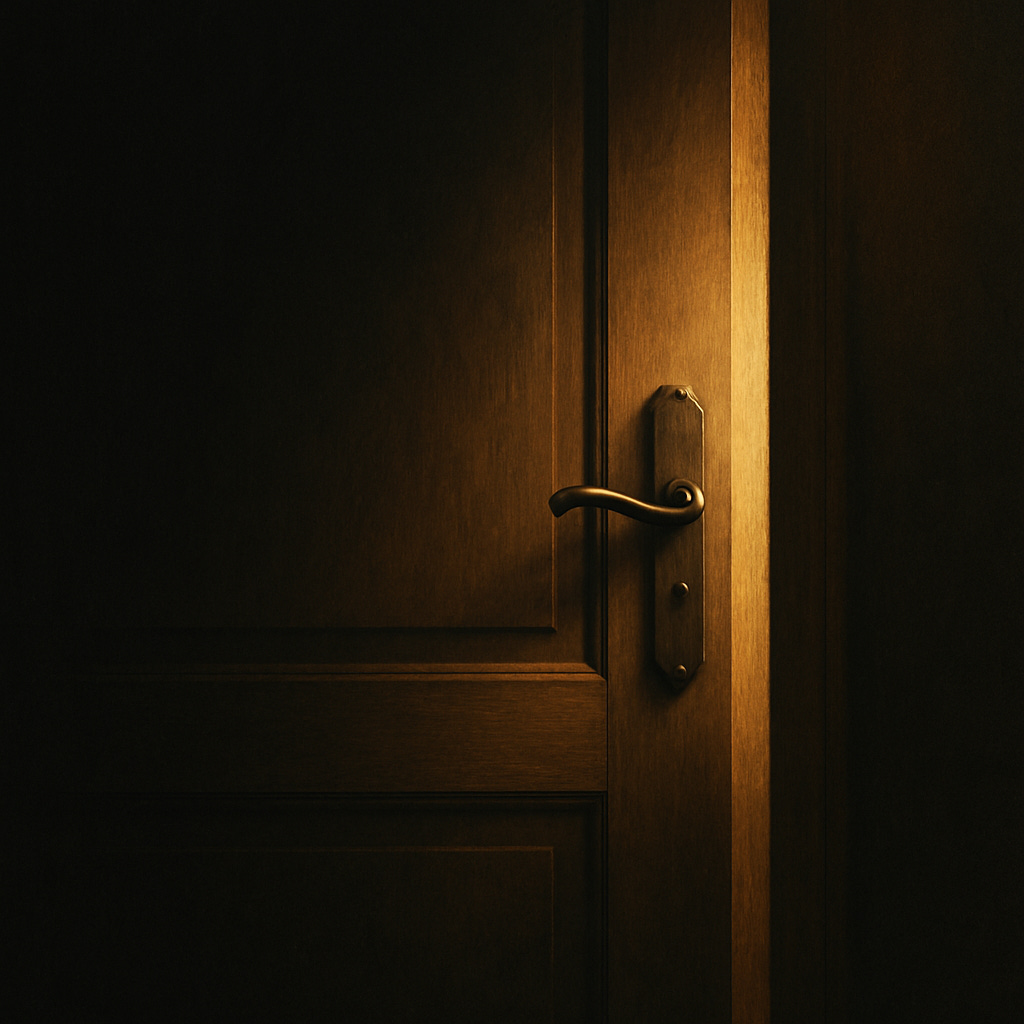
Chapter 1 — A Bottle on the Shelf
It begins with a bottle. Not a miracle, not a manifesto—just glass, a cork, a neat handwritten label that may as well read: please ignore. London, 1910. The room smells of phenol and ink. A junior chemist lifts the bottle to the window, lets a gray wedge of morning insinuate itself through the liquid. The name is cumbersome, more syllables than promise—3,4-dihydroxyphenethylamine—an intermediate, a stepping stone, something that exists on its way to something else. He sets it back down between adrenaline’s confident brown vial and a ledger of numbers that will be filed and forgotten. History exhale, pause.
What makes a thing visible is not its existence but our readiness to see it. At the time, nerves were mostly electricity and reflex; mind was philosophy or pathology; chemistry was busy with vitamins, dyes, and the new glamour molecules that snatched headlines by restarting hearts and narrowing vessels. Adrenaline had a story you could tell at dinner. This clear liquid did not. It was chemistry without fate. A molecule waiting for its century.
You could say its first life was a life of misrecognition. It was mapped but not meant, named but not narrated. The way a child stands in a doorway while adults argue about larger things. Papers mentioned it the way a train schedule mentions the tiny station you never visit: necessary to the route, irrelevant to your journey. Even its eventual nickname—dopamine—would arrive later, short, punchy, almost cheerful, as if trying to compensate for the decades it spent as a ghost in other people’s experiments.
It is tempting to rush ahead to the fireworks—the reawakened bodies, the lever-pressing rats, the bright theories—and forget the long patience before them. But the patience matters. Because the bottle on the shelf tells us something uncomfortable about knowledge: discovery is not merely finding; it is noticing. And noticing, as any lover knows, requires a certain poverty of noise. The early twentieth century did not have that poverty. It had the bustle of progress, the confidence of explanations, the intoxication of new tools. It had enough light to be dazzled. It did not have the kind of quiet that lets a plain bottle declare itself.
So dopamine’s story opens with delay, with the humility of being passed over. If it were a person, it would have learned early how to wait without sulking. It would have understood that truth sometimes enters through the side door, years after the applause has died down for lesser revelations. This is not romanticism; it is a pattern. Our age insists that novelty equals importance, that immediacy equals reality. The bottle contradicts us. It says: I was here, exact and invisible, because you did not yet have the questions that would make me visible.
Imagine, for a moment, the hands that handled it. Careful, competent, unconverted. They could feel the slight chill of the glass, the meniscus clinging to the inner wall, the little tremor that turns a liquid into a thought. They were not wrong to shelve it. In that season of science, the mind was electric; the body, hydraulic; chemistry, a backstage laborer. The idea that a simple amine could be a sentence in the language of will—of movement, of desire—was beyond plausibility. Even the word “neurotransmitter” had not yet acquired its full weight. Some truths require a scaffolding of other truths; dopamine was waiting for its scaffolding.
There is a mercy in this prehistory. We get to see the signal before the capture. Before it became a buzzword, a meme, a cudgel; before it was made to carry our anxieties about phones and politics and pleasure. Here it is, unburdened: a modest compound, a link in a biochemical chain, a quiet piece of the metabolism of life. If you listen, you can almost hear what it is not yet: not a pleasure button, not a villain, not the excuse for every restlessness. Just a possibility.
Every civilization has objects like this—ordinary vessels where the future hides. A ledger line that will one day be an empire’s hinge. A word in a marginal gloss that will rewire theology. The bottle teaches us how thin the membrane is between the seen and the overlooked, how much of our fate is stored in shelves we never scan. It also offers a rebuke to the way we measure importance. What if the decisive things are not the loudest things? What if the map of meaning is drawn in invisible ink first?
Years later—decades, in fact—someone will lift a related bottle, administer its contents, and watch a frozen body begin, almost shyly, to remember motion. That moment will look like magic. It will be science, yes, but also confession: we did not know what we were looking at. We had the key in our house and did not try it in the door.
For now, keep the scene small. The fog hangs low outside the sash windows. The label curls a little at the edge where a thumb has worried it. Somewhere down the corridor, a bell rings for tea. The bottle sits at attention, as if aware—ridiculous thought—that one day it will be asked to explain not only tremor and stillness but longing and appetite and the strange modern sorrow of wanting everything at once. It will be asked to carry the weight of an age. It will refuse, of course, by being what it is: a signal. The rest will be our work—our interpretations, our systems, our hunger.
For the story to move, for the bottle to speak, another century has to arrive. The questions have to ripen. The room has to quiet a little. Then a signal, long shelved, will step forward and teach us how to see.
Chapter 2 — When Motion Returned
The next time the bottle speaks, it does not do so in theory but in bodies. Postwar Europe, fluorescent light, the quiet clatter of cages. A drug called reserpine is draining animals of their amines—serotonin, noradrenaline, and that overlooked intermediate, dopamine. The result is uncanny: creatures that can move do not; they sit as if a command has been mislaid between intention and muscle. It looks like sorrow made physical, like time refusing to pass.
Arvid Carlsson watches this stillness and does not accept it as a mood. He treats it as a signal: if emptiness can be induced, perhaps fullness can be restored. He gives L-DOPA—the precursor the brain can convert to dopamine—and the room changes. It is not dramatic at first. A posture softens. A paw tests the floor. Then motion returns as if someone found a fuse in the dark. What electricity could not coax, chemistry does: a path opens from will to limb. The animals do not become happy; they become possible.
Reports like this feel, in the telling, inevitable. They were not. They required a refusal to keep seeing dopamine as a ghost in another molecule’s story. The lesson is embarrassingly simple and endlessly rare: pay attention to what works, then ask what it means. Carlsson’s work did both. He did not only move bodies; he moved an idea—dopamine from corridor to center stage.
Meanwhile, in Vienna, Oleh Hornykiewicz is listening to a different kind of silence. He is measuring brain tissue from the dead—people who shook and stiffened and slowed until the world outran them. In the striatum, a hub of the basal ganglia, he finds a low, a near-absence: dopamine is not there in the quantities the living require. What had been described clinically as “shaking palsy” now shows a biochemical face. One can argue with metaphors; one does not argue with a nearly empty vial.
He suggests a simple, dangerous thing: if the deficit is dopamine, give the precursor and see. The first patients are not abstractions; they are men and women who have learned a new etiquette of waiting. Their hands have forgotten small talk; their faces—the neurologist’s “masked facies”—have set like uncarved wood. L-DOPA enters the blood. Hours pass. A heel lifts. A mouth that learned to ration words spends them with relief. A wife says his eyes came back. In hospital corridors, nurses witness the kind of change that makes them believe, against training, in miracles.
Of course, nothing remains simple when it becomes standard. Tolerance, dyskinesias, the choreography of dosing—Parkinson’s treatment will prove to be a long apprenticeship in timing. But the first fact stands like a reopened door: for some conditions, chemistry is not commentary but cause. Movement is not merely electrical or moral; it is also a ledger of molecules met or missed.
If Chapter 1 was the patience of being overlooked, Chapter 2 is the humility of being proven by mercy. Dopamine is no longer a bottle on a shelf; it is a difference you can film. Here the molecule acquires a moral: there are states of human stuckness that are not failures of will. Dignity may require pills. This is not a surrender to reductionism; it is a refusal to romanticize suffering.
Science, being human, could not absorb such a revelation without politics. Debate follows: is dopamine truly an independent signal or merely a courier on norepinephrine’s route? Old maps complain when rivers are redrawn. But arguments fade in the presence of people who can button their shirts again. Medicine, at its best, lets evidence become kindness.
There is a photograph from those years—pick any of a hundred—that captures the pivot without intending to: a patient mid-stride, a physician leaning forward, hands open as if to catch a new future. What changes in that frame is not only a gait. The entire field shifts its metaphors. The brain is no longer just wire and spark; it is also ink and solvent. The question is no longer only where signals travel, but what they are made of.
I dwell on these rooms and these bodies because they anchor what comes next. Soon dopamine will be accused of greater crimes and credited with stranger salvations. It will be pulled into psychiatry and then into culture, enlisted to explain hallucination and hunger and the way we reach for our phones at midnight. Before that frenzy, one must remember this quieter triumph: the return of motion. Not euphoria, not spectacle. A man stands from a chair and walks down a hall that had grown longer each year. A woman lifts a spoon without bargaining with her hand. The molecule’s first public act is not seduction. It is restoration.
There is a temptation—our era’s—to skip from miracle to metaphor, to turn every success into a general theory. Resist it. What L-DOPA gave was not a philosophy but a fact: dopamine participates in the sentence the brain speaks to muscle. The beauty of that sentence is plain and practical. Later we will argue about desire and attention and the economy of engineered wanting. For now, let the story hold still long enough to honor the mundane grace of a life resumed.
Years later, medals will be struck and speeches made. The language will praise discovery and courage and the dance between bench and bedside. All true, and yet insufficient. The truth of this chapter is quieter: a signal once overlooked became a bridge between intention and action. In that crossing, a century learned to see chemistry not as the enemy of meaning but as one of its instruments. Motion returned. The story—our story—could move on.
Chapter 3 — Madness, Pleasure, Compulsion
Once motion returned, the mind stepped forward and asked its own questions. Hospitals learned a new quiet in those years. Wards that had sounded like fever dreams—voices colliding with fluorescent hum—grew strangely hushed after a chalky pill. Chlorpromazine, then haloperidol and its kin, were passed across stainless carts, and the world inside certain heads softened at the edges. Delusions dimmed, not because they were argued with, but because a knob had been turned on a signal no one could see. The same chemistry that bridged intention to muscle could, it seemed, steady a mind that had tipped toward the storm.
There is a kind of awe in watching a metaphor become measurable. Doctors noticed a pattern that felt like an x-ray of an idea: the stronger a drug bound to a particular receiving dock—the dopamine D2 receptor—the more the hallucinations retreated. It was not the final word on psychosis, but it was a word you could test. The brain, which had once been explained by family romances and dreamwork, now answered—at least in part—to a ledger of molecules. It was not that childhood or grief vanished from the story; it was that chemistry was no longer backstage.
But nothing in this chapter is simple. To dial down a signal is also to risk dimming the room it lights. Patients who heard fewer voices sometimes developed a new stiffness, a tremor that whistled the first bars of Parkinson’s from the far end of the hall. There were mouths that began to twist, tongues that learned strange choreographies no one wanted to see—tardive movements, side effects that felt like a penalty for clarity. The trade was brutal and real: a decrease in persecuting angels purchased with a tax on grace. Medicine, honest, had to speak both halves of the sentence.
Even as psychiatry learned to lower the volume in one theater, another stage blazed into view. A rat discovers a lever; a rat learns that pressing it sends a jolt into a bundle of nerve fibers that might as well be a false sun. Night after night it hunches over that metal salvation, pressing, pressing, as if hunger had found a new grammar. What the electrodes illuminated, and what drugs like cocaine and amphetamine made garish, was not happiness but insistence: the animal was not drowning in bliss; it was conscripted into pursuit. Desire unlatched itself from satisfaction and revealed a second face—compulsion.
Here the molecule’s paradox came into focus. Too little dopamine and the world cannot begin; too much and it cannot stop. The same signal that asked muscles to rise from the chair could, when amplified or misdirected, ask a hand for “one more” until dawn. The distance between a man buttoning his shirt again and a man emptying his pockets at a casino is not moral fortune alone; it is circuitry, tuned and mistuned, a common alphabet spoken in opposite directions.
If you listen carefully to the stories from that period—the clinic, the lab, the late-night kitchen—you can hear a single theme. In a ward, a quiet settles and a patient says, “The radio in the wall has gone silent.” In a laboratory, a rat wears a path into the sawdust and will not eat. In an apartment, someone who promised not to uses again and swears afterward the promise was never the problem; appetite had rewritten the hour. None of this makes choice disappear. It does, however, explain why certain choices arrive with the weight of weather, and why sermons feel like umbrellas in a hurricane.
Culture took its own notes. Advertisers and dealers and designers learned to speak to the same doors the scientists had found. The language of leverage—of cues and cravings, of cues that become cravings—slipped from journals into billboards and back again. We did not yet have our present vocabulary for it; that would come later, when the feed and the notification taught every pocket to vibrate like a small casino. But the outlines were visible: a signal that steadies can also seduce, and the line between the two is thinner than anyone wants to admit.
It would be convenient to blame the molecule, to name dopamine as villain and call the matter settled. But villains twirl mustaches; signals carry news. What the history of these rooms and cages and kitchens teaches instead is responsibility: to ask what we have built around the signal, what environments magnify it into tyranny, what mercies we are willing to pay for, and at what price. If chemistry can return a voice to its owner, it can also lend its grammar to our hungers. The task is not to abolish the grammar but to write better sentences.
Somewhere in these same years, another correction is quietly forming. A few careful minds begin to argue that dopamine is not pleasure itself but the gap between what we expected and what arrived, the little sting of surprise that tells a nervous system to update its map. That is a different story, almost a different morality—a signal not of ecstasy but of education. We are not there yet in this chapter. For now, hold the paradox steady: a molecule that calms a storm can also summon a chase; a lever that promises relief can become a trap. Between the ward’s new hush and the rat’s stubborn ritual, a civilization begins to recognize the mirror it did not mean to design.
Chapter 4 — The Teaching Signal
The story turns when surprise enters the room. Not the tabloid kind, but the quiet shock of being wrong. A light clicks on above a lab rig; a drop of juice arrives; a monkey blinks. Electrodes record the soft percussion of midbrain cells, and the pattern refuses the old script. At first the neurons fire for the sweetness itself—pleasure, we might say, if we insisted on romance—but soon they learn the light. The pulse migrates from reward to prediction. Then comes the strangest note: when the light promises juice and the juice does not come, the activity dips below baseline, as if the brain were marking the debt with a frown in its ledger. A signal that had been accused of temptation reveals itself as pedagogy. This is dopamine teaching reality: you expected X, you got Y—update your map.
It would be easy to turn this into an algebra of the soul, to recite “prediction error” like a spell and congratulate ourselves on knowing how learning feels from the inside. But the beauty here is simpler and more scandalous: we are apprentices to surprise. What moves us is not just pleasure but correction. The nervous system takes attendance on events, compares them to forecasts we didn’t know we were making, and adjusts desire accordingly. The lever-pressing rat of the last chapter was not merely addicted; it was trapped in a world where every press promised a resolution that never fully arrived, a classroom with a broken clock. The lesson could not complete itself.
Once you see it, you can’t stop seeing it. A lover waits for a message that used to come by midnight; the screen stays silent; a small hurt opens under the ribs—negative prediction error, the body’s lowercase grief. A salesman rehearses certainty and meets a shrug; the dip teaches him to change his pitch. A child laughs when the jack-in-the-box pops too early and is bored when it pops on time. Surprise turns the key; repetition turns it dull. We do not only chase rewards; we chase the rightness of our forecasts. Reality’s little betrayals instruct us more deeply than its favors.
The science, being human, found poetry hard to resist. Kent Berridge and Terry Robinson offered a distinction that felt like a mercy: “liking” is the sweetness on the tongue; “wanting” is the engine that drives the hand. Disable dopamine and an animal still shows the facial signatures of pleasure at a taste of sugar; what vanishes is the willingness to work for it. The old conflation—dopamine as happiness—began to unravel. The signal was less a bell of delight than a spur: not “this is bliss,” but “this is the path.” Wanting without liking is a definition of hell we already knew from the night kitchen and the casino floor.
Meanwhile another migration was underway, from wet lab to dry code. Engineers borrowed the brain’s habit and wrote it into algorithms: when the world surprises you, adjust the weights; learn to expect what pays; explore when the map grows stale. It was an odd moment of recognition. The machine learned by disappointing itself toward accuracy, and we recognized the pattern because it was ours. That should have made us humble. Instead, somewhere between grant proposals and press releases, we crowned ourselves with the metaphor: the brain is a kind of reinforcement learner, and dopamine is its teaching note. True enough to be useful, false enough to be dangerous. Metaphors always exact a toll.
What changes in this chapter is not only theory but morality. If dopamine is a teacher, then the question becomes: who designs the classroom? A slot machine offers a curriculum of intermittent maybes; a phone becomes a desk that never dismisses class; an economy learns to salt the day with small uncertainties that keep the midbrain listening for the bell. To live under such instruction is to be graded, minute by minute, on our tolerance for surprise. Some of us adapt by clutching at the new; others by numbing the lesson; few of us learn how to choose our teachers.
I want to honor the gentler side of this, too. A dancer practicing a phrase, missing the landing by a hair; a cook tasting, adding salt, tasting again; a mathematician leaning into a proof that refuses to close, then feeling the hinge click—these are also dopamine’s students. The signal is not a whip alone; it is also an invitation to mastery. The right dose of error, the right rhythm of attempt and adjustment, and the days become a workshop where attention learns to hold. We are, at our best, animals who love being corrected by the world into truer forms.
But the workshop can be sabotaged. Flood the room with constant novelty and the prediction machinery never stabilizes; starve it with dead routine and it quits listening. The age to come—and we are nearly there now—will learn to sell both extremes: jittery unpredictability for the bored, scripted certainty for the anxious. In between, the narrow path where craft grows is hard to find. That path requires the one resource our culture has decided is uneconomical: patient repetition under honest feedback. Close the door. Do the thing badly until it clicks. Let the small dips in the curve teach you where the truth hides.
Dopamine’s reputation will never fully recover from its tabloid years. It will always be accused of pleasure while doing the humbler work of alignment. That is fine. Signals do not ask to be understood; they ask to be heeded. What matters is that we admit what the data and our days already agree upon: desire is educable. The future is the sum of what we choose to let instruct us. We can apprentice our attention to the feed, to the market, to the crisis; or we can apprentice it to a craft, to a vow, to a community that teaches us which errors are worth suffering.
If the bottle on the shelf was a lesson in delay, and the return of motion a lesson in mercy, then this chapter is a lesson in correction. We are not the heroes of our cravings; we are their students. The midbrain writes notes in a hand we rarely recognize: more here, less there; this surprised you into life, that surprised you into pain. To live well is to read those notes without becoming their servant. It is to decide, deliberately, what will be allowed to surprise us—what we will practice until the pulse moves from the sugar to the light, and from the light to a door we meant to open all along.
Chapter 5 — The Dopamine Economy
By now the signal has acquired an audience, and the audience has learned to charge admission. Somewhere in a glass office, a product team is arranging the furniture of attention. They name their altars with harmless words—retention, session length, time on site—while a dashboard blooms with little green arrows that point up like promises. No one speaks of lever-pressing rats. They talk about “delight,” about “frictionless flow,” about “meeting users where they are,” and then they hire a designer to remove the end from the page so that the scroll never meets a floor. A bell that once lived in a midbrain now rings from a pocket. The room nods. The graph smiles.
You can watch the curriculum of Chapter 4 get repurposed. Prediction error—the tutor that helps a brain learn—becomes the trick that keeps it guessing. The interval between stimulus and reward is salted with uncertainty; sometimes the message lands, sometimes it doesn’t; sometimes the like arrives in a chorus, sometimes in a whisper, sometimes not at all until you check again. A classroom built for mastery has been rented out to a carnival. The same surprise that taught a monkey the meaning of a light now teaches a teenager to live inside a slot machine. We call it “engagement,” as if the word did not also mean betrothal.
There is a dinner table where no one is quite present. The father tilts his phone under the cloth like a contraband devotion; the mother laughs but her eyes are two centimeters to the right; the child’s thumb performs a gesture so well-practiced it has no mind left in it. If you could translate the air, you would hear a small chime every few seconds—a roomful of invisible bells marking the pace of appetite. No one planned to be rude. They planned to be reachable. They planned to belong. The plan was successful; what failed was dinner.
Not every villain wears a hoodie; some wear suits that fit. In another building, a meeting is deciding which shade of a button will yield another tenth of a percentage point in conversion. The language is clean. The slides are clean. The moral residue will be washed off by calling this optimization. You could stand up and say: we are civil engineers of craving. You would be told to calm down. Numbers do not lie, but they are very good at saying less than they know.
We have, as a species, always had markets for desire. The novelty of this one is not that it exists, but that it follows us into bed. Old markets closed their doors. This one comes in through the charger. It sells us to ourselves. The inventory is our attention, and the warehouse has no walls. The price is small and continuous: the energy it takes to look up from the wheel and remember where you were going. After enough purchases, the road itself begins to resemble a feed.
It would be sentimental to blame only the companies. They are mirrors and accelerants, not sorcerers. The real product is the feeling that something might happen if you just check once more. That maybe a message arrived that will lift the day half an inch. That perhaps the world is a little less indifferent than it was this morning. In this economy, hope is both the commodity and the hook. The chime says: you are not forgotten. The silence that follows says: earn it again.
Work learns the same grammar. The office becomes a theater of perpetual partial attention. We congratulate ourselves for multitasking while our thoughts slip their leashes and wander. Managers who cannot tolerate the quiet of trust create miniature emergencies to feel alive; employees who fear invisibility paint themselves with status updates. The whole machine hums with effort and produces, very often, busyness. Deep work requires closing doors; the dopamine economy prizes open plans and open tabs. If you ask the room what it values, it will say collaboration; if you ask the nervous systems what they are doing, they will whisper: ducking and darting, nibbling and refreshing, mistaking motion for movement.
Politics does not escape. The leader who governs by spike learns to feed the loop: provoke, watch the graph, provoke again. Policy becomes set dressing for the next minor apocalypse on television. Outrage is renewable; attention recycles. The dopamine economy teaches presidents the same lesson it teaches teenagers: visibility is survival. The country, like the family at dinner, forgets how to sit still long enough to do anything expensive with time.
I am aware of the temptation, in this kind of chapter, to scold. It is a temptation, and it is boring. The point is not that we are weak. The point is that we have built an infrastructure that treats our prediction machinery as a vein to be mined. When a mine is productive, the company does not ask the mountain to be stronger; it brings bigger tools. The solution is not stronger mountains. It is a different industry.
Yet condemning an industry won’t give you your hour back tonight. So attend to the physics at hand. The midbrain leans toward surprise. The world we have made is a surprise factory. If you want a different life, you will have to stage a small mutiny against the factory settings. Not because you are noble, but because you are finite. There are rooms where the bell does not ring. There are doors that shut. There are crafts that only reveal themselves when the graph goes blind.
The tragedy of the dopamine economy is not that it makes us evil. It is that it makes us thinner. Our gestures become short; our thoughts arrive in fragments; our loyalties fray into performative signals that never cash out into care. You can feel this thinning most sharply when you try to love someone in the old way—with patience, with repetition, with the dailiness that lets a face become a landscape. The feed interrupts. The lever suggests itself. The chime asks whether you wouldn’t rather be anywhere else for a second, and the second becomes a season.
Somewhere in this same market, however, truth keeps its stall. A wooden table. A book with a spine. A practice that bruises your pride because it will not move faster than you can become. The old technologies—walking, cooking, prayer, instruments—do not compete well on “engagement,” and so they survive. They are not nostalgic; they are stubborn. They are the closed doors through which, if you bother, you can still carry a self.
This is not yet the chapter of solutions. It is, instead, the scene-setting for hope. To name the economy is to begin to see its invoices, to notice who pays and what for. The bill arrives in stolen mornings, in shallowed attention, in the dull ache of a day spent grazing on prompts. Pay enough of those, and you will forget what a full meal feels like. Refuse enough, and hunger will sharpen into clarity. The signal is not our enemy. The market we have made around it is. We can still walk out, but not by accident.
Chapter 6 — The Overstimulated Human
What kind of person does a surprise factory make? Imagine a day assembled from fragments: a message that might arrive, a chart that might move, a headline that might matter. The midbrain keeps the drumbeat—maybe, maybe, maybe—and the self begins to keep time with it. We become apprentices not to craft but to interruption. Our attention learns to live with its coat half on, keys in hand, one shoe already pointed at the door.
In love, this training shows itself first as a tremor and then as a habit. The early blaze of a relationship—those generous weeks when every sentence is a discovery—used to cool into a warmer fire lit by repetition: the ordinary dailiness of knowing where the olive oil is, how they take their coffee, what silence means in that room. The dopamine economy is impatient with this; it prefers the first act on a loop. Comparison becomes a tide. Why linger in one harbor when the sea is full of lights? The feed teaches the eye to count alternatives, and counting corrodes gratitude. Partners feel each other through a scrim of elsewhere, attention divided into slivers too small to carry a gaze. Tenderness, which is mostly repetition without boredom, begins to feel like a lost craft. Drama survives—fights, reconciliations, cliffhangers—but the slow work of building a house out of afternoons goes soft around the edges. We don’t fall out of love so much as we leak out of it, one notification at a time.
At work, the new human performs heroics that are all sizzle. We are quick, responsive, always reachable, half brilliant in bursts—and strangely incapable of the kind of concentration that makes a year cohere. Dashboards and pings take the place of quiet competence. The day becomes a swarm of micro-rewards: someone reacted to the doc, someone cc’d the thread, someone used your name in a meeting. We mistake these electric pricks for meaning until we try to read our own week backward and discover it contains very little that could be called a paragraph. Projects sprawl like open tabs; the door never quite shuts; exhaustion arrives not from labor but from posture—perpetual readiness without depth. We are busy the way a tidepool is busy, churned without going anywhere.
Managers trained by the same weather learn to lead as if reassurance were a substance you can mine hourly. They check, they nudge, they convene, they share their screen as if it were a lantern in a cave. Trust is a silence they cannot bear. Crisis offers a satisfying spike, so crises multiply: red banners in Slack, war-room calendars, the high of the fix. The team, watched to pieces, adapts by performing visibility. Everyone is “aligned,” no one is nourished. Metrics that can be shown replace improvements that would require waiting. If leadership once meant choosing what would matter in a year, it now risks meaning only: what will register by Friday. People do not burn out because they are weak; they burn out because the flame is asked to leap without ever being allowed to rest into coals.
Politics, drunk on the same diet, becomes theater more openly than usual. A leader discovers that the midbrain loves outrage and feeds it accordingly. Governing shrinks to provocation management: announce, inflame, pivot; repeat until the graph purrs. Policy is a stagehand. Visibility is survival. A nation’s attention, treated like a commodity, starts to behave like one—volatile, extractable, abandoned when the vein runs thin. The civic arts of patience—compromise, stewardship, boring competence—have trouble finding an algorithm. The republic learns to live on cliffhangers and forgets how to move a bill through a corridor.
Even science, our temple of delay, is susceptible. The reward schedule tightens: publish, post, promote. Novelty is coin; replication is penance. A scholar wakes to the ping of a citation alert and goes to bed measuring significance by a number that will never admit how much solitude was required to think. Hype creeps into the methods section like a cheerleader who learned Latin. We do not get worse people; we get a worse sabbath—the quiet that lets a problem sit inside you long enough to offer you the right question. The laboratory stays fluorescent, but the old, stubborn dark that makes discovery honest is harder to find.
Activism, too, learns a rhythm of spikes. Outrage is renewable; attention is a fuel. A cause burns like magnesium and then collapses into ash where an institution should have been. Marches are easier to organize than water boards. The choreography of care—boring, local, accountable—is less “engaging” than a thread that invents the world anew each morning. We are not crueler; we are thinner, and thin people struggle to lift heavy things.
This is not a sermon against tools or a nostalgia for quills. It is a diagnosis of time. Overstimulation compresses the future into the next few minutes and enlarges the present into a carnival. It punishes patience by making it feel like neglect and rewards volatility by bathing it in signal. When the teaching signal—dopamine’s gift—gets conscripted by an economy of engineered surprise, character itself begins to reorganize around reactivity. We are not worse than our grandparents; we are wired to different weather. The self becomes a collection of responses that never cool into temperament.
And yet, if you study the cracks in this glass, you can see the old world still trying to speak. A craftsman who turns off the internet and spends an afternoon losing at a phrase until it stops losing. A midwife whose whole job is to dilate time when everything in the room wants to sprint. A neighbor who remembers that casseroles are a technology. These figures are not quaint; they are smuggling oxygen. They are practicing a different prediction schedule—long, honest, costly—under the nose of a market that prefers you jittery.
The point is not to blame a molecule for our manners. The point is to admit that our manners have been trained by a curriculum that profits from our restlessness. If the bottle in Chapter 1 taught us how much is missed when we cannot see, and if the laboratories in Chapter 2 taught us that chemistry can be mercy, and if the wards and cages of Chapter 3 warned us that the same signal steadies and seduces, and the rigs of Chapter 4 showed us that learning is surprise, and the dashboards of Chapter 5 revealed the factory that sells our midbrain back to us—then Chapter 6 simply holds the mirror. This is what the factory makes: quick, clever, generous people who cannot keep a promise to their own attention. Hungry people who confuse a chime for a call. Tender people who love in flashes and then wonder why love leaks.
I do not think we are lost. I think we are tired of being thin. Somewhere in the body there is a memory of thicker hours: bread dough on a counter, the ache of practice, a friend’s face unpixelated by urgency, the clean relief of finishing something that did not flatter you while it was becoming itself. The nervous system is educable. The question is who we allow to teach it. In the next—and last—chapter, the door shuts. Not as an escape, but as a vow. The signal returns to its proper work, and desire remembers what it was for.
Chapter 7 — Toward Enduring Joy
Hope does not arrive as a surge; it enters like a craftsman with a toolbox and no time for speeches. After the years of chimes and graphs, there is something scandalously plain about the way a good life begins again: a door shuts, a phone goes face-down, a human being turns toward a task that will not flatter them while it is becoming itself. Nothing explodes. The signal, which we once treated as a god or a goblin, returns to its older vocation: a tutor in the art of staying.
I think of the bottle on the shelf—the one we almost didn’t notice—and how much of rescue begins that way: unglamorous, available, ignored. We keep looking for thunder while hope waits in the pantry like flour. The nervous system is educable; it always was. It learned the surprise factory because the factory was everywhere. It can learn other weather if we build it.
The first architecture is the room. A table cleared of little altars. A chair that faces a window. An instrument left out where a hand can trip over it. This is not asceticism; it is hospitality. You are preparing a place for attention to sit down and take off its coat. At first nothing good happens. The mind kicks and bargains. It asks for a chime. Let it stamp. Then a minor miracle: the pulse of wanting, deprived of novelty, begins to look for pattern. Dopamine, un-dramatized, resumes its humbler work—error, adjustment, a line practiced until the wrist remembers what the mind keeps forgetting. The light migrates from sugar to signal again.
The second architecture is the day. A sabbath that is not a lifestyle but a law you keep for your own survival. Once a week, the economy of engineered surprise finds a locked gate. You do not banish pleasure; you season it. You go for a walk not to count steps but to let the world correct you at a scale your screen cannot provide. The bread takes the time it takes. A friend’s face, unpixelated by urgency, returns to its old role as an altar where attention learns to kneel. This is the pedagogy Chapter 4 tried to teach: surprise that instructs instead of fractures.
The third architecture is the room we share. The dinner that begins on time and has a center. A neighborhood where casseroles are still a technology. A workplace with doors that actually shut and managers who can bear the silence of trust. If leadership is the power to set the weather, then the first duty of leaders is meteorology: close the windows that let the storm in, open the ones that let the air move. Celebrate outcomes, not noise. Make boredom legal again so craft can return through the side door. Do not reward the crisis that could have been prevented by patience last month.
There is policy in this, though it does not wear its name loudly. We learned to regulate substances when we admitted they could conscript bodies without asking permission. The slot machine in the pocket is not a metaphor; it is hardware. Humane defaults are not moralizing; they are public health. Endings are a civil right: feeds with floors, notifications in bundles, delays that protect us from our own impulsive send. A city that can require seatbelts can require “enough.” None of this abolishes the market; it disciplines it to serve creatures who fatigue.
But legislation, like medicine, cannot restore what culture refuses to honor. So the fourth architecture is vow. A guild of designers who sign their names to products that do not cannibalize attention for rent. A university that teaches the physiology of craving next to rhetoric, so citizens can hear when their midbrain is being recruited for someone else’s quarterly. A congregation—secular or sacred—that treats silence as a sacrament. The appetite for spectacle is not cured by contempt; it is fed by it. It is cured by a thicker joy.
I do not mean the rare joy of fireworks. I mean the slow joy of competence. The hour when the dancer lands the phrase in muscle. The quiet after pages when a sentence finally wears your voice without pinching. The garden that begins as dirt and ends as food among friends. These are not exceptions to desire; they are its home. They ask dopamine to do what it was made to do: apprentice us to reality until accuracy becomes pleasure. You can feel the difference in your bones—the way the craving that once pried your day into fragments gives way to a desire that can carry weight.
Someone will ask whether this is realistic, whether people harried by debt and grief and work can afford romance about bread and violins. The question is honest. The answer is that overstimulation is not a luxury phenomenon; it is a poverty tax. It steals the only wealth the exhausted still possess: their hour. Humane defaults and thick rituals are not delicacies; they are protections for the vulnerable. The mine will always ask the mountain to be stronger. Good law tells the company to bring smaller tools.
If you need a parable, return to the hospital corridor in Chapter 2. Motion returned not because a sermon persuaded a limb but because a molecule bridged intention and muscle. The fix was chemical and it was mercy. Our present paralysis is different, but the principle rhymes. We will not argue our way out of an economy built to keep us peaking. We will have to move furniture. The cure is structural enough to be boring and spiritual enough to be mocked. It is also the only one that scales: doors that shut, sabbaths that hold, leaders who can go a week without inventing an emergency, devices that consent to be tools again.
And beneath the structures, the oldest work: to decide what we will allow to surprise us. Let a child’s question interrupt you more often than a headline. Let a craft defeat you until it doesn’t. Let friendship be the platform that never pivots. The bottle taught us that meaning can sit unloved for decades while the world applauds itself elsewhere. Perhaps endurance is simply the courage to keep a shelf for the things that will save us when the fashion passes.
I am not naïve. The chime will keep ringing; the mine will keep digging; the graph will keep asking to be fed. But there is a kind of fidelity that makes weather. A family can make it at a table; a studio can make it at a desk; a company can make it in a calendar; a country can make it in a law. And the body, wise despite us, will make it in a nervous system that remembers what it is for. The signal is not a tyrant. It is a servant. It wants to be given a craft.
What returns, when it works, is not purity. It is thickness. Hours that carry their own weight. Work that closes into paragraphs. Love that grows a roof. Politics that prefers bridges to cliffhangers. Science that can bear to be boring long enough to be true. Activism that outlives its hashtag because someone stayed to run the water board after the cameras went home. These are not miracles. They are the ordinary resurrections a civilization earns when it stops selling its attention for parts.
We will always have desire; without it the world would not turn. The question is whether we will keep renting it to the nearest carnival or teach it, patiently, to love what endures. The lever is still there; the light is still there; the bell still rings. So do doors. So do sabbaths. So do friends. In the end we do not kill dopamine. We consecrate it. We give the teaching signal back a subject worthy of being learned, and in that small, stubborn apprenticeship our era remembers how to be human again.
—Elias WinterAuthor of Language Matters, a space for reflection on language, power, and decline.