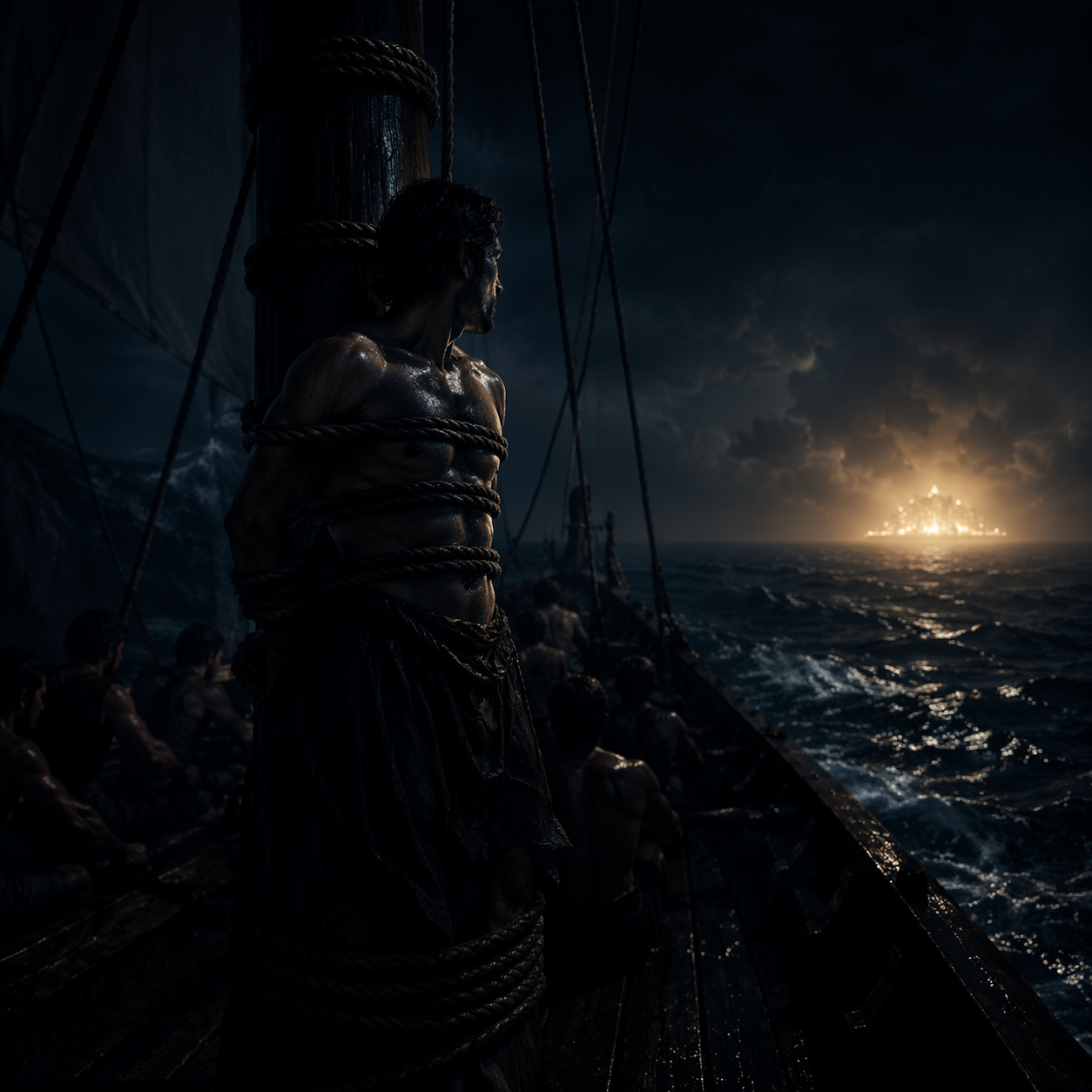
I. The Ship Nearing the Song
There are dangers that announce themselves with claws. There are others that come not as violence but as invitation. The first kind arouses vigilance. The second asks for recognition. The first strikes the body. The second asks for consent. It is the second kind that more often destroys a man.
The sea is already full of memory when the ship nears the place. Odysseus does not arrive at the Sirens innocent. He comes warned. Before the water narrows into that fatal region, before the strange meadow appears, before the voices begin their impossible work, another woman has already spoken. The knowledge has been given in advance. This matters. In the older wisdom of the world, survival often begins not in the moment of danger but in the dignity of prior warning.
Circe had told him what lies ahead.
Not only the Sirens, but the logic of them. Not only that they sing, but that whoever hears them and follows is lost. Not only that the song is beautiful, but that it is fatal precisely because beauty is not incidental to the danger. It is the medium of the danger. Bones lie there, she says. Men did not perish because they were stupid. They perished because the thing that called them was shaped to their hunger.
By then Odysseus already knows something of women who delay, soften, capture, and disclose. He has known a different island first: Aeaea, where Circe lives among wolves made tame, where smoke rises from her house, where his men, weary from the sea, entered at the invitation of a voice. They found food, sweetness, welcome. They found the oldest trap under its most civilized form: hospitality emptied of innocence. She mixed the meal with her drugs, struck them with her wand, and the men became swine. Not dead. Lowered. Not annihilated. Reduced. Appetite without rank. Bodily life without speech fit for men. One escaped. Odysseus was warned. Hermes met him on the road with the herb that would keep enchantment from entering too deeply. He went to Circe’s house not untempted but prepared. He withstood the spell, forced the oath, entered her bed only after surviving her danger, and remained there a year. A year. Even rescue, once accomplished, becomes delay. Even victory asks whether a man still remembers home.
It is this woman, dangerous first and wise afterward, who tells him about the next thing.
So now the ship approaches. The sea does not look like a sermon. There is no thunderbolt. No righteous fire. Just a place in the water toward which other men have steered and not returned. Odysseus does not tell his crew everything, or rather he tells them what is needed. He takes wax and softens it. He stops their ears so that they will hear nothing. He himself asks to hear. This too matters. He does not choose innocence. He does not choose not to know. He chooses instead the more difficult relation: to hear and not obey.
Then he gives the command that makes the whole story endure.
Tie me to the mast.
Not loosely, not ceremonially. Bind me. If I beg, do not release me. If I command you, bind me more tightly. If I rage, treat my speech in that hour not as law but as evidence of danger. In that sentence lies an entire philosophy of the divided self, though the philosophy comes later. For now it is enough to see the image: a king instructing his men that his future words, uttered under enchantment, are not to be trusted over the prior command.
The ship goes on.
Then the song begins.
In Homer the Sirens do not howl. They do not bark out threat like crude monsters. They call him by name. They flatter. They promise. They present themselves not as a pleasure against truth but as the deeper truth itself. Come here, Odysseus. No one has passed without listening. No one has failed to leave wiser. The temptation is perfect because it does not sound like self-destruction. It sounds like fulfillment. It sounds like knowledge. It sounds like the final answer to a hunger that had not yet found its language.
And he wants it.
This must be said plainly. He does not hear them and laugh. He does not hear them and discover himself immune. He strains against the ropes. He commands his men to untie him. He is not serene. He is not above the thing. His body leans toward the song. His speech turns against his own earlier wisdom. If they heard him, they might obey. But they do not hear him. Wax has sealed their ears. They row on. Some accounts say they bind him tighter. They honor the truth of the earlier man against the pleading of the later one.
That is how he passes.
Not by ceasing to want. Not by proving the song false in the moment. Not by becoming morally pure. He survives because he arranged in advance that wanting would not be sovereign. The ropes do not remove desire. They prevent desire from steering.
Soon the sound weakens. The ship clears the range. The men remove the wax. The knots are loosened. The danger is not refuted; it is behind them. They do not win by argument. They win by endurance and form.
Something in this ancient scene remains unbearably exact. The ship on dark water. The warning received from another island. The body bound to a mast. The future self anticipated and mistrusted. The voice that does not order but invites. The men rowing on while the leader begs to be released. It is one of the most enduring images in the literature of the West because it understands something humiliating and therefore permanent: there are states in which the self that desires is not the self that should decide.
The sea has always known this before philosophy did.
II. The Women of Delay, the Creatures of Appetite
Greek myth is more exact than modern simplification often allows. It does not merely give us “temptation” as a single undifferentiated force. It offers instead a taxonomy. Not every seduction has the same structure. Not every delay works the same corruption. Not every danger destroys by the same means. The Odyssey is in part a catalog of derailments, a sequence of forms by which a man is drawn away from home.
Circe is not the Sirens. Calypso is not Circe. The Lotus-Eaters are not the Sirens either. To read them as interchangeable symbols of “bad desire” is to miss the precision of the poem. Homeric imagination is not lazy. It knows that oblivion, enchantment, luxury, and fatal allure are different species of danger.
Circe belongs to the order of transformation. She is divine or semi-divine, daughter of Helios in the old genealogies, a woman of remote island power, herbs, drugs, voice, and shape-shifting force. She is what the world becomes when beauty, softness, and appetite form an alliance against human vigilance. Her house is not a battlefield. It is more dangerous than that. It is civilized. There is food, song, woven cloth, a woman at the loom. The men do not charge in as conquerors; they enter as guests. That is why the metamorphosis into swine is so severe. They are not killed. They are lowered. The symbol is not childish insult but anthropological judgment: unguarded appetite reduces the human being below his own proper form. The swine has body, hunger, immediacy, sensation. What it lacks is remembered dignity. To become an animal in myth is not simply to change species. It is to lose rank within the order of being.
The Sirens belong to another order. They do not transform. They call. Their danger is not degradation through indulgent enchantment, but destruction through fatal allure. Ancient accounts differ about their exact parentage, as myths often do. They are associated with river gods, with Muses, with chthonic or liminal powers, with the border between song and death. What matters is not genealogical certainty but symbolic function. They are voices at the edge of passage. They promise what the soul most wants to hear: that this time the thing before you is not merely pleasant, but ultimate. Their danger lies in the convergence of beauty and certainty. Circe softens a man into appetite. The Sirens persuade him toward self-destruction under the sign of comple…