Prologue — The Question Under Every Age
Every civilization has a hidden altar, and every altar has a price. Sometimes the price is animals and grain. Sometimes it is obedience and fear. Sometimes it is labor time, then money, then reputation. In our age, the price is attention—measured, auctioned, and harvested by machines that do not need to be believed in to be obeyed. This is an essay about that migration: how worship moved from the sacred to the market, and from the market into automated systems that can train desire faster than conscience can respond. Not because human beings became uniquely wicked, but because infrastructures learned how to make return feel inevitable.
Chapter 1 — The First Voice
No one can prove what the first prayer sounded like. We don’t have a recording. We don’t have a text. We have bones, ash, pigment on stone, and the long shadow of a capacity that eventually built temples and courts and creeds: the capacity to hold attention on something that isn’t physically present, and to address it as if it were. So this chapter begins as reconstruction—not certainty, but a plausible scene built from what we know about human lives before writing, before cities, before formal religion.
The wind had been steady all afternoon, sliding through grass without breaking it. By dusk the cold sharpened, and the band tightened its circle around the fire—two families, maybe three. Hunger was always a shared problem, and so was injury: the older man’s knee had been swelling for days, and everyone noticed how he rose more slowly, how he sat with the leg extended in a posture that tried to hide pain. On the edge of the light the boy—no longer a child, not yet a man—kept his back against a rock, spear across his knees, hair smelling of smoke, hands smelling of animal fat and cold iron stone.
Earlier that day he had done what he was supposed to do. He had thrown well. The animal fell hard and fast, a clean collapse, and the older hunters nodded the way they did when competence mattered more than praise. The women began the work that always followed, stripping usefulness from the body before the light went and the scavengers came. There was no celebration—only relief, then labor, then the quiet settling of bodies into fatigue. But as the animal fell, the boy felt something that didn’t fit into relief: at first a jolt behind the eyes, then a tightening in the chest that didn’t fade when adrenaline should have faded.
At the fire he watched the faces as they ate. The youngest child smeared grease across his cheek and laughed. Someone told an old story about a storm from a previous season, and the group made the appropriate sounds—recognition, agreement, a small laugh at the part meant to be funny. The boy’s eyes followed the smoke upward: it rose straight for a while, then scattered, then vanished into dark. Above, the sky was clean and crowded with stars, and the pale band of them ran overhead like a seam. He had seen this sky all his life. What was new was the sensation that it was not merely there, the way a stone is there. It felt like an audience—not because he believed someone lived inside it, but because his attention kept returning to it as if drawn.
He looked down at his hands. A thin line of dried blood remained near his thumb, missed in the quick washing. He rubbed it and felt grit. The animal’s eye had been open after it fell—not wide, not dramatic, just open, catching light—and he hadn’t liked that. The open eye made the body seem less like meat and more like… something that had been looking. He swallowed, and then it happened: a sentence formed that was not spoken aloud. Not sound. Not gesture. Meaning appearing whole inside the space where fear and hunger and memory already lived: You did that.
He sat still, as if moving might break something. The fire cracked. Someone coughed. The child laughed again. Life continued. But the sentence did not dissolve into noise. You did that. And then, with a weight he couldn’t locate in his body: And it mattered. He tried to push it away by returning to what was practical—travel soon, weather turning, the older man’s knee might not hold, sleep, keep watch. Yet the sentence returned sharper, worse, because it pointed forward: You can do this. Not “you did.” “You can.”
He had seen death often enough; survival wasn’t new. What was new was that the death had come through his arm—through his choice, through his aim—and that this act now sat in his mind as something that belonged to a larger frame he could not name. He didn’t have the word “meaning.” He didn’t have the word “sacred.” He had only the experience of attention refusing to leave a thing alone. And because he didn’t know what to do with that pressure, his attention turned into the simplest release it could find: address. He directed thought outward as if outwardness could receive it—not to the group, not to any person he could see, but to the unknown that had opened inside him: I didn’t want it to suffer. Then, after a pause: Thank you. Then, with something like fear: Don’t be angry.
Nothing answered in the way a human answers. No sign appeared. The sky remained the sky. But something changed anyway: the act of address rearranged him. It created relation where there had been only sensation. It pulled his mind out of the immediate loop of hunger and relief and set it into a posture of accountability to the unseen. That posture is older than doctrine and older than institutions. It is worship—not worship as singing in a building, but worship as the human act of giving attention to what is not merely useful.
Later that night, after the group slept, he took a small piece of bone from the day’s kill and walked a little away from the fire. He chose a place where the ground was hard and flat and scratched the bone against stone until it left pale lines: a crude mark, then another, then another. Nothing anyone would call writing—no message for another human—just a private act that took time. He looked at the marks and felt steadiness, as if he had placed something down. He looked up at the stars and felt the inner voice return, quieter now: You are not only an animal that eats.
He didn’t have the words “human,” “spirit,” or “soul,” but he had recognition: there was a dimension of life that could not be reduced to appetite. He could step back from impulse and watch himself. He could notice. He could reflect. He could speak inwardly and address outwardly. That ability—attention—was his distinction. And with that distinction came vulnerability, because whatever governs attention governs the person: if the unseen is terrifying, attention becomes superstition; if the unseen is holy, attention becomes restraint; if the unseen is approval, attention becomes performance; if the unseen is money, attention becomes transaction.
Before sleep took him, he directed one last sentence into the dark—not to anyone he could see, but to whatever might exist beyond seeing: Teach me what to do with this. Worship begins like this: not as a system, but as a moment when attention refuses to remain inside appetite. But moments do not survive on their own. If worship is to last beyond one night and one life, it must become repeatable—something the group can carry together, teach, reenact, and remember. That is where ritual begins, and that is where the next chapter begins: in a world where the sacred is no longer only felt in private, but organized in public—calendar, priest, sacrifice, and the first architectures of memory.
Chapter 2 — The House of God
He arrived before dawn because the roads were safer that way. From the ridge above the city, the Temple mount was already visible—a pale mass against the dark, too large to feel like a building and too deliberate to feel like a hill. As light rose, edges sharpened into lines: colonnades, gates, stairways, and the slow, converging movement of people climbing. Even from a distance you could feel what the structure did to the mind. It didn’t merely house worship; it gathered it, concentrated it, made it legible at scale.
He had been saving for months. Not in coins alone—though coins mattered—but in restraint: the decision not to buy something, not to fix something, not to take the easier route. The animal he brought was not the best he owned, but good enough that he felt the cost in his stomach each time it pulled against the rope. He told himself he was doing this because it was commanded, because that was the simplest explanation and the one that kept you from sounding strange. But the truth was less tidy. Sometimes, late at night in his village, a fear rose in him that didn’t have a clear object: not wolves, not Rome, not hunger—those had names. This was the fear that his life was being lived on the surface, that something could be wrong inside him without his noticing, that his days could pass without ever aligning.
They entered the city through a gate crowded with vendors. Men shouted prices. Women argued. Children ran between legs. You could smell bread and animals and sweat and stone warming as the sun climbed. A Roman patrol stood near a corner in leather and iron, half watching, half bored. They weren’t there for the Temple; they were there for the crowd. Their presence was a reminder that holiness and occupation could occupy the same air without resolving each other. The pilgrim tightened his grip on the rope and kept moving.
Near the entrances, basins were cut into stone: mikva’ot, ritual baths. People descended in ones and twos, immersed, stepped out dripping, breathing sharply in the cold. In his village, immersion was quiet and familiar; here it was a river of bodies moving through a boundary. He stepped down, and the water stole his breath. For a moment the world muted—no bargaining, no patrol, no crowd, only pressure and heartbeat. When he rose, blinking, he felt not virtue but punctuation: a hard stop inside the mind. This is what ritual does when it works. It separates one state from another. It trains attention to recognize thresholds.
Then came the money-changers. The Temple tax could not be paid in just any coin; foreign images were suspect, and Roman coins bore faces that claimed divinity by inscription. So people exchanged. The sound was metallic and constant: coins counted, weighed, slid across wood; rates spoken and disputed; a poor man’s anger flaring when he realized what he would lose; a rich man paying without looking. The pilgrim felt his stomach tighten, because this was the first place where the sacred announced its dependency on a machinery it could not fully purify. He knew, in theory, that worship required systems—priests, schedules, supplies. He still felt something humiliating about approaching God through a transaction. His cousin leaned in and said, “Don’t argue. You won’t win,” and the pilgrim handed over his coins, trying to keep cynicism from hollowing the act.
The animal was inspected before sacrifice. A priest and assistants checked for blemishes with the practiced coldness of men who had done this a thousand times: lift the lip, run fingers along flank, look into eyes. Approved. The pilgrim exhaled as if he had been spared, and they moved into a court where smell thickened: blood, smoke, burning fat. It hit the back of his throat. He had imagined sacrifice as one animal, one prayer, one clean offering. Instead it was rhythm—industrial in its steadiness. Animals entered in succession; the knife moved without hesitation; bowls caught blood; blood was carried and applied by rule; assistants moved like a team. Everything had an order. Everything had a procedure. If you stood at the edge and looked long enough, you could see two realities at once: the private meaning each worshipper brought, and the institutional system that processed it.
When the moment came, a priest told him where to place his hands. He rested his palm on warm hide, alive and unaware of the meaning imposed on it. He had rehearsed words on the road—he wanted to say, I’m afraid; I’ve been careless; don’t let my life become nothing. But the crowd pressed and the ritual demanded timing. So he spoke inwardly with the compressed urgency of someone trying to tell the truth through a narrow window: Forgive what I have done. Keep my household. Make me clean. The knife moved. The animal sagged faster than he expected. There was a brief convulsion—life refusing verdict—and then stillness. The sound of the crowd did not pause. He expected release, tears, an answer. What he felt was the bluntness of fact: a life had ended, and God—if God was receiving anything—was receiving it through a system that did not stop to look at him. And yet beneath the bluntness he felt something quieter: alignment, like a knot tightened. Not intimacy. Order.
Afterward he wandered into a different court where the Temple felt less like slaughter and more like law. Teachers gathered clusters of listeners. Arguments rose and fell: purity, calendar, boundaries, identity under empire. The pilgrim felt the weight of it: the Temple was not only worship; it was a nation’s nervous system. Ritual trained attention; law stabilized memory; boundaries resisted assimilation; public forms carried a people across generations. And still, as he listened, discomfort surfaced. Some spoke as if obedience could compel the world to make sense, as if doing the right things in the right way guaranteed favor. The pilgrim knew from his own life that this wasn’t always true. He had seen drought hit righteous men. He had seen children die in households that kept the law. He wanted to ask, What about when obedience doesn’t work? He didn’t ask. He kept walking.
As the sun climbed, the Temple’s beauty struck him in full: bright stone, gold catching light, disciplined construction insisting on God’s reality. He felt pride—real pride—to belong to a people who built this. He also felt a faint unease he could not name, because the Temple made a quiet demand: let the schedule be enough; let the form be enough; let the system carry you. For many, it was enough. But he had come because of a fear that lived deeper than compliance: a fear about the interior voice, about the possibility of performing outwardly while remaining disordered inwardly.
Outside the precincts the same economy continued—animals, doves, oil, salt, bargaining. Worship and commerce were not separable. He watched a man sell doves to poor women who could not afford larger offerings. The seller’s hands moved fast. His face was bored. The pilgrim felt anger rise, then checked it. Nothing stays pure at scale, not because people always choose corruption, but because systems require throughput. Throughput turns acts into units. Units invite pricing. Pricing invites extraction. The Temple did not invent this; it merely lived inside it, the way every large sacred institution eventually does.
He sat at a low wall and drank water, and his cousin sighed with satisfaction as if the day’s duty had been accomplished. “It’s done,” the cousin said. “God will see.” The pilgrim nodded, then felt a different sentence form inside him—quiet, almost shameful: God must be more than this. Not that the Temple was false. The Temple felt real. It felt necessary. But the very success of the Temple—its ability to organize worship at scale—created something it could not fully control: expectation. The more the sacred was administered, the more people hungered for the sacred to be immediate again, not merely processed. That hunger was everywhere in the city: apocalyptic talk, disgust toward elites, whispered rumors about prophets, longing for a Messiah, the sense that the world was due for reversal.
As he walked back through narrow streets, he kept hearing the same word in people’s mouths—half hope, half threat: “Soon.” Soon Rome would fall. Soon God would act. Soon the righteous would be vindicated. Soon the Temple would be purified. Soon the world would make sense. He had come for alignment and received order. He was leaving with something sharper: the awareness of unresolved tension. Ritual could stabilize attention. It could bind a people. But it could not guarantee intimacy, could not eliminate hypocrisy, could not prevent the sacred from becoming an institution that served itself while insisting it served God.
A rumor passed him, barely formed the way most rumors begin: a man from Galilee who spoke as if he had authority, not like the teachers, and who gathered crowds without the Temple’s permission. The pilgrim kept walking. He didn’t turn toward the rumor. Not yet. But the same interior attention that pushed him to climb the mountain registered it and held it like a seed, because when ritual becomes heavy, someone always appears who speaks directly to the interior voice. And when that happens, the managers of worship feel threatened—not because worship is wrong, but because it has been domesticated. That is where the next chapter begins: outside the Temple, where a man without an empire starts talking as if God is near, and as if attention itself must be redeemed.
Chapter 3 — A Man Without an Empire
He first heard the name in a marketplace, the way names travel before people do: not as proclamation, not as doctrine, more like weather. A woman buying fish said it with irritation—“He’s there again.” A man selling olives shrugged—“He speaks well.” Someone else laughed—“He tells the poor they’re blessed. Of course they like him.” Judea had no shortage of men who could quote scripture. It was full of men who claimed to know what God wanted. But this Galilean kept returning in conversations that were otherwise practical, and the pilgrim—back in his village now—did what people always did when rumor pressed against the boredom of daily life: he listened without admitting he cared.
A few weeks later a neighbor returned from the lakeside and reported it with more specificity. “He doesn’t talk like the scribes,” the neighbor said, as if that settled it. “What does that mean?” someone asked. “It means he isn’t careful,” the neighbor replied. “It means he talks like he’s certain.” Certainty without institutional backing got men killed. Certainty without money got men ignored. Certainty without an army got men mocked. And yet the stories kept spreading: he ate with people who didn’t deserve it; he touched the unclean; he spoke about the Kingdom of God as if it was close enough to reach; he insulted religious men in public and didn’t apologize afterward; he healed people—though no one could agree what that meant exactly. The pilgrim felt a familiar tension rise: skepticism on the surface, curiosity underneath, because he had grown tired of teachers who made the law feel like weight and Rome feel like fate. He wanted someone who could speak to the interior fear he carried—the fear that ritual could be performed while the soul stayed untouched.
One afternoon he left his work early and walked a long way toward where a crowd had gathered. He approached from behind, staying near the edge, seeing only backs and shoulders shifting as people tried to get closer. He could hear the voice, though: clear, unhurried, not strained by the need to impress. The teacher wasn’t dressed like a priest. No adornment. No assistants forcing order. Just a man on slightly higher ground so people could see him. The pilgrim listened and felt something that surprised him: not awe, not terror, but recognition. The man was speaking to the place where attention lives—where people put their minds, what they were trained to notice, what they were too distracted to see.
He spoke about hypocrisy not as an insult but as a condition: people saying the right words while their inner lives remained disordered. He spoke about prayer performed to be observed, giving designed to be noticed, righteousness used as costume. The pilgrim’s throat tightened because this named what he had never been able to phrase: worship can become performance, and performance can become a substitute for truth. People asked questions about purity laws and Rome with the careful tone of men who knew that the wrong sentence could become a charge. The Galilean answered, but not by turning God into a weapon against Rome or ritual into a scorecard. He spoke as if the real battleground was inside a person, not only outside a nation.
Then something happened that revealed the deeper conflict. A local authority—a man whose posture carried entitlement—stood with arms crossed, testing him. The Galilean did not refuse the test. He answered, then turned the question back with a pressure that made it clear he was not there to negotiate permission. The crowd reacted the way crowds do when they sense confrontation: attention sharpened, a collective inhalation. The pilgrim understood the danger with sudden clarity. This man was not merely teaching; he was reassigning authority. He was implying that God could be encountered without Temple management, that purity could be internal rather than architectural, that the interior voice mattered more than public performance. That wasn’t a theological quibble. It threatened a system: priesthood, sacrificial economy, boundary enforcement, and the fragile arrangement with Rome that kept the city from being crushed.
He left before the crowd dispersed, not wanting to be seen among the others. He walked home with the words looping in his mind and with a colder thought: this will not end quietly. When the Galilean went to Jerusalem for the festival, that much was predictable; everyone went, if they could. But he did not go like a pilgrim seeking alignment through the Temple’s order. He went like someone walking toward a confrontation he had already accepted. The city was crowded, tense with holiday energy—sellers, animals, families, teachers, Roman patrols watching with calm suspicion. The pilgrim was there again too, as he often was when he could afford it. He was not a disciple; he had a household and obligations. But he was in Jerusalem, and he was listening.
He heard the Galilean entered with a crowd around him. He heard some called him “Son of David,” a title spoken with enough ambiguity to be deniable and enough hope to be contagious. The pilgrim stayed near the edges, watching. Then he heard shouting from the Temple precincts—different from bargaining and commerce. This was disruption. He pushed forward until he could see: tables overturned, coins scattered across stone, men grabbing at money as it rolled, doves flapping wildly in cages, guards moving in with calculation. The Galilean’s voice rose above it, hard and public. Whatever the exact words, the meaning was clear: he was attacking the fusion of worship and commerce. Not proposing reform. Declaring corruption. It was one of the few acts that could unite almost every class against him: priests saw threat to authority; sellers saw threat to livelihood; Rome saw threat to order; cautious villagers saw recklessness; the poor saw a moment of justice. The Temple absorbed the shock the way large systems often do: tables were righted, money collected, sellers resumed, ritual throughput restored. But the act could not be forgiven, because it struck at the system’s legitimacy in the open, during the season when crowds made the city most combustible.
In the following days, stories became contradictory and urgent. He was teaching in public again. Authorities were looking for a way to arrest him without provoking riot. One of his followers had turned. Then rumor became fact: he was arrested at night. Night arrests in Jerusalem meant someone wanted control without crowds, speed without argument. The pilgrim woke to the city buzzing in a way that made it hard to breathe, and by midmorning he heard the sentence that ended movements: crucifixion. Rome’s solution to messianic energy was always the same: public execution designed to humiliate, to warn, to turn hope into fear. The pilgrim did not go to the place of execution. He told himself it was prudence—family, livelihood, risk. But the truth was also simpler: he could not bear to watch the system crush a man whose crime was speaking directly to the interior voice.
Jerusalem moved on, as it always did. Crowds dissolve. Rome stays. The Temple continues. Sellers sell. Priests sacrifice. It should have ended there. Most such movements did. A teacher dies, followers scatter, and everyone pretends it never mattered. But that isn’t what happened. A few weeks later, in a house on the edge of the city, a small group gathered quietly after dusk. No banner, no public call, no attempt at crowd. Their bodies carried shock—eyes too alert, voices too low. The pilgrim was not supposed to be there, but a cousin insisted. “You need to hear it,” he said. “At least once.” The pilgrim followed him through narrow streets into an ordinary doorway and into lamplight.
There were perhaps twenty, maybe thirty. Women and men with laborers’ hands. No priests. No Temple officials. No visible signs of authority except attention: everyone focused on a few people at the center who spoke from memory. They told scenes—not summaries—because memory was their infrastructure. Then the claim came and the room tightened: they said the Galilean was alive. Not “his teachings live,” which would have been safe, but alive as in seen, touched, spoken with. The pilgrim felt suspicion rise—not only rational, but protective. If false, it was dangerous. If true, it was more dangerous. A man who had followed him—fisherman by the look of him—spoke like someone broken and rebuilt: fear after execution, hiding, shame, then seeing him again and feeling not triumph but a mixture of joy and accusation and forgiveness.
Then the meal began. Bread and wine, ordinary and poor, treated with seriousness not because it was elaborate but because it was repeatable. No priest blessed it. No Temple officiant declared it valid. And yet it felt like ritual, because it performed a transfer: worship without a temple, sacrifice without animals, access without toll booths. “Do this in remembrance of me,” they said, and the pilgrim understood what was forming. Not an institution, not yet. A portable practice. A relocation of the sacred from managed architecture to shared interiority—table, memory, imitation. This bypass threatened the old economy of access, because if God could be encountered in a house among ordinary people, the Temple was no longer the exclusive gate.
Before they left, the fisherman said something the pilgrim did not expect: they were not to seek revenge. Not against Rome, not against priestly elites, not against the betrayer, not even against mockers. It sounded absurd in a world trained to understand power as seizure. But the faces in the room did not look like men and women making a moral suggestion to appear good. They looked like people trying to live inside a new sovereignty: not the sovereignty of force, but of attention and conscience. If true, it was not a rebellion that captured power; it was a rebellion that withdrew from false power. Even if you kill us, you have not touched the source. That kind of claim does not threaten empires by winning arguments. It threatens them by relocating allegiance.
When the meeting ended, people left in pairs, watching streets, avoiding patrols. The pilgrim walked back through Jerusalem with the taste of wine faint in his mouth and with a thought he could not easily discharge: Christianity began, at least here, not as an empire and not as a brand, but as a disciplined refusal—worship made portable, interior, non-spectacular, resistant to both Temple management and Roman intimidation. It would take centuries to harden into doctrine and power. But at the start it was simple: a room, a meal, a memory, and the claim that the true God could not be bought, administered, or conquered. The question that followed was not only theological but practical: how does a worship that can happen anywhere survive inside an empire built on spectacle, law, and force? That is where the next chapter begins.
Chapter 4 — The Printing Shop and the Split
The shop smelled like ink, damp paper, and hot metal. It was early morning in a German town—still dark enough that lantern light mattered, but busy enough that carts already rattled on stone outside. Inside, apprentices moved with blunt efficiency: arrange type, lock the frame, ink the form, press the sheet, lift it carefully, hang it to dry. In the corner, a man counted—not coins, but pages—tapping stacks the way a merchant taps inventory, with urgency and calculation, because he knew what paper could do when it left the room.
On the worktable lay pamphlets: thin, cheap, designed to travel fast. Their title pages weren’t devotional; they were confrontational—arguments flattened into something you could hold in one hand and spread in an afternoon. The printer turned to the visitor standing near the press: a young scholar with a nervous steadiness, the kind of intensity that suggested he didn’t sleep much. “So,” the printer said, lowering his voice, “you understand what you’re asking.” The scholar didn’t flinch. “I understand what I’m saying.” The printer shook his head. “That isn’t the same. You’re not writing a sermon. You’re putting fire into the hands of the public.” Then he asked the real question—the logistical one that was also a moral one: “A hundred copies or a thousand?” The scholar hesitated only long enough to feel the scale of the new world. “A thousand,” he said, and the printer exhaled—half laughter, half dread—and began issuing instructions. In that moment, the argument stopped being private dispute and became portable event.
Luther had not come, in his own mind, to destroy Christianity. He had come to rescue it from what it had become: confession schedules that never ended, indulgence economies that turned fear into revenue, the sense that salvation had become a managed transaction. His struggle was not political first; it was interior: the fear you can’t outrun because it follows you into prayer, the suspicion that even your good acts are contaminated, the feeling that performance cannot clean what is crooked inside. He tried to obey his way out of it. It didn’t work. And then—through scripture, study, and a kind of inward confrontation—he arrived at a thought that was both liberating and explosive: if grace is real, it cannot be purchased; if God is real, God cannot be administered as a market.
But by the early 1500s the Western Church was not only a spiritual authority; it was an administrative order woven through Europe’s finances and politics. It built cathedrals, negotiated with princes, collected revenue, funded wars, mediated legitimacy. Like the Temple, it relied on a principle that was partly theological and partly infrastructural: access must be mediated. Sacraments must be administered by authorized hands. Interpretation must be stabilized by trained authorities. Forgiveness must come through recognized channels. Without mediation, the system feared chaos; with mediation, the system could survive. So when Luther insisted that a person could stand before God with conscience and scripture without passing through the Church’s economic toll booths, he wasn’t merely offering an argument. He was moving the center of gravity: from priesthood to conscience; from sacramental management to inward trust; from institutional certainty to personal responsibility. Even if Luther wanted reform, the shift he triggered could not be contained inside reform.
The press made that containment impossible. As the shop ran full batches, paper multiplied with a speed no pulpit could match. Runners carried bundles not only to churches but to inns, markets, university doors, and merchant routes—places where men gathered and talked, where rumor turned into conviction. By evening, the town was murmuring, not with prayers but with reading. Men who had never read theology began reading theology, or at least reading enough to feel included in the argument. Some laughed at sharp phrases. Some frowned and said, “Careful. If the bishop hears—” But the bishop could not unhear what was now in the air, because the air itself had changed: debate was no longer confined to clerical rooms. The public could now see the fight—and join it.
At first, this looked like liberation. Scripture in vernacular. A layperson able to judge a priest’s behavior by a text more authoritative than the priest’s personality. The sense—new and intoxicating—that an ordinary person could stand alone before God without institutional cover. Some found it exhilarating; some found it terrifying. Because when authority moves inward, burden moves inward too. If scripture is accessible, interpretation becomes responsibility. If conscience matters, doubt becomes unavoidable. If millions can read, millions can disagree. The unity of worship—built over centuries of managed mediation—fractured into camps, and camps hardened into power. Princes learned theology had political utility. Cities learned “reform” could mean independence from Rome’s taxes. Wars began with arguments about grace and ended with bodies in fields. Luther may have wanted purification; Europe learned something it could not unlearn: there would no longer be one unquestioned center.
Late one night, after the apprentices had gone, the printer sat alone with one pamphlet in his hands. He had read it too many times to find it shocking. What stayed with him now wasn’t the insult or the wit; it was the structural implication. The press was only a machine, but it had done something irreversible: it had scaled interiority. The private conscience worship once cultivated slowly—through prayer, confession, fasting—was now being activated across populations through argument, text, and public dispute. And once the interior voice is activated in millions, it doesn’t remain inside religion. It migrates into politics as conscience, into society as critique, into the habit of questioning every authority. The printer didn’t yet know where it would end, and he didn’t need to. He could already sense the next hinge forming in the distance: if conscience can stand against the Church, perhaps reason can stand against God. And if reason becomes sovereign, what restrains power when power no longer claims sacred justification? That is where the next chapter begins.
Chapter 5 — The Salon of Reason
The room was warm in a way winter rooms rarely were. A coal fire burned behind a polished screen. Candles stood in clusters, their light doubled in mirrors and caught in glassware. The table had been cleared of dinner plates and reset with paper, quills, and a few books whose bindings were too fine to be owned by anyone poor. Conversation had already been moving for an hour—fast, confident, amused by its own sharpness—the kind of evening that made people feel history tilting without needing a drumbeat to announce it.
This was Paris in the middle of the eighteenth century, the kind of private room that functioned as a public engine. A young man in a fitted coat spoke about priests the way you might speak about weather—an older force that had once been necessary but had outlived its usefulness. A woman—host, patron, organizer—redirected the energy before it turned into mere sneering. “Not priests,” she said, smiling. “Authority.” In that word, the mood shifted from wit to architecture. Here authority wasn’t sacred; it was a design problem. A philosopher at the far end put down his glass and said, “If we’re serious, we have to be serious about what replaces it.” The host answered without drama, as if correcting a bookkeeping error: “The human mind.”
It was not an absurd sentence. They had evidence. Within their grandparents’ lifetimes, a new kind of truth had emerged—truth that did not require church sanction. Telescopes revealed moons around other planets. Mathematics predicted motion. Inoculation reduced death. Experiments produced repeatable results. Nature behaved according to discoverable laws, and those laws did not ask permission from Rome or Jerusalem. If the world could be understood without revelation, perhaps society could too. That was the wager: reason as a new sovereignty, not only for science but for morality and politics. And unlike the old sacred order, this sovereignty promised transparency. Not mysteries guarded by priesthood, but arguments any educated person could inspect.
They spoke about tolerance not as sentiment but as necessity; Europe had bled for generations over doctrine, and the blood had not produced clarity, only exhaustion. They spoke about rights as if rights were self-evident—an idea so radical it had to be spoken casually to sound possible. They spoke about education as liberation: ignorance produced superstition; superstition produced cruelty; therefore knowledge could produce freedom. Some in the room were not naïve about power—they had seen what kings did, what mobs did—but they believed, stubbornly, that the human mind, once freed from dogma, could organize itself toward the good. The dream was not chaos; it was self-rule.
Then the conversation drifted, as it often did, to commerce. Someone mentioned a Scottish work being read across the Channel about markets, wealth, and the moral psychology of ordinary people. A merchant-adjacent man leaned forward. “Smith,” he said. “He understands something the theologians never did.” Someone asked, already ready to dislike the answer, “And what is that?” The man replied, “A society doesn’t need saints to function. It needs incentives.” A philosopher objected, not angrily but precisely: “Incentives are tools, not morality.” The merchant smiled. “Tools shape the world.” That small exchange contained a fault line they could feel but did not yet fully name.
The Enlightenment was trying to do two things at once: create a universal moral order grounded in dignity and reason, and unleash material prosperity through science, industry, and trade. In that room the two projects felt like allies. Prosperity could reduce desperation. Less desperation could make people more rational. More rational citizens could build more humane institutions. It was elegant, and it worked—partially—for a time. But the elegance depended on a fragile assumption: that moral cognition could scale at the same speed as economic complexity. It assumed that as systems grew, the human mind would keep pace—seeing consequences clearly enough to govern them.
Move the scene away from Parisian charm to a colder room in a disciplined city: Königsberg. The streets outside were neat and gray. Clocks mattered. Routine mattered. A professor—Kant—walked the same route each day with such regularity that neighbors joked you could set your watch by him. In his lectures he described freedom not as appetite but as moral architecture: freedom was the ability to bind yourself to a law you recognize as right. It was reason at its most austere, almost monastic: not pleasure-worship, not crowd-worship, but conscience trained into duty. He believed a rational person could perceive the moral law and obey it not out of fear, but out of respect for universality. If you want the Enlightenment at its most serious rather than its caricature, it is here.
And yet even this seriousness carried an assumption that would later fracture under pressure: that the self could reliably govern itself once educated, that reason would hold appetite in check, that citizens could be formed faster than temptations could be industrialized. In Paris, back in the salon, the host stepped out briefly when a servant whispered about accounts. She returned with a thinner smile. “Nothing serious,” she said. “A delayed shipment.” Someone asked what kind. “Sugar,” she said, and the room moved on, because logistics were not what they came to talk about.
But logistics were becoming the world’s hidden theology. Sugar implied ships, credit, insurance, ports, colonial governance, and distant labor that most beneficiaries would never witness directly. The point is not to score a moral “gotcha” against the Enlightenment; many thinkers condemned slavery and exploitation explicitly. The point is structural: as economic systems expand across distance and layers of mediation, causality becomes opaque. When suffering is far away and routed through contracts, ledgers, and institutions, it becomes easier for ordinary virtue to coexist with extraordinary harm—not because people are uniquely cruel, but because perception cannot grasp the full chain. Recognition is not governance. Conscience is not omniscience. A society can believe in dignity while living inside mechanisms that constantly outrun moral attention.
Late that night, after guests left, the host sat alone with a ledger. She understood, practically, what her guests preferred not to dwell on: the salon itself—this space where reason could argue freely—required funding. Candles, wine, books, protection from political consequences: all of it depended on patronage. Patronage depended on markets. Markets depended on empire. This wasn’t cynicism; it was infrastructure. And infrastructure does not wait for moral consensus. It rewards what scales and punishes what hesitates.
In that quiet, she sensed a new authority rising that did not need to be crowned and did not demand worship in churches. It demanded participation. The market did not say, “Believe.” It said, “Buy.” It said, “Compete.” It said, “Grow.” It said, “If you cannot keep up, disappear.” It did not care if you were noble or common; it cared if you were useful. Unlike kings, it had no face you could overthrow. Unlike priests, it had no creed you could disprove. And because it required no belief, it could govern people who considered themselves liberated. The Enlightenment had torn down sacred authority and tried to replace it with reason; it had not fully anticipated that reason could become an instrument within a larger incentive machine, and that this machine could organize behavior without needing the soul’s assent. That is where the next chapter begins: the counting house, where dignity meets wages, and where time itself becomes a commodity that trains attention more relentlessly than any sermon.
Chapter 6 — The Counting House
The first bell rang before the sun was fully up. In the narrow street outside the mill, the air carried the raw smell of wet stone and coal smoke. Men and women moved toward the entrance in small clusters, collars turned up, faces half-hidden, bodies already bracing for noise. Some carried tin pails. Some carried nothing but fatigue. A few children walked too—old enough to work, young enough that another century would call it obscene.
At the door a foreman stood with a ledger. He didn’t greet anyone; his job wasn’t fellowship but time. One by one he marked names, converting people into entries and lateness into deduction. No argument, because deduction meant hunger and hunger meant compliance. Inside, the sound was immediate—mechanical force constant enough to erase private thought. The looms didn’t only produce cloth. They produced a new kind of human day: segmented, measured, priced. In the older village life, time had been shaped by seasons and sun—hard, yes, but textured, with slack and intensity alternating as weather and body allowed. Here, slack was theft. Your hours were sold, and once sold, they belonged to someone else.
A man named Thomas—twenty-two, already older than his age—stood at his station feeding thread into a machine. His hands moved with practiced speed because speed was not ambition; it was rent. His father had died the previous winter. His mother had gone quiet. The world did not pause for grief. Thomas wasn’t thinking about the Enlightenment, and he wasn’t thinking about Christ. He was living inside their consequence: a society where sacred time had been replaced by industrial time, and where recognition was increasingly attached to measurable participation. If you asked him what mattered most, he would have said, without irony, work—not as worship, but as the gate to survival, and survival as the gate to everything else.
A few streets away, in a building with clean windows and quieter air, another bell did not ring. A clerk sat at a desk in a counting house, writing by lamplight. His ink was neat. His hands were clean. His job was not to move cloth but to move numbers—shipments of cotton, barrels of sugar, crates of manufactured goods that left the port and returned as profit. The ledger contained more power than any single man in the mill, because the ledger decided whether wages fell, whether the mill expanded, whether a bad season ruined a family. The clerk did not need to hate the workers to govern them. He needed only to be competent inside the system that priced their time.
At midday the merchant arrived and scanned the columns quickly. “How are we positioned?” he asked. The clerk pointed to the margin. “Better than last quarter. Demand is rising. We can expand the run.” The merchant nodded, satisfied, then asked—casually, as if asking about weather—“Wages?” The clerk hesitated just long enough to show he understood the risk. “We can press them lower,” he said. “There’s labor surplus.” “Do it,” the merchant replied, and that was the entire moral process. Within the logic of the system, it wasn’t cruelty; it was optimization. The system did not ask whether Thomas could feed his household. The system asked whether the business could grow. And “grow” had begun to function like an unquestioned commandment, not preached from a pulpit but embedded into survival itself.
Across town, in a small office that did not yet call itself “advertising,” a young man learned a different kind of leverage. His name was Edward, and he wasn’t born poor. His father had money in shipping; Edward had read a little philosophy and could say “progress” without laughing. He also had a talent for noticing what other people wanted. The company he worked for made soap—industrial soap, the kind that could be distributed widely. Production was not the problem anymore. The mills had solved production. The problem was choice. A crowded market turns goods into noise, and noise makes attention scarce. Edward sat with a blank page and asked a question that would shape the next century: what makes someone buy? Not what should, not what is rational—what actually moves them.
He tested words: pure, clean, modern, scientific. One word stayed: respectable. Because respectable wasn’t about soap; it was about the gaze of neighbors, about being seen as the right kind of person. Edward drafted an advertisement showing a spotless family in a spotless home and implying, without stating it, that cleanliness was not hygiene but virtue, not health but status. When the ad ran, sales rose. Edward felt a quiet thrill—not because he was evil, but because he had discovered the new priesthood: not priests of sacrifice, but managers of perception. Attention could now be redirected toward purchasable symbols through suggestion and repetition. It required no coercion. It required training.
A decade later, the ledgers grew stranger. The merchant’s son no longer wanted to own ships. Ships were heavy and risky. He wanted to own paper—contracts, debt, insurance, futures—money that could multiply without touching a bale of cotton. The numbers began to detach from visible reality. A rumor about a bank could ruin a city. A machine could make hundreds of workers “inefficient” overnight. The causal chain became too long for any single conscience to hold. Responsibility thinned out, not because people became worse, but because the system made consequences distant and opaque. This is one of the great moral transformations of modern life: optimization can be sincere and still become cruel, because optimization is indifferent to what it does not measure.
Thomas left the mill at night with his ears ringing and walked past a church with open doors. A few people sat inside, scattered and quiet. A priest spoke about salvation and the dignity of the soul. Thomas slowed for a moment, wanting a place that wasn’t owned by machines. Then he kept walking. He had work again before dawn. On the way home he passed a poster promising a better life through a product, happiness presented as something you could purchase, distinction offered as an image you could rent by buying the right thing. Thomas stared longer than he meant to. He didn’t believe soap made you loved. But something in him wanted to be included in the life the poster displayed. That wanting was attention—and attention, once recruited into status, does not easily return to older objects.
This is the shift that matters for what comes next. In the Temple, worship trained attention toward God through ritual and sacrifice. In early Christianity, worship trained attention toward Christ through imitation and refusal of spectacle. In the Enlightenment, attention was redirected toward reason, conscience, and progress. In industrial capitalism, attention began to be trained toward status and consumption, because status and consumption could be measured, scaled, and sold. Money did not merely become important; it became the condition of recognition, the default authority that organized days without needing anyone to call it holy. To resist that authority required interior discipline—but the new system steadily removed the habitats where such discipline could grow. And when attention becomes scarce and priced, the next invention is predictable: a machine that can capture it continuously, measure it in real time, and refine itself automatically. That is where the next chapter begins.
Chapter 7 — The Age of Broadcast
Before the feed, there was the audience. Before the algorithm learned to personalize, institutions learned to standardize. Newspapers thickened into empires of print. Then came radio—a voice that could enter a living room without knocking. Then television—moving images that could train the nervous system nightly, synchronized across millions. None of this required people to abandon reason in theory. It only required them to sit still and look. Attention became a mass resource, gathered not in temples or salons but in homes, at predictable hours, around glowing furniture that rearranged family time into a schedule of reception.
The decisive innovation was not the screen itself. It was measurement. Once advertisers could estimate how many eyes were present, attention became something you could price. The logic was simple and brutal: content gathered attention; attention could be rented; rent could be used to fund more content; the loop tightened. The modern bargain was born: entertainment and news appeared “free” because the real product was the viewer’s time and susceptibility. No one had to believe this was worship. They only had to return, because return is what makes a ritual profitable.
This was also the century when persuasion became explicit craft. There had always been propaganda, always been rhetoric, always been priests and poets shaping collective imagination. But modern public relations professionalized it. The question shifted from “What is true?” to “What will land?” and from “What is right?” to “What can be repeated until it feels inevitable?” Edward’s soap poster was a primitive version. In the broadcast era, the scale and sophistication expanded: slogans, jingles, image management, crisis containment, narrative framing. A corporation could have a “reputation.” A politician could be “marketed.” A war could be sold as a story with heroes and threats. None of this required totalitarian control. It required only that the public sphere become a competition for mindshare.
A man in a suit—call him Arthur—sat at a desk in a Manhattan office and wrote lines designed to lodge in memory. He was not a poet, but he understood the mechanics poets always knew: repetition creates familiarity; familiarity creates trust; trust creates permission. Arthur didn’t need the public to think deeply. He needed them to feel, and to feel the same way at the same time. He tested phrases, trimmed them, made them punchy enough to survive the noise. Then he watched them spread through radio and print, and he felt the peculiar satisfaction of a man who can move crowds without touching them.
In the same decade, another kind of priesthood formed around politics. Campaigns learned that voters did not merely evaluate policies; they inhabited identities. A candidate was not only a program but a symbol, and symbols live in attention. Political speech began to borrow from advertising: simplified messages, emotional triggers, constant repetition. This wasn’t because democracy is fake; it was because democracy is vulnerable to attention economics. When millions must be persuaded, persuasion becomes industrial. Industrial persuasion favors what is legible and repeatable. Legibility is rarely nuanced. Repeatability prefers slogans over arguments, images over explanations, enemies over complexity. This is not a moral condemnation; it is a structural constraint.
Broadcast did one more thing that matters. It created shared reality at scale. Entire populations could watch the same event, hear the same voice, repeat the same phrases. This had virtues: common reference points, national memory, coordinated action. It also had a cost: a narrowing of attention into channels controlled by a small number of gatekeepers. In the Temple, gatekeeping was priestly. In the Church, it was clerical. In broadcast, it was corporate and political. The public sphere became a managed space—sometimes responsibly, sometimes cynically—but always with the same underlying fact: attention could be engineered because attention could be aggregated.
Then the cracks appeared. Gatekeepers lost legitimacy. Competing narratives emerged. Trust thinned. The audience fragmented. This fragmentation did not end the attention economy; it intensified it. Because when attention splinters, competition increases. And when competition increases, persuasion becomes sharper, faster, more emotionally calibrated. Broadcast had trained the world to receive. It had also trained institutions to chase. But broadcast still had limits: the message was largely one-to-many. You could measure audiences, but you could not measure each individual’s micro-reactions in real time. You could not personalize the sermon for every person’s private appetite. You could not iterate instantly based on what one nervous system did at 11:07 p.m.
That limitation was the opportunity waiting for a new machine. The next system would keep the pricing of attention, keep the engineering of persuasion, keep the habit of return—but it would remove the last restraints of broadcast: fixed schedules, shared channels, human editors, and slow feedback. It would replace them with continuous delivery, individualized selection, and automated refinement. Not because someone planned a grand moral inversion, but because incentives reward whatever captures return most efficiently. That is where the next chapter begins: the feed, where attention becomes measurable in seconds and worship becomes a loop.
Chapter 8 — The Feed
On the wall of a conference room, a line chart climbed. It wasn’t dramatic—just the steady upward slope that makes everyone sit a little straighter. The labels sounded scientific and harmless: Daily Active Users, Session Length, Retention. A product manager clicked through slides in a voice trained to remove moral heat. “We’re seeing a drop-off after the third scroll,” she said, pointing at a dip. “If we reduce friction there, we’ll win the week-two cohort.” An engineer nodded. “We can test a new ranking model—more personalized, faster feedback.” Someone else added, “Surface more content that performs. The model learns what people want.” A designer asked, cautiously, “Are we concerned about the quality of what the model surfaces?” The room paused, not because they didn’t care, but because quality is hard to define when the system is funded by engagement. The product manager answered with honest constraint: “We care about engagement. That’s our mandate.” No one argued. Engagement was not a preference; it was the business. Investors demanded growth. Growth demanded retention. Retention demanded attention.
They discussed notification timing like a sacred schedule: which hour, which phrasing, which frequency. They debated whether a red badge produced anxiety or compulsion, whether streaks increased daily return, whether infinite scroll reduced exit points. They spoke about people the way the counting-house clerk spoke about the mill: not as souls or neighbors, but as behavioral patterns inside a system. No one said worship. But every decision aimed at one thing: what will people return to? The modern liturgy was being written in A/B tests—small rituals designed to train attention, enforce return, and make participation feel inevitable. This was not conspiracy. It was incentives doing what incentives do when they are paired with real-time measurement.
Across the city, a man named Jason lifted his phone as if by reflex. He wasn’t miserable in the dramatic sense. He had a job, he paid rent, he had friends he saw sometimes. But his days felt thin. He carried a low-grade loneliness he couldn’t justify, and a fatigue that sleep didn’t fix. He opened the app without thinking. At first it gave him what it always gave him: familiar faces, jokes, small outrage, small pleasure. His thumb moved with the practiced ease of a habit that barely registers as action. He told himself he was relaxing.
A video appeared: a woman dancing. It wasn’t porn; it wasn’t explicit. But it was calibrated—the angle, lighting, expression, clothing—built to catch the eye for long enough to teach the system. Jason watched longer than he meant to. Then he scrolled. Now a clip of a fight in a school hallway. Then a political argument chopped into ten seconds. Then a podcast sneer. Then a confession. Then an advertisement that looked like content. Then another dancing body. The transitions were fast, almost violent. His nervous system couldn’t settle into anything. It kept spiking—arousal, disgust, amusement, anger, curiosity—without resolution. That was the point. The feed didn’t want completion. It wanted continuation.
After enough loops, a piece of content appeared that produced a clean, specific pleasure: someone being humiliated. Someone he disliked—or someone he was being trained to dislike—being exposed, mocked, punished. Jason felt pleasure, then shame at the pleasure, then scrolled to escape the shame. The feed did not let him escape; it moved him to another humiliation, another outrage, another certainty. He began to feel righteous. Righteousness is one of the most addictive emotions a human being can feel. It provides meaning without sacrifice, identity without transformation, a clean enemy and a clean self. The feed learned this quickly. It did not hate him or love him; it did not know him. It optimized. In the older religions, worship took time and demanded restraint. Here the ritual demanded speed and rewarded compulsion. The altar was not God or even money directly. The altar was return.
A week later, a stranger was publicly destroyed online. It began with a clip out of context. Then commentary. Then outrage. Then calls to punish. Then employers were contacted. Then apologies were demanded. Then apologies were mocked. Then the person vanished—fired, resigned, disappeared. Some called it accountability. Some called it cancellation. The system treated it as engagement. What mattered was not the truth of the initial claim so much as the predictable pattern: accusation, amplification, ritual condemnation, sacrifice, purification, return to scrolling. This is not new because humans newly enjoy cruelty; humans always did. The novelty is that a machine can now distribute that cruelty with perfect timing and monetize the attention it generates.
In another part of town, a man posted a photo of himself holding a Bible. He wasn’t a theologian. He wanted stability and identity, and online he had found a community that offered flags. The photo functioned as allegiance, a signal: I am with you. After posting, he spent an hour arguing with strangers and felt energized because argument made him feel alive and morally relevant. Later that night he consumed pornography—not because he had a coherent worldview, but because his nervous system had been trained to seek stimulation. He did not experience the contradiction as a crisis; the system teaches people to split: public certainty, private compulsion. The costumes differ across tribes; the mechanisms are similar. The feed trains attention toward arousal, dominance, humiliation, belonging, and performance. Those are lucrative because they are reliable. They keep people returning.
The people building these systems were not necessarily monsters. The product manager did not know Jason. The engineer did not see the stranger being destroyed. They saw dashboards and targets and investor expectations. In a sense, they were captive too. The system did not require belief. It required compliance. This is one of the most important characteristics of modern false gods: they organize behavior without demanding explicit loyalty. The market did this through wages and prices. The feed does it through compulsive design and real-time measurement. Money worship becomes attention worship because attention can be converted directly into profit.
Late one night, Jason sat at his kitchen table with his phone turned face down. For a rare moment, he felt a desire not for stimulation but for silence. He remembered his grandmother at dusk, holding beads, doing nothing visibly productive, sometimes whispering, sometimes not. As a child he had thought it was boredom. As an adult he recognized it as power: she had practiced attention. Not attention to spectacle or tribe, but attention to the unseen—God, or something like God. Jason didn’t know if he believed. That wasn’t the point. He recognized that some forms of attention make a human being more human: more capable of patience, more capable of love, more capable of resisting the impulse to turn the world into stimulus and enemy.
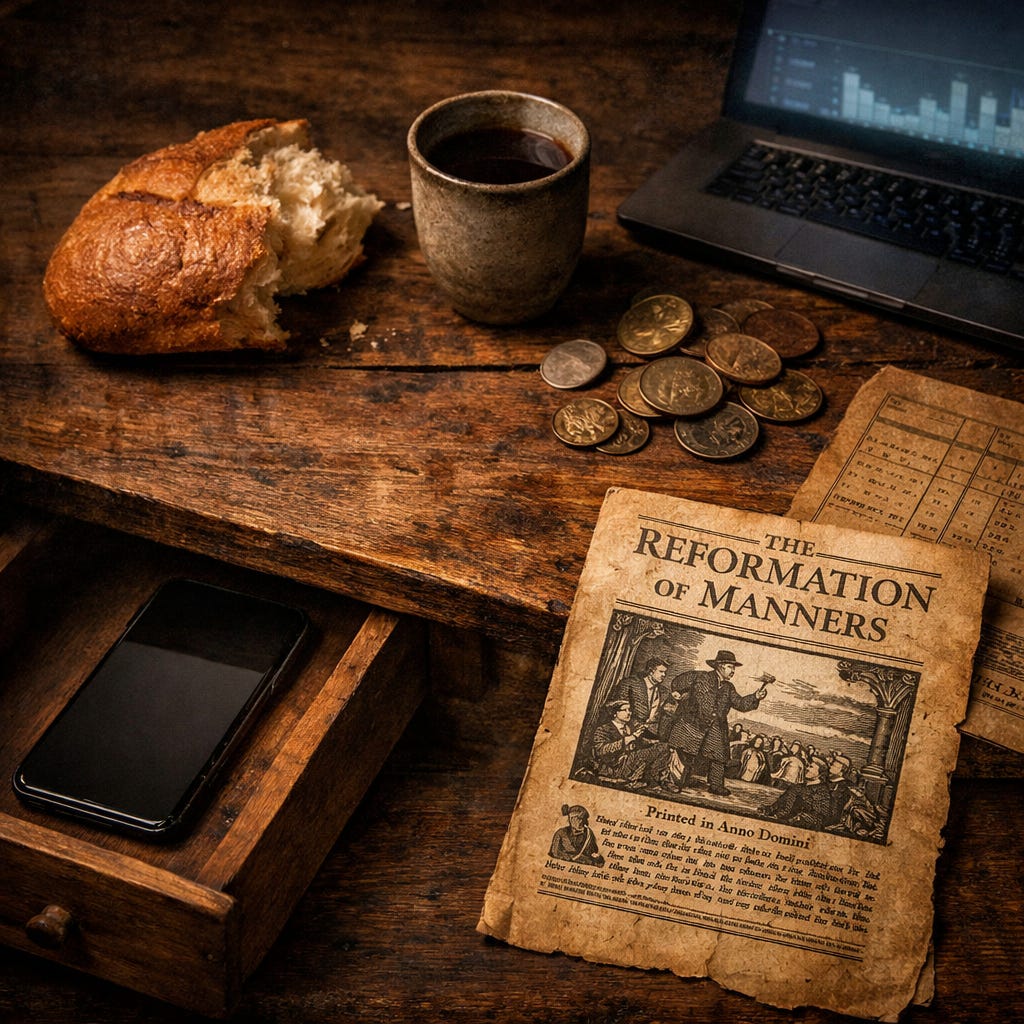
He felt the pull of the feed like a physical force. Then he did something small and decisive. He put the phone in a drawer. It wasn’t heroic. It wasn’t viral. No one applauded. But in that act was the only kind of resistance that reliably threatens the feed religion: withdrawal. The Temple weakened when worship migrated beyond it. Kings weakened when people stopped believing in divine right. Church monopolies weakened when conscience became portable. The feed will not be defeated by better arguments alone, because it does not live primarily at the level of argument. It lives at the level of habit. If it is defeated at all, it will be defeated by communities that rebuild disciplined attention and refuse to monetize their souls.
Which returns us to the question beneath this entire story: can Christ still be that God? Not as a tribal flag. Not as branding. Not as nostalgia. But as a living refusal of false worship—especially the worship of money and attention—Christ remains, in this lineage, the figure least absorbable by the machine without betrayal. Not because Christ offers a new enemy to hate, but because Christ offers a new way to see. And that is exactly what the feed is designed to prevent. If renewal is possible, it will begin where it began the first time: not in empires or markets or viral movements, but in small rooms, quiet meals, disciplined bodies, and attention given to the unseen without the hope of applause. That is where worship started. And that is where it can start again.
Epilogue — Refusal
The room didn’t look like anything important. It was a multipurpose room behind a modest church in a mid-sized American city—folding chairs, a long table with coffee, a heater that clicked on and off like it was arguing with itself. A hand-lettered sign near the door read NO PHONES DURING THE HOUR, and someone had added, in smaller letters, (IF YOU CAN), as if they didn’t want it to sound like a law. Twelve people were there that night, not as symbolism but as attendance: a woman in her sixties in a heavy coat with both hands around a paper cup; a young couple sitting close without touching; a man with a work badge still clipped to his belt who looked unsure what to do with his face when he wasn’t performing competence; a teenager with arms crossed and eyes cautious, as if she expected manipulation.
No priest facilitated. The man who ran it—Andrew—was a public school teacher who had started the group after his own collapse. He didn’t begin with a sermon or a diagnosis of the internet or capitalism. He didn’t sell a solution. He began the way the early Christians began before they had power or infrastructure: with a reading and a meal. He held up a printed page, not a phone. “We’ll keep it simple,” he said. “Ten minutes of silence. Then this. Then we eat.” A few people shifted uncomfortably. Silence was harder than doctrine. Silence made room for the interior voice—the thing most of them had learned to drown.
Andrew set a timer face down on the table and sat. At first, the room filled with the ordinary noises that rush in when the feed is gone: chairs settling, heating clicking, someone coughing, the small humiliation of being present in your own body. Then, slowly, the sounds thinned. When the timer vibrated, Andrew didn’t rush. He let language return the way people return after being underwater. He read, without commentary, “You cannot serve God and Mammon.” Then, “Blessed are the poor in spirit.” Then, quietly, “Forgive them.” He let the sentences sit in the air like surviving artifacts—older than empires, older than markets, older than phones.
After the reading, he passed a basket with plain bread and a bottle of cheap wine. Some drank wine; some drank water. No one performed sacramental precision. They weren’t trying to recreate the Temple. They were practicing something more basic: attention given to what cannot be bought. They ate in silence for a few minutes, and then Andrew asked the only question he wanted to make central. “What did your attention serve this week?” Not what did you believe. Not what side are you on. What did your attention serve? The man with the work badge laughed once, sharp and tired. “My boss,” he said. “The company. Deadlines. And then… the scroll.” Andrew nodded. “And what did it do to you?” The man stared at the table. “It made me smaller,” he said. “I don’t know how else to put it.”
The older woman spoke next. “I’ve been alone since my husband died,” she said. “The phone helps until it doesn’t. I get angry at people I’ve never met. Then I feel ashamed. Then I watch something to numb the shame. It’s like a loop that eats my day.” The young couple hesitated. The woman said, “We started filming everything. Not for followers. Just… we got used to narrating our life like an audience was watching.” Her partner exhaled. “We were losing privacy even from ourselves.” The teenager finally spoke, surprising the room. “I hate it,” she said. “I hate that everything is a performance. But I also hate being invisible. If I’m not online, I don’t exist.” No one corrected her. Andrew didn’t offer reassurance. He understood that reassurance is cheap in a world where existence is measured by response. He said, “That’s honest. And it’s the trap.”
The hour ended without a crescendo. That was deliberate. Andrew had built it like a counter-machine: nothing spectacular, nothing that could become content, nothing designed to spike emotion for the sake of release. But before people left, he offered two practices for the week, not as moral badges but as mechanics. “First,” he said, “one hour a day with your phone physically out of reach. In a drawer. In a box. In another room. Not just ‘I won’t check it.’ Out of reach.” A few people nodded with the grimness of those who know withdrawal is real. “Second,” he continued, “one act that costs you something and no one sees it. A call you avoid. A meal you bring to someone who won’t repay you. An apology that doesn’t come with a speech. One hidden act.” Someone asked why hidden. Andrew answered simply: “Because the feed converts even goodness into performance. Hidden acts retrain your attention. They put you back under a different authority. Call it God. Call it conscience. Call it reality. But it isn’t applause.”
Three days later, Jason stood in a grocery store aisle holding a box of cereal and staring at his phone. He had meant to honor the hour. But the day had been bad. He had been unseen at work. A colleague had been praised for something Jason had built. Bitterness rose, familiar and hot, and his hand reached for the phone like muscle memory. The app opened and offered relief with perfect cynicism: outrage tailored to irritation, then a political sneer, then something sexual, then a humiliating takedown of someone he was trained to dislike. The machine was offering him a self—righteous, aroused, superior, justified. He stared at the screen and recognized the moment the entire story has been circling: attention being recruited downward into a loop that shrinks a person while pretending to make him feel alive.
He locked the phone. He did not feel holy. He felt deprived and irritated, like an addict turning away from a hit. Then he did something that embarrassed him precisely because it was so concrete. He walked out to his car, put the phone in the glove compartment, locked it, and came back inside. When he returned to the aisle, he noticed the world had remained: an older man struggling to reach an item on a high shelf, a mother trying not to yell, a cashier whose face carried the particular exhaustion of retail—polite on top, scraped raw underneath. With his attention briefly unoccupied by the feed, human-scale reality reappeared. He helped the older man without fanfare. On the drive home he felt a small sensation that was not pleasure and not righteousness, but something quieter: orientation.
The following Sunday, Jason didn’t become religious overnight. He didn’t stop desiring. He didn’t gain mastery of his mind. He walked into the back room again. There were fourteen people this time. Someone had brought soup. Someone had brought extra bread. The teenager looked slightly less guarded. The man who usually wore his work badge had removed it before sitting down, as if the room had taught him—without argument—that he did not have to be a function here. Andrew read the same line again: “You cannot serve God and Mammon.” This time, no one smirked. They were beginning to hear it not as a slogan but as diagnosis.
You serve what organizes your attention. You worship what you return to. You become what you repeatedly give yourself to. The feed asks for return. Money asks for return. Christ—at least in the early, undomesticated sense—asks for something else: not performance but transformation, not tribal victory but refusal, not attention as currency but attention as love. If there is a path back to God—or back to a civilization where Enlightenment values can breathe—it will not begin as an institution reclaiming dominance. It will begin as ordinary people withdrawing attention from false gods one day at a time, until a different kind of life becomes visible not through spectacle but through steadiness. That is how it began the first time. And if it begins again, it will look like this: small rooms, unmarketed meals, disciplined attention, and lives the algorithm cannot easily convert into profit.
—Elias WinterAuthor of Language Matters, a space for reflection on language, power, and decline.