Every empire has a story about why it deserves to rule.
Rome said it was order.Britain said it was civilization.America says it is freedom.
And yet, under the slogans, a quieter question gnaws at the foundations:
At what exact moment did we stop being just another hungry tribe and become something else?
Not “better people,” not “chosen people,” but different in kind: capable of telescopes and vaccines and nuclear reactors, of global empires and global markets, of planetary-scale machinery whose consequences even its makers cannot fully predict.
We call that difference “modernity” so we don’t have to explain it. We call it “Western values” so we don’t have to earn it. We fold it into race, or religion, or destiny, because we are too tired and too distracted to sit with the harder truth:
There was a spark, a specific, fragile, institutional miracle that happened in Europe.It could have happened elsewhere first. In some sense it did.And now, the very civilization that rode that spark to planetary dominance is busy sawing through the branch it stands on, insisting its sickness is a sign of moral revival.
Meanwhile, the civilizations that once carried the earlier light—the Islamic world that preserved and extended Greek science, that built observatories and hospitals when Europe was still largely illiterate—have their own betrayal to answer for: aborting their climb toward that same spark and retreating into dogma and tribalism, often with Western fingers quietly shaping the knife.
This is a story about those two sins:the ingratitude of the West, and the abandoned nerve of the Middle East.
But before talking about sin, we need to remember the miracle.
Part I – The Spark
1. The Night the Sky Changed
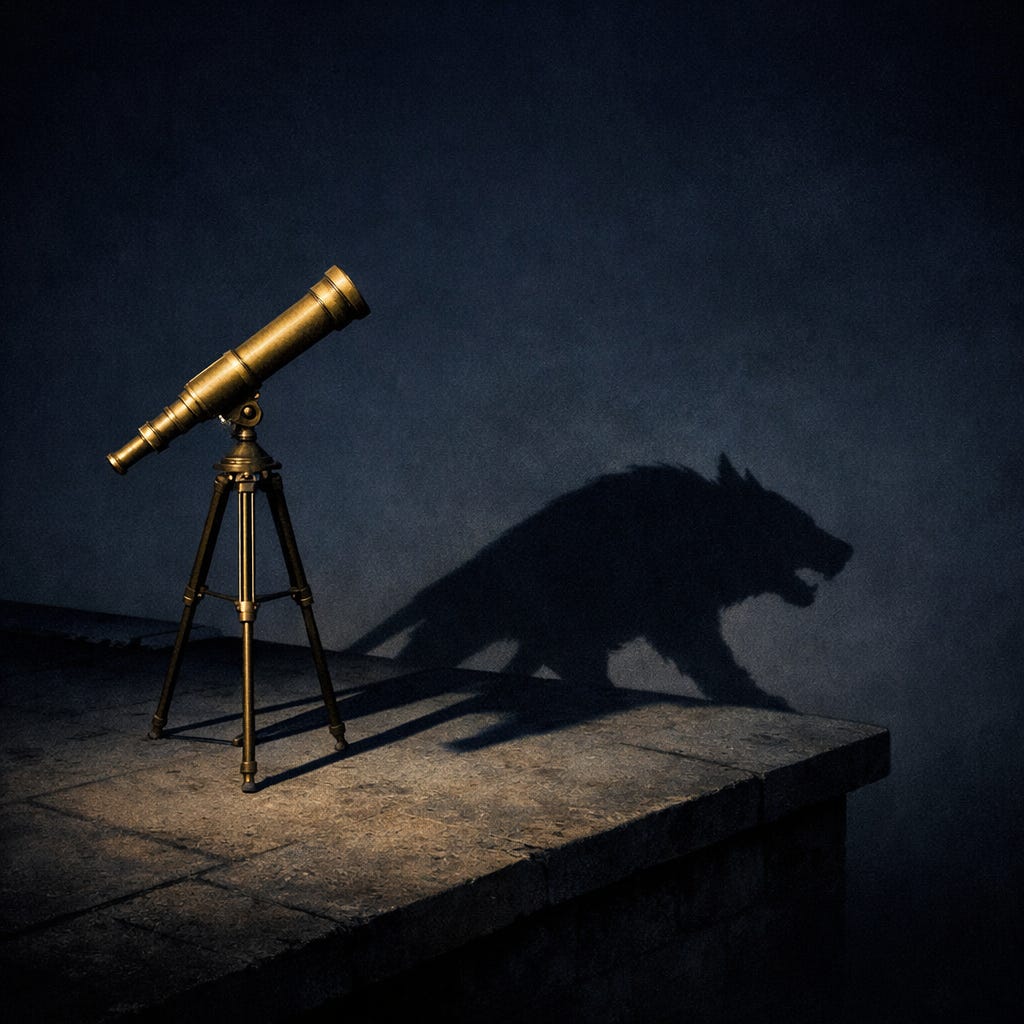
Imagine a winter rooftop in an Italian city at the turn of the seventeenth century.
The air is damp, the kind of cold that doesn’t dramatize itself with snow, just seeps into the stones and the joints and the wood. Below, the city is still mostly medieval: crooked lanes, low houses pressed together for warmth, church bells that announce the hours of a God who, officially, has already explained the structure of the universe.
On the roof, a man stands beside a crude assembly of wood and glass.The instrument is ugly: a long, imperfect tube, more plumbing than divinity. The lenses inside it are cheap and ground by hand. He has had to build and rebuild the thing because nothing like this really exists yet for what he wants to do with it. Glass was made for windows, for light, not for asking heaven to confess its lies.
He raises the tube toward the sky, toward a point of light that the educated world has been told is a perfect, godlike sphere moving in eternal circles.
Through the glass, the point becomes a disc.And around that disc, tiny stars.
He comes back the next night.The stars have moved.
Night after night, he climbs the roof and the stars swing around the disc like attendants around a throne. They are not painted to the crystal sphere. They orbit a body that itself is said to orbit us.
In that small, absurd instrument, the official universe breaks.
It breaks not because this one man is morally better, or racially better, or beloved by God. It breaks because for the first time in a long time, a civilization has been quietly constructing something far more dangerous than an empire: institutions that protect the question, even when the answer cuts the throat of authority.
Behind that man on the rooftop, barely conscious of itself, stands a new ecology:
* Universities that can hire, fire, and argue without checking every line with a bishop or a prince.
* Printing presses that can replicate banned ideas faster than censors can burn them.
* Scientific societies that prize observation over scripture, experiment over status.
* Rival states that hate each other too much to agree on which heretic to kill.
The telescope is not the miracle.The miracle is that he is allowed to keep looking.
He will still be threatened. He will still be forced to recant, formally. But the damage is done. The moons of Jupiter exist now in more than one mind. They have been printed. They have circulations and defenders and apprentices. The sky is no longer a closed text; it is a nervous system of matter that can be probed, measured, contradicted.
That night is not a lone genius birthing modernity out of nothing. It is a relay. Because centuries earlier, in another language and another faith, somewhere between the Tigris and the Guadalquivir, other men had already begun this work.
The telescope is pointed at Jupiter.But the light passing through it still remembers Baghdad.
2. Baghdad, Córdoba, and the First Light
Long before that Italian rooftop, there was another city of books.
Baghdad under the Abbasids is not a moral paradise—no human city ever is—but it is a machine for thinking. The House of Wisdom gathers Greek, Persian, and Indian texts. Scholars translate, argue, extend.
A Persian mathematician writes about algorithms and algebra.A physician compiles medical encyclopedias that Europe will use for centuries.An optical theorist insists on experiment, dark rooms, and lenses, centuries before anyone utters the name Galileo.
In Córdoba, street lamps burn when much of Europe is still dark after sunset.In Cairo, hospitals run with a regularity that would shame later kingdoms.
The Islamic world, for a long time, is the civilization with the spark. Not the modern spark—printing press, autonomous universities, scientific societies—but an earlier one: the conviction that God’s world is intelligible, that numbers mean something, that bodies can be studied and healed, that logic matters.
Europe, at this point, is the pupil, not the teacher.Its monasteries copy texts; its scholars make pilgrimages to learn from Arabic commentaries on Aristotle. The light passes through languages: Sanskrit, Greek, Arabic, Latin. No one owns it. It cares nothing for flags.
If there is a “chosen people,” it is not a nation or a race. It is the loose network of those willing to take reality more seriously than their pride. The House of Wisdom falls. The books scatter. But the habit, the idea that knowledge can be cumulative, migrates.
By the time the man is on the roof with his telescope, the river of influence has changed direction. The pupil is about to become something even more dangerous than a good student.
It is about to turn curiosity into infrastructure.
3. How Europe Built an Engine Out of Doubt
The real miracle of Europe is not a single discovery. It is the decision—never fully conscious, always contested—to build machines that outlive their founders and are loyal not to the ruler but to the question.
The medieval university begins as a church project but becomes something else.
In Paris, Bologna, Oxford, you get guilds of scholars who argue over Aristotle and law and theology, but also over medicine and astronomy. They develop procedures:
* Who gets to claim a truth.
* How claims are defended.
* Who is allowed to teach.
Over centuries, this hardens into the idea that truth is not a royal or priestly prerogative; it belongs to those who can show their work and survive hostile questioning.
Then comes the printing press, that rude little device which does for ideas what gunpowder does for walls. Suddenly:
* Scripture itself can be questioned in the vernacular.
* Pamphlets fly across borders faster than armies.
* A monk with a hammer and some theses can fracture a continent.
The Reformation and the religious wars nearly tear Europe apart. In the long, bloody hangover, states discover a bitter lesson: if every doctrinal disagreement turns into war, there will soon be nothing left to govern. So they begin to separate the machinery of the state from the total authority of the church—not because they became kinder, but because they became tired.
Out of fatigue and horror, secularization emerges: a gradual, uneven, improvised attempt to keep the peace by letting multiple beliefs exist under one legal roof.
Meanwhile, the scientific societies appear: the Royal Society in England, the Aca…