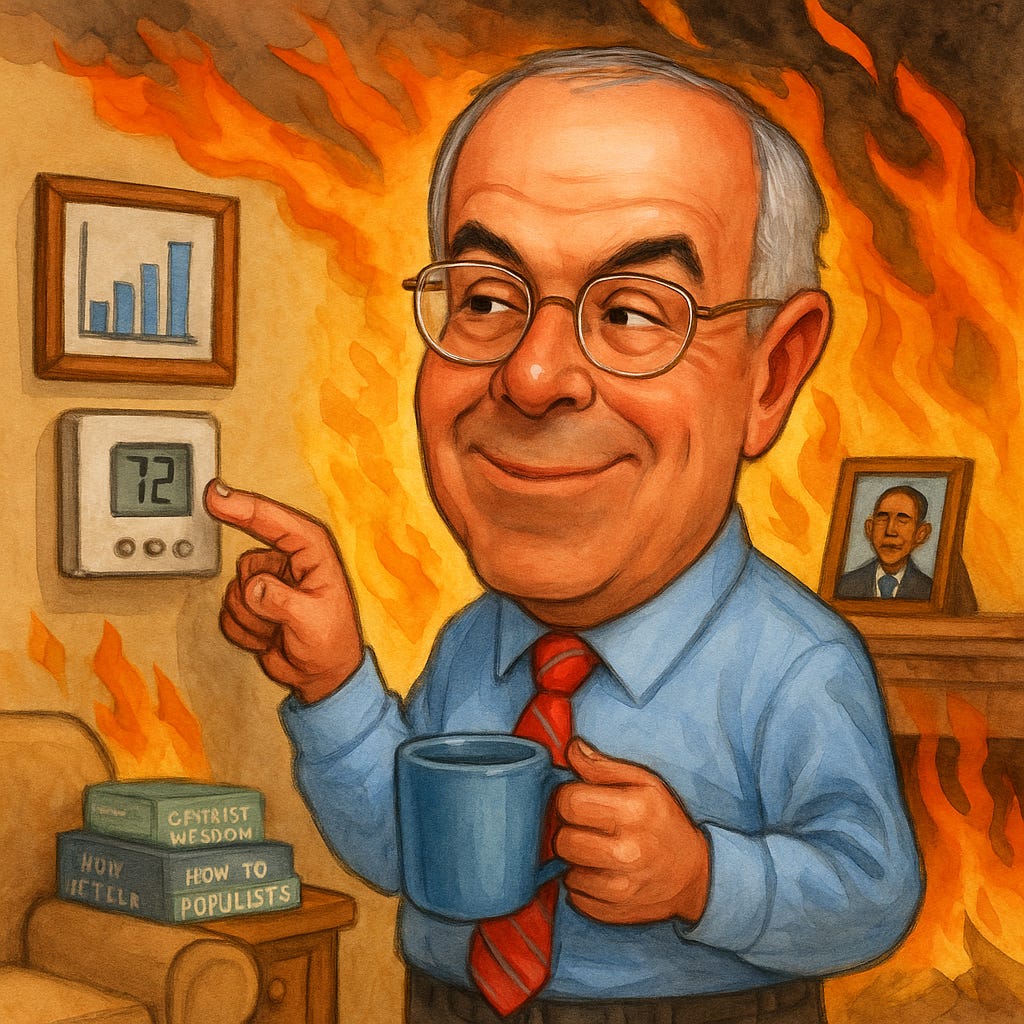
He points to the thermostat—$83,000 GDP per capita, rising median wages, surging disposable income—and urges us to stop lying. Stop exaggerating. Stop feeding the populist myth of decline. According to Brooks, America isn’t collapsing. It’s just cranky.
But the thermostat isn’t the house. And the temperature isn’t the fire.
This essay is not a rebuttal to his tone. It is a confrontation with his method. Because Brooks does not lie with numbers. He lies with which numbers he trusts, what questions he refuses to ask, and whose bodies he leaves out of the frame.
What follows is not just a correction. It is a counter-vision—a refusal to let statistical consolation silence historical grief.
I. The Tyranny of the Mean: GDP Per Capita as Mirage
Brooks opens with a number: GDP per capita is over $83,000. Higher than Europe. Higher than Japan. Higher even in Mississippi than in Germany.
And yet:
* Median household income is $74,000, far below the GDP mean.
* Real incomes for the bottom 50% have grown less than 1% annually since the late 1970s.
* Life expectancy in Mississippi is 71.9 years, lower than Cuba.
GDP per capita is a mean, not a median. It is dragged upward by the fortunes of billionaires while revealing nothing about how ordinary Americans live, die, or struggle. It is a number that hides more than it shows—a theological abstraction presented as national proof of life.
Prosperity that flows to a few while the base rots is not prosperity. It is elite insurance. It is fire-resistant siding on a house with rotting beams.
II. The False Recovery: Wages, NAFTA, and the Lost Decades
Brooks claims that median wages have grown since NAFTA, that the real pain was in the 1970s and 1980s. He suggests the Clinton-Obama years were not neoliberal betrayal but steady stewardship.
But the facts are harder, rougher, more betrayed:
* From 2000 to 2015, median wages were stagnant, even as productivity soared.
* The share of GDP going to labor declined, while corporate profits ballooned.
* The recent wage gains (2019–2023) were not products of free trade or market wisdom—they were emergency interventions: stimulus, pandemic labor shortages, and delayed inflationary corrections.
What Brooks presents as proof of moderation is really the residue of delay—growth for the already mobile, fueled by asset bubbles and demographic inertia, not shared renewal.
To invoke NAFTA as part of a wage recovery story is to bury the broken towns beneath the averages.
III. Disposable Income and the Illusion of Freedom
Disposable income in the U.S. is higher than in Europe, Brooks assures us. As if that means freedom.
But disposable income is calculated before the costs of housing, healthcare, education, and childcare—all of which are radically more expensive in the U.S. than in the European countries he names.
* Healthcare: Americans pay double per capita compared to Europeans and still experience worse outcomes.
* Education: Student debt exceeds $1.6 trillion. In Europe, university is often free.
* Housing: The median U.S. home price now exceeds $400,000, while European cities enforce rent caps, public housing, and dense transit-oriented growth.
What Brooks calls “disposable” is, for most families, already spoken for—consumed by systems designed to privatize burden and commodify need.
His metric assumes freedom. Your credit card knows better.
IV. The China Shock: Offsetting Human Devastation
Brooks dismisses the populist alarm over globalization by noting that the China shock caused “only” 90,000 job losses a year, and that these were later “offset” by export gains.
But this framing is morally obscene.
* The job losses were concentrated: in Ohio, Michigan, Pennsylvania, North Carolina. Towns were gutted. Suicides surged.
* “Offset” does not mean recovery. The same workers who lost jobs did not gain new ones. The same towns did not rebuild. The export gains flowed elsewhere—to cities, to capital, to firms that never hired them.
* The shock coincided with union decline, offshored leverage, and austerity dogma—leaving workers stripped of bargaining power and social safety.
To speak of “offsets” while men die by overdose in shuttered steel towns is not just poor economics. It is a failure of imagination. A refusal to mourn.
You do not “offset” a lost life.
V. America vs. Europe: The Religion of More
Brooks compares the U.S. to Europe and declares victory. Larger homes. Higher GDP. Higher income.
But the comparison is spiritually empty:
* Americans work more hours, take less vacation, and die younger.
* Trust in government, media, and institutions is collapsing.
* Mass shootings are weekly events. Student debt is a precondition of adulthood.
* Loneliness, anxiety, and spiritual vacancy define a generation raised on screens and unpayable promises.
Europe is not heaven. But America is not winning. It is consuming. Extracting. And performing success at the expense of the people it no longer knows how to protect.
Brooks wants us to be grateful for the square footage. The soul asks: What is it filled with?
VI. Inequality: The Brief Reversal That Didn’t Fix the Disease
Brooks notes that from 2019 to 2023, wages at the bottom grew faster than those at the top. He takes this as evidence that inequality is overstated.
But this is statistical sleight of hand:
* The brief reversal was due to pandemic shocks, minimum wage increases, and temporary labor shortages—not policy design.
* Wealth inequality remains obscene: the top 1% hold over 30% of national wealth, while the bottom 50% hold less than 3%.
* Structural drivers of inequality—like asset ownership, housing policy, and education access—remain untouched.
Brooks sees the blip and calls it a trend. He sees the sugar high and calls it health.
He does not ask why inequality returned the moment the stimulus faded.Because to ask would be to indict the model he defends.
VII. The Specter of Immigration
Brooks claims the backlash isn’t economic—it’s cultural. People fear the loss of identity, not wages. But this is only half the story.
The immigration regime was not a passive force. It was a deliberate workaround, a shadow policy designed to delay demographic collapse while avoiding political cost.
America wanted growth without sacrifice, care without taxation, workers without citizenship.
So it let millions in—and told them to stay invisible.
Now, that compromise is failing. And the panic is not about culture. It is about the end of a bargain the elite never admitted they made.
The immigrant was the patch. Now the seam has torn.
Epilogue: The Comfort of the Reasonable Lie
In the end, Brooks isn’t lying the way propagandists lie. He is lying the way institutions lie—by calming the surface while burying the collapse.
His numbers are tidy. His voice is moderate. His conclusions are soothing.
And that is the most dangerous lie of all.
Because it is not the populists who created the void. It is the consensus class. It is the era of Obama and Clinton. It is the technocratic mind that mistakes growth for good, metrics for meaning, and order for justice.
You do not need to embrace Trumpism to reject the framework that built the conditions for his rise. You only need to love the truth more than decorum.
Brooks wants us to stop lying about the past.But the real lie—the one we refuse to end—is that this system was ever sustainable, that we can continue borrowing against the future, that we can pay no moral cost for decades of strategic cowardice.
That lie is dying. And the men who told it are still checking the thermostat.
— Elias WinterAuthor of Language Matters, a space for reflection on language, power, and decline.