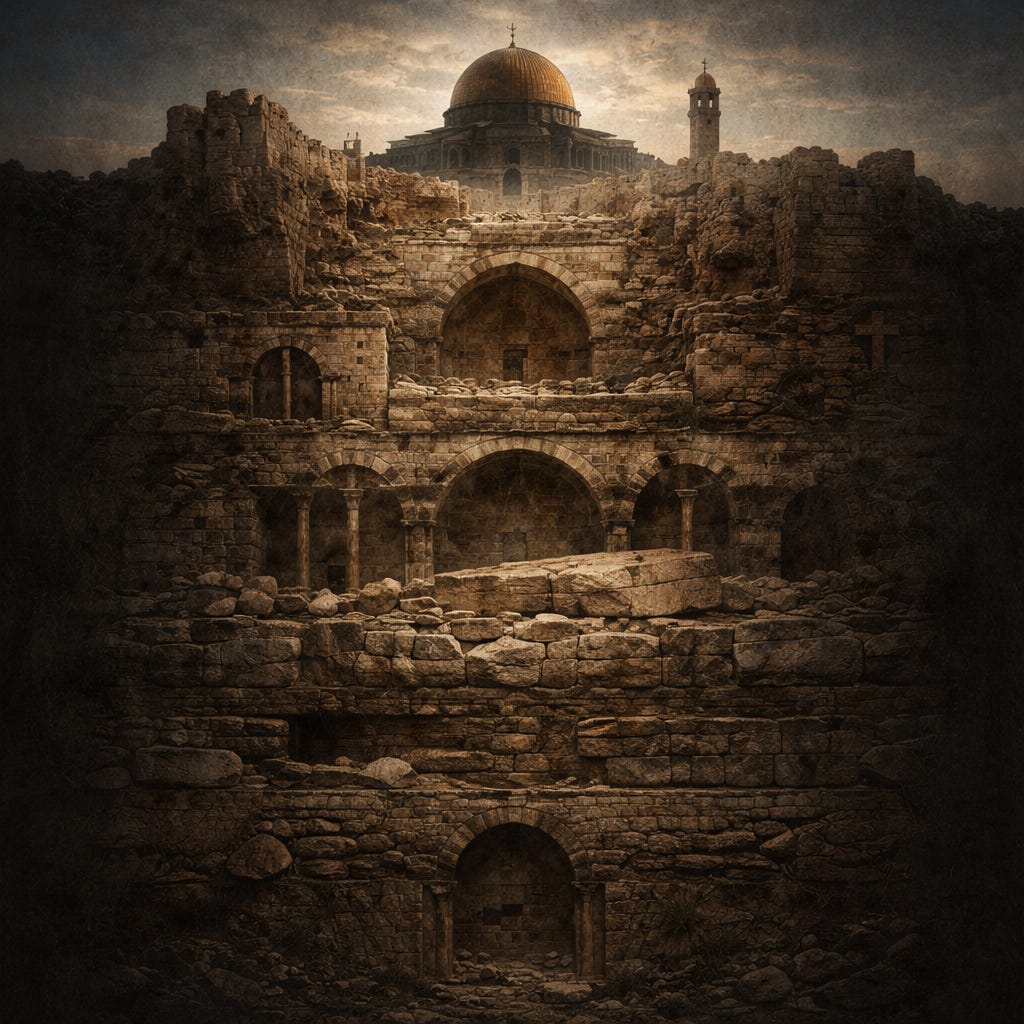
I. Before Israel, There Was Canaan
Before the city became an argument, before it became a promise, before it became a wound recited in prayer and blood, there was Canaan.
The land that would later be called holy by Jews, Christians, and Muslims was not born holy in the abstract. It was a corridor. It was a bridge between Egypt and Mesopotamia, between empires that could never leave the Levant alone because geography would not let them. Armies crossed it. Traders crossed it. Gods crossed it. Languages crossed it. The land did not belong to one people in the modern sense because the modern sense did not yet exist. It was held in fragments, in city-states, in fortified hills and agricultural plains, in local cults and regional loyalties.
The people who lived there were what historians call Canaanites: a family of related Semitic-speaking populations spread across the Levant, sharing broad cultural patterns, religious ideas, and material life. Their world was not a nation but a mosaic. Cities such as Hazor, Megiddo, and Lachish rose and fell under local rulers while larger powers pressed down from afar. In one era Egypt was the distant master, ruling Canaan through local kings, tribute, diplomacy, and occasional force. The Amarna letters preserve the sound of that order: anxious Canaanite rulers writing to Pharaoh, pleading for help, reporting rebellion, negotiating survival in a world where sovereignty was always thin.
This matters because later histories often begin with Israel as though nothing meaningful existed before it. But there was already a civilization here, already memory, already fields and walls and shrines. The Jewish story begins in a land that was not empty, not waiting, not inert. It begins inside an older human world.
II. A People Emerges from Inside the Land
When the Israelites appear in history, they do not enter like a clean blade from outside. They emerge out of the same Semitic world that preceded them.
The biblical narrative tells the story one way: Abraham leaves Mesopotamia, his descendants go down to Egypt, Moses leads them out, Joshua conquers Canaan, and a covenant people takes possession of a promised land. This narrative would shape Jewish self-understanding for millennia and remains central to religious memory. But secular history, archaeology, and the study of material continuity suggest a more complicated emergence.
Around the end of the Late Bronze Age and the beginning of the Iron Age, roughly around 1200 BCE, the eastern Mediterranean underwent collapse. Empires weakened. Trade networks fragmented. Old cities declined. In the highlands of Canaan, new settlements appeared: small agrarian villages, modest, locally rooted, not obviously the footprint of a vast incoming army. The pottery, architecture, and everyday life of these communities looked deeply continuous with the Canaanite environment from which they arose. Their language too would be a Canaanite language: Hebrew, close kin to Phoenician and related dialects of the region.
This does not prove that every ancestral memory in the Bible is false, nor does it dissolve the power of the Abrahamic story. It does something more unsettling and more historically plausible: it suggests that the Israelites were, to a large extent, a people formed from within Canaan itself. Not pure outsiders. Not the opposite of Canaanites. A branch that differentiated itself, a social and religious reconfiguration within an older Levantine landscape.
The first historical mention of “Israel” appears not in Hebrew scripture but in the Merneptah Stele, an Egyptian inscription from around 1208 BCE. Israel is already there, in the land, named as a people. Not yet a kingdom, not yet a state, but already a presence.
So the beginning is not a simple arrival. It is an emergence. A people becomes itself by distinguishing itself from the world that produced it.
III. Jerusalem Becomes a Center
At first the Israelites are not united under one stable monarchy. They exist as tribes, local coalitions, loose alliances, a confederated people held together by memory, kinship, and crisis. Their early political form is unstable because their world is unstable. But then comes centralization. Then comes kingship. Then comes Jerusalem.
Tradition places Saul first, then David, then Solomon, in a line that marks the transition from tribal federation to kingdom. However one judges the scale of the so-called united monarchy, the symbolic transformation is decisive. David captures Jerusalem and makes it a capital. Solomon builds the First Temple. A hill city becomes the political and religious axis of a people.
This is one of the great acts of civilizational concentration in the ancient Near East. Power, worship, dynastic legitimacy, and sacred geography converge in one place. Jerusalem is no longer merely a city among others. It becomes center, nerve, symbol. The Temple becomes the house of the God of Israel. The monarchy anchors itself in Davidic memory. The city becomes the meeting point of heaven, people, and rule.
Whether the kingdom was as vast as later biblical texts suggest is a matter of debate. Archaeology has not confirmed a grand empire on the scale of the most maximal biblical reading. But the historical question of scale should not obscure the deeper fact: Jerusalem became central. Once that happened, everything changed. The city entered the grammar of permanence. It would never again be only a city.
IV. The Kingdom Splits, the Empires Gather
After Solomon, the kingdom fractures. The unified monarchy gives way to two political entities: the northern kingdom of Israel, with Samaria as its capital, and the southern kingdom of Judah, centered on Jerusalem. This split weakens both.
Israel in the north is larger, richer, more exposed. Judah in the south is smaller, poorer, more defensible, more tightly bound to the Temple and the Davidic line. The split is not just political; it is structural. Two Hebrew-speaking kingdoms now face the same geopolitical reality separately. And that reality is merciless.
The Levant is a narrow strip between massive powers. A small kingdom there is never simply itself. It is always a frontier, always a buffer, always at risk of becoming a battlefield for stronger states. Egypt watches from the southwest. Mesopotamian empires rise from the northeast. The internal split of the Israelite world makes imperial absorption not inevitable, but increasingly likely.
Small states can survive between empires if they remain unimportant, invisible, or unusually skilled. But when trade routes, tribute, military access, or symbolic power are involved, invisibility becomes impossible. The two Hebrew kingdoms continue, but the empires are gathering.
V. Assyria: Terror as Statecraft
The Neo-Assyrian Empire was one of the most formidable and brutal imperial machines of the ancient world. It did not merely conquer; it made conquest into theater. Its kings boasted of flaying rebels, impaling enemies, and deporting entire populations. Assyrian cruelty was not an accidental excess but a system. Terror was policy.
In 722 BCE, Assyria destroyed the northern kingdom of Israel. Samaria fell. Elites and populations were deported. Foreign groups were resettled. The northern kingdom ceased to exist as a sovereign state. In later Jewish memory this becomes the tragedy of the “lost tribes,” but at the level of political history it was something stark and anciently familiar: a small kingdom had been consumed by empire.
This is the first great rupture of Israelite sovereignty. It is also a lesson in ancient statehood. To stand in the path of Assyria without Assyrian scale, Assyrian bureaucracy, or Assyrian military force was to stand on borrowed time. Israel did not lose because its story was false. It lost because the world of iron empires had no sentiment for covenant.
And yet even here the destruction is not only military. It is narrative. Assyria teaches the region a lesson every empire loves to teach: that it is not enough to rul…