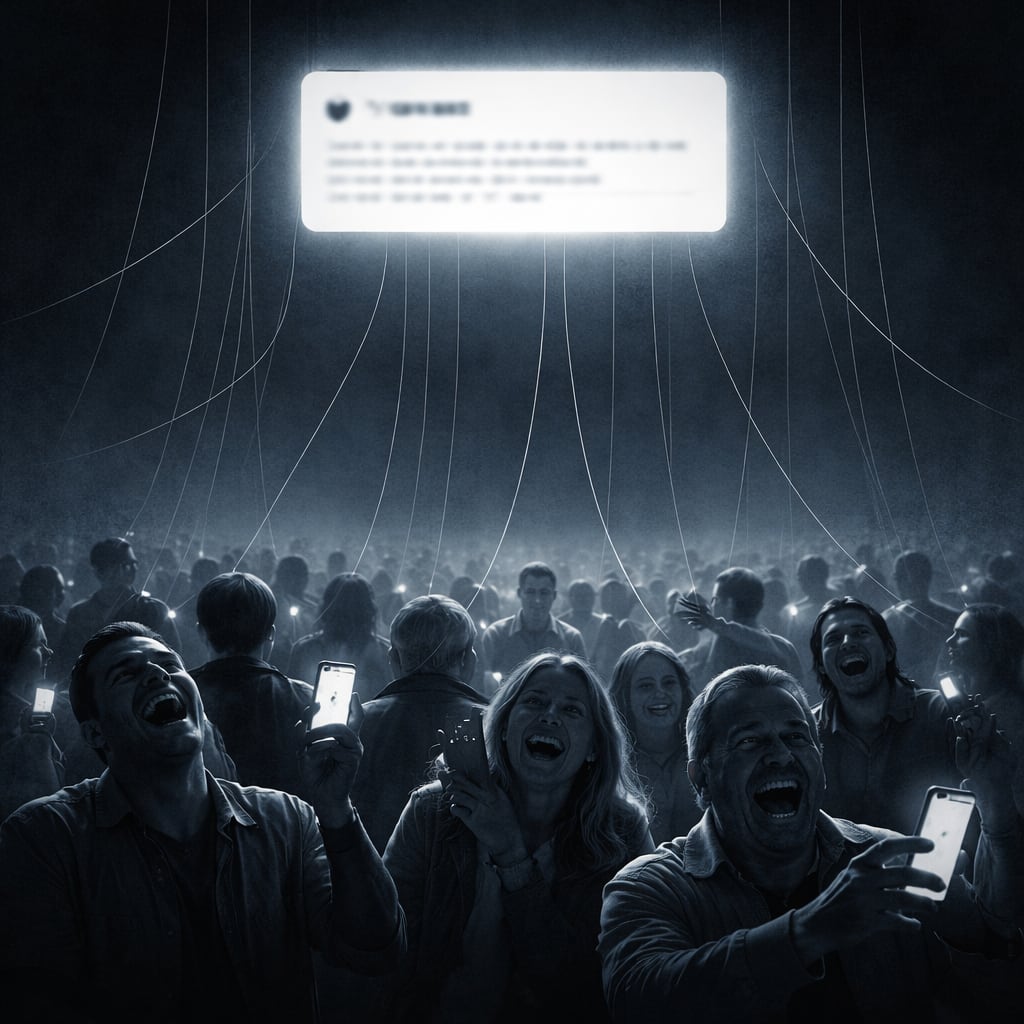
A sitting president reposts a video in which the first Black president of the United States and his wife are turned into monkeys.
There is music, of course. There is always music now. A childhood song, something harmless and familiar, plays over an image whose entire point is to be unharmless. The harmony and the hatred share the same frame. That is the joke.
By now, we all know how this goes. The defenders insist it’s “just a meme.” The critics call it racist, which it obviously is. The staff blame a junior aide. The networks book their experts. The platform counts its clicks. Tomorrow, another clip devours the same attention.
We have learned to respond to this kind of thing with a script: condemn, defend, shrug, move on. The country behaves like a nervous system caught in a feedback loop, jolting on command whenever the right words or images are applied.
So I want to ask a different question.
Not: Is this racist?Not: Did he mean it?Not: Will this hurt him in the polls?
The question that matters is quieter, and more dangerous:
Who enjoyed this, and what does their enjoyment tell us about the country that made them?
Because the truth is simple and ugly: a racist video only has power if there is an audience for it. Not a passive audience you can blame, but an active one that takes pleasure in what is being done.
That audience is not the whole country. It is not half the country. It is not even most of the president’s supporters.
But it is real. It is large enough to matter. And it did not appear out of nowhere.
We built it.
This essay is not about the man who posted the clip. It is about the world that made that post feel inevitable, and about what it would actually take—not symbolically, not rhetorically, but structurally—for such a country to know peace again.
Not quiet. Not victory. Not civility.
Peace.
I. Five Ways to Enjoy a Cruel Joke
Start here: not everyone who saw the video enjoyed it, and not everyone who enjoyed it enjoyed the same thing.
When a president shares a piece of racist spectacle, he is not speaking to “his base” in some bland, unified sense. He is striking different wounds and appetites at once. The same clip functions as a weapon, a wink, a relief, a test, and a toy.
You can think of at least five distinct audiences.
1. The dominator
For a small but focused minority, the racism is the point.
They do not pretend. They have always known Black people as less than, and they experience any image that reasserts that hierarchy as a form of truth-telling. For them, the video is not a joke, it is a correction. A reminder of “how things really are.”
They do not need irony. They want order. The primates on the screen are proof that the world has not yet been fully stolen from them.
2. The transgressor
Others are there for the violation, not the target.
These are the people who have been told, all their lives, what they cannot say. Some of them are tired of being watched. Some of them simply enjoy the feeling of running a red light.
For them, the joke is not “Black people are monkeys.” The joke is, You’re not allowed to say this anymore and he just did. The offense is the punchline.
They will swear it is “just humor,” but the humor lives precisely in the knowledge that someone else is being hurt.
3. The aggrieved
Then there is the large, quiet group that feels humiliated by history.
Factories closed. Wages stagnated. Towns emptied. Lives grew smaller and more precarious while the vocabulary of public life grew more elaborate and moral. These people were told they had “privilege” at the exact moment their lives became less livable.
They do not walk around thinking in racial theories. They walk around thinking: I used to matter. Now I don’t.
For them, the video delivers not an ideology but a sensation: relief. Someone else is being mocked. Someone higher up the symbolic ladder is being lowered. It is not the racism they enjoy; it is the easing of humiliation.
They would never say it this way, but inside the nervous system the message lands as: At least I am not at the bottom today.
4. The loyalist
Another group barely cares about the content at all.
Their emotional life is fused with the leader’s. They feel strong when he looks strong, aggrieved when he looks persecuted, and triumphant when he refuses to apologize.
For them, the clip is a test of allegiance. If “the media” is angry, if “the left” is outraged, then it must have been a good move. The more they howl, the more loyalists feel confirmed in their loyalty.
They enjoy the spectacle not for what it depicts, but for what it proves: Our man will never bow.
5. The nihilist
Finally, there is the irony-poisoned cohort.
For them, everything is content. They are too wounded or too bored to believe in sincerity. They live between timelines, sampling jokes from all sides. They will share the video with a shrug: lol this is insane—not to endorse it, not to condemn it, but to participate in the flow.
They enjoy the feeling that nothing matters enough to require a stance. The cruelty is just another texture, another asset in the feed.
None of these people is happy.
The dominator is brittle, terrified of falling.The transgressor is stimulated, not satisfied.The aggrieved is nursing a wound that never closes.The loyalist cannot stand on his own two feet.The nihilist is numb, laughing from inside a kind of spiritual anesthesia.
What they share is not a politics, but a strategy for surviving a life that no longer offers ordinary dignity.
The racist video did not create that. It harvested it.
The honest question, then, is not “Why are they like this?” but:
What kind of country produces these as its stable personality types?
II. How a Country Manufactures Unhappy Citizens
None of these audiences was born on the internet. Each sits at the end of a long, specific history.
We like to pretend that racism, transgression, grievance, leader-worship, and nihilism are personal defects. They are not. They are adaptive responses to structures that taught people what to fear, what to hope for, and what to give up on.
The dominator’s ancestry
The dominator is the most obvious descendant.
Chattel slavery created a world in which whiteness and personhood were fused. Jim Crow rebuilt that world after the brief interruption of Reconstruction. For centuries, the law explained to white Americans who they were by explaining who they were not.
When the Civil Rights movement finally stripped away the legitimacy of open supremacy, the legal structure changed faster than the psychic one. Hierarchy lost its public justification, not its appetites.
The explicit dominator today lives with a kind of historical hangover: a memory of total security built on the knowledge that someone else could never touch you—even if you have never consciously thought of it that way.
Take away the structure; leave the fear. The result is a person who experiences equality as theft and accepts cruelty as restitution.
The transgressor’s alibi
The transgressor is a child of Puritans and rock stars.
America began as a moral surveillance state. The early settlers watched each other for signs of sin. Later, every wave of cultural rebellion—jazz, rock, punk, drugs, sex—taught a new lesson: that freedom means breaking a taboo.
Then the market learned to monetize that feeling.
By the time we arrive at the era of algorithmic media, transgression is no longer pointing toward any political or spiritual liberation. It is simply a stimulant: the cheapest way to feel briefly alive in a system that treats you as a consumer and a data point.
Racist jokes, sexist jokes, homophobic jokes—they all become interchangeable instruments in the same band. The point is not belief; the point is edge. A society that taught people that “being good” means being watched should not be surprised when some decide that being bad is the only way to feel free.
The aggrieved’s wound
The aggrieved are not invented by talk radio. They are manufactured by policy.
In the middle of the twentieth century, the country made a promise to its working class: if you worked hard, if you joined the union, if you kept the rules, your life would slowly get better. You might not be rich, but you would be secure and respected.
Then, over the next fifty years, that promise was quietly revoked.
Factories shuttered. Unions were broken. Public institutions withered. The economic elite went global, and the cultural elite went to college. The people left behind were told their suffering was an unfortunate side effect of globalization, or a necessary sacrifice to keep inflation low. Then they were informed that they were “privileged” and should update their vocabulary.
What happens to a person whose material world shrinks while the language of the culture expands into a kind of moral luxury good?
They become resentful. And because they have no access to the boardrooms where the real decisions were made, they turn their anger toward targets they can see: foreigners, minorities, coastal elites, whoever the demagogue points to.
Racist spectacle does not create that resentment. It gives it a face. It concentrates a diffuse humiliation into a single image and says: Here. At least you can laugh at this.
The loyalist’s refuge
The loyalist grows in the cracks of a collapsing public sphere.
The Cold War trained Americans to see politics as an existential struggle between Us and Them. When the Berlin Wall fell, that structure did not vanish; it turned inward. Cable news drew new battle lines. Political parties became tribes. Presidents became brands.
At the same time, the experience of ordinary governance—schools that work, agencies that deliver, courts that protect—became less reliable. It became easier to feel represented by a face on television than by the institution in your town.
In that world, attaching yourself emotionally to a leader feels less like worship and more like survival. If everything is corrupt, then at least “my guy” will fight for me. If every institution is lying, then at least I can cling to a person.
Racist spectacle, in this context, functions as a loyalty test. You prove your commitment by refusing to flinch. You take comfort from his refusal to apologize. It is easier to believe in a man who hits back than in a system that asks you to grow up.
The nihilist’s shrug
The nihilist is what remains when the country exhausts its own moral language.
Decades of deception—from Vietnam to Iraq, from subprime mortgages to tech utopianism—have hollowed out trust in any institution that asks for belief. A generation raised on advertising and contradiction realizes, quite rationally, that every story can be spun and every fact can be framed.
Then comes the firehose: infinite feeds, contradictory headlines, deepfakes, bots. The one reliable experience is not truth or justice but overload.
In that environment, the safest posture is detachment. You share the racist video because it is “crazy.” You share the condemnation because it is “necessary.” But either way, you are above it. Nothing sticks to you. Nothing is allowed to matter enough to change you.
This is not apathy. It is self-defense. If every previous attempt at sincerity was punished, betrayed, or mocked, you learn to stand at a distance from everything, including your own reactions.
Put all this together and you get a country in which millions of people are walking around with legitimate grievances and illegitimate outlets; with long histories of humiliation and very short horizons of hope.
A country that has spent more energy on managing speech than on repairing lives. A country that has turned politics into content and citizens into an audience.
In such a place, cruelty becomes one of the last remaining ways to feel anything at all.
III. What Peace Would Actually Require
When people talk about “healing the nation,” they usually mean “getting the other side to shut up and behave.” That is not peace. That is fantasy.
Peace is not everyone liking each other. Peace is not the absence of conflict. Peace, in a country like this, would mean something much simpler and much harder:
A life in which you no longer need dominance, transgression, grievance, permission, or detachment just to tolerate being alive.
So ask, concretely: what would that require for each kind of person we just walked through?
For the dominator, peace would require release from status fear—a way of being in the world that does not depend on being above someone else to feel real. That cannot be preached into existence. It demands a society where dignity is available without hierarchy, where worth is anchored in contribution rather than comparison.
For the transgressor, peace would require loyalty to something they will not mock: a craft, a vow, a community, a responsibility that they are willing to protect even when it makes them feel constrained. Transgression loses its thrill when you have something to lose.
For the aggrieved, peace would require dignity restored in material terms. Not an apology tour. Not a new museum. Jobs that matter, institutions that serve, neighborhoods that are not treated as collateral damage. The opposite of humiliation is not representation; it is repair.
For the loyalist, peace would require inner authority: the ability to stand without borrowing a spine from a politician. That, in turn, requires institutions that are predictable enough and fair enough that you do not feel the need to fuse your identity with a single person to stay safe.
For the nihilist, peace would require permission to care about something that might break their heart: a cause, a place, a person, a God—a center of gravity that is allowed to matter more than their fear of being fooled again.
None of these conditions can be delivered by a slogan. None can be produced by fact-checking. All of them demand a shift in how the country is actually organized.
You cannot sermonize people out of the drugs you forced them to need.
If you want less cruelty, you have to change the conditions that make cruelty feel useful.
IV. The Terms of Peace: A Politics We Refuse to Try
What would that look like, at the level of policy and structure?
It would not look like either of our existing platforms. It would not fit neatly into “left” and “right.” It would sound, at first, like something from another country.
Call it, for clarity, a politics of dignity and stability.
1. Dignified work instead of hierarchy
First, you make it possible to feel important without anyone beneath you.
That means treating work—not consumption, not branding, not content—as a first-class civic good. Not just “jobs,” in the abstract. Work that visibly sustains the world: maintaining bridges and water systems, caring for children and elders, building and repairing homes, tending land and infrastructure, nursing and teaching and driving and fixing.
You create apprenticeships and guilds and craft paths that do not require four degrees and a lifetime of debt. You index wages to the cost of living in the places where people actually live. You build career ladders in industries that cannot be shipped overseas at the stroke of a pen.
You design an economy where status comes from keeping things alive, not from extracting value out of them faster than the next firm.
The dominator who once needed racial hierarchy to feel tall does not disappear. But over time, he finds other ways to stand up straight.
2. Security without humiliation
Second, you decouple survival from obedience.
Right now, access to basic security—healthcare, housing stability, child care—often comes wrapped in a performance. Prove you are needy enough. Prove you are compliant enough. Prove you are deserving enough.
That ritual is not accidental. It teaches people that the price of not falling completely through the floor is to accept surveillance, lectures, and the constant threat of removal.
A country interested in peace would make the opposite bet: boring, universal guarantees. Healthcare that does not depend on employment or paperwork acrobatics. Child benefits that arrive automatically. Stabilizers that kick in when an industry or town is hit, without forcing everyone to reenact their misery for a bureaucrat.
The point is not charity. It is to remove the emotional blackmail that makes men and women go looking for a savior in a suit.
If you are less afraid of losing everything, you are less likely to keep cheering for a man who promises to destroy someone else on your behalf.
3. Obligation instead of spectacle
Third, you give people serious responsibilities again.
We have built a culture in which the primary way to participate in public life is to react: like, share, clap, denounce. The body is missing. The hands are idle. The work is elsewhere.
A sane republic would invite its citizens, early in life, into service—not as punishment, not as conscription, but as rite of passage.
You could spend a year or two helping to repair roads, clean rivers, care for the dying, rebuild after storms, tutor children, or staff understaffed facilities. You would be paid enough to live. You would be held to standards. You would be asked to show up on time and be useful.
You would, in other words, become needed.
For a transgressor, that kind of experience turns the world from a stage into a workshop. You are less likely to laugh at everything once you have held someone’s hand in a flood or walked into a nursing home and been the only person under seventy in the room.
The question shifts from “What did you post about this?” to “What did you help carry?”
4. Honest institutions and boring rules
Fourth, you make authority predictable, and you make it tell the truth.
This means admitting failure. Not in the abstract. Specifically. The wars that never should have been fought. The factories that were abandoned. The opioids that were pushed. The promises about college and homeownership that broke on contact with reality.
It means speaking in plain language, and giving communities real say in how policies are implemented instead of inviting them to symbolic “listening sessions” after every substantive decision has already been made.
It means investing in the dull machinery of fairness: courts that move at a human speed, agencies that answer phones, regulators who are not captured. It means limiting the discretionary power of executives, so that fewer lives hinge on the mood of a single person.
When rules are clear and enforcement predictable, you no longer need to fuse your identity to a leader to survive. Politics can recover its proper scale: important, but not godlike.
The loyalist may still admire his chosen politician. But he no longer has to collapse into him.
5. Attention with consequences
Finally, you put speed limits on the road where we keep crashing into each other.
Right now, the platforms that govern our attention are designed to maximize engagement at any cost. That cost is not abstract. It is the nervous system of the country. Clips like the racist video travel at light speed because the architecture is built that way. Cruelty is not an aberration in such a system; it is a feature.
A society interested in peace would treat virality the way it treats other forms of public risk: not with bans, but with friction and liability.
You slow down the automatic spread of political content. You cap and stagger reposting. You hold companies accountable when their algorithms consistently reward dehumanization. You remove the financial incentives that make outrage profitable and boredom unaffordable.
The point is not to purify speech. The point is to make it harder to turn every provocation into a national referendum in six hours.
Cruel jokes will still exist. But their ability to hijack the country’s nervous system will be sharply reduced.
Taken together, these are not minor tweaks. They represent a different theory of what a country is for.
Not a showroom for virtue.Not a marketplace for attention.Not a permanent cage match between tribes.
A place where enough people are needed, secure, and respected that they no longer have to reach for cruelty, grievance, and nihilism just to feel a pulse.
V. Why No One Will Run on This
If this sounds both obvious and impossible, that is because it is.
You can find fragments of this platform scattered across the existing parties, like shards of pottery in the ruins of a house. But the house itself is gone.
One party talks about health care and wages and sometimes about industrial policy. It is not wrong. But it has spent years confusing managing language with repairing lives. It is more comfortable policing speech than confronting the economic and institutional betrayals that generated the resentment in the first place. It is deeply entangled with the same platforms and industries that profit from permanent agitation.
The other party talks about work and dignity and distrust of elites. It is not wrong either. But it has chosen to organize those energies around dominance and permission, building a politics in which grievance is not a wound to be healed but an identity to be reinforced, and where the willingness to humiliate others in public is treated as proof of authenticity.
Both formations are optimized for mobilization, not for peace.
They need you angry enough to vote, afraid enough to donate, engaged enough to refresh, loyal enough to excuse. A citizen who is quietly needed and quietly secure does not click as much, and does not scare as easily.
The politics sketched here would reduce demand for both parties’ core products.
It would produce fewer dominators to scare people with, fewer transgressors to shame, fewer aggrieved hearts to harvest, fewer loyalists to command, fewer nihilists to sell to. It would drain the entertainment value out of governing.
That is why, for now, it is a thought experiment.
But thought experiments have a purpose.
They show you that what you are told is unthinkable is, in fact, perfectly thinkable—and that the real obstacle is not physics, but appetite.
Epilogue
We live, for the moment, in a country that turns people’s pain into content and then sells it back to them. A racist video is not the worst thing that country has done, only the clearest reflection of what it has become.
You and I are not going to rebuild the economy or redesign the platforms this week. We are not going to write new labor law in the comment section.
But there is one lever left in our hands that is not theoretical.
Attention.
The next time a president—or anyone else endowed with power—feeds you a clip designed to make you hate, or gloat, or feel cleverly above it all, notice what you are being invited to become.
Not what you think about him, not what you think about them.
What you are being trained to be.
You do not owe your nervous system to people who have chosen to rule by corrosion. You do not have to become the creature the clip requires.
Peace, at the personal scale, may begin as something very small and very unheroic: refusing to laugh at the joke that needs someone’s face on an animal to make you feel tall. Refusing to share the clip that treats your outrage as free fuel. Refusing to let your days be scripted by people who depend on your agitation to stay in power.
None of that will change the world overnight.
But it will keep something alive in you that this age is trying very hard to kill: the part of you that would rather live in a country of adults than in an empire of audiences.
Everything written above about work and dignity and stability and attention is, in the end, a structural way of saying the same thing:
We could build a society in which fewer people need cruelty to feel alive.
We have chosen not to.
So far.
The terms of peace are on the table. The question is not whether they exist. The question is whether we would rather be healed than entertained.
—Elias WinterAuthor of Language Matters, a space for reflection on language, power, and decline.