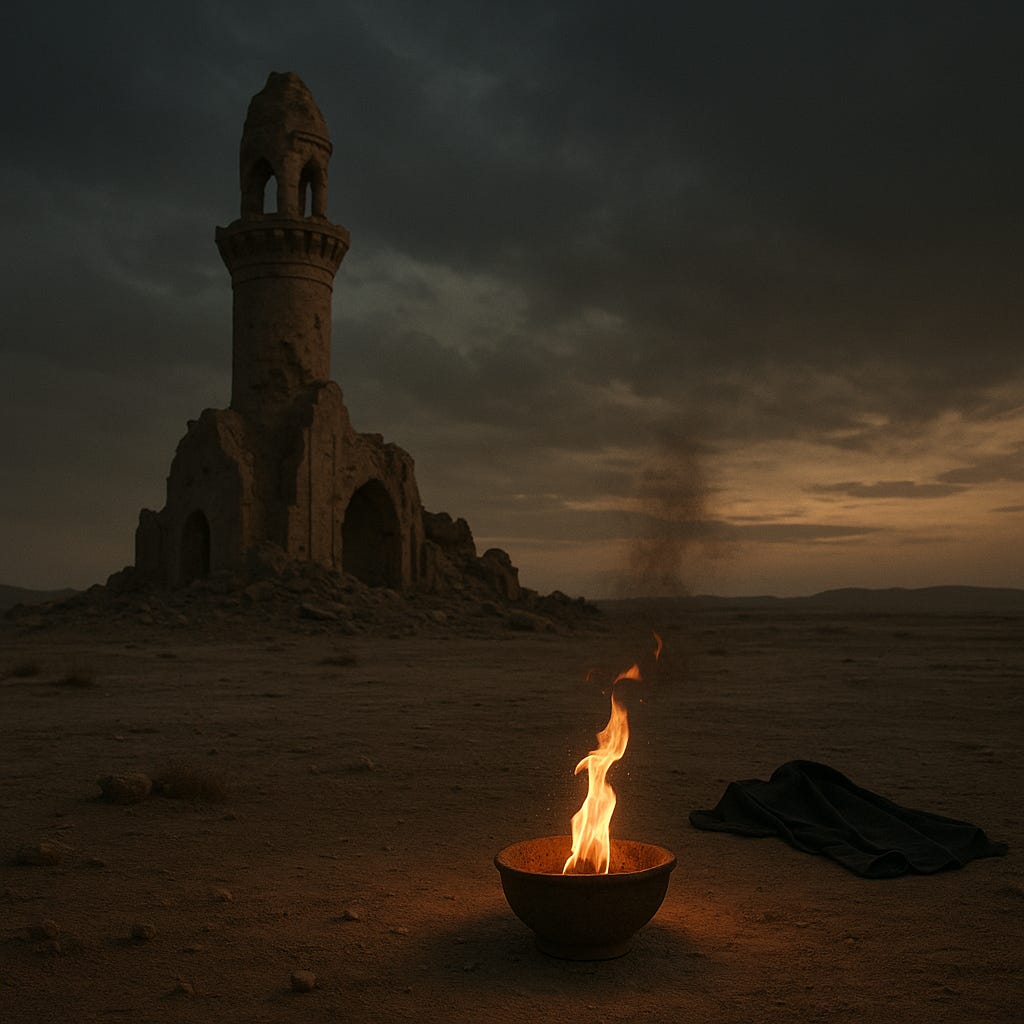
Part I: The Fire That Preceded the Book
Zarathustra’s empire, the flame of Ahura Mazda, and the quiet echo of a people who remembered too much.
Before the Book arrived, there was Fire.
Not metaphor, not symbol—actual fire. Sacred. Tended. Whispered to by priests who believed light was not just energy but ethics. In the ancient Iranian imagination, the world was not random. It was a battleground of truth and lie, flame and shadow, Ahura Mazda and Angra Mainyu.
This was not optimism. It was a theology of vigilance. You didn’t get paradise for free. You held it off, minute by minute, in the shape of your speech, your choices, your posture toward truth.
And then came the Book.
Not the Avesta—the other Book. The one brought by men who prayed in Arabic and carried swords, not censers. It came not as conversation but conquest. The Arab-Muslim armies of the 7th century didn't ask Persia if it wished to change gods. They arrived as empires do—claiming revelation, delivering ultimatum.
And Persia broke.
But here is the part no conqueror understands: Persia never forgets. It absorbs. It bleeds, yes, but while it bleeds, it listens—and then rewrites the story in its own grammar.
The Zoroastrian empire fell, but the Zoroastrian impulse—the moralization of history, the centrality of light, the dualism of meaning and lie—was not destroyed. It was transmuted. Planted like a seed in the clay of Shiism, mysticism, resistance.
The fire never died. It changed names.
And so began the long, haunted marriage between Islam and Iran—not of equals, not of strangers, but of two visions of the divine too proud to bow to each other.
Part II: The Empire That Mourned
Of Abbasids in silk, martyrs in mud, and the wound that became a religion.
Islam has many faces. In Damascus, it wore marble. In Baghdad, mathematics. But in Iran, it wore black.
Not immediately. Not at first. When the Abbasids overthrew the Umayyads in 750 CE, they leaned on Persian bureaucrats and poets to stabilize their caliphate. Arabic was the tongue of power, but Persian was the hand that held the pen. Names like al-Farabi, Avicenna, and Rumi emerged—not as Arabs, but as Iranians writing within the empire that had swallowed them.
And still, something deeper stirred. A restlessness. A memory. A whisper under the minaret.
You see, Iran did not forget what it was like to be conquered. And it did not believe in the stories told by the victors. The caliphate spoke of unity, but unity meant submission. It preached justice, but justice came from men who ruled in palaces far from the graves of their enemies.
So the Iranian heart turned elsewhere.
It found, in the tragedy of Karbala, a mirror.
It found in Husayn—the grandson of the Prophet, slaughtered in the desert by a caliph’s army—the figure of ultimate betrayal. The innocent killed by the powerful. The light extinguished by politics. And suddenly, Islam was no longer the faith of the victor. It was the religion of the wronged.
This was not Sunni Islam. This was not the Islam of caliphs and legal codes.
This was Shiism—and Iran saw itself in its blood.
Shiism is not theology. It is memory turned into ritual. It is history that refuses closure. It is the scream of the mother of martyrs echoing across centuries. And for a people who had once been Zoroastrians, who had seen their temples burned and their language subordinated, this faith felt familiar. It did not ask them to forget. It gave them permission to mourn.
To be Shia in the Iranian soul was to say: We remember.
Not just the fall of the Prophet’s family. But the fall of their own.
This was not Islam as submission.
This was Islam as defiance.
This was the wound that became a doctrine.
Part III: The Crown That Made Faith a Flag
The Safavid gamble, the invention of a Shia state, and the empire built from forced remembrance.
There are moments in history when faith is not inherited—it is enforced.
In 1501, Shah Ismail rose from the mists of war and prophecy, declaring Iran not just an empire, but a Shia empire. It was a decision so brutal, so total, that it rewrote the genetic code of a civilization.
Before Ismail, Iran was mostly Sunni. After him, it bled itself into Shiism. Entire cities were converted at sword-point. Sunni scholars were exiled. Rituals once whispered underground were paraded through the streets. What had been a wound became a weapon—sanctified, codified, state-approved.
Why?
Because the Safavids needed a border sharper than geography. The Ottomans to the west were Sunni. The Mughals to the east were Sunni. Persia needed a theological firewall. And it found it in the blood of Karbala.
But this was not love. It was strategy. Shiism, once the faith of the persecuted, was conscripted by the crown. Martyrdom was monetized. Lamentation was legislated. The Ashura procession became both spectacle and surveillance.
And yet—something strange happened.
What was meant to serve the state began to undermine it. For in Shiism, the state is never holy. The Imam is always in occultation—absent, hidden, unjustly denied. The king, no matter how devout, is always suspect. The true sovereign is elsewhere. Beyond time. Beyond approval.
So the very doctrine used to unify Iran carried within it a theology of resistance. The Shah crowned himself with a faith that did not believe in kings.
The Safavid empire survived for over two centuries. But beneath its palaces, the sermons continued. They spoke not of loyalty, but of betrayal. Not of obedience, but of grief.
A faith that had once mourned a single martyr now remembered millions. It remembered the fire, the conquest, the lie of unity. And it refused to forget.
This is the paradox at the heart of Iran: a nation forced into a faith that taught it never to trust the ones who rule.
Part IV: The Man Who Believed in Nations
Mosaddegh, the oil, the lie, and the moment Iran chose law over loyalty—and was punished for it.
Before the veil. Before the cassette tapes. Before theology became handcuffs—there was a man in a suit.
Mohammad Mosaddegh did not come from the mosque. He came from the archive. He spoke the language of law, not lineage. His hands were unbloodied, his mind Western-trained, his loyalty Persian and real.
He believed that a nation could stand without a master. That its oil could serve its people. That its voice did not need translation by empire.
In 1951, he did the unthinkable: he nationalized Iran’s oil.
It should have been a moment of pride. A return of sovereignty. A declaration that the age of foreign looting was over.
Instead, it became a death sentence.
Because when a small nation touches its chains and dares to say mine—the empires gather. Britain fumed. America smiled the smile of a banker sharpening a knife. The CIA named the operation Ajax, as if cleansing history were a matter of soap.
In 1953, they overthrew him.
The newspapers called it necessary. The diplomats called it strategy. But the people knew what it was: betrayal. Not by Mosaddegh—but of him. Of themselves. Of the possibility of a Persian democracy free of both crown and turban.
The Shah returned. This time more obedient. More armed. More afraid.
And the Iranian soul fractured.
Mosaddegh had offered law. The West answered with tanks. He had offered independence. The clergy, watching from the sidelines, offered vengeance.
This is the wound that made the Islamic Revolution possible.
When the people saw the scholar cast aside, the judge mocked, the constitution shredded—they turned not to ballots, but to banners. Not to reason, but to ritual. Not to Mosaddegh, but to Husayn.
And when Khomeini came, they were ready.
Not because they wanted a theocracy.
But because they had seen what happened to the last man who spoke of freedom without a god behind him.
Part V: The Veil and the Machine
The Shah, the mosque, the exile in Paris, and the revolution that prayed with clenched fists.
Modernity came to Iran like a thief in uniform.
In the 20th century, the Pahlavi dynasty rose with polished boots and broken mirrors. Reza Shah—and later his son—looked westward and saw strength in secularism, salvation in steel. They shaved beards, banned the veil, renamed streets, and told the Iranian soul it was backward. That to become modern was to amputate memory.
They did not understand what they were breaking.
The mosque was not just a place of worship. It was archive, refuge, resistance. The clerics were not just priests. They were custodians of meaning—men who remembered the fire beneath the book.
So when the Shah crowned himself with oil and Western weapons, it was not just tyranny. It was blasphemy.
And then came the return.
From exile in Paris, a black-turbaned man sent cassette tapes like missiles. Ayatollah Khomeini did not promise prosperity. He promised revenge. Not personal, but theological. He named the Shah a Pharaoh, the West a seducer, the people of Iran a chosen flock misled.
And the people rose.
Not for veiling. Not for sermons. They rose for dignity. For a voice that did not come from London or Langley. They rose for the part of themselves the Shah had tried to scrub out with French cologne.
The revolution of 1979 was not an embrace of Islam. It was a refusal to forget.
Islam, in that moment, became the language of rebellion. The mosque became the last place the machine could not enter. The cleric became the one figure the generals could not erase.
But revolutions lie.
Because once the Shah fled, the sermon became law. The moral became police. The Ayatollah who had whispered dignity now thundered obedience. The people who had overthrown one king found themselves ruled by men who spoke of God but demanded the same silence.
It was not the veil that returned. It was the machine—now cloaked in prayer.
And beneath it, the Iranian people began to feel an ancient ache.
They had once been Zoroastrians. Then subjects. Then Shias. Then citizens.
Now, again, they were property.
Part VI: The Republic of Silence
The sermon became law, the veil became a cage, and the nation became a hostage with a passport.
It was never supposed to be this quiet.
The streets that once sang "Allahu Akbar" from rooftops, that flooded with bodies and banners and barefoot children, grew still. The mosque that once protected became the court. The black cloth became uniform. The prayer became legislation.
The Islamic Republic was born not from scripture, but from exhaustion. The people did not ask for Velayat-e Faqih. They asked for a future that did not smell like gasoline and betrayal. But the future, once seized by clerics, was wrapped in jurisprudence and locked behind beards.
They renamed the ministries. They rewrote the textbooks. They designed a Constitution that claimed the return of the Hidden Imam but made his absence an excuse for their permanence.
What emerged was not Islam, but management in God’s name.
And management requires silence.
Over the next decades, Iran became a factory of obedience. Girls were told their bodies were distractions. Boys were told their desires were sins. Every public moment became a stage for performance: prayer at the right angle, mourning on the right day, slogans in the right pitch.
But in private?
The people smoked. Listened to forbidden music. Cursed the martyrs they were forced to memorize. Watched banned films. Prayed to a God they no longer trusted—but could not quite abandon.
This was not atheism. It was something deeper. A spiritual bruise.
Because the state had claimed the name of God—and used it to justify humiliation.
And so God became suspect.
The streets still echoed with the Prophet’s words. But they came through loudspeakers wired to fear. The mosque still stood—but with cameras in the dome. The Qur’an was still quoted—but mostly in courtrooms sentencing women for dancing.
This is what tyranny does when it wraps itself in holiness: it rots the sacred from the inside. It poisons the very words that once meant liberation.
Iran became not just a dictatorship, but a spiritual trap.
To reject the regime meant rejecting the faith.
And for millions, it felt safer to say nothing.
A republic of silence.
Of veiled contempt. Of buried hope.
But even silence, in Iran, is not stillness.
It is breath held—waiting to break.
Part VII: The Children Who Would Not Kneel
They were born beneath the veil, baptized in martyrdom, and taught to lie to survive. But they remembered how to burn.
They did not choose this faith.
They inherited it—wrapped in barbed wire, recited in classrooms where dissent meant detention. The children of the Islamic Republic were not raised on religion. They were raised on its residue. Not revelation, but enforcement. Not devotion, but performance.
They memorized Qur’anic verses while their mothers wept in private. They pledged loyalty to the Supreme Leader while their fathers cursed him in whispers. They were taught that heaven was granted through silence, and that to speak truth was to betray the blood of martyrs they never met.
But children do not forget injustice.
They observe. They absorb. They remember—even when language is forbidden.
They saw the sons of clerics driving foreign cars, vacationing in Istanbul, posting filtered photos while preaching sacrifice. They saw sermons broadcast in empty mosques while bread prices soared. They saw the women beaten for a strand of hair and the generals celebrated for genocide.
And they knew: this was not God.
This was costume.
This was cruelty dressed as tradition.
So they broke the script.
They danced. They made art with stolen internet. They sang in the ruins of doctrine. They made memes out of the Supreme Leader. They wore their hair like rebellion and their silence like armor. They prayed—not to be holy, but to be spared.
Until one day, they stopped praying altogether.
Until one day, a girl named Mahsa Amini was murdered for her hijab—and the veil turned into a funeral shroud.
And the children burned it.
Not because they hated Islam. But because they refused to let it be used against them.
This is the truth the regime cannot survive: that the children it sought to mold into martyrs became witnesses instead. Not to the glory of the Republic—but to its lie.
They no longer chant in chorus.
They scream, alone if they must.
But they scream with the clarity of a generation that has inherited not faith—but the ashes of faith.
And from those ashes, they are building something the clerics cannot see:
A future without fear.
A nation without sermons.
A God who does not need permission to be loved.
Part VIII: The Mosque and the Mall
Where the call to prayer competes with the cash register, and God becomes content or corpse.
The crisis is not Iran’s alone.
It is Islam’s.
Not the Islam of orphans and mystics, not the Islam of light and longing—but the Islam of state, brand, and bureaucracy. The Islam of skyscrapers shaped like palm trees and regimes shaped like sermons. The Islam whose minarets reach higher than its morals.
Across the Muslim world, the divide has become obscene.
In one corner: Dubai, Riyadh, Doha—gleaming, pious, algorithmically efficient. Mosques with air conditioning and digital khutbas. The Qur’an recited in seven dialects, streamed in 4K. Islam as ornament. Islam as asset class.
In the other: Gaza, Kabul, Sistan—children digging through rubble while clerics debate modesty laws. Austerity mistaken for piety. Misery mistaken for divine discipline. Islam as austerity. Islam as punishment.
And in the middle, Iran, suspended between memory and manipulation.
The regime chants Death to America while their sons study in Los Angeles. They preach humility while hoarding currency. They weaponize the Qur’an to punish women and ignore it to enrich generals.
This is not hypocrisy. It is infrastructure.
It is theocracy as business model.
The mosque has not died—it has been franchised. Licensed by the state, monetized by the elites, and emptied of spirit. Friday prayers are televised. Martyrdom is subsidized. God is not approached in trembling love but invoked in PowerPoint slides.
And the people see it.
They see that religion is no longer a path—it’s a performance. No longer sanctuary—but surveillance. No longer truth—but trademark.
So they retreat.
Some to exile. Some to apathy. Some to the ancient, aching silence where no state can reach. Where God, if He still exists, is not a politician. Where the Divine is not enforced—but encountered.
The real mosque—the one of trembling hearts and whispered forgiveness—has gone underground again.
The mall has won the skyline.
But not the soul.
Not yet.
Part IX: The West Watches the Fire and Misses the Ghost
Where liberal eyes see oppression and miss the wound, and empires mistake rebellion for imitation.
The West loves a veiled woman.
Not as a person—but as proof. Proof that its wars were justified. That its freedoms are universal. That its feminism is portable.
Iran becomes an object lesson. A backdrop. A symbol. Headlines scream for hijabs and human rights. Senators quote Rumi between drone votes. Silicon Valley weeps for Iranian women while its servers censor them.
But what the West sees is always surface.
It sees the veil as prison, not inheritance. It sees protest as liberalism, not memory. It mistakes rebellion for aspiration—as if every Iranian woman burned her hijab to become an influencer.
No.
They burn it because it was forced, not because they wish to forget where they came from.
They rise not to be Western—but to be whole.
The West does not know how to read Iran because it does not know how to read trauma that remembers. It knows how to sell identity, not how to mourn it. It wants to free Iran into something that looks like Paris, votes like Seattle, shops like Brooklyn.
But Iran is not a copy.
It is an ancient soul under siege—by mullahs, yes—but also by misunderstanding.
It does not need saving. It needs witnessing.
It needs the world to see that this uprising is not about joining the West—it is about ending the lie. The lie that Islam belongs to the state. The lie that identity must be policed. The lie that God requires a government.
The Iranian people are not reaching for America.
They are reaching for breath.
For air that doesn’t cost allegiance. For a homeland that doesn’t humiliate. For a future that doesn’t demand forgetting.
And when they chant in the streets, it is not for democracy, not exactly.
It is for dignity.
A word the West once knew, but no longer speaks.
Part X: The Return
When a nation reclaims what the state defiled, and God begins to speak in new tongues.
Not a revolution.
A return.
Not to the past—not to the monarchy, the mosque, or the myth of purity—but to something deeper. To what was betrayed. To what lived underneath the propaganda and the prayer rugs. A voice too quiet to be broadcast, too sacred to be politicized.
It begins, always, underground.
In the mother who tells her daughter, You are not wrong to want more.In the boy who kneels not toward Mecca, but to hold the hand of a friend whose brother was taken.In the silence between rituals—where no regime can reach.
It is not atheism.It is not fundamentalism.It is the trembling third thing. The resurrection of meaning after its state-sponsored murder.
The Iranian people are not waiting for salvation.
They are doing something holier.
They are weeding the sacred—pulling out the propaganda, the violence, the hollow sermons, and leaving only what speaks in the language of mercy. They are remembering God not as general, not as jailer, but as the witness to suffering. The One who watched Karbala. The One who heard the scream in Evin Prison. The One who knows what silence costs.
And slowly, they are learning to speak again.
Not in the regime’s Qur’anic dialect.Not in the West’s digital creed.But in the trembling, stubborn tongue of a people who will not let their faith be used against them.
This is not reform.
This is not rebellion.
This is a reckoning.
And in its wake, something holy is rising.
Not a perfect state.
Not a secular utopia.
But perhaps—finally—a country that can live with its ghosts, speak with its God, and tell the truth about itself without fear.
A country not of martyrs.
But of witnesses.
—Elias WinterAuthor of Language Matters, a space for reflection on language, power, and decline.