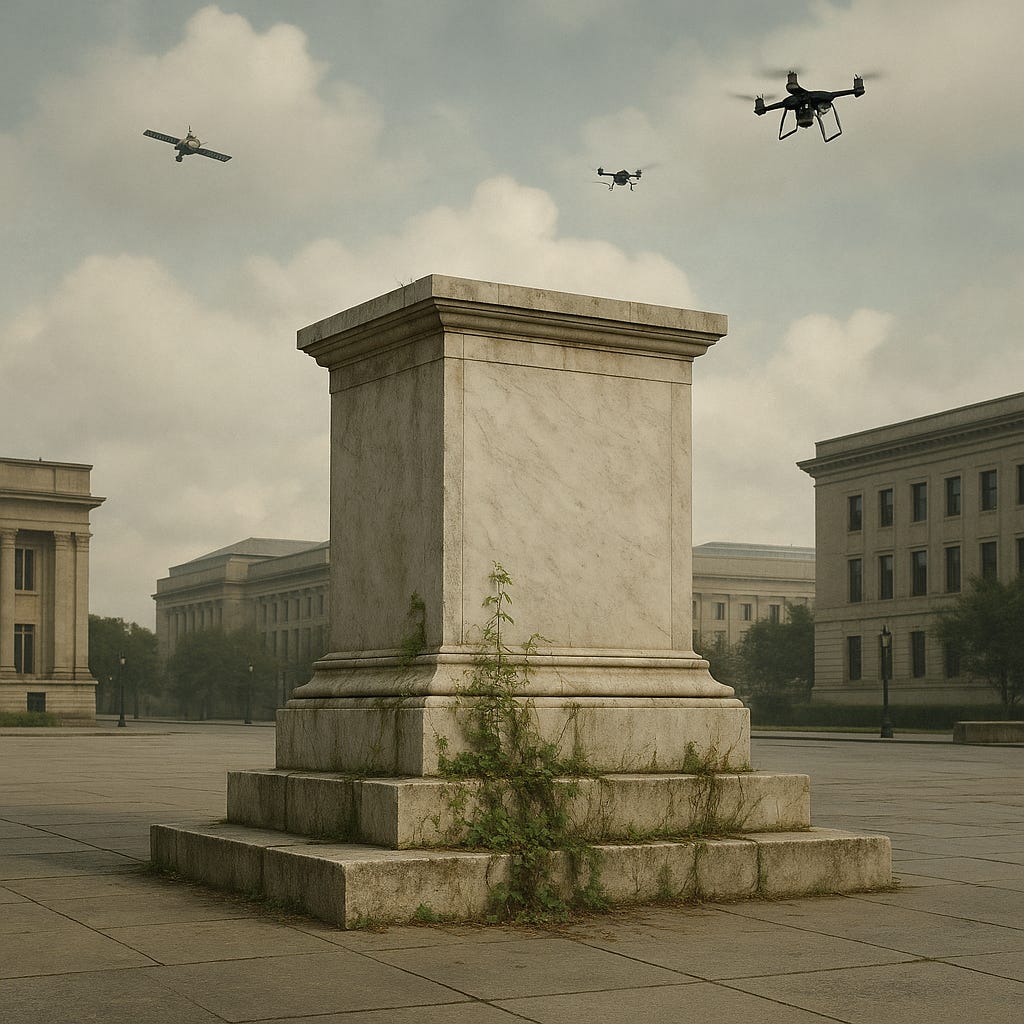
I. The Age of the Steward
In the decade after the Second World War, America’s wealthiest citizens lived under a kind of invisible leash. It was not moral virtue that tethered them, but structure. Taxes were confiscatory by today’s standards: the top marginal rate in the 1950s reached 91 percent, and even if loopholes softened the blow, the signal was unmistakable—excess wealth was not fully yours to keep. Unions were strong, capital controls limited overseas flight, and the Cold War created a national mood that demanded loyalty from elites no less than from workers. Wealth was tolerated on the condition that it was domesticated, reinvested, and shown to be socially useful.
Henry Ford II exemplifies this ethos. When he inherited the Ford Motor Company after his grandfather’s death, Detroit was not just a backdrop but a crucible. The company’s survival was inseparable from the city’s survival. To keep Ford strong meant to keep Detroit stable. Factories anchored communities; pensions promised permanence; wages were not charity but a way of buying peace. The logic was not sentimental—Ford wanted to avoid strikes and communist agitation—but it bred a kind of civic paternalism. The industrialist was not free to detach himself from the fate of the city; his legitimacy depended on its endurance.
John D. Rockefeller Jr., heir to the oil fortune, carried a different model but within the same moral orbit. His religious convictions made him austere and duty-bound, and he expressed this through institutions. Rockefeller Center was not only a profitable real estate development but a civic monument during the Great Depression. Thousands were employed, and the complex became a symbol of resilience. His philanthropy was vast: universities, churches, public health campaigns. Whether motivated by genuine belief or reputation management, the effect was the same—wealth was poured back into visible, enduring structures that testified to loyalty to the republic.
Even J. Paul Getty, whose parsimony became legendary—installing a payphone in his own mansion so guests could not freeload—was eventually drawn into the same pattern. His Getty Museum, founded with his art collection and fortune, became one of the most significant cultural institutions in the United States. He may not have believed in civic obligation in the same way Rockefeller did, but the gravitational pull of mid-century America made it almost impossible for the wealthy to die without leaving behind a monument to the nation.
This pattern—of the steward bound to place and polity—was enforced as much by fear as by duty. Fear of worker revolt, fear of communism abroad, fear of a return to Depression-era chaos. The social contract was fragile, and elites understood that their legitimacy depended on performing stability. They did not imagine themselves as visionaries transcending the nation; they imagined themselves as custodians of a nation whose collapse would swallow them too. Their fortunes were not only personal but public, not only private but national.
II. Legitimacy by Monument
If the mid-century elite were stewards, their chosen proof of legitimacy was stone, steel, and marble. They built monuments not because they believed in eternity, but because they believed in accountability. To be wealthy in America after the war was to accept a condition: your fortune must stand visible in the public square, incarnated in a library, a museum, a plaza, or a university building. It was not enough to accumulate. One had to translate wealth into permanence, into a civic grammar that ordinary citizens could walk through and point to.
This was not philanthropy in the contemporary sense of the term. It was not venture capital disguised as charity, nor private governance hidden in the structure of a foundation. It was a theater of belonging. Andrew Carnegie, a generation earlier, had built over 2,500 libraries across the country. By the 1950s, his example had become a script for elite survival. The wealthy had to immortalize themselves through institutions that outlived them. These monuments reassured the public that wealth was not purely extractive, that it could leave behind something tangible. To walk into a Carnegie library was to be reminded that private power could take civic form.
Consider Lincoln Center in New York, conceived in the 1950s and heavily financed by Rockefeller money. Its architecture was cold, almost imperial, but its purpose was clear: to create a permanent home for the arts, a secular cathedral of American cultural ambition. Its plazas and theaters announced to the world that American capitalism did not only produce cars and oil but also opera, ballet, and symphony. Rockefeller Center had served a similar purpose two decades earlier. Even as it functioned as a profit-generating real estate complex, it stood as a civic gesture, a claim that private wealth could stabilize public morale during the Depression.
These monuments carried contradictions. They often displaced communities, polished reputations, and entrenched elite dominance under the guise of civic generosity. Lincoln Center itself was built on the cleared remains of San Juan Hill, a working-class Black and Puerto Rican neighborhood. Yet the moral logic still held: wealth had to be justified in public, even if the justification was laced with violence. To be rich without leaving behind a civic edifice was to risk being remembered as illegitimate, parasitic, incomplete.
It is easy to sentimentalize this era, to imagine the Rockefellers and Fords as benevolent caretakers. They were not. They fought unions, exploited workers, and lobbied ruthlessly for their interests. But they lived under a different symbolic order. The republic demanded receipts, and those receipts were cast in stone. A wealthy man could not simply escape into his private island or offshore trust. He had to inscribe his fortune into the architecture of the nation. His immortality was mediated by the institutions he left behind.
This insistence on monumentality created a peculiar bond: even when elites acted from self-interest, they inadvertently bound themselves to the life of the nation. A library could not flee overseas. A plaza could not be domiciled in Bermuda. These structures held the wealthy in place, turned their names into civic fixtures, and ensured that their power was at least partially accountable to the public gaze. It was a compromise, fragile and imperfect, but it meant that the wealthiest lived in dialogue with the society around them.
III. The Unshackling
The architecture of obligation did not collapse all at once. It eroded, decade by decade, until the leash snapped and the wealthy walked unbound. What changed was not merely tax codes or regulatory statutes, but the very moral scaffolding that defined what it meant to be legitimate.
The 1970s marked the first cracks. Stagflation, oil shocks, and global competition unsettled the old bargain between labor and capital. American companies, once content to dominate domestic markets, now faced rising threats from Japan and Europe. To remain competitive, they began to look outward, and with globalization came escape routes. No longer tethered to the town or the factory, capital could seek cheaper labor abroad, lighter tax regimes, and more favorable regulations. The industrialist who once sat across the bargaining table from a union leader could now fold the table and move production overseas.
Policy accelerated the shift. The Reagan era slashed top marginal tax rates from 70 percent in 1980 to 28 percent by the end of the decade. Deregulation swept through airlines, finance, and telecommunications. The very language of governance shifted: no longer stewardship or stability, but efficiency, growth, competitiveness. The old fear—that if wealth was not shared, social order might collapse—faded into memory. In its place came a new creed: if wealth was maximized, prosperity would trickle down. Obligation was recast as inefficiency; redistribution as theft.
At the same time, the rise of shareholder primacy transformed the internal logic of corporations. Milton Friedman’s 1970 essay in The New York Times declared that the sole social responsibility of business was to increase profits for shareholders. This was more than an economic argument; it was a moral reorientation. The corporation was no longer a social institution with multiple stakeholders—workers, communities, the nation—but a profit machine accountable only to owners. CEOs, once measured by stability and longevity, were now judged by quarterly earnings. Buybacks, downsizing, outsourcing—once seen as desperate moves—became markers of efficiency and managerial courage.
The wealthy themselves adapted to this new ethos. Where a Rockefeller or Ford might have spoken of duty, the rising financiers of the 1980s—figures like Michael Milken, Carl Icahn, and the corporate raiders of Wall Street—spoke the language of discipline, innovation, and creative destruction. They did not see themselves as stewards of continuity but as liberators of value. In this narrative, factories were not communities to preserve but assets to optimize; workers were not partners but costs to be cut.
The unshackling was not only structural but psychological. The wealthy no longer feared the mob at the gates. Union density plummeted from one-third of the workforce in the 1950s to barely one-tenth by the 1990s. The Cold War’s specter of communism dissolved with the fall of the Berlin Wall. Tax revolts like California’s Proposition 13 in 1978 signaled a cultural shift: ordinary Americans themselves were demanding lower taxes, even if it starved public institutions. The social imagination turned away from collective survival toward individual ascent.
By the end of the century, the moral grammar of wealth had been rewritten. To be rich was not to prove legitimacy through monuments or obligations; it was to be the proof itself. Wealth demonstrated genius, vision, superiority. A billionaire no longer needed to justify his fortune by endowing a library. His fortune justified itself by existing. This was the true unshackling—not only the loosening of legal restraints, but the liberation from the expectation of belonging.
IV. The Creed of Disruption
With the old scaffolding dismantled, a new creed rose to fill the void. It did not speak of stewardship or duty. It spoke of speed, innovation, and rupture. By the dawn of the twenty-first century, the wealthiest Americans no longer saw themselves as custodians of continuity but as prophets of transformation. The word they chose for themselves was not caretaker but disruptor.
Mark Zuckerberg’s early motto for Facebook—move fast and break things—captured this ethos in its purest form. It was not merely a strategy for product development; it was a moral declaration. The legitimacy of wealth no longer came from building structures that endured, but from shattering structures that already existed. In disruption lay proof of genius, proof of superiority, proof of inevitability. To break was to create. To destabilize was to lead.
This creed found fertile ground in the culture of Silicon Valley, which framed itself as the antithesis of old industrial America. Where the Fords and Rockefellers measured success in factories built and institutions endowed, the new elite measured success in lines of code, platforms scaled, and industries overturned. A handful of engineers in a garage could now command more influence than a steel mill employing fifty thousand. Scale came not from muscle but from networks, not from assembly lines but from platforms. In this shift, the very meaning of responsibility dissolved. If you no longer employed half a city, to whom were you accountable?
Elon Musk embodied the creed at its most messianic. He did not speak of balance sheets or pensions but of humanity’s survival. His mission statements carried the cadence of scripture: make life multi-planetary, accelerate the transition to sustainable energy, defend humanity from artificial intelligence. These are not the words of a steward tending a fragile social order. They are the words of a visionary who has transcended the nation and speaks instead to the species. Musk’s wealth does not legitimize itself through civic monuments but through cosmic ambition. He does not promise to preserve Detroit; he promises to colonize Mars.
Jeff Bezos offered a quieter, more methodical version of the same creed. His company, Amazon, grew not by breaking into communities but by abstracting them away. Local bookstores, department stores, even malls withered under the weight of his logistical empire. Efficiency was the new morality: cheaper, faster, frictionless. His wealth, like his warehouses, became a monument to optimization. And yet his most visible legacy project is not a library or a museum, but a 10,000-year clock hidden in a Texas mountain—a private monument to time itself, inaccessible to the very workers who made it possible.
What unites these figures is a conviction that legitimacy flows from vision, not obligation. They are not judged by how well they sustain the present, but by how boldly they imagine the future. Disruption is their creed, and it licenses them to act without the tether of community or nation. A broken system is proof of their success, not a measure of their failure. The middle class hollowed by automation, the town stripped of its retail core, the democracy polarized by algorithmic feeds—these are not seen as signs of moral debt but as collateral damage on the road to progress.
To disrupt is to claim transcendence. And in this creed, wealth does not apologize for its detachment; it sanctifies it. The steward once said, I will build so that the republic endures. The disruptor now says, I will break so that the future arrives. It is a different kind of bond—not to the nation, but to an imagined horizon. Yet in its brilliance, it carries a silence: the absence of belonging, the absence of care for the fragile order that still holds the present together.
V. Beyond the Nation
If the creed of disruption loosened the bond between wealth and community, the next step was its outright abandonment. The wealthiest Americans of the twenty-first century no longer imagine themselves as custodians of a republic. Their horizon is larger—or perhaps more evasive. They speak not of towns, not even of nations, but of the species, the planet, the cosmos. They live beyond the nation.
This shift is not simply rhetorical. Henry Ford II could not conceive of Ford without Detroit. His legitimacy was inseparable from the fate of an American city. But when Elon Musk speaks of SpaceX, his language makes no reference to California, or Texas, or the United States. His unit of concern is “humanity.” His audience is posterity on Mars. To invest in rockets is not to protect a polity but to escape one. It is a redefinition of responsibility: not to secure the republic, but to secure the species—though by means only he can direct.
Jeff Bezos mirrors this expansion with different symbolism. His obsession with long-term projects—the 10,000-year clock, the dream of moving heavy industry into orbit—projects wealth into a scale beyond politics, beyond democracy, beyond the rhythms of ordinary life. His Washington Post ownership gestures at civic responsibility, but his heart is in Blue Origin, a company that envisions a future in which millions live in space colonies. The promise is not a stronger United States but a trans-human destiny. The nation is an afterthought, a waystation.
Mark Zuckerberg’s project is more insidious. His metaverse does not transcend Earth; it transcends geography altogether. The community he builds is placeless, post-national, a digital realm where belonging is mediated by avatars and data flows. His ambition is not to bind Americans together but to create a new kind of human habitat, owned and governed by a private platform. In Zuckerberg’s world, the nation is no longer a container of identity—it is noise in the feed, an artifact of the offline past.
Even the philanthropists speak in planetary terms. Bill and Melinda Gates did not endow a university in Seattle as Carnegie once endowed libraries across the Midwest. They built a foundation that governs global health at a scale rivaling the World Health Organization. Polio eradication in Nigeria, malaria nets in Sub-Saharan Africa, vaccine rollouts in India—these became the stage on which Gates wealth performed legitimacy. In one sense, this is noble: the suffering of billions deserves attention. But it is also revealing. The wealthy no longer see their first duty as preserving the institutions of their own republic. Their stage is the world, and their audience is history.
This expansion of moral horizon—from city, to nation, to species—carries both grandeur and evasion. To think of humanity is to think beyond borders, but it also frees one from the mess of local belonging. Detroit’s pensions, America’s infrastructure, the hollowing of its middle class—these burdens no longer anchor the wealthy imagination. The billionaire has ascended to a scale where the republic itself looks provincial. The state becomes not the horizon of responsibility but a resource to be bypassed, lobbied, or outlasted.
In this sense, the beyond is also an escape. The wealthiest once staked their immortality on the endurance of the nation: Rockefeller Center, Carnegie’s libraries, Lincoln Center. The new wealthy stake it on leaving the nation behind. Their monuments are not plazas but platforms, not libraries but laboratories, not civic institutions but cosmic ventures. The republic is no longer the frame of their belonging. It is the residue of an older order they have already transcended.
VI. The Parallel Republic
To live beyond the nation is one thing. To replace it is another. In the early twenty-first century, America’s billionaires began not only to detach from civic obligations but to construct their own parallel systems of governance. What began as philanthropy has hardened into privatized sovereignty.
The Gates Foundation offers the clearest example. With an endowment exceeding $50 billion, it commands resources larger than many governments. Its staff does not merely donate to causes; it designs global health campaigns, funds vaccine research, negotiates with pharmaceutical firms, and implements strategies in villages and cities across continents. The scale rivals that of the World Health Organization, yet with none of the accountability of democratic oversight. Its power flows not from elections but from wealth, and its reach stretches where American federal agencies cannot or will not go. Gates does not govern a nation; he governs a domain.
The Chan Zuckerberg Initiative adopts a similar posture, but cloaks it in the language of Silicon Valley. Structured as a limited liability company rather than a traditional nonprofit, it allows Zuckerberg and his wife to invest in for-profit ventures, fund political initiatives, and direct billions toward scientific research. They call it philanthropy, but in practice it is a venture-capital state, pursuing goals they define with rules they set. It is government without consent. If Carnegie once built libraries to shore up public education, Zuckerberg builds a parallel architecture of influence, answerable only to himself.
Amazon, too, functions as a shadow state. Its logistical empire spans continents, its data centers form the backbone of the internet, and its warehouse network employs more Americans than most public agencies. Its capacity to deliver goods, manage information, and control infrastructure rivals that of governments—sometimes exceeding it. When natural disasters strike, it is Amazon’s supply chain that proves most reliable. When intelligence agencies require cloud services, they turn not to the Pentagon but to Amazon Web Services. Bezos may not call himself a sovereign, but his company has quietly become indispensable to the republic’s functioning.
Even the supposed “charitable” visions of these elites take on sovereign proportions. Musk’s SpaceX is not simply a private company building rockets; it is, in practice, America’s space program, contracted by NASA and relied upon for satellite launches and national defense. He holds the keys to the heavens, and with them, leverage over governments themselves. What began as disruption matures into dependence: the republic cannot function without its billionaires, even as they increasingly function outside its authority.
This is the paradox of the parallel republic. On the one hand, the wealthy step in where the state has failed. American infrastructure crumbles, public universities hollow out, and Congress deadlocks. In the vacuum, billionaires offer solutions—vaccines, satellites, logistics, education technology. On the other hand, the very success of this parallel republic accelerates the weakening of the actual one. Each private foundation that substitutes for public health makes the public system less necessary. Each platform that replaces civic institutions further displaces democratic accountability. The cycle feeds itself: the weaker the republic, the stronger its shadows.
The mid-century elite legitimated their wealth by binding it to the nation. Today’s elite legitimize theirs by showing they can replace the nation. But replacement is not belonging. It does not bind the wealthy to the fate of the people; it binds the people to the whims of the wealthy. A vaccine rollout can be launched or halted by the choice of a single foundation. A supply chain can falter or expand depending on one man’s quarterly ambitions. Sovereignty itself migrates upward, into private hands.
What emerges is not just inequality of wealth, but inequality of governance. The citizen remains bound to the republic; the billionaire floats free in his own. The nation once demanded monuments as receipts of loyalty. Now it receives services outsourced from above. What vanishes in this trade is the very idea of shared fate, the sense that wealth and polity rise or fall together. The parallel republic is efficient, even dazzling, but it is not ours. It belongs to those who built it, and it survives only as long as their will permits.
VII. The Architecture of Immortality
The industrial titans of the mid-twentieth century built stone and steel so that their names might outlast their flesh. Carnegie’s libraries, Rockefeller Center, the Ford Foundation—these were forms of symbolic immortality. They told a story: even as men died, their wealth would persist in public institutions, woven into the nation’s fabric. Their monuments were less about their bodies than about their memory, less about defying death than about ensuring that the republic itself became their tombstone.
The new elite seek something different. They do not trust in stone, nor in the endurance of the institutions that stone once symbolized. Their gaze is not fixed on the library, the university, or the plaza; it is fixed on the body itself, on the mind, on the span of life. The wealthy today do not build civic permanence; they chase biological permanence. They construct not libraries but laboratories devoted to defeating aging, extending lifespan, even conquering death itself.
Consider Peter Thiel, the contrarian billionaire who has invested in parabiosis experiments—transfusing young blood into older bodies—as well as cryonics, hoping to have his body frozen until technology can revive him. Or Jeff Bezos, who has poured hundreds of millions into Altos Labs, a biotech startup devoted to cellular reprogramming and radical life extension. Their vision of legacy is not a university hall where students might read their names but the indefinite survival of their own consciousness, their own cells, their own continuity. Immortality becomes not a metaphor but a research agenda.
Even those who do not explicitly chase longevity projects gravitate toward the cosmic or the eternal. Bezos’s 10,000-year clock is not meant for public use; it is a monument to time itself, hidden in a desert, accessible only to those he permits. Musk speaks of interplanetary colonization as though the republic’s survival depends not on infrastructure, schools, or hospitals, but on leaving Earth altogether. The message is clear: permanence lies not in this world, not in shared institutions, but in transcending them—by lifespan, by planet, by digital simulation.
This architecture of immortality signals a profound break with the past. Carnegie believed that the memory of his name attached to libraries would endure longer than his bones. He tied his legacy to the life of the republic, betting that institutions would outlive him. Today’s billionaires bet that institutions will collapse, that the republic cannot guarantee permanence, and so they place their faith in laboratories, spaceships, and servers. Their immortality is personal, not civic; technological, not institutional; private, not shared.
There is, hidden in this obsession, a confession. The new wealthy no longer believe in the endurance of the republic. They no longer trust that a library will stand unburned, that a foundation will remain uncorrupted, that a university will continue unpoliticized. They look at the decay of public life and conclude that the only permanence is what they can carry with them—through time, through space, through the body itself. Where their predecessors believed in outliving death through institutions, today’s billionaires believe in outliving institutions through the conquest of death.
And yet, this quest for immortality leaves the nation impoverished. Libraries, plazas, and museums belong to all; longevity labs and Martian rockets belong to the few. The public receives no monument, only the spectacle of billionaires attempting to outrun mortality. Their pursuit is dazzling, even sublime, but it is not binding. It does not reassure a people that their fate and the fate of their wealthiest are entwined. It reassures only the wealthy themselves that they might persist while the republic fades.
VIII. The Abdication of the Republic
It is tempting to imagine that the wealthy simply changed—that they lost their sense of duty, that their moral fiber decayed, that disruption seduced them into forgetting the nation. But to stop there is to miss half the story. The transformation of America’s elite is inseparable from the transformation of America itself. The republic that once held its wealthy to account has abdicated its role.
In the mid-twentieth century, constraint was structural. Tax policy stripped away excess, unions kept wages tethered to productivity, antitrust law hemmed in monopoly, and Cold War ideology made elite loyalty a patriotic necessity. The wealthy could not easily imagine themselves outside the nation because the nation did not allow it. The state was not strong in every sense—it was segregated, exclusionary, often brutal—but in its relationship to capital, it was authoritative. Wealth was tolerated on condition of service.
That authority eroded. Beginning in the 1970s, a deliberate political project weakened the tools that once bound the elite to the common good. Tax cuts starved the treasury. Deregulation dismantled barriers to monopoly and speculation. Union-busting gutted collective bargaining, leaving workers atomized. Campaign finance reform, far from curbing influence, legalized it: money became speech, lobbying became governance, and billionaires became kingmakers. The republic, once an arbiter, became a client.
The abdication was cultural as much as legal. Ordinary citizens, exhausted by inflation and distrustful of government, joined tax revolts and voted for candidates promising to “get government off our backs.” Public faith in institutions withered; confidence in Congress, universities, and media collapsed across the political spectrum. In this climate, billionaires no longer had to defend themselves against charges of illegitimacy. The state had lost the standing to make the accusation. The referee had left the field.
The result is not simply that billionaires are unmoored. It is that the republic has outsourced its own obligations to them. Public health, once the domain of the CDC, now depends on the largesse of foundations. Space exploration, once NASA’s proud frontier, now leans on Musk. Infrastructure delivery, once the province of government planning, is often smoother through Amazon’s logistical web. Citizens, left in the hollowing shell of the public realm, look not to Washington but to the private sphere for solutions. And the wealthy, far from resisting, step into the vacuum with open arms.
But abdication is not neutral. It remakes the moral terrain. If the republic no longer insists that wealth legitimize itself through civic contribution, then philanthropy becomes a performance, not an obligation. The billionaire is free to choose whether to fund malaria nets, space stations, or nothing at all. Obligation is replaced by whim. Legitimacy is self-defined, not publicly negotiated. The bond between wealth and nation does not break by betrayal; it dissolves through silence.
This is the moral tragedy of abdication: the republic has not been overthrown, but abandoned. The nation once demanded monuments as receipts of loyalty. Now it applauds press releases and TED talks. The wealthy have not so much usurped power as inherited it from institutions too weakened, too gridlocked, too compromised to wield it. And in this inheritance, the republic loses something essential: the sense that it can call its wealthiest citizens to account, that it can define the terms of belonging.
The abdication leaves us with a haunting question: if the republic no longer binds its billionaires, who does? If the state cannot compel service, and society cannot shame detachment, then what remains but the billionaire’s own self-conception? The old architecture of accountability has collapsed, and in its ruins stands a new order: private sovereignty unmoored from public will. The republic, in stepping back, has created not citizens but kings.
IX. The Vanishing Bond
The story of America’s wealth across the last seventy years is not only about changing fortunes, new industries, or shifting policies. It is about the disappearance of a bond—a moral tether between the richest citizens and the nation that once housed them.
In the mid-century, that bond was visible even through contradiction. The Rockefellers and Fords were not saints; they broke strikes, lobbied for favorable laws, and protected their empires with ruthless precision. Yet they still understood that their legitimacy rested on a fragile compact: their fortunes existed inside the fate of the republic. Their monuments—libraries, plazas, foundations—were receipts of belonging, however self-interested. They built in stone because they believed the nation would endure, and because they knew their wealth could not outlive it alone.
Today’s billionaires live in another order. Their wealth is not domesticated by tax or union, nor tethered by Cold War loyalty. They answer not to the nation but to the market, to global networks of capital, to the boundless imagination of technology. Their monuments are not civic halls but longevity labs, spaceports, and digital platforms. They seek immortality not through institutions but through themselves—through the extension of their own lives, the export of their ambitions to other planets, the enclosure of human interaction within privately owned digital realms.
What has vanished is not genius or ambition. The new wealthy are no less intelligent, no less audacious, than their predecessors. What has vanished is the tether. The bond that once tied fortune to polity, ambition to republic, has dissolved. Wealth no longer needs the nation to survive; indeed, it increasingly imagines survival apart from the nation, or even after it. The republic is tolerated as a staging ground, a platform, a resource—but not as the horizon of obligation.
The danger lies not only in inequality of wealth but in inequality of fate. In the 1950s, when an industrial city faltered, the titan who owned its factories faltered with it. Today, when a town hollowed by automation collapses, the billionaire who pioneered the technology feels no tremor. His wealth is safe in code, in offshore trusts, in diversified assets untethered from geography. The middle class cannot escape the republic; the wealthy already have.
This is the true vanishing: not betrayal, not even indifference, but absence. The wealthiest no longer stand inside the same circle of risk. They live beyond it, above it, outside it. The bond that once forced their fortunes to rise and fall with the republic has been replaced with a freedom that looks like transcendence but functions as abandonment.
And yet, even in its absence, the bond haunts us. A nation without stewards is a nation without confidence in its future. The wealthy now build the architecture of escape while the republic struggles to repair its crumbling roads. They imagine colonies on Mars while bridges rust. They design digital worlds while civic institutions decay. Their ambitions are vast, but their belonging has thinned to transparency.
What vanishes is not merely a set of monuments, nor a style of philanthropy, nor a tax regime. What vanishes is the sense that the richest citizens and the ordinary citizen are bound by the same fate—that if the republic falls, they fall too. That bond was once fragile, imperfect, often violent in its compromises. But it existed. Today it has dissolved. And in its vanishing, the republic is left to ask whether it can endure without it—or whether it must find a way to call its wealthiest home again.
Epilogue: A Call to Return
It is easy to conclude this story with despair. The bond has frayed, the republic has abdicated, and the wealthy have built their towers beyond the reach of the nation. But despair would only deepen the silence that already corrodes our civic life. There is still another path.
For all their detachment, today’s billionaires remain bound by something they cannot escape: their fortunes rest on human beings who live not on Mars, nor in simulation, but here, in towns and cities, in neighborhoods and schools, in the fragile weave of the republic. No algorithm writes itself, no rocket builds itself, no warehouse runs without bodies. The bond has not vanished entirely; it has only been denied. Beneath the layers of code and capital, the tie remains.
And so there is hope, because bonds can be renewed. History shows that legitimacy is never fixed. The titans of the Gilded Age were once reviled, yet by mid-century, their heirs had been bent—by law, by culture, by conscience—into stewards. The same could be true again. The structures of accountability can be rebuilt, and the wealthy can discover once more that their survival is inseparable from the survival of the republic.
But the deeper hope lies not in policy alone. It lies in a choice. The wealthiest among us have the chance to redefine greatness—not as escape, but as belonging. To build not only clocks in mountains or colonies in space, but institutions here, on this ground, among this people. To see that the real measure of ambition is not how far one can transcend a nation, but how deeply one can sustain it.
The republic does not ask its wealthiest to be saints. It asks only that they remember: their fortunes were born here, their possibilities made possible here, their names secured by a system of laws and a fabric of trust that others built and defended. To forget this is to build on sand. To remember it is to plant one’s wealth in soil that can still bear fruit.
The bond has weakened, yes. But it is not gone. It waits to be renewed—through monuments not of escape, but of care; through investments not only in technology, but in trust; through the recognition that immortality is not found in the self alone, but in the endurance of a people.
To those who hold unprecedented power, the appeal is simple: come home. Not to a past that cannot return, but to a future that will not exist without you. Your wealth has given you the power to leave. Use it instead to stay.
—Elias WinterAuthor of Language Matters, a space for reflection on language, power, and decline.