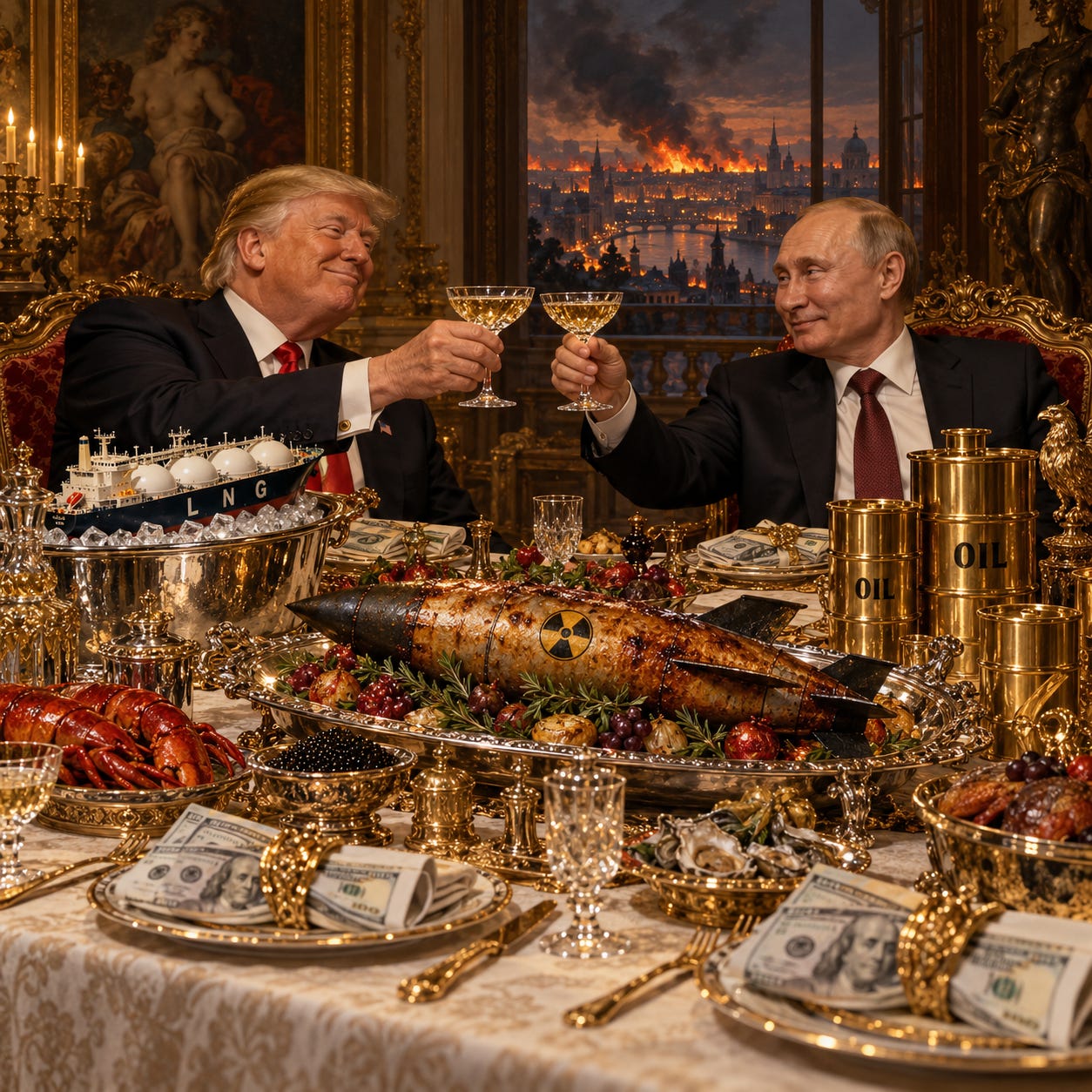
There is a great mystery haunting Western civilization. It has perplexed journalists, troubled intelligence analysts, and kept respectable people awake at night: Why does Donald Trump seem so fond of Vladimir Putin?
Some suspect blackmail. Others suggest ideological affinity. Entire libraries have been written about authoritarian psychology, masculine insecurity, and the mysterious chemistry between men who consider themselves indispensable to human history.
But perhaps we have overlooked the most obvious explanation.
Business.
After all, America and Russia may disagree about democracy, sovereignty, international law, and the appropriate number of countries Ukraine should be divided into. But both understand something far more fundamental.
A satisfied customer is a returning customer.
Consider the Russian invasion of Ukraine.
In February 2022, Vladimir Putin launched a catastrophic war against his neighbor. Cities were destroyed, millions were displaced, and Europe suddenly remembered that international borders were not merely decorative suggestions.
Naturally, the continent panicked.
And where there is panic, there is opportunity.
American weapons manufacturers, displaying the entrepreneurial instincts that made the republic great, discovered an extraordinary new European appetite for military hardware.
According to the Stockholm International Peace Research Institute, American arms exports to Europe increased by 217 percent between the five-year periods of 2016–2020 and 2021–2025.
Two hundred and seventeen percent.
There are Silicon Valley founders who would sacrifice their firstborn for that kind of growth.
Lockheed Martin, RTX, and their distinguished colleagues found themselves supplying the instruments of European reassurance: fighter jets, missiles, air-defense systems, and the comforting knowledge that freedom comes with a maintenance contract.
It was a beautiful arrangement. Europe purchased security. America supplied the equipment. And Russia, through its invasion, had accomplished something generations of American sales representatives could only dream of: making European governments desperate to buy American weapons.
No advertising campaign could have achieved such results.
Then came the energy business.
Before the war, Germany had committed the unforgivable sin of purchasing relatively cheap Russian natural gas.
For years, Americans warned Europeans that depending on Russian energy was dangerous. The Germans, being German, continued doing what appeared economically rational.
Then someone blew up the Nord Stream pipelines.
Who? German prosecutors have charged a Ukrainian suspect and pursued evidence involving a Ukrainian group. The ultimate responsibility and chain of authorization remain unresolved.
We should not confuse the existence of beneficiaries with proof of perpetrators. This is geopolitics, not an Agatha Christie novel, although the cast is admittedly suspicious.
But whatever happened beneath the Baltic Sea, the commercial consequences were unmistakable.
Europe needed alternative gas supplies.
And who happened to have gas?
America.
By 2025, the United States supplied approximately 58 percent of the European Union’s liquefied natural gas imports.
The Europeans had escaped dependence on a Russian supplier only to discover that their new American supplier offered a premium service involving liquefaction, transatlantic shipping, regasification, and several additional opportunities to charge a fee.
Freedom, it turned out, required an import terminal.
Still, Europeans could console themselves with the knowledge that their money was going to a friendly democratic ally rather than financing an aggressive foreign power.
At least until the democratic ally started another war.
Enter Iran.
In February 2026, the United States and Israel attacked Iran. Iran disrupted shipping through the Strait of Hormuz, one of the world’s most important energy corridors.
Oil prices surged. Diesel supplies tightened. Governments discovered that modern civilization depends rather heavily on substances extracted from beneath the earth.
And suddenly, across the world, a familiar gentleman in Moscow noticed that his merchandise had become considerably more attractive.
Russia, whose energy exports had been punished by sanctions and discounted prices following its invasion of Ukraine, found itself benefiting from higher oil prices and renewed demand for alternative supplies.
Not universally, of course. Ukrainian attacks on Russian energy infrastructure damaged production, and Russia’s overall oil revenues remained under pressure. But scarcity gave Moscow something sanctions were meant to deny it: bargaining power.
Then, on October 9, 2026, came a development so exquisitely absurd that satire briefly became unemployed.
Donald Trump announced an agreement with Vladimir Putin for Russian diesel supplies.
Yes.
The United States, which had spent years attempting to reduce Russian energy revenues because Russia invaded Ukraine, was now seeking Russian diesel to relieve an energy crisis arising from America’s war with Iran.
The American government even eased sanctions to facilitate the arrangement.
One could almost hear the accountants applauding.
The proposed shipments may prove too small to substantially reduce prices. But their political significance is enormous.
America helps Europe reduce its dependence on Russian energy while Russia helps America address an energy shortage created by America’s own military adventure.
Ladies and gentlemen, welcome to the international rules-based order.
Terms and conditions apply.
And perhaps this helps illuminate the mysterious Trump–Putin relationship.
Not because we have discovered some secret agreement between them. We have not. Nor does it prove either leader began a war to enrich the other’s industries.
The more interesting possibility is that geopolitical hostility and commercial accommodation coexist quite comfortably when circumstances make cooperation useful.
Putin’s war helped expand markets for American arms and natural gas. America’s war with Iran helped strengthen the commercial value and negotiating position of Russian energy.
The two men need not be friends. They need not even trust each other.
They merely need to recognize an invoice when they see one.
Of course, there is a small complication in this otherwise magnificent business model.
Somebody has to die.
Ukrainian families bury their children. Iranian families search through rubble. European households absorb higher energy bills. Soldiers return in coffins, when they return at all.
None of these people appears as a beneficiary in the quarterly earnings reports.
And perhaps that is the most remarkable achievement of our civilization: we have created an economic system sophisticated enough to generate profits from catastrophe without requiring anyone to celebrate the catastrophe itself.
The weapons manufacturer does not need to love war. He merely fulfills demand.
The energy trader does not need to support bombardment. He merely responds to scarcity.
The politician does not need to admit that suffering has commercial value. He merely announces another agreement.
Everyone is doing his job.
Everyone is behaving rationally.
Everyone has an explanation.
And somewhere, someone is digging another grave.
Perhaps, then, we should spend less time asking whether Trump and Putin secretly like each other.
The more consequential question is why our political and economic institutions remain so comfortable converting destruction into opportunity.
Because the deepest obscenity is not that enemies sometimes profit from each other’s wars.
It is that we have learned to call this normal.
The nations bury their dead under different flags.
The invoices are written in the same language.
—Elias WinterAuthor of Language Matters, a space for reflection on language, power, and decline.