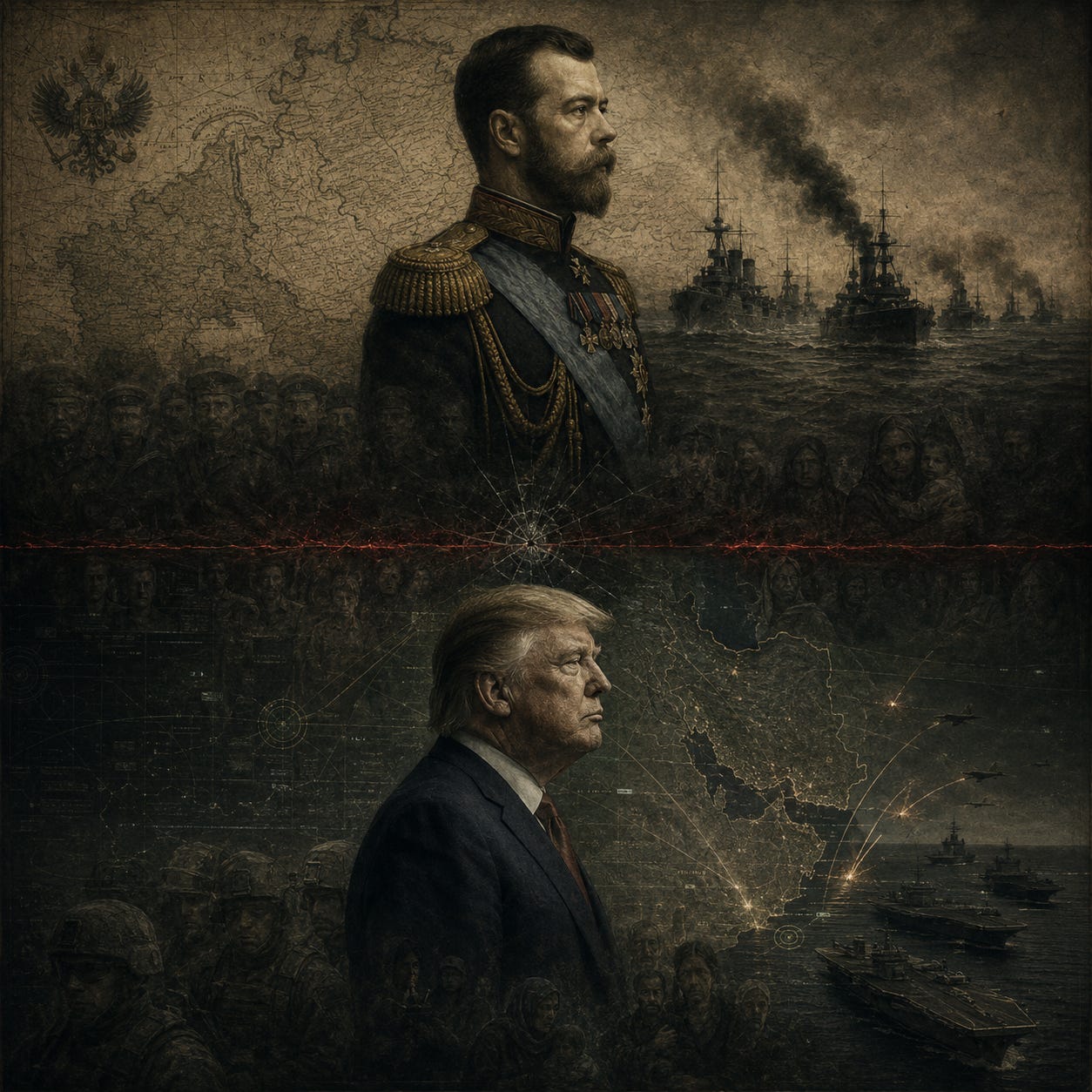
Prologue — The Tsar Was Certain
In the winter palace of Nicholas II, the world still possessed an order.
There were great nations and lesser nations. There were ancient empires and newly dressed imitators. There were white armies, disciplined by history, and yellow armies, assembled from peoples who had only recently learned the machinery of Europe. Russia stretched across the curvature of the earth. Japan was an island at its edge.
The Tsar was certain.
He was not certain because he had studied Japan carefully. Certainty rarely comes from study. Study produces complication, and complication makes certainty difficult to maintain. Nicholas was certain because the world around him had been arranged to make Russian superiority feel like a fact of nature.
Russia had millions of men.
Russia had defeated Napoleon.
Russia had occupied Paris.
Russia had railways, fortresses, admirals, princes and the accumulated mythology of a European empire. Japan, within the memory of living men, had been largely closed to the West. Its modern army was young. Its navy had been assembled from borrowed designs and foreign instruction.
What could such a country teach Russia?
This was not merely arrogance. It was a theory of reality.
Nicholas and many of the men surrounding him believed that racial hierarchy predicted military hierarchy. Historians have found that racial and cultural stereotypes distorted Russian assessments of Japan before the Russo-Japanese War, while bureaucratic rivalry further corrupted the information reaching the imperial government. Nicholas was influenced by the widespread conviction that Japanese soldiers could not equal a European army. (MIT Press Direct)
And yet, while the Russian court contemplated its greatness, Japan studied.
Japanese officers studied European artillery, naval doctrine, military medicine and logistics. They studied Russia’s railways and the distance between Russia’s population centers and its eastern forces. They understood that Russia was enormous. They also understood that enormous things do not move quickly simply because they are enormous.
Russia possessed more power in theory.
Japan asked how much of it could arrive at the battlefield.
War began in February 1904. Russia expected the insult to be temporary. Instead came defeat after defeat.
Port Arthur fell.
Russian forces were beaten at Mukden.
Then the Tsar sent his Baltic Fleet on one of the most extraordinary voyages in military history. The ships traveled from northern Europe, around Africa and across the Indian Ocean toward the waters of East Asia. The voyage itself became a parable of imperial confusion. Early in the journey, Russian ships fired upon British fishing vessels in the North Sea after mistaking them for Japanese attackers.
The fleet continued.
It crossed half the world to preserve Russian honor.
In May 1905, near the island of Tsushima, the Japanese navy destroyed it.
The empire that had believed Japan incapable of challenging it watched almost an entire fleet disappear into the sea.
There is something almost merciful about history. It gives us the answers before the examination.
There is something almost unbearable about human beings.
We insist on taking the examination without reading them.
Chapter I — The King and His War
For most of history, war did not require the consent of the people who would die in it.
A king inherited a claim through his mother. A prince married the daughter of another sovereign. A monarch believed a neighboring province belonged to his dynasty. A port promised greater customs revenue. A river marked an unsatisfactory frontier. A rival court had committed an insult.
Armies moved.
European history is filled with wars whose names reveal how little they had to do with the wishes of ordinary people: the War of the Spanish Succession, the War of the Austrian Succession, the War of the Bavarian Succession. Entire populations were marched through famine, taxation and death because royal families disagreed over which branch of a family possessed the proper hereditary entitlement to govern strangers.
The language was elevated.
Honor.
Inheritance.
The balance of power.
The defense of the realm.
But below the vocabulary, war was often a form of armed litigation among dynasties.
The farmer did not negotiate the marriage.
The conscript did not inherit the disputed crown.
The widow did not own the province whose rightful possession had required her husband’s death.
They supplied the tax, the wheat, the horse and the son.
This does not mean that every historical war was merely vanity. Peoples were invaded. Cities were besieged. Predatory states existed. Defensive wars could protect populations from conquest, enslavement or extermination.
But even where a genuine danger existed, another question remained:
Who possessed the authority to define the danger for which everyone else must bleed?
The king answered easily.
His security was the security of the kingdom because the kingdom was his. A threat to his dynasty became a threat to the realm. His humiliation became national humiliation. His ambitions acquired a flag.
The genius of monarchy was not that it concealed this identification. It announced it.
The king’s body represented the state. His inheritance was its destiny. His prestige was its prestige.
Then, over several centuries, kings weakened or disappeared. Republics were declared. Constitutions were written. Subjects became citizens. Armies no longer marched under the personal banner of a hereditary sovereign but beneath the flag of a nation.
Yet something curious survived the death of monarchy.
The phrase national interest inherited much of the work once performed by royal honor.
His Majesty requires this became national security requires this.
The vocabulary became impersonal, but the power to define necessity remained concentrated.
Nicholas II did not invent the conflict between Russia and Japan alone. Russia and Japan were rival empires competing over Korea and Manchuria. Japan ultimately opened hostilities. But Russian expansion, diplomatic intransigence and confidence that Japan would retreat helped create the confrontation. Ordinary Russians had no elected national legislature capable of authorizing or refusing it.
A peasant in Tambov was not asked whether Manchuria belonged within Russia’s natural sphere.
A worker in St. Petersburg was not invited to inspect the Trans-Siberian Railway and decide whether the empire could sustain a distant war.
The policy was created in the court, ministries and military commands of the ruling class.
The population entered the discussion later.
It entered as manpower.
Chapter II — The Democracy of Rich Men
We congratulate ourselves because the king is gone.
Now we vote.
There is truth in that celebration. The difference between citizenship and subjection is not decorative. Elections can remove governments. Rights can protect dissent. Independent institutions can expose lies. Political organization can force concessions that hereditary rulers would never voluntarily offer.
But democracy contains a structural problem that the ballot does not solve.
Before a citizen can vote for a candidate, the citizen must know that the candidate exists.
To become known, a candidate requires attention.
To acquire attention, a candidate requires money, organization, institutional recognition, media exposure or an already established form of fame.
So the democratic story does not begin on Election Day.
It begins much earlier, when a vast field of theoretically possible representatives is reduced to the handful of people deemed serious enough to appear before the electorate.
Democracy equalized the ballot.
It never equalized the road to the ballot.
This is why wealth matters even without bribery.
The crude picture of oligarchy imagines several billionaires sitting in a dark room and assigning policies to obedient politicians. That sometimes approximates reality closely enough to remain useful satire. But the deeper power of wealth does not require a conspiracy.
Those who own media institutio…