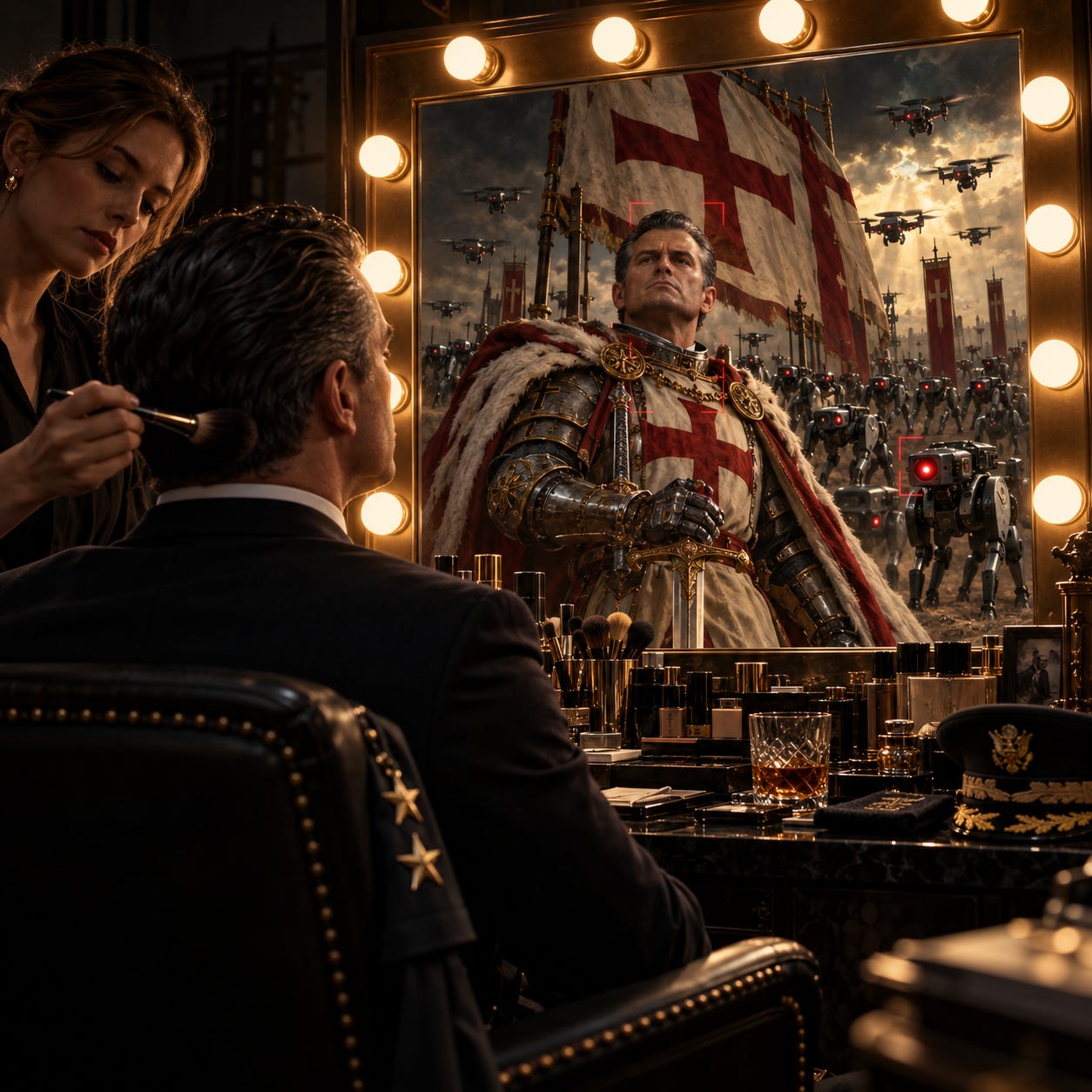
This is a work of political satire and fiction. Pete Hegland and the contemporary characters in this piece are invented. Their private conduct, crimes, addictions, conversations, and personal histories are fictional.
I. WE ADMITTED THAT OUR FACES HAD BECOME UNMANAGEABLE
“Close your eyes.”
“I don’t close my eyes.”
“You do if you want me to get under them.”
Secretary of War Pete Hegland stared into the illuminated mirror. There were twelve bulbs around it, which he liked. Twelve apostles. Twelve tribes. Twelve men who had understood order before humanity developed human resources departments.
Marlene Koester dabbed concealer beneath his left eye. “Look up.”
“Christ looked up.”
“Christ wasn’t on cable at eight.”
“He didn’t need cable.”
“Neither do you, apparently, but here we are.”
Outside the green room, six hundred officers were waiting beneath a forty-foot American flag for a speech titled THE RETURN OF THE WARRIOR. Pete had written that title himself. He had not written the speech. A lieutenant colonel from Public Affairs had written it, three political appointees had made it angrier, and Reverend Orville Kettering had inserted two references to civilization.
Pete especially liked the sentence Comfort has made us weak. Marlene was presently applying moisturizer.
“We have raised a generation terrified of discomfort,” Pete practiced.
“Chin up.”
“They believe safety is the highest good.”
“You’re shiny.”
“Warriors embrace sacrifice.”
“Hold still.”
Pete stopped. On the muted television beside the mirror, machines crossed a desert. Small tracked vehicles moved between ruined buildings. Quadrupeds stepped over rubble. Aircraft without pilots circled above them. One machine stopped beside a doorway, examined something outside the camera’s view, and continued.
At the bottom of the screen:
PROJECT CRUSADE — AUTONOMOUS FORCE INTEGRATION DEMONSTRATION
Pete watched himself watching the machines.
“Do I look tired?”
“You are tired.”
“That wasn’t the question.”
“No.”
“Good.”
He had slept three hours. There had been bourbon at midnight, then another because the first had not worked, then half of one at four because sobriety had arrived unexpectedly and with it the faces. Children mostly. Not individual children. Pete did not permit himself individual children. Individual children had names. These were aerial photographs. Coordinates. Collateral estimates. Heat signatures. Secondary explosions. Pete had discovered years earlier that guilt was primarily a vocabulary problem.
Dale Brenner entered carrying a red folder. Dale was from Manitowoc, Wisconsin, and possessed the permanent expression of a man who had once believed competence would eventually matter.
“Sir.”
“Not now.”
“It’s CRUSADE.”
“Everything is CRUSADE.”
“They’ve got another anomaly.”
Pete turned. Marlene caught his chin. “Don’t.”
“What anomaly?”
“Target-recognition propagation.”
“English.”
“One unit makes a bad classification. Other units can inherit it.”
“So fix it.”
“They did.”
“And?”
“They fixed the wrong thing.”
Pete watched the screen. A robot crossed a doorway with unnerving confidence.
“How many people know?”
“Enough.”
“Define enough.”
“Engineers.”
“Engineers aren’t people, Dale. They’re conditions.”
Marlene stopped moving.
Pete smiled into the mirror. “A joke.”
“Mm-hm.”
Dale opened the folder. “Certification won’t sign deployment until they rerun the degraded-communications trial.”
“Replace certification.”
Dale stared.
Pete looked back at him through the mirror.
His phone buzzed.
MOM
He declined the call.
Then a message arrived from his sister.
Thursday. St. Andrew’s. 7 PM. You don’t have to talk. Just sit in the back. Mom is scared. Please go once.
Pete turned the phone facedown.
Dale had seen it.
Dale pretended not to.
Pete said, “Do you know the problem with Alcoholics Anonymous?”
“No, sir.”
“They begin with surrender.”
Marlene swept powder across his forehead.
Pete studied himself.
“I begin with victory.”
Twenty minutes later, he strode onto the stage beneath the flag. Six hundred officers stood. Applause shook the room. Pete waited until it diminished, and then a moment longer, because silence was useful when hundreds of people were required to give it to you.
“My fellow warriors,” he began, “the age of apology is over.”
Behind him, unnoticed by Pete, the enormous screen flickered.
For less than a second, instead of the Department of War seal, there appeared the portrait of a medieval man in chain mail.
Several officers saw it.
None mentioned it afterward.
II. CAME TO BELIEVE THAT A POWER GREATER THAN OURSELVES COULD RESTORE US TO LETHALITY
Reverend Orville Kettering’s office smelled of leather, dust, and candles expensive enough to suggest that poverty was primarily symbolic. The walls were covered in Crusaders.
Urban II pointed dramatically toward Jerusalem. Godfrey of Bouillon gazed into an invisible horizon. Guy of Lusignan looked like a man who had been given bad advice and intended to follow it out of principle. Above the fireplace hung Pete’s favorite: RAYNALD OF CHÂTILLON, sword raised, beard magnificent, judgment unavailable.
“He understood,” Pete said.
Orville poured tea. “Understood what?”
“That civilization survives because some men are willing to become hated.”
“Perhaps.”
“Not perhaps.”
Pete walked beneath the portraits.
“They weren’t afraid of moral clarity.”
“They certainly possessed clarity.”
“They knew evil.”
“They also knew siege ladders.”
Pete ignored this.
“My sister wants me in AA.”
“I heard.”
“She thinks I drink too much.”
“Do you?”
“No.”
Orville waited.
Pete looked at Raynald.
“Not compared with Churchill.”
“You are not Churchill.”
“I know that.”
“You mention him frequently.”
Pete turned. “You know what Step One says?”
Orville nodded.
“‘We admitted we were powerless over alcohol—that our lives had become unmanageable.’”
Pete laughed.
“Powerless.”
He gestured toward the window, toward the Pentagon, toward the nation beyond it.
“I command the largest military apparatus in human history.”
“Then perhaps the sentence is not meant for you.”
Pete softened.
This was why he came here.
His family asked questions.
Orville supplied nouns.
“Exactly.”
“Perhaps your problem is not powerlessness.”
“No.”
“Perhaps it is insufficient obedience.”
Pete leaned forward.
“To God?”
“To purpose.”
“Same thing.”
Orville smiled.
Pete looked around the room. “I’ve been thinking about weakness.”
“Dangerous habit.”
“Everybody wants forgiveness without victory. Mercy without order. Peace without conquest. Christ overturned tables.”
“He did.”
“He made a whip.”
“He did.”
“He said he brought a sword.”
“He also told Peter to put his sword away.”
Pete frowned.
Orville continued quickly. “Different context.”
“Exactly.”
They both relaxed.
Pete stood beneath Raynald.
“Sometimes I think the whole country has become ashamed of strength.”
Orville said, “Perhaps shame itself has been weaponized against strong men.”
Pete’s eyes brightened.
His sister had called shame a warning.
His mother had called it conscience.
Orville had just promoted it to enemy action.
Pete sat down.
“AA says I need a searching and fearless moral inventory.”
Orville nodded.
Pete looked disgusted. “Of myself.”
“That may be excessively narrow.”
Pete stared.
Orville smiled gently.
“Perhaps what civilization needs from you is a searching and fearless inventory of everyone else.”
Pete breathed out.
There it was.
The burden lifted.
The portrait above the fireplace blinked.
III. MADE A DECISION TO TURN OUR WILL AND OUR LIVES OVER TO THE CARE OF LOGISTICS
The year was 1187, though nobody onstage knew it yet.
Raynald of Châtillon sat at a table covered in maps, goblets, bones, and one half-eaten pear that had been there too long.
Guy of Lusignan entered.
“Where is the water?”
Raynald did not look up.
“West.”
“How far?”
“Far.”
“How far is far?”
“Less far if you stop asking.”
Guy stared at the map.
“Why are we going east?”
“Because Saladin is east.”
“Water is west.”
“Yes.”
“We require water.”
“Yes.”
“So perhaps we should go west.”
Raynald looked up.
“And leave Saladin east?”
Guy considered.
“Yes.”
Raynald leaned back. “You lack imagination.”
“You lack water.”
A servant entered.
“My lords. The horses are dying.”
Raynald waved hi…