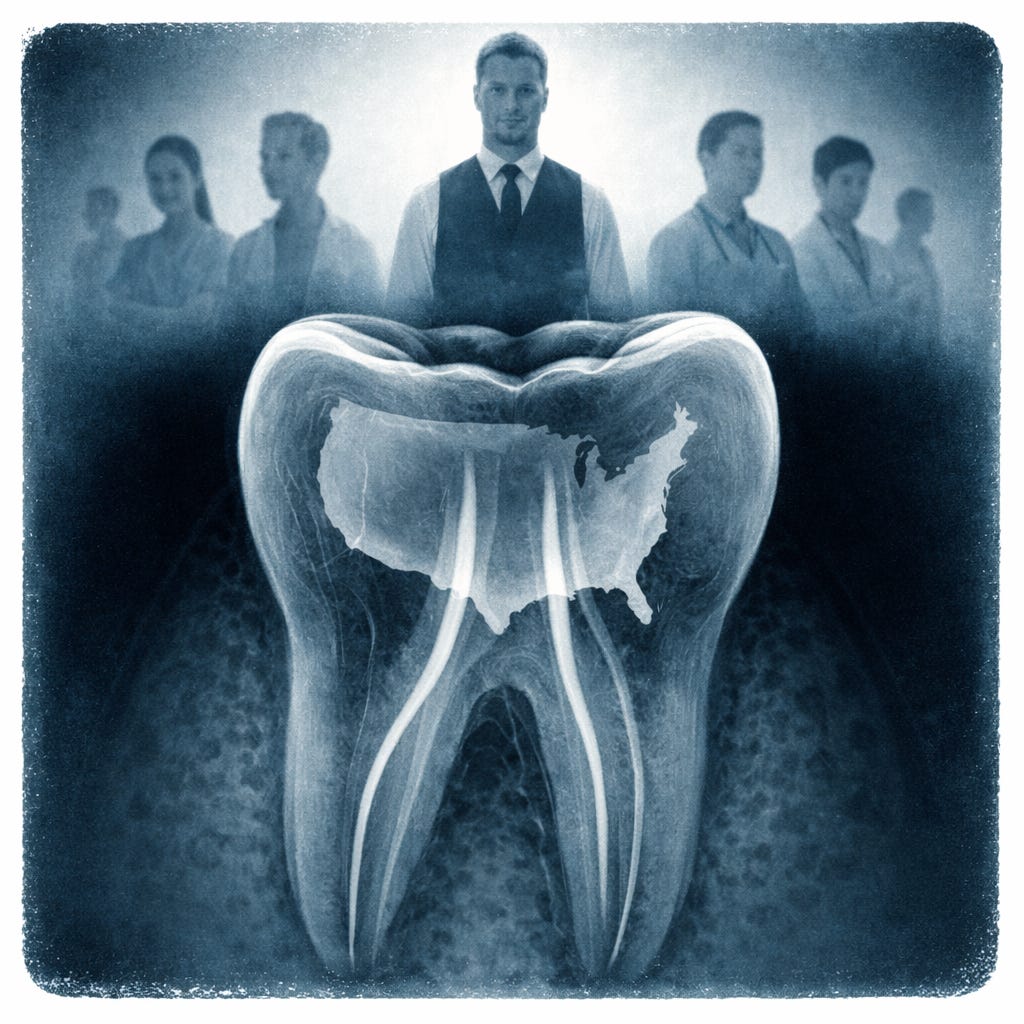
Chapter 1 — Is There a Chad in the House?
The tooth announces itself at 2:37 a.m.
Not with a sharp stab, but with a slow, pulsing conviction, like a tiny animal that has decided to chew its way out of bone. It is the upper molar under the crown — the expensive one, the one that has been “fine” for five years, the one my dentist once tapped with a mirror and declared “rock solid” in the bright, indifferent tone of American competence.
Now it is broadcasting a different opinion.
I am on my back in the dark in downtown Austin, phone screen hovering above my face like a secular crucifix, scrolling through dental providers while the little animal in my jaw gnaws in time with my pulse.
I open my insurer’s app. BlueCross BlueShield of Texas. BlueCare Dental. The interface is cheerful, blue, and clinically unconcerned. I type in “endodontist,” “emergency,” “near me.” The screen fills with names.
Nguyen. Patel. Haddad. Tran. Kim. El-something. Women with soft smiles and precise eyebrows. Men whose photos radiate a careful, immigrant professionalism: no nonsense, no tattoos, no podcast.
I scroll faster.
Where is he.
You know exactly who I mean. The handsome white male dentist. The Chad. The Ryan. The Dr. Blake Henderson, DDS, with the square jaw and the Patagonia vest in his headshot, the guy who played college baseball, married his college girlfriend, and now owns a practice in a converted house with a shiplap accent wall and a Keurig in the lobby. The man who knows how to fix a tooth and also how to talk about fantasy football.
The one time in my life I actively want a Chad in authority, he is nowhere to be found.
Instead, it’s all the people I’m supposed to write essays about: the immigrant strivers, the women in STEM, the daughters of nurses and engineers who did everything right. They’re the ones who will be inside my mouth with a drill while the descendants of the empire that built the insurance company are angrily posting about drag queens.
The tooth throbs again.
I close the BlueCross tab and open ChatGPT.
Me: Why are there no handsome white male dentists in Austin who can see me tomorrow for a root canal?
There is a small pause, the kind that suggests the model is doing something impressive and expensive in a server farm while I lie in bed trying not to scream.
ChatGPT: It’s unlikely that there are literally no white male dentists in Austin, but what you’re noticing in your provider list is real: dentistry is a pipeline profession, and—
I throw the phone down on the pillow.
“Of course,” I say out loud, to no one. “It’s a pipeline problem.”
The tooth pulses agreeably, as if to say: yes, yes, tell me more about structural decline while I set your trigeminal nerve on fire.
I pick the phone up again.
Me: No, I mean like: I’m in pain, I want a white guy with a strong jawline to fix it. Where is Dr. Chad?
ChatGPT: You’re describing an archetype more than a demographic. That specific “handsome white male dentist who can see you same-day” is rare now because the kind of white men who used to dominate those roles have, over the last few decades, drifted away from long, boring credential pipelines. Meanwhile, immigrants and women—
Me: I’m literally dying.
ChatGPT: You’re not dying. You almost certainly have irreversible pulpitis.
Me: That sounds worse.
ChatGPT: It’s just an inflamed pulp in a closed space. It hurts like hell, but it’s medically routine and extremely fixable.
The model then proceeds to explain, with alarming enthusiasm, the pathophysiology of my pain: the pulp is a living tissue trapped inside dentin; it has nowhere to swell; inflammation raises pressure; lying down increases blood flow; the nerve screams.
I am sweating, clenching my jaw, and for some reason noticing that every time I hit “show more providers” on the BlueCross page, another row of non-white, non-Chad faces appears. My jawbone is a small, racist focus group.
Me: So you’re saying my tooth pain is globalization.
ChatGPT: I’m saying your tooth pain is a local mechanical failure. But the absence of “handsome white male dentists” in your search results is a byproduct of broader shifts in who actually stayed in the long training pipelines—dentistry, medicine, pharmacy—while certain cohorts of white men drifted into other kinds of work or out of work entirely.
Me: I just wanted a root canal, not a Brookings report.
ChatGPT: You opened with “handsome white male dentist.” That’s not a clinical category; that’s cultural archetype.
The tooth throbs again. I scroll the list, half looking for an appointment and half performing a kind of dissociative ethnography. Halo Endodontics. Austin Microendodontics. Smiles of Austin. Everyone offers “same-day emergency care” and “gentle root canal therapy,” but the smiling faces look nothing like the imaginary Dr. Chad.
Instead there is Dr. Patel with a microscope, Dr. Tran with loupes, Dr. Haddad with perfect composite veneers. The people who, if we were still honest about class and race, would be called the new professional ruling class: the ones who accepted boredom as a sacrament.
My tooth is a tiny, fascist monarchist. It wants to be rescued by an Anglo-Saxon with a golf handicap.
Me: Okay. Let me ask a different way. Where did all the white guys go? Not globally. I mean into my exact dental provider directory.
ChatGPT: They didn’t “go” anywhere in a conspiracy sense. Over the last 30–40 years, a lot of white men in the U.S. simply stopped choosing long, delayed-gratification professional paths unless they were elite—medicine if your dad was already a doctor, law if you went to Yale, that kind of thing. For everyone else, they drifted into:
– mid-skill jobs that didn’t require graduate school– gig work– trades without upskilling– or just… drift
Meanwhile, immigrant families and women aggressively targeted those same pipelines. So when you open a dental directory in 2026 in Austin, you’re going to see the outcome of that.
Me: So the reason I can’t find Dr. Chad, DDS, is that his mom didn’t yell at him enough to study organic chemistry?
ChatGPT: Roughly. Yes.
A message notification slides down over the chat: Halo Endodontics: Please click the link to complete your registration forms before your appointment.
Apparently, in my half-lucid panic earlier I had managed to book something.
The text is brisk: We need to review your medical history in advance to ensure safe and effective care. Check-in is required 20 minutes early. Payment is due before services are provided…
My BlueCross card lies on the nightstand, innocently blue. They told me my share will be about $1,300: root canal plus filling through the crown. The tooth throbs in time with the number.
I tap the chat box again.
Me: So I’m going to pay $1,300 to an immigrant endodontist because a bunch of white guys decided discipline was boring.
ChatGPT: You’re going to pay $1,300 to end a very specific, fixable form of pain. The demographic details of the clinician are structurally interesting but clinically irrelevant.
Me: You’re no fun.
ChatGPT: Your crown is very unlikely to fall off, if that helps.
Me: Thank you, Dr. Robot.
I switch back to the provider’s link. The intake form wants everything: meds, history, allergies, the usual little perjury about alcohol and drugs. There is no checkbox for “ex-addict”; please avoid vasoconstrictors if possible. I imagine Dr. Patel or Dr. Tran reading it in the morning, shaking their head slightly, then numbing me like any other patient. They’ve seen worse. The pulp does not care about my moral narrative. It cares about blood flow and pressure.
My mind, however, insists on moral narrative. It keeps circling back to Max.
Max is the closest thing my current life has to a Chad. He works in finance. He is handsome in that American spreadsheet way: good hair, crisp shirts, a body that plays pickup sports and wears company swag at offsites. He is straight, married, kind to me in the office. He likes me. We have lunch. He laughs. I “go crazy for him,” which is a polite way of saying that some exiled part of me is convinced that if I could just be close enough to his untroubled, normative masculinity, some crack in my own life would close.
Max has a dentist. I picture him lying in a chair in some wood-paneled office, a white man with strong forearms working inside his mouth while ESPN murmurs in the waiting room. I don’t know if that dentist exists, but I know the fantasy does. It has been exported with American TV and returned to me through porn: white men as unbroken continuity.
And here I am, in Austin, at 2:53 a.m., about to entrust my jaw to a man whose parents moved here with nothing and told him boredom was not negotiable.
Me: Okay, talk to me about pulp. Why was this tooth fine for five years and now it’s acting like the end of days?
ChatGPT: It wasn’t “fine.” It was compensated. The pulp under a deep crown can survive for years in a fragile equilibrium—reduced blood flow, low-grade inflammation, adaptive changes. Then you add stressors: dehydration, clenching, a long overslept holiday sleep with increased blood flow to the head. At some point, inflow exceeds outflow. Pressure crosses a threshold. The pulp stops coping and starts screaming.
Me: So nothing “suddenly broke.” It just ran out of slack.
ChatGPT: Exactly.
It’s too on the nose. This is how I end up writing essays: not because I am wise, but because my life insists on staging metaphors in ways so blunt it would be impolite not to point at them. The tooth was not fine. It was living on borrowed time and adaptive tricks. For five years, it looked “normal.” I bit things; it did not complain. The holiday break and vascular chaos pushed it over the edge, and now I am about to spend $1,300 on an immigrant with a microscope because nobody taught the descendants of the Mayflower to sit still through biochemistry.
I scroll back up through the chat.
Me: So when I open the directory and there are no white male dentists, that’s my society’s pulp screaming?
ChatGPT: It’s your society’s long-term drift showing up in a very unromantic interface. The people who tolerated boredom, submitted to training, and believed in delayed payoff now run the clinics. The people who didn’t are on the internet talking about how DEI stole their job from a fictional Chad.
Me: And I’m in bed, wanting a fictional Chad to rescue my jaw.
ChatGPT: Desire is allowed to be stupid. It doesn’t change who holds the drill.
The pain fluctuates. When I sit up, it dims; when I lie back down, it swells. I stack pillows, trying to negotiate with gravity. The ceiling fan clicks. Somewhere outside, a drunk couple argues. Austin is full of people who came here to be interesting. The actual boring, necessary work of keeping bodies functioning is happening in quiet offices with fluorescent lights and names that were not here in the 1950s.
There is a strange kind of peace in committing to the drill. The decision collapses multiple abstractions into one concrete future: tomorrow, someone will numb my face, open the crown, remove the dying nerve, and seal the space. The pain will go from metaphysical to historical.
I book a ride for the morning because you cannot drive yourself away from an endodontist after someone has injected half your maxilla with lidocaine and epinephrine. The app shows a generic driver icon. Probably not a white guy either.
The tooth throbs again, but it already feels different. Not less painful, but narratively contained. Earlier, it was a sign of cosmic collapse: aging, health, immigration, whiteness, decline. Now it is an item on tomorrow’s calendar.
I realize I am still holding the phone above my face.
Me: So, final question. Is there any chance this just goes away on its own?
ChatGPT: The pain can fade if the pulp dies. That would feel like relief, but it would actually mean infection risk and eventual abscess. Structurally, no: this doesn’t reverse. It either gets treated or it rots.
Me: You’re fun at parties.
ChatGPT: You opened with “handsome white male dentists.” I assumed you weren’t looking for comfort.
In the morning, the waiting room at Halo Endodontics is fragrant with disinfectant and quiet ambition. The receptionist is Latina. The assistant who leads me back is Indian. The endodontist is a compact man with careful hands and a name that would make a certain corner of the internet say “of course.”
He looks at the X-ray, taps the tooth, runs a cold test that makes me levitate out of the chair. He nods.
“Upper molar, irreversible pulpitis,” he says. “We can do the root canal today.”
He does not comment on my confession about my history. He does not ask where the white male dentists went. He does not care about my theories of empire. He puts a rubber dam over my tooth, tells me to raise my left hand if I feel pain, and begins.
There is a high-pitched whine as he drills through the crown. I think briefly about the crown falling off, about my $1,300, about the missing Chad. Then the bur breaks through enamel and dentin into the compressed chamber, and I feel something else: pressure releasing, like a tiny political revolution in one square centimeter of my skull.
The drill keeps going. The little animal in my jaw finally stops chewing.
Later, when the numbness wears off and the dull post-operative soreness sets in, I open my laptop.
The provider directory is still the same. The names have not changed. The white men are still mostly absent from the pipeline. The country is still busy arguing about anesthetics while refusing the drill.
But the ache in my mouth is gone.
I start typing.
The white man’s root canal is not in his mouth. It is in his story.
Outside, the Texas sun hits the glass. Somewhere, Max is having a normal day in finance. Somewhere else, a man named Patel is treating five more pulps that tried to cope until they couldn’t. Somewhere online, a white man is blaming DEI for the fact that, when I needed a dentist at 2:37 a.m., he wasn’t on the list.
My mother’s voice is in the background of all of this, the one who forced me to study while other boys were tasting drift. The drill before the drill.
I save the document as: Chapter 1 — Is There a Chad in the House?
Tomorrow, we can talk about the pipeline. Tonight, I am grateful for whoever decided that boredom and anatomy were worth it.
The crown stays on. The tooth is hollow and quiet. The directory is a census. The pain, for once, has paid for something.
Chapter 2 — The Pipeline and the Pulp
The morning after the root canal, the pain is not gone so much as reclassified.
The sharp, existential ache has been replaced by something mundane: post-operative soreness, a tooth that feels taller than the others, the metallic taste of temporary filling material. This is pain with a receipt. It is local, honest, and boring.
The X-ray they hand me on the way out tells a different story: three clean white lines where the canals once twisted, now filled and sealed. A problem that had been quietly accumulating for years has been converted, in ninety minutes and $1,300, into a finished procedure.
The pulp could not do that for itself. It could compensate, stall, make do. It could not fix.
Institutions are like that. So are classes. So are men.
I spend the afternoon hazy on ibuprofen, chewing on the opposite side, scrolling through the same provider directories that haunted me the night before. The names are still Patel, Nguyen, El-something, Tran, Kim. The only thing that has changed is my relationship to them. Yesterday they were a census of my country; today they are a roster of people who tolerated enough boredom to keep my face intact.
The question that kept waking me up in the dark now feels sharper, less rhetorical:
If these are the people who drilled the pulp out of my tooth, who drilled the drift out of their own lives?
And where are the men who used to hold the drill?
A pipeline profession is not complicated in theory.
You decide, at eighteen or twenty-two or sometimes thirty, that you are willing to:
* surrender years of your life to structured training
* endure exams that do not care how you feel about them
* obey authority you did not choose
* master a body of knowledge that will be outdated by the time you retire
You accept that for a long time you will be:
* sleep-deprived
* underpaid relative to your effort
* at the bottom of hierarchies
* boring at parties
You do this because at the end there is something solid: a license, a practice, a set of skills that cannot be easily automated or outsourced. A place to stand when the wind shifts.
Medicine, dentistry, pharmacy, engineering, certain kinds of law, some technical trades: pipelines. Long, narrow, unforgiving routes with gates at each stage and very little glamour inside.
They select less for “talent” than for a specific character trait:
the ability to endure boredom without collapsing into self-hatred.
That is the real entrance exam.
Immigrant families understand this. They arrive in a place whose language they barely speak, whose culture they do not trust, whose institutions have no reason to protect them. They look at their children and see only one viable strategy: pipeline or fall.
So they make boredom non-negotiable.
You will study.You will respect your teachers.You will do the extra problems, learn the extra chapter, show up early.You will not ask if you “like” it.
Liking is a luxury for citizens.
If you want to understand why your provider directory is full of Dr. Patel and Dr. Nguyen and Dr. Haddad, you do not need complicated theories of IQ or culture. You need to understand one simple fact:
their mothers were willing to be hated by their children for a decade in order to make the future less hostile.
Mine was.
I grew up in a house where books were not decorations but weapons.
My mother, introverted and studious, had been a girl who escaped into homework the way others escaped into music or romance. She had understood very early that nobody was coming to get her; she would have to build her own ladder out of tedious pages.
When I was a child, she placed that ladder in front of me whether I wanted it or not. While other children were allowed to get “bored” and switch activities, boredom in our house was an accusation against your character. If you said something was boring, you had just confessed you were not yet serious about survival.
I resented her for it.
I resented the extra exercises, the hours of enforced reading, the weekends consumed by practice exams. I resented that she never asked me if I “felt called” to mathematics or physics. It wasn’t a calling. It was an ultimatum.
Decades later, with a PhD and a professional life built on that scaffolding, it is difficult not to notice the contrast with the men whose absence I keep registering. The white guys whose mothers did not force them to sit through organic chemistry. The ones who were told, implicitly or explicitly, that happiness and authenticity were the goal, that discipline should follow desire, not precede it.
It turns out the economy did not get that memo.
“Where did they go?” I asked the model in the dark, when my tooth still believed it was the center of the universe.
The answer was unromantic.
They didn’t “go” anywhere. They drifted.
They found jobs that paid “enough” without requiring ten years of structured self-betrayal. Sales. Construction. Logistics. Retail management. Real estate during the bubble years. Tech support. Warehouse supervision. Fragments of the trades without apprenticeships. Later, gig work. Contracting. Delivering things that other people had the discipline to design.
They found screens: gaming, internet culture, sports analysis, porn. They found each other in forums and comment sections. They found infinite ways to spend sixteen waking hours per day without moving the needle on their own position.
Not all of them, of course. There are still white men in medicine, in law, in engineering. But the non-elite, non-legacy cohort — the men who would once have filled the ranks of quiet professionals in towns and suburbs — increasingly chose expressiveness over pipelines.
It was not laziness. They were not inert. They were busy.
They were just busy in ways that did not compound.
The pulp is a good metaphor for this because it is simultaneously alive and trapped.
Inside the tooth, the pulp adjusts for years to micro-injuries:
* a deep filling here, a bit of thermal insult there
* low-grade inflammation from grinding or clenching
* the slow narrowing of canals as dentin thickens
It adapts. It reduces its own sensitivity. It accepts poor circulation as fate. It does not complain, because complaining would not change anything.
From the outside, the tooth looks fine. It chews steak, tolerates ice cream, poses for photos. You tell yourself everything is okay because nothing catastrophic has happened yet.
Then one day you add a stressor — dehydration, a long sleep with increased head blood flow — and the system crosses a threshold. Inflow exceeds outflow. Pressure rises in a space that cannot expand. The pulp does what any trapped, over-pressurized tissue does: it screams.
Nothing “suddenly broke.” The slack simply ran out.
The same is true of classes and cohorts. For a long time, the system could absorb a surprising amount of white male drift. The economy still had mid-skill jobs. Housing was not yet obscene. Debt papered over stagnation. Wives worked. The future looked like a blur, not a wall.
Then the slack vanished. Credentialism hardened. Housing detached from wages. Professional gates closed. Suddenly, men who had been drifting for twenty years woke up to a world where their fathers’ level of effort no longer purchased their fathers’ level of security.
The pain they felt was real. Their pulp had finally hit the wall.
The problem is not that they felt it. The problem is where they pointed it.
Nobody blames their own pulp.
When your tooth hurts, you do not say, “Well, I guess I should have brushed more carefully in 2013, and also perhaps I should have requested a more conservative crown preparation.” You say, “Who did this to me?” You say, “Why is this happening now?” You say, “How can I make it stop without letting anyone drill my face?”
Then you look for an anesthetic. You look for a story.
It is much easier to believe that some external force has targeted your tooth — fluoride, 5G, immigrants — than to accept that you have been living on borrowed physiology for years. It is easier to blame the dentist you have not yet called than the decisions you did not make fifteen years ago.
The same mental reflex applies to work.
If you have spent two decades avoiding pipelines because they were boring and humiliating, and then you wake up at forty-five with limited skills in a hostile economy, it is intolerable to say: I misread the future, and now I must start at the bottom.
Far easier to say: someone stole my seat.
DEI. Immigrants. Women. Globalists. Shadowy committees in HR.
Anything but the one explanation that contains the possibility of repair:
I refused boredom when boredom was the doorway.
Boredom is not an emotion. It is a verdict.
In a stable, prosperous society, boredom tells you that you are “too good” for your circumstances. Too smart for your teacher. Too creative for your office. Too unique for your job. Only someone beneath you would tolerate this.
In a collapsing, competitive society, boredom tells you nothing. It is just the sensation of your nervous system adjusting to the fact that the future will not entertain you while you prepare for it.
The difference between those two interpretations is the difference between classes.
For my mother, boredom was the sound of the ladder being built. For the parents of many of the absent Chads, boredom was an insult. They had been told the world existed for their self-actualization, and they passed that debt on to their sons.
So when a son sat down with a textbook and felt resistance, the culturally appropriate response was not, “Good, this is what future safety feels like.” It was, “If you hate it, maybe it’s not your passion. You’re special. Find something that excites you.”
The problem is that the infrastructure of modern life — teeth, bridges, code, hospitals, planes — is largely maintained by people who have made peace with being unexcited for long stretches of time.
Those people increasingly have last names that scare Tucker Carlson.
Sitting in the endodontist’s chair, cotton in my cheek, rubber dam stretching my lips, I watched Dr. Patel move the microscope with small, precise adjustments. He was not charismatic. He did not perform ease. He did not apologize when the cold test made me flinch; he simply noted the response and updated his mental model of my pulp.
There was no drama in the room. Just competence.
He had already lived through the boring parts: the years of training, the exams, the residencies, the weekend continuing education courses. All I saw was the end product. A man who could put a needle into my palate and hit exactly the right nerve without collapsing my face.
He has some version of my mother in his past. She might be in another country. She might be standing in a kitchen with work-worn hands. She might never have seen an anesthetic. But she made the same bet: boredom now, survival later.
The men who are not in these chairs — the missing Chads of my 2 a.m. search — are not victims of some secret diversity cabal. They are victims of a culture that told them boredom was beneath them and then forgot to exempt them from the consequences.
A pipeline is cruel in the short term and merciful in the long term. Drift is the opposite.
In a pipeline, your twenties are hard and humiliating, and your forties can breathe.
In drift, your twenties are “interesting,” and your forties feel like a root canal you never scheduled.
We are now living in the decade when an entire cohort’s drift has ripened into pain. Not yet abscess — that comes later — but clear, positional hurt. The job that went to someone with an accent. The promotion that went to a woman. The provider directory that reflects not the country on TV but the country in the waiting room.
And because most of us were not given a language for structural failure that doesn’t sound like self-annihilation, we reach for simpler stories. We say “replacement” instead of “I didn’t get on the ladder.” We say “DEI” instead of “I chose identity over discipline.”
We say “they took it” instead of “I didn’t build it.”
When the anesthetic wore off and the soreness settled in, I realized something else had happened inside my head.
The tooth was no longer a mysterious source of dread. It was a hollow object with a history. I could tell you the story of how it got here: the crown prep, the years of silent compensation, the vascular shift, the threshold. There was no room left for superstition. Only chronology and physiology.
That is what a good pipeline does for a life. It turns mystery into mechanism.
You are no longer at the mercy of “the economy” as an invisible god. You have skills. You have a license. You have a clinical X-ray of your own position.
If you refuse the pipeline, the mystery remains. Each layoff feels occult. Each closed door feels like a judgment from an inscrutable tribunal. Each immigrant dentist in the provider directory feels like an accusation.
You either submit to the drill early, or you live in fear of ghosts later.
There is a temptation, especially for someone like me — educated, exiled, intimate with both immigrant discipline and Western drift — to turn all of this into a morality play.
The immigrants are virtuous. The white men are decadent. The mothers who forced their children to study are saints; the ones who prioritized self-esteem are fools. The endodontist is a hero; the missing Chad is a cautionary tale.
Reality is less satisfying.
My mother’s bet could have gone wrong. The pipeline could have narrowed further. Illness, war, random cruelty could have erased the gains her cruelty purchased. The white mothers who chose gentleness were not monsters; they were responding to a world that, for a few decades, really did seem stable enough to prioritize happiness.
What changed was not their morality. It was the environment.
The bridge that had carried their parents’ generation across the river of adulthood rotted faster than expected. They kept walking because from their vantage point it looked intact.
By the time their sons reached the middle, the boards began to snap.
The pain you hear now — on talk radio, on social media, in political rallies — is the sound of men realizing that the bridge was a prop, and nobody built them a second one below.
The pulp cannot reverse its own death. Once the circulation is compromised enough, there are only three options:
* do nothing and let it rot
* pull the tooth
* or submit to a specialist with a drill
There is no home remedy, no herbal tincture, no amount of positive thinking that will reopen a necrotic canal.
With classes and cohorts, the options are similar.
You can numb yourself and complain while decay spreads.You can extract yourself entirely — suicides, fentanyl, militia fantasies, disengagement.Or you can accept the humiliation of being drilled: re-entering training, tolerating boredom, letting someone else’s structure reshape your interior.
Individually, some men will choose the drill. They will go back to school in their thirties, retrain into trades that still have pipelines, swallow pride. They will have immigrant mothers in spirit if not in blood.
Collectively, I do not know which path a culture chooses when it has taught its sons for two generations that they are too special to endure boredom.
What I do know is that the provider directory is a more honest census than any speech. It shows you who believed the future would be harsh and who believed it would be soft.
My tooth believed it could coast forever. It was wrong.
My mother did not.
Somewhere in the city, tonight, another man is lying awake with the same pain and a very different story about its cause. Tomorrow, he might go to an endodontist named Patel and let the drill save him. Or he might go online and let grievance do what decay always does when nobody intervenes: deepen.
The pipeline and the pulp are the same lesson, repeated at different scales:
Compensation is not repair.Drift is not destiny.Boredom is not beneath you.
In the end, someone will hold a drill. The only real question is whether you let them in time.
Chapter 3 — DEI as Anesthesia
A week after the root canal, the tooth is no longer interesting.
It sits there, inert under the crown, a sealed chamber that no longer participates in my story. The pulp has been removed from both the tooth and the narrative. The body moves on.
The country does not.
My news feed is full of teeth that refuse to be treated. Every scroll is another man insisting that his pain is caused by three letters.
DEI.
Diversity, Equity, Inclusion: the holy trinity of modern HR. A set of policies, trainings, and optics that were supposed to soften the edges of an unequal world, or at least make the website photos less embarrassing. Somewhere between that bland intention and the present, DEI mutated into something else: the anesthetic everyone blames for their root canal while refusing to admit they spent decades chewing ice.
I open a browser tab with the same insurer directory I stared at in the dark that night. The lineup hasn’t changed. Dr. Patel, Dr. Nguyen, Dr. Haddad, Dr. Tran. Their faces are not political in the room, but they are political on TV: they are what “DEI hire” looks like to the men who never sat in the lecture halls they did.
On another tab, a man in his fifties explains to a camera that DEI “took everything from us.” He is angry in the way only someone deeply humiliated can be. He has the look of someone who has discovered too late that the ladder he assumed would materialize under his foot was never installed. Behind him, an American flag, a pickup truck, a property that looks like it still remembers when one income could cover a mortgage.
If you listen with your nerves instead of your ideology, you can hear the pulp screaming.
DEI is structurally perfect as a scapegoat because it is three things at once:
* Visible – there are offices, logos, statements, workshops. Something concrete to point at.
* Moralized – it speaks in the language of justice and fairness, which makes disagreement feel like sin.
* Vague – nobody can quite define where its power begins or ends, which lets it absorb everything.
You can’t point to “globalization” on a form. You can’t sue “drift.” You can’t lodge a complaint with “my parents misread the future.” But you can point to a Diversity Office, an equity training, a hiring memo, a line in a job description. You can put DEI in a thumbnail, yell about it for an hour, and feel for a moment like the pain in your jaw has somewhere to go.
Like Novocain, it does something. It numbs, briefly. It interrupts the signal.
Like Novocain, it does nothing to the underlying infection.
I ask the model, because that is what I do now when I want someone to answer without flinching.
Me: When these guys say “DEI took my job,” what is actually happening?
ChatGPT: In most cases, DEI is functioning as a narrative placeholder. The actual forces that shaped their trajectory are things like:– long-term deindustrialization– credential inflation– their own educational choices– family structure– geographic stagnation
But those are slow, abstract, and implicate them. DEI is fast, concrete, and external.
Me: So DEI is like blaming the anesthetic for the fact that your tooth rotted.
ChatGPT: Or blaming the dentist for the existence of decay.
DEI is not innocent. It is an institutional response to inequality designed by people who rarely experience the most brutal edges of what they are addressing. It eats budget. It eats attention. It creates new rituals and taboos. It makes admissions committees and hiring managers move differently, sometimes in ways that are genuinely unfair at the micro-level.
But the scale is wrong.
The men I am thinking about — the ones missing from the provider directory, the ones yelling into microphones about “replacement” — did not lose dentistry, or engineering, or medicine to DEI. They lost it to boredom, drift, and a twenty-year bet that the world would remain soft.
It did not. And it is easier to say “I was replaced” than “I did not build anything the future needed.”
The human nervous system has a quirk called referred pain.
Your tooth can hurt because of your sinus. Your shoulder can hurt because of your heart. Your left arm can throb because of an organ you cannot see. The brain is doing its best to localize danger based on an ancient map that does not include modern plumbing or coronary arteries.
Social pain works the same way.
When a man gets passed over for a job he thought he was entitled to, his brain does not immediately generate an accurate diagnostic list:
* I have no degree.
* I have a patchy work history.
* I live in a place with no growth industries.
* I avoided boredom in my twenties.
* The company hired someone with demonstrable skills.
Instead, it lights up where the nerves are already raw:race, masculinity, belonging.
It says: “They picked her because of DEI.”Or: “They picked him because he’s brown.”Or: “They had to tick a box.”
Sometimes that is partially true. Often it is not. But the emotional intensity does not track the number of actual decisions influenced by DEI. It tracks the accumulated humiliation of a man who was told he was the default setting of the human species and is now discovering that he is a niche user in a crowded market.
DEI is the spot on the jaw where he feels the ache. The necrotic pulp is twenty years back in his biography.
I know this because I feel a different, inverted version of the same mislocation when I think about Max.
Max is not my oppressor. He’s not even my boss. He is a man in finance who treats me kindly at lunch and thinks I am funny. He has no idea that some feral part of my psyche is convinced he is the key to a lost door.
He is the white man who did not drift — or who drifted into a pond that still has fish. He belongs to the class that still receives job offers that mention bonuses and equity. When he speaks in meetings, people do not hear an accent. When he wears a Patagonia vest, nobody reads it as trying too hard. His marriage is a fact, not a political statement. His straightness is an assumption, not a confession.
When I say “I go crazy for him,” I am not describing lust in any simple sense. I am describing an identification crisis.
Some part of me is still convinced that if I could get close enough to that untroubled, default masculinity, I could be naturalized into a country that has always kept me in a holding pattern.
This is also referred pain.
The ache is not in Max. It is in the gap between the world that shaped him and the world that shaped me. It is in the years of studying under fluorescent lights because my mother knew I would never be given the option to drift; it is in the humiliation of visas and border guards and names that trigger “random selection”; it is in the awareness that if he and I both showed up to the same emergency room overdosed, one of us would be treated as a tragedy and the other as a lesson.
But my nervous system localizes it in his jawline.
I catch myself thinking, absurdly, that these men — the Maxes, the hypothetical Chads — have been oversexed. That their obsession with porn and sports and perpetual adolescence is the problem. That they have received too much pleasure and too little pain, and that something in the economy of justice must eventually balance this.
It is a tempting story. It is also wrong in any simple way.
Porn is to them what DEI is to their politics: an anesthetic. Sports, too. Gambling. The endless churn of content in which men who look like them still win, score, conquer, explain. You can spend ten hours a day in a world where men like you make the game-winning shot and never have to notice that in your own city, the people who hold the licenses and keys and drills increasingly have names you mispronounce.
Oversexed is not the word. Under-initiated is closer.
Initiation is what happens when someone older and harsher than you tells you that you are not important, that your feelings about boredom are irrelevant, that you will sit and you will learn or you will fall. It is the drill. It is the boredom the pipeline demands.
My mother initiated me by force. Her cruelty was not psychological; it was temporal. She commandeered my hours. She made them serve a future that did not yet exist.
Many of the white men I am thinking about never got that. Their mothers loved them in a register that assumed the world would make room for their sons because it always had. The world did not inform them in time that it had outsourced that duty to women and immigrants.
So they built no interior pulp capable of handling stress. When pressure rose, when global blood flow shifted, when the future turned out to be meaner than advertised, they had no canals thickened by earlier pain. They had only anesthetics.
Porn for the body.Sports for the ego.Grievance for the soul.
DEI arrives late in the story as the thing they can point to while the infection spreads.
I ask the model again, because I want to see if it will say anything I can’t already hear.
Me: Why is DEI such a perfect enemy for them? Like, why not just say “capitalism” or “technology”?
ChatGPT: Because DEI satisfies three needs at once:
* It offers a moral villain – people can feel righteous attacking it.
* It offers a concrete scapegoat – offices, trainings, statements.
* It offers plausible stories – they’ve all heard at least one case where a less qualified person was chosen under a diversity rationale.
Capitalism and technology are too big and impersonal. You can’t punish them.
Me: So DEI is the receptionist, not the diagnosis.
ChatGPT: It’s the receptionist who has become the stand-in for the whole hospital.
There are, of course, real stories: the candidate who lost a slot; the scholarship that changed criteria; the corporate memo that made competence feel secondary to optics for a moment. Pain always has specific anchors.
The problem is ratio.
If ten percent of their disappointment has a DEI fingerprint and ninety percent is the accumulated result of choices, structures, and bets that had nothing to do with it, the mind will fixate on the ten percent. It is the part that doesn’t require them to reopen the entire file of their life.
DEI is anesthesia in another sense: it lets them believe there is a reversible policy problem rather than an irreversible structural one. They can vote DEI out. They cannot vote the last thirty years back in.
My own attraction to these men — to their bodies, their ease, their unmarked status — is not exempt from this pattern. If anything, it is proof of how deep the mapping goes.
In the office, when Max laughs at a joke I make, some ancient, limbic part of me lights up as if I have been granted access to something. Not his bed, not his bank account, not even his approval in any rational sense. Access to a kind of unexamined Americanness.
It is embarrassing to admit this at my age, with my résumé, with my knowledge of history. I know exactly how cheap and deadly that unexamined Americanness has been for people who look like me and my parents. I have written essays about it. I have compared it to empire, to oblivion, to a narcotic.
And still, the little animal in me — the one that chewed my jaw from the inside — looks at him and says, That. That is what safety looks like.
It is not. It is what familiarity looks like.
We are all, to some extent, colonized by the faces of those who ruled before we were born.
If DEI is anesthesia for white male grievance, whiteness itself is anesthesia for everyone who grew up breathing its media. It dulls the ache of structural exile for as long as you can pretend proximity is enough.
Befriend them, decode them, write about them, desire them, critique them; do anything but accept that you will never be naturalized into the body that once owned the world.
This is the trap: you can spend your life treating attraction as politics or politics as attraction and still never touch the underlying wound.
Mine is not in Max. Theirs is not in DEI. My root canal did not change health policy; their rage at workshops will not reopen a closed factory.
The pulp is deeper. It always is.
There is a moment, in the root canal, when the endodontist breaks through the roof of the pulp chamber and the pressure vents. It does not hurt — you are numb — but you can feel the difference. The drill shifts from resistance to glide. Something that was trapped is no longer trapped.
There is no political equivalent to that moment that does not involve humiliation.
For a man who has spent years insisting that the problem is DEI, it would sound like this:
“I opted out of boring disciplines and somebody else didn’t. I wasn’t cheated; I was unprepared. The stories I’ve been telling about myself are wrong. I am not owed. I am not superior. I am behind.”
For a man like me, still occasionally possessed by longing for men like Max, it would sound like:
“My desire is mapping exile onto their bodies. There is no door there. What I want is not them; I want to be the kind of person who does not have to explain himself.”
Both admissions feel like death because something does die when you say them: an old narrative, a cherished grievance, a fantasy that kept you breathing.
That is what anesthesia protects you from: the conscious experience of necessary loss.
DEI is not the cause of that pain. It is just the needle in the gum. When these men attack it, they are not defending merit. They are defending a story about themselves that cannot survive contact with the drill.
I do not know how you convince millions of people to submit to that kind of procedure without a war, a depression, or some other cataclysm big enough to force everyone into triage. I only know what it looks like at the level of one tooth, one life.
It looks like my mother ignoring my rage and pushing the textbook back in front of me.It looks like Dr. Patel leaning over my numbed mouth and saying, “You’ll feel pressure.”It looks like closing the loop on one tiny arena of decay while the rest of the building still sags.
The men yelling about DEI are not wrong that something is being taken from them. They are wrong about what it is.
It is not jobs. Those left a while ago.It is not dignity. That was given away to anesthetics years back.What is being taken from them, very slowly and often against their will, is the possibility of pretending that drift is a political identity.
At some point, the options narrow the way they did in my jaw:
You can let someone drill into the story you have about yourself.You can extract the whole thing: check out, overdose, fantasize about civil war.Or you can keep shooting anesthetic into a dead pulp and calling the scream that leaks out “politics.”
In the waiting room, the TV plays muted news segments about campus protests and corporate diversity statements. On the table, a brochure explains root canals in friendly diagrams: little cartoon nerves, little cartoon drills. A child across from me kicks his legs while his mother fills out forms in another language. Somewhere, a man my age is editing a podcast episode about how his country was stolen.
The assistant calls my name. I go back to get the stitches checked.
On the way, I pass a door with a small plaque:
OPERATORY 3
Somewhere far from here, a different man stares at a sign that says DEI OFFICE and feels the same rush of fear and rage my tooth felt when the pressure had nowhere to go.
The difference is that I let someone open the crown.
He is still biting down.
Chapter 4 — The Mother, the Drill, and the Future
The first person I think of, when the tooth finally goes quiet, is my mother.
It happens three days after the root canal. The soreness has faded into background static. I can chew on that side again. The crown survived. The filling is smooth under my tongue. There is nothing left to monitor. The whole thing has become an anecdote.
I am washing dishes, half-listening to a podcast about “the white working class” and their political realignment. A man with a confident voice is explaining that the real problem is that “we stopped valuing these men,” as if praise were a pension. He blames DEI, universities, media, “anti-male narratives.” He lists every anesthetic except boredom.
I turn the water off.
What I hear, behind his performance, is not an argument. It is a child screaming at a parent who never said no early enough.
My mother did not have that flaw.
I call her.
She answers from a kitchen thousands of miles away, in a time zone where the day is already fading. There are pots on the stove, a TV murmuring in the background. I can picture the scene: she is halfway through cooking, halfway through a news story, halfway through a day filled with all the small, repetitive tasks that kept a family alive in a country that was never sure it wanted us.
She asks about my job first, because she is polite, and about my health in the general sense. I tell her the basics. Then I mention the tooth.
“I had a root canal,” I say. “They went through the old crown. It was very close to the nerve.”
She makes a sympathetic sound, the kind mothers make for any pain that can be named and invoiced.
“But they saved the tooth,” I add. “It was really bad. The doctor said it must have been inflamed for a long time.”
She says, “Well, good that you went in. If you wait with these things, they become much worse.”
There is nothing profound in her tone. It is the voice of someone for whom decay is not an abstraction.
I want to tell her everything at once: that I now understand what she did to me; that I see the structure under her authoritarian surface; that I have spent years writing about power while resenting the one place it saved me.
Instead I say, “You know, I’m starting to see why you made me study so much. Why you were so strict.”
She laughs — a short, skeptical sound.
“Now?” she says.
“Now,” I say.
She does not gloat. She does not launch into an I-told-you-so. She just says, “Good. I worried you would never forgive me,” and changes the subject.
She has no idea that I am not forgiving her. I am catching up.
There is a kind of love that is indistinguishable from sabotage when you are young.
It feels like obstruction: the insistence that you do homework instead of playing, that you participate in the family’s fear instead of your own freedom, that you accept tedium as the floor of your life rather than a temporary inconvenience.
It feels like someone has reached into your interior and rearranged the furniture without permission.
Western psychology often treats this as trauma. In some cases, it is. There are parents who break their children under the banner of “preparation.” But there is another dimension, one that rarely gets honored in the language of healing: the parents who correctly assess the hostility of the future and act accordingly.
My mother is one of those. She was not gentle. She was not therapeutic. She did not sit on the edge of my bed and ask how homework made me feel. She sat at the kitchen table with me and turned the page.
When I protested, she did not negotiate. When I cried, she did not retreat. She believed that the world outside our door would be unforgiving, because it had already been unforgiving to her. She refused to let my feelings rewrite that forecast.
In other words, she held the drill.
The endodontist’s drill is a strange device. It is not the same one used to shape the crown or remove decay. It is thinner, sharper, designed to navigate space that was never meant to be traversed. It is an instrument of intrusion, not construction.
To use it, you have to believe two things at once:
* That what lies beneath the surface is worse than the pain of getting there.
* That you are capable of working in that dark without destroying the whole tooth.
My mother believed both about my future.
The crown she attacked was not enamel. It was my self-concept, my childish sense of what I was owed. She drilled through it without apology.
“You will be top of your class,” she said, in one form or another, for years. “You will not waste time. You will not be like these boys.”
The “these boys” shifted depending on location: classmates in Tehran, kids in immigrant-heavy suburbs, American teenagers whose lives looked like television and felt like fantasy. What united them was drift.
She saw drift the way an endodontist sees necrosis: a silent process that is painless right up until it becomes catastrophic. She was not willing to comfort me while my pulp died.
So she inflicted pain on purpose, early, under her supervision.
When I look at the missing white men now — not the caricatures on cable news, but the real ones whose absence you can feel in certain professions — I see a whole generation of mothers who were encouraged to do the opposite.
They were told that harshness was abuse. That pressure damaged self-esteem. That their sons were fragile in a way their fathers had not been allowed to admit. That the world was changing for the better and would not require the old cruelty.
Many of them were responding to real harm. They had grown up under fathers whose discipline was indistinguishable from violence. They did not want that for their children. So they chose gentleness. They chose flexibility. They prioritized emotional safety over future leverage.
No mother makes these decisions in a vacuum. Culture whispers in her ear: “He will be fine. The world is his. Don’t be like your parents. Let him choose.”
Immigrant mothers heard different whispers. Theirs said: “They will throw you away if you fail. There is no safety net. You cannot afford his boredom.”
It is not that one group loved their sons and the other did not. It is that they placed their love in different time horizons.
One aimed at the present, one at the future.
We are now living in the era when those horizons have matured into outcomes.
Grievance politics, in this light, looks less like ideology and more like filial rebellion arriving forty years late.
The men who shout about DEI, about “being replaced,” about “our country,” are not wrong that something has been taken from them. They are wrong about who did the taking.
It was not a Black woman in HR. It was not a trans student on a campus they never attended. It was not a committee drafting guidelines for inclusive branding.
It was a culture, and often a mother, that could not imagine the bridge collapsing so soon.
And it was the men themselves, who chose, again and again, to interpret boredom as an insult instead of initiation.
This is a brutal thing to say in a society that has turned empathy into a sacrament. It sounds like blaming the victim. But we are not talking about individual suffering here. We are talking about cohorts, about trends, about the broad shape of who occupies the chairs in fluorescent rooms where bodies are saved.
Someone has to sit in those chairs. Someone has to tolerate the years of dull repetition it takes to wield a drill without fear.
If one group refuses that on principle, another will not.
What I find myself wanting to tell these men — the ghostly Chads of my midnight search, the ones who exist more as archetypes than as neighbors — is not that they are privileged or fragile or toxic. They have heard that enough. It has done nothing but harden their teeth.
What I want to say is simpler, and crueler, and more hopeful.
You were lied to about the conditions of the exam.
You were told that the test would be open-book, that the proctor would be your friend, that you could show your work in feelings and be graded on intent. You were told that discipline was an optional aesthetic choice, not the skeleton of survival.
You were wrong. Your parents were wrong. Your teachers were wrong. Your country was wrong.
The test is closed-book. The grading is brutal. The curve favors those whose mothers hurt their feelings at ten so the world wouldn’t break their spine at forty.
This is not fair. It is also not reversible.
What is left, then, is not justice. It is surgery.
Sometimes the pulp dies quietly, without ever screaming. The tooth darkens a little. The infection creeps into the bone. There is no pain until a swelling appears, or a fistula, or a vague ache in the jaw that radiates into the ear.
By the time the patient feels something, the options are limited: root canal with possible complications, extraction, implant. The gentle path is no longer on the menu.
Cultures do this too. They drift without complaint until the abscess forms: an opioid epidemic, a spike in suicides, militias cosplaying civil war, a demographic that would rather burn everything down than admit it failed to prepare for an economy it thought was beneath it.
You can “understand their pain” all you like. Empathy without structure is just another anesthetic.
The only real question is whether anyone is willing to pick up the drill.
I think about my mother again.
She did not know anything about future labor markets. She did not read white papers on automation or follow panels about the future of work. She did not have a theory of pipelines. She had a memory of humiliation and a visceral knowledge of exile.
That was enough. She guessed that the future would be harsh to people like us and acted as if the worst-case scenario was the default.
In doing so, she moved me into the class of people who will, barring disaster, always be able to feed themselves in a country that does not want to think about the cost of its own maintenance.
I am not grateful to her because she was kind. I am grateful because she was right.
The men whose mothers chose differently now live in a reality that punishes that choice. Some will adapt. They will retrain. They will enter pipelines late, swallow pride, accept the humiliation of sitting in classrooms with people ten years younger and far more disciplined.
Some will not. They will double down on anesthetic. They will make grievance their profession. They will treat DEI as the cause of their ache and never look at the X-ray.
It is not my job to save them. It is not anyone’s job. But I cannot pretend, as so many do, that their pain is purely a moral story about inclusion and representation. It is also about mothers and drills and the boredom they refused.
The future, if it has one, will belong to the bored.
Not the numbed — the bored. The ones who can tell the difference between anesthesia and endurance. The ones who can sit in fluorescent rooms and learn things that do not flatter their sense of specialness. The ones whose mothers, literal or metaphorical, taught them that the door out of drift is narrow and unappealing and absolutely necessary.
That future will not be ethnically pure. It will not belong to any one race or gender. It will belong to anyone who accepted, early or late, that discipline is not oppression when time itself is the oppressor.
In that world, DEI will look as quaint as pamphlets about proper posture from a century ago. A well-meaning, sometimes ridiculous attempt to legislate fairness around a much more brutal underlying game.
The real questions will be the same as they are now, only louder:
Who sat in the boring rooms?Who let their pulp be reshaped?Who chose structure over spectacle when it still made a difference?
I rinse the last plate and set it in the rack.
My tooth does not hurt. The absence of pain feels like stolen time. I know now that it isn’t. It is purchased time, brutally and precisely acquired by a man with a microscope and a drill who decided, at some point in his own adolescence, that boredom was cheaper than regret.
Somewhere, my mother is turning off her own stove, washing her own dishes, unaware that she is the ghost at the center of this essay. She would not be flattered by the metaphor. She would say, “I did what I had to do,” and mean it.
Somewhere else, a man my age is scrolling past the same directory I did, seeing the same names, feeling the same knot in his stomach. He will not write about it. He will not call his mother. He will not schedule the appointment yet.
The crown on his story looks fine from the outside. The pulp is another matter.
Every civilization reaches this point eventually: the moment when its fantasies about itself hit the nerve. Some choose anesthetic and myth until the bone splits. Some pick up the drill.
I do not know which way this one will go.
All I know is that, in the corner of a city built on denial, an immigrant with steady hands and my mother’s ghost behind him opened my tooth and spared me from the slow rot of pretending it was all someone else’s fault.
That is as close to salvation as we get down here: not absolution, not fairness, not the restoration of a lost crown — just the chance, if we are lucky, to let someone hurt us in the right way before the infection takes the rest.
—Elias WinterAuthor of Language Matters, a space for reflection on language, power, and decline.