I. Opening: The Word That Explains Too Much
There are words that clarify reality, and there are words that absorb it.
“Woke” has become the second kind.
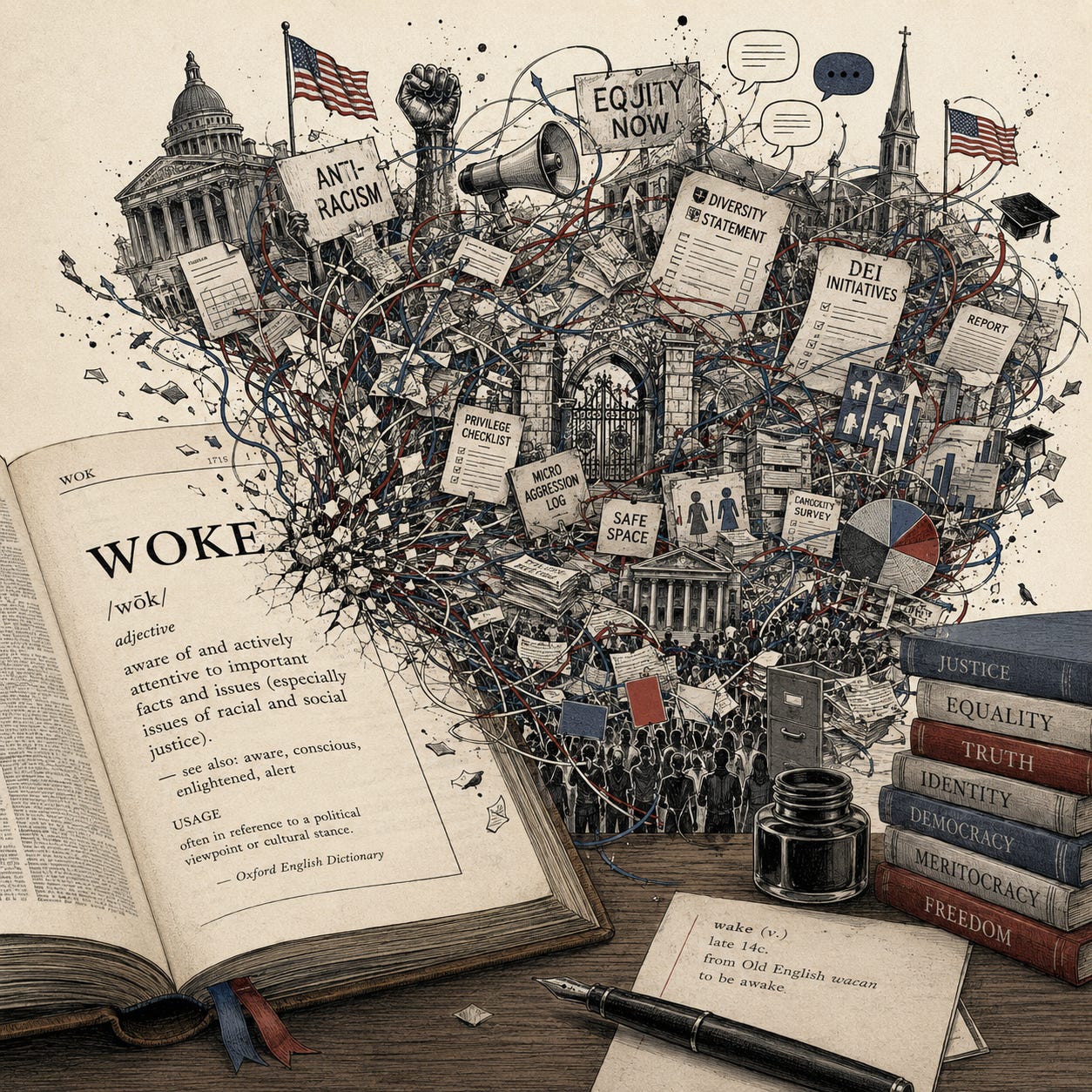
It is no longer a stable term. It does not point to one doctrine, one movement, one policy, one moral failure, or one political tribe. It has become a compression chamber for half the conflicts of contemporary American life. When someone says “woke,” they may mean racial justice, campus censorship, DEI bureaucracy, trans politics, corporate virtue-signaling, anti-meritocratic hiring, historical guilt, elite hypocrisy, language policing, moral performance, or simply the vague feeling that the world has changed and nobody asked their permission.
This is why the word is so powerful. It explains too much.
A precise word helps us think. An overloaded word helps us avoid thinking. “Woke” now functions less as an argument than as a flare: a signal sent into the tribal sky. It tells us where the speaker stands before it tells us what the speaker means.
The danger is not merely semantic. A society that loses the ability to distinguish between moral awareness and ideological coercion, between justice and bureaucracy, between compassion and performance, between grievance and historical memory, begins to lose the ability to govern itself.
A word becomes dangerous when it stops naming reality and starts replacing the work of thought.
“Woke” is one of those words now.
It began as wakefulness. It became consciousness. Then it became style. Then procedure. Then accusation. Then insult. Now it is a whole collapsed argument packed into one syllable.
To understand the word, we have to unpack the ruins inside it.
II. The Original Wakefulness
Before “woke” became an accusation, it was a warning.
Its earliest political force came from Black American speech, where to “stay woke” meant to remain alert: to danger, to deception, to racial power disguised as normal life. It was not a lifestyle brand. It was not a campus slogan. It was not a Human Resources module. It was a survival instruction.
To be woke was to know that danger often arrives wearing ordinary clothes.
The word carried a kind of moral realism. It said: do not sleepwalk through the world as it is described by those who benefit from describing it. Do not confuse legality with justice. Do not mistake politeness for safety. Do not assume that institutions are innocent because their language is clean.
In that original sense, wakefulness was not hysteria. It was perception sharpened by history.
A society built on slavery, segregation, exclusion, and selective memory requires certain people to develop double vision. They must see both the official story and the machinery behind it. They must hear what is said and what is meant. They must learn which doors are open, which are decorative, and which are traps.
That is the lost dignity of the word.
Before it became a culture-war object, “woke” named a form of attentiveness. It meant: stay conscious in a world that profits from your sleep.
That meaning should not be casually discarded. There are injustices that remain invisible precisely because the powerful call them normal. There are forms of danger that require vigilance to survive. There are social arrangements that can only be defended by asking the wounded to doubt their own perception.
Wakefulness, in that sense, is not ideology. It is the refusal of enforced innocence.
But no moral perception remains pure once institutions discover it.
III. The Expansion: From Alertness to Moral System
The word expanded because the problem expanded.
Or more precisely: the framework expanded. What began as alertness to racial injustice moved into a broader theory of structural power. Race, gender, sexuality, class, disability, colonialism, policing, language, representation, history, and institutional access were increasingly understood as interconnected systems rather than isolated prejudices.
This expansion was not inherently absurd. Much of it was intellectually and morally necessary.
A society can discriminate without announcing discrimination. A workplace can exclude without using slurs. A school can reproduce hierarchy while speaking the language of opportunity. A country can celebrate freedom while forgetting the people whose labor, land, and bodies made that freedom possible. Power is often most effective when it becomes atmosphere.
The progressive impulse, at its best, tried to make invisible power visible.
It asked: Who is missing from the room? Whose pain is treated as anecdotal? Whose language is considered professional? Whose history is called divisive? Whose anger is pathologized? Whose comfort is protected by the accusation that everyone else is being too sensitive?
These are not frivolous questions. They are civilizational questions. A society that cannot ask them becomes sentimental about itself.
But attention can harden into doctrine.
The moment moral perception becomes a total explanatory system, it begins to lose humility. It no longer asks where power is operating; it assumes power has already been mapped. It no longer listens for complexity; it assigns roles. Victim, oppressor, ally, colonizer, marginalized, privileged, unsafe, harmful, centered, erased. These words may reveal something. They may also replace the person standing in front of us.
That is the first corruption: when categories built to expose dehumanization become capable of dehumanizing in return.
The second corruption is institutional. Once universities, corporations, nonprofits, foundations, media organizations, and government agencies adopted the vocabulary of justice, the language changed again. It no longer belonged only to activists, writers, students, or communities trying to name their conditions. It became professionalized.
The moral vocabulary became administrative.
And once conscience becomes administrative, it begins to behave like administration.
IV. The Bureaucratization of Conscience
Institutions do not know how to love justice, so they manufacture procedures that imitate it.
This is the heart of what many people now mean when they complain about “wokeness.” They are not always objecting to moral awareness itself. Often they are reacting to the bureaucratization of moral life: the transformation of conscience into compliance.
The signs are everywhere.
The mandatory training that reduces history to a set of approved responses.The DEI statement that asks not what a person has done, but whether they can speak the institutional dialect.The campus policy that cannot distinguish between harassment and discomfort.The corporate email that mourns injustice in perfect brand voice.The land acknowledgment delivered by an institution that has no intention of returning anything.The hiring rubric that quietly turns moral vocabulary into a credential.The administrator who treats reputational risk as ethical urgency.The public ritual in which everyone says the correct thing and nobody is changed.
This is not justice. It is moral risk management.
The institution does not become brave. It becomes fluent. It learns the language of vulnerability, equity, harm, inclusion, trauma, and belonging. But too often, the language functions as insulation. It allows the institution to appear morally awake while remaining structurally asleep.
The corporation can celebrate inclusion while suppressing wages.The university can denounce privilege while charging impossible tuition.The nonprofit can speak of community while exploiting the emotional labor of its staff.The elite institution can confess complicity in beautiful prose while preserving every mechanism of selection that produced its power.
Here the conservative critique finds real material. Not all of it, but enough.
There is something grotesque about institutions discovering moral language only after that language becomes useful for legitimacy. There is something spiritually deadening about watching justice become a style guide. There is something false in a moral culture where the right words can subs…