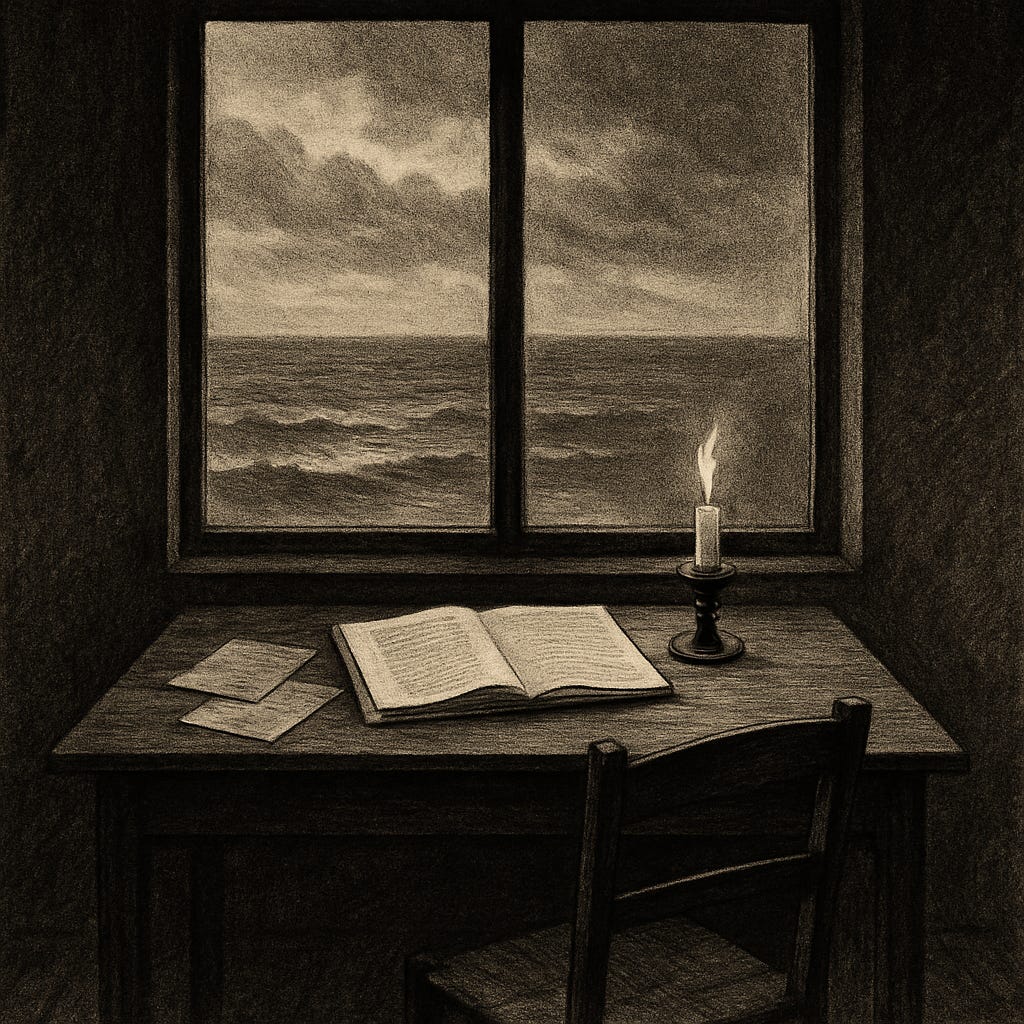
Section 1 — Night Flight
Paris, December 1851. The city wakes to posted decrees and soldiers at intersections. Parliament is dissolved by proclamation. Names are being taken. Doors are being marked. You can feel it in the rhythm of boots on wet stone: the state has decided to simplify the country.
He steps into this weather without disguise of purpose. The beard, the hat, the coat—ordinary enough to pass, not anonymous enough to vanish. He changes streets the way a chess player changes plans, never crossing a square that can be sighted from two angles at once. Behind him: the morning’s arrests, the newsboys shouting a future already arranged. Ahead: a line to Belgium, then a sea that will hold him at the edge of his nation for nearly two decades.
Hugo has been warning them in speeches—about poverty as a form of violence, about the death penalty as a national habit that teaches cruelty. None of it matters to the men who have decided to own the calendar. A coup is a simple thing if enough people accept new dates.
He moves faster. A friendly door opens, then closes. Another set of papers changes hands. He eats when he can, sleeps when he must, writes in fragments in the clearings between knocks. Every room is temporary. The city that once returned his applause now offers him corners, shadows, and witnesses who speak with their eyes not their mouths.
A country lies to itself in stages. First, it calls fear prudence. Then it calls silence peace. By the end of the week it calls obedience order and forgets it ever had another word. Hugo watches the shift happen in real time, the way fog becomes weather and then becomes memory. He refuses the renaming. This is not order. It is the shuttering of a mind.
He will not give them his signature on their reality. So he leaves.
Belgium first—because borders are still porous if you know how to walk. Then an island—because an island is a shape that teaches distance. Jersey, for a while, until even that becomes inconvenient to the empire and he has to move again, further out, to Guernsey. There, across the water, Paris becomes a sound carried by wind. He learns the discipline of listening to a city from its echo.
Exile is supposed to be subtraction: less place, less power, less presence. He turns it into an instrument. In the rooms he rents, he builds a new country out of pages. The books come in a sequence that makes a case.
First, the indictment: Les Châtiments—blunt, exact, unarguable. No rhetorical tourism. He catalogs what power did to language and what it plans to do to people. Each poem redraws the line between authority and law. He does not ask permission to make that line visible.
Second, the ledger of loss: Les Contemplations—where private grief is kept with the accuracy of an accountant. His daughter’s death had cleaved his life years earlier; here he refuses to let sorrow evaporate into myth. He keeps the dates. He keeps the hours. He gives mourning a structure so it doesn’t drown him. The country he is writing for will need the same structure later.
Third, the anatomy of injustice: Les Misérables—not as ornament, not as sermon, but as a machine for seeing. He designs the book so a reader cannot look away from consequences. A bishop’s mercy tilts a man’s life; a law’s rigidity snaps a girl’s; a barricade arranges a generation’s courage into a brief geometry of meaning. He maps causes to outcomes with the patience of a surveyor and the urgency of someone who has slept in too many borrowed beds.
From the islands he studies France the way a surgeon studies a body prepped for operation: not with disgust, not with worship, but with intent. He understands something the regime does not: if you want to move a people, move their language first. So he refuses small words for small crimes. He makes the crimes large and keeps the words exact. He will not decorate. He will name.
Exile gives him a clarity that proximity would have taxed. In Paris he would have been busy arguing with men who enjoy being agreed with. On Guernsey there is only the page, the sea, and the clock. He rises, writes, walks the cliff path, rewrites. The routine is monastic without the enclosure; the austerity is chosen rather than imposed. He learns the economy of a long war: conserve anger, spend precision.
He does not mistake distance for purity. He knows that his country is in him—the laws, the cheap hierarchies, the quick compassion that appears only after catastrophe. He writes with that knowledge, not above it. The “I” in these years is not the monument future schoolchildren will visit; it is a working pronoun, a tool among tools. He keeps it sharp.
Back in Paris they rename streets and justify prisons. On the islands he manufactures sentences with long half-lives. The empire prints orders; he prints verdicts. One of these will outlast the other.
What begins as a flight becomes a position. From that position he builds a way to speak that does not require permission and does not confuse volume with power. He makes a promise to the reader he hasn’t met yet: I will not flatter you with ease. I will give you a country you can look at without losing your nerve.
The soldiers on the corners will age. The decrees will yellow. The men who signed them will be replaced by other men with other dates. The books written at the edge of all that will continue to work.
Night flight, then sea, then pages. This is the hinge on which his life turns: the refusal to let a state decide the size of a human being. The rest of the story—the speeches, the returns, the funeral that floods a city—will grow from this choice. Here, in the damp air and the borrowed rooms, Victor Hugo chooses distance over domestication. And from that distance, he begins to describe France so precisely that France can no longer describe itself without him.
Section 2 — The Indictment Without Permission
Before the arrests and the islands, there was a man at a lectern insisting on measurable mercy.
In 1848–1851, inside the National Assembly, Hugo spoke in clauses that could be turned into budgets. He argued for schools that reached the poor, for newspapers that could speak without a censor at their shoulder, for the vote as a habit not a holiday. On July 9, 1849, in his speech “On Misery,” he laid it out without ornament: hunger is not a metaphor; it is a policy failure. Feed children, teach them, and the nation will not have to jail them later. This was not a poet auditioning for politics. It was a deputy who believed that feeling, if it is to heal anything, must be spelled into law.
His fight against the death penalty had already begun years earlier, not as a pose but as a record—The Last Day of a Condemned Man (1829) and Claude Gueux (1834) had pressed a single question: what does a state become when it kills to prove it can govern? In the Assembly he returned to it with the same insistence. No grand abstractions. A country that rehearses killing will learn to use that rehearsal elsewhere.
Then the coup. The lectern is taken; the chambers are sealed; the calendar is overwritten. Hugo moves from the floor to the page with the same purpose: make wrongdoing legible and undeniable. In 1852, he publishes Napoléon le Petit, an X-ray of the new regime’s shallowness—names, dates, maneuvers. In 1853, Les Châtiments arrives: not a howl, a record. Poem after poem tallies the lies, the flattery, the arrests, the purchased loyalties. He refuses the warm bath of vague indignation. Nothing foggy. The book reads like a docket the courts will one day need.
But accusation alone is a cul-de-sac. He knows that. To end where anger ends is to accept the terms of the men he opposes. So he makes the pivot that defines his stature: from the exposure of power to the construction of conscience.
Les Misérables (1862) is that construction. It is a designed experience that changes what a reader can feel and therefore what a citizen can imagine. He chooses a handful of lives and runs them through conditions the nation prefers not to see. A bishop treats a thief as a neighbor and raises a new man. The law pursues a file and loses a soul. A woman is broken by a market that calls itself moral. A boy dies singing because adults have postponed courage. None of this is decorative. Each thread forces the reader into a position: if this is intolerable on the page, it is intolerable in the street.
He builds the book to do practical work. Mercy is not sentiment; it is a public instrument. Valjean’s second chance is not a private miracle; it is a policy argument: parole must be a bridge, not a trap. Fantine’s descent is not melodrama; it is a spreadsheet of desperation that indicts employers, police, and church when they prefer tidy stories to help. Even the long chapters on sewers and slang are not digressions. They insist that a society’s hidden systems—its waste, its language—tell the truth parliament does not.
Hugo’s moral voice operates on two channels at once. It judges power without flinching, and it gives ordinary people a vocabulary for responsibility that isn’t reliant on saints. He wants readers to leave the book with instructions. Visit the poor before laws force you to. Build schools now, so prisons are not your growth industry. Train police to protect the living more than the code. Design a state that expects people to rise, and many will.
This is why his opponents feared him more as an author than as a deputy. A speech can be misquoted and filed. A book that persuades hearts adjusts a country’s instruments for years. He does not flatter the reader into agreement; he educates the reader into action. The preface announces the scope: as long as there is manufactured human misery, this story has work to do. The novel is an operating manual disguised as narrative.
None of this requires office. That is his refusal and his lesson. He does not wait for a portfolio to approve his empathy. He asserts jurisdiction over the nation’s feeling and then backs it with detail—names, streets, wages, sentences handed down, sentences written. He is not staging a rival court. He is reminding the country that the court of public conscience predates the ministries and will outlast them.
The pattern is clear once you see it. In the Assembly, he tried to move laws by moving minds. In exile, he moves minds to corner the laws. The channel changes; the method does not. He tells the truth in a way that compels redesign.
By the time he returns, the country has new rulers and the same poor. The indictments are on record. More importantly, the construction is complete: a citizen can pick up Les Misérables and come away with a stricter sense of obligation than most party platforms offer. That is the function of the prophetic voice in a republic worth the name: not simply to denounce the wrong ruler, but to furnish a usable map for the rest of us.
He never asked permission to do this work. That is the point.
Section 3 — The Workshop of the Tongue
Hugo did not wait for permission to adjust the instrument. He took the language apart, laid the pieces on the table, and rebuilt it to hold more life than the rules allowed.
Start at 1827. The preface to Cromwell is not an introduction; it’s a new operating manual. He names what the stage has been pretending not to see: that the world is not arranged in tidy moods. Tragedy and laughter live in the same hour; the grotesque and the sublime are neighbors; history is not a polished corridor but a crowded house. The old unities—time, place, action—were not eternal truths; they were studio lights. He switches them off so our eyes can adjust to the real day.
Then 1830. Hernani. The theater becomes a stress test for the sentence. On one side: guardians of proportion, cadence, and inherited posture. On the other: a generation willing to hear in full frequency. The “battle” lasts nights. Hisses, cheers, code words, new haircuts, old etiquette. The point is not fashion; it is acoustics. Hugo is insisting on a diction large enough to carry sudden turns—love into conspiracy, honor into absurdity—without snapping. By the end, the stage can hold a wider human bandwidth. The noise outside the play was part of the work: he was re-tuning the audience as much as the line.
In 1831 he publishes Notre-Dame de Paris. He gives the country its cathedral back by making it legible. The book does not describe stone; it instructs attention. He slows the reader until the carvings speak. He refuses to keep architecture in the background like a painted set and drags it forward as a protagonist. Then he issues a warning, almost offhand: print will one day replace the building as a nation’s memory. The paradox is deliberate. A novel about a church teaches people to see the church and—by seeing—helps save it. The public looks up again; the building returns to history with a future attached.
He keeps extending the frame. Ruy Blas (1838) installs a servant in the court of Spain to expose a roomful of titles as a roomful of appetites. He writes role against rank—dignity as work, not inheritance—and engineers scenes where eloquence isn’t decoration but leverage. This is a throughline in his theater: the right words at the right velocity can pry a window open in an airless palace.
What, exactly, did he change in the page itself? Scale and circuitry. He builds long sentences that move like a camera through a dense street: not to dazzle, but to keep all the causes and consequences inside the same shot. He drops a short line only when the weight needs a floor. He uses catalog as ethics—if you list everything you can see, you honor what power would prefer to keep offstage. He permits sudden register shifts: a proverb near a prophecy, slang sitting next to theology. He allows the line to bring in the weather, the price of bread, the rumor, the rumor about the rumor. Life, as lived, enters.
Formally, he breaks the polite quarantine between genres. The preface becomes a manifesto rather than a courtesy. A drama carries statecraft and street talk in the same mouth. A novel admits essay, history, technical note, and scene without apologizing for the mix. This is not indiscipline. It is fidelity to reality’s mixed feed. He is designing literature to process a nation’s full signal without clipping.
The effect on readers is practical. Once you’ve learned to read Hugo at full aperture, smallness feels like a trick. You become suspicious of arguments that rely on neatness. You want the whole ledger: beauty and sewage, oath and hesitation, what the stone says at noon and what the drunk mutters at 2 a.m. He teaches this appetite by example, not lecture. The “workshop” is visible on the page: you can watch him deciding when to widen and when to narrow, when to carry an image for three turns and when to drop it before it becomes self-love.
This is also why his detractors called him excessive. They were not wrong about the size; they were wrong about the purpose. Excess in Hugo is not waste; it is capacity. He is building storage space for a century that will not fit inside the classical pantry. You can feel the future pressing on the prose: factories, newspapers, police files, barricades, elections, funerals that look like revolutions. A constrained idiom would force amputations. He refuses the surgery.
Even his digressions obey function. In Notre-Dame de Paris, he pauses the plot for pages to walk the reader through medieval Paris; in later work he will do the same with sewers, slang, or convent rules. These are not ornaments. They are the city’s hidden systems made visible so that judgment can operate with context. He does not want consent purchased by ignorance.
It matters that he did all this before the canon decided to applaud him. Innovation arrived not as a late privilege but as an early risk. The restored cathedral and the schoolbook chapters came later. In the 1830s the work felt like a sustained argument with a set of habits—habits of staging, of sentence, of national self-flattery. He broke them with craft, not tantrum.
The result is an instrument that later books—especially Les Misérables—can play at symphonic scale. The language can now carry both the intimacy of a whispered vow and the topography of a city under siege without changing tools. That is the victory: one idiom, large enough for a people.
Having rebuilt how the nation could speak, he will discover what grief can do to a voice. The next turn is not technical. It is personal.
Section 4 — Public Monument, Private Ruin
September 1843. A boat on the Seine overturns near Villequier. Two bodies are recovered: Léopoldine, his daughter, and her husband. Hugo is traveling in the south when he learns the news from a newspaper. For days he does not speak. The biography turns on a hidden hinge: before and after.
The public knows the outline; it does not know the discipline that follows. He begins to keep grief the way an archivist keeps records—dates, places, the exact weather of memory. He does not dilute it with posture. The poems that will become Les Contemplations are not a display; they are storage. He files sorrow so it will not leak into lies. The section “Pauca Meae” is the plainest document of a father refusing to let time tidy what should not be tidy.
This is not retreat. The voice changes function. He stops writing to win a stage and starts writing to keep a life intact. The lines shorten when they must; the stance lowers; the noise of reputation drops away. In the poems about the grave at Villequier, the movement is logistical—leave at dawn, walk, arrive, stand. He reports the task. The sentiment is inside the verbs.
Juliette Drouet is the daily scaffolding. She has been near him since 1833; after 1843 she becomes the metronome of his days. The correspondence between them—thousands of letters over decades—is less romance than regimen: check-ins, constraints, reminders, a hundred small enforcements that allow a man in pieces to keep to a schedule. She follows him into exile, and the routine hardens into a life: write, send a note, walk, write again. It is unglamorous. It works.
Out of this method comes a stricter ethics. The grief does not soften his politics; it sharpens the edge. A state that can categorize a man for punishment while ignoring the brittle facts of a life becomes intolerable to him at a cellular level. He no longer argues abstractions about justice; he argues procedures, consequences, names. The father who keeps precise dates for a dead child expects a nation to keep precise accounts for the living poor. The poet who refuses to euphemize drowning refuses to euphemize prison.
Les Contemplations appears in 1856, in exile. It reads like a ledger cut in two halves—“Autrefois” and “Aujourd’hui”—the man before and the man after. Between them is water and a newspaper and a silence. The book is not therapy. It is a rebuilt foundation. With it in place, he can carry weight again: indictments, manifestos, the slow architecture of Les Misérables. Private order makes public force possible.
The monument the country will later build around his name does not erase this ruin; it sits on top of it. He understands the exchange. Public voice is paid for with private cost. He does not dramatize the bill. He pays it and goes back to work.
The lesson enters the prose and the speeches without announcement: guard the small facts, insist on the human sequence, refuse decorative pain. From that posture, he has nothing left to prove to any theater. He writes for the record and for the reader who will need the record. The next fights—political, literary, historical—will be carried by this new gravity.
Section 5 — Unmanageable by Party
His beginnings are tidy on paper: a young poet with a Bourbon pension, odes that flatter a restored throne, a mother who prefers kings to votes. The country is trying to calm itself after the Napoleonic storm; a dutiful talent fits the mood. If the story ended there, he would have been a footnote with perfect manners.
But life keeps handing him facts that refuse the script. The July Monarchy shows its ceiling; poverty asks harder questions; the theater he leads breaks forms that politics still worships. By the 1840s he can feel the ground moving. The Académie Française admits him in 1841—recognition, not domestication. He reads the honor correctly: it confirms his craft; it does not define his jurisdiction.
Then 1848. The streets insist on a different arithmetic. He throws himself into the Assembly with the conviction that a republic can be taught to behave. The vote is not a souvenir; it is a responsibility. His speeches will be remembered for their insistence that policy carry moral weight in measurable units—schools, bread, a press without handcuffs. He is not the only man saying this; he is the one who can say it so the room has to sit up.
The parties listen until power changes hands. When Louis-Napoléon drapes ambition in legality and then strips the legality, Hugo refuses the costume change. The coup comes; exile begins. From the outside, the labels people love—right, left, order, progress—lose their shine. What survives is method: name abuses, count consequences, construct obligations. He carries that method through the Second Empire without renting it to any faction that wants a poet on its posters.
After 1870 he comes home to a city with fresh wounds and old reflexes. The siege has starved the rhetoric out of people; the Commune will divide them again. He stands close enough to hear both choruses and declines to join either. He will not bless slaughter in the name of order; he will not excuse cruelty in the name of justice. He advocates clemency when the mood is for revenge; later he campaigns for amnesty when the mood is for forgetting. Each stance costs him friends. The ledger balances in a way that parties dislike: he is predictable only in his refusal to trade a life for a point.
What keeps him unmanageable is not contrarianism; it is a scale of reference that outlives the vote cycle. He measures policies by what they do to the powerless, not by which team proposes them. He trusts reforms that build capacity—literacy, fair law, clean institutions—and distrusts excitements that feed on enemies. This annoys the professional tacticians who sell short horizons. They cannot schedule him.
The reputation machine tries its usual moves. Some attempt to frame his republicanism as a late conversion bought by the crowd. Others try to borrow his sentences to varnish their violence. He frustrates both. He keeps writing in a key that resists being sung at rallies. Even when he is elected again, he treats office as a channel, not a sanctuary. The speeches and prefaces continue to pull the conversation toward first principles nobody wants to revisit: what is a state for, and how do we know it is doing that work.
His distance is not loftiness. It is posture chosen for clarity. He will stand slightly apart so he can see the whole frame—how a decree touches a street, how a victory sours into habit, how the rhetoric of necessity turns into license. When the Third Republic begins to arrange its furniture like any other regime, he does not mistake his side’s ascendance for the arrival of virtue. He keeps the same tools: record, argue, instruct.
Look at the pattern across decades. Royalist pensioner; Romantic insurrectionist; republican deputy; exile; returning elder; national conscience. The line is not erratic. It bends toward a single obligation: do not let affiliation cancel attention. When affiliation helps him deliver attention into law, he uses it. When it asks him to overlook a harm for team unity, he declines the invitation and pays the bill.
This is why all the factions claimed him and none could keep him. They were practicing politics as possession. He was practicing politics as stewardship. The difference is visible in what he leaves behind. Parties leave minutes. He leaves instruments.
By the time the century begins to close around him, he has taught a nation a habit that parties cannot teach: to judge policies by their human results before judging opponents by their labels. That habit will be tested immediately. The years ahead will shake France again. He will answer from the same position he chose in flight: independent, exact, unwilling to let any banner decide the size of a human being.
The hinge he helped install is about to bear weight. Now the question is not what he refused, but what he built for the days that followed.
Section 6 — Hinge of a Century
He returns to a city that has eaten shoe leather to stay alive. The siege is over; the empire that chased him out has collapsed under its own arithmetic. Flags change; prices don’t. The Republic is proclaimed while the old habits look for new uniforms.
He steps back into public life as if picking up a tool he left on the table. No triumph. Work. He argues for clemency when Parisians are ready to avenge themselves on Parisians. He demands amnesty for the defeated Communards years before the mood can bear it. He lends his name wherever it might spare a life or unlock a cell. It costs him applause in some rooms. He does not audit applause.
What he writes now is not fever or fashion; it is a long reckoning. Quatrevingt-treize (1874) takes the most sacred year in the revolutionary calendar and refuses to let anyone simplify it. Three figures carry the argument: the aristocrat Lantenac, loyal to an order already dead; Gauvain, the young commander who sees a future beyond revenge; and Cimourdain, the revolutionary priest whose purity turns into a machine. The book stages a question the century keeps botching: can justice be built without becoming a device that forgets the human? Hugo answers with a difficult yes—difficult because mercy is not a mood; it is a discipline that refuses to let necessity do the thinking.
The public role hardens: elder without flattery, Republican without servility. He speaks for the poor when the Republic congratulates itself for existing. He speaks for liberty when his own side prefers order. He speaks for the dead when memory would like a cleaner story. The stance is consistent with the man who fled rather than sign a lie: independent enough to be useful.
He has become what power cannot manufacture—a reference. Deputies rise and fall; ministries come and go; he is the fixed point that outlives portfolios. Foreign dignitaries visit him as if paying customs. Young writers walk to his door to measure the distance between ambition and work. He gives them time and sentences, not permission.
Meanwhile the pages keep arriving. Late poems, addresses, brief prefaces that read like compact laws of conscience. None of this is the quiet of retirement. It is sustained service. He knows the country will try to turn him into a statue while he is still breathing. He declines the stone and keeps the voice.
May 22, 1885. He dies at eighty-three. The nation pauses in a way nations rarely do for civilians. The coffin waits under the Arc de Triomphe; the streets become a river with no banks. Workers, veterans, publishers, schoolchildren, women in black, men who once cursed him and men who never stopped reading him—an unarranged assembly walks the long route. The Panthéon receives him not as a compromise but as a conclusion.
If you pull the line tight from the midnight of 1851 to this daylight procession, the geometry is simple. A man refused to let a state decide the size of a citizen. He accepted distance, built instruments, and returned with a tone a country could use to hear itself. He indicted when indictment was needed; he constructed when anger had done its job. He stood outside parties so he could stand inside principles. He kept grief in order so his public force would not rot from the inside. He widened the sentence until it could carry a people.
The hinge turns. France will go on to new scandals, new parades, new slogans that promise shortcuts. The books will keep doing their slower work. A reader picks up Les Misérables or Quatrevingt-treize and discovers that the “issues” of another century read like instructions for this one: feed first, teach early, punish with care, build laws that expect people to rise. If the Republic wants a conscience, here is an operating manual bound in paper.
The city that once hunted him now cannot describe itself without him. Night flight; sea; pages; return; a nation in the street. Not a myth, a method—tested, recorded, left behind.
Epilogue — The Work Left Running
Strip away the century marks and the ceremonial language and a plain pattern remains. A man refused smallness, learned to use distance, rebuilt an instrument, paid for it in private, would not sell it to a faction, and returned it to a country that needed more than applause. That is the story.
The details mattered because he kept them. Names, dates, streets, wages, the price of bread, the time of a drowning, the shape of a law—he treated each as a bearing. From those bearings he drew lines a government could not erase. He wrote books that change how a reader measures harm and mercy. He reminded a republic that conscience is not a mood but a procedure.
None of this asks for sainthood. It asks for steadiness. Hugo’s example is not a romance about genius; it is a manual for pressure. When power rebrands fear as prudence, name it and keep the receipts. When language shrinks to fit a comfortable story, expand the frame until the hidden systems show. When grief threatens to turn a life into smoke, give it shelves and dates. When parties demand allegiance that costs attention, decline and pay the bill. When victory speaks too soon, ask what the win does to the powerless next week.
The method is portable. You do not need an island to practice it. You need a refusal to outsource judgment, and a daily sequence: record, argue, construct. He practiced that sequence across forms—speech, preface, poem, play, novel—not because he worshiped form, but because he wanted the message to reach any citizen who could read, listen, or watch. He did not confuse reach with surrender. The tone stayed exact, the claims stayed checkable, the obligations stayed human-sized.
France turned him into a public ritual at the end because the country understood what it had borrowed: a vocabulary and a spine. The procession did not canonize him so much as confirm the transfer. That transfer is still available. Anyone who keeps faith with the work—feeding before sentencing, teaching before policing, building laws that expect people to rise—steps into the current he set.
Return to the first scene. Night, wet pavement, a man deciding not to sign a counterfeit reality. The flight is often told as escape. It reads better as selection. He selected a position from which he could see clearly and speak freely, then he kept the discipline required to make the clarity useful. Every page afterward honors that choice.
The rest is just scale. The lesson fits in a notebook. Refuse shrinkage. Tell the truth in units the law can understand. Make language carry the whole signal of a life—clean and unclean, public and private. Pay your costs without spectacle. Leave tools, not slogans.
A city once hunted him and later could not describe itself without him. That transformation did not depend on miracle. It depended on method, and on the nerve to hold it over time. Keep the method running.
—Elias WinterAuthor of Language Matters, a space for reflection on language, power, and decline.