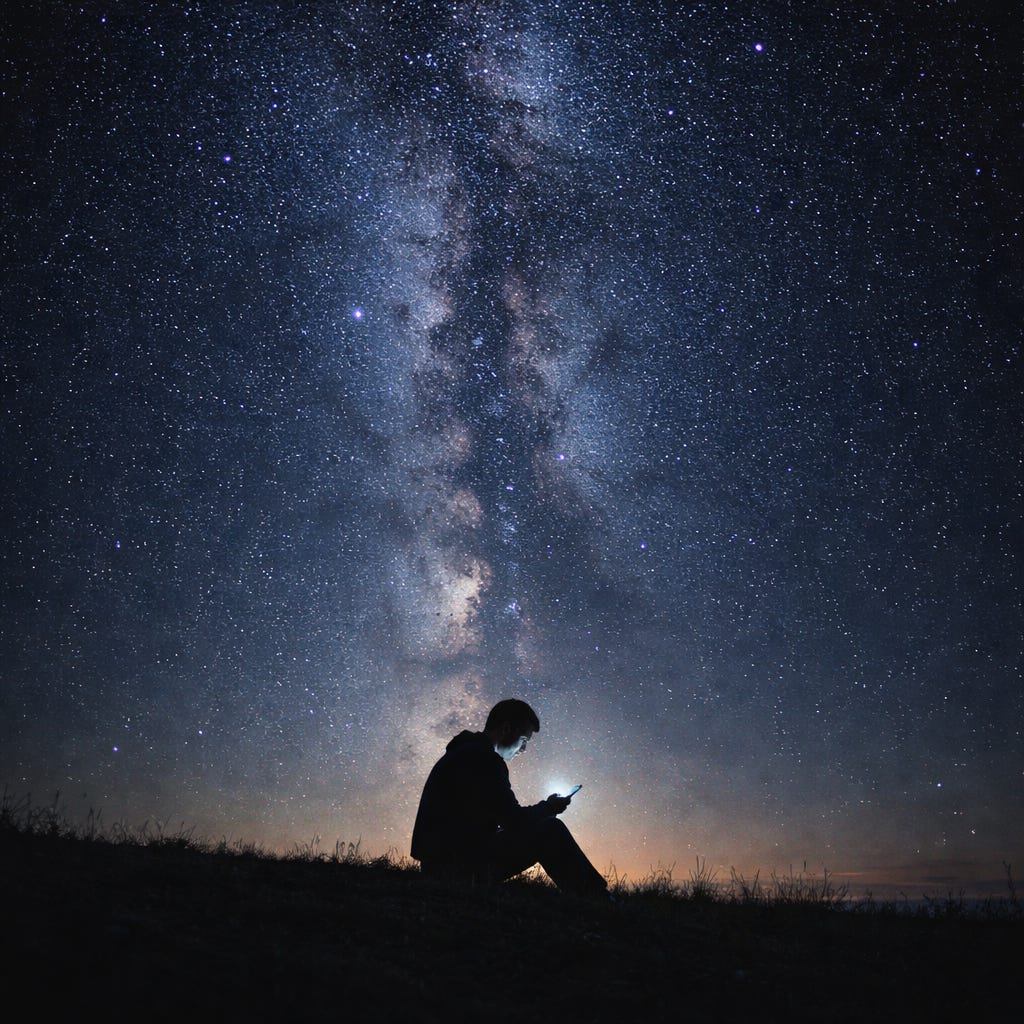
A person can lie in bed, half-asleep, and watch high-definition video from a robot on Mars.
He can ask his phone how old the Earth is and get an answer—around 4.54 billion years—before the screen has fully lit his face. He can scroll past a simulation of colliding galaxies, a news article about gene editing, a chart of global temperatures, and a weather forecast stitched together from satellites that see storms from orbit.
He lives in a world that dates rocks, edits genomes, and listens to the faint afterglow of the universe’s first light.
And then, with the same untroubled certainty, he can walk into a voting booth or a pulpit or a cable studio and speak as if the planet were a few thousand years old, as if species arrived all at once by decree, as if history is a script written in advance for his group and backed by cosmic fire.
We learned the stars, and we kept the superstitions.
The scandal is not that ordinary people lack specialist knowledge. Everyone does. The scandal is that a civilization capable of this much measurement has never built what you could call a cultivated adulthood—a culture that can face reality without needing flattering myths. We use science to engineer our tools and medicine, then let our shared life be organized by older stories that put us at the center.
We have built a technical order on top of an imaginative world that often still thinks like a village.
1. Wonder is not the problem
One distinction matters from the start.
The problem is not wonder. Not prayer, not awe, not the shiver under a night sky when language fails and something in you bows.
The problem is the way stories from a pre-scientific world are still treated as if they were geology, biology, and statecraft—and handed authority over curricula, law, and war.
There is nothing inherently dishonest about ancient sacred texts. They are attempts to say what life feels like from the inside: creation and loss, guilt and mercy, exile and homecoming. Dishonesty begins when we pretend those texts were secretly doing astrophysics, or when we use them to overrule everything we have learned since.
Wonder says, “the world is deeper than I can explain.” Superstition, in the sense I mean here, says, “I already know how this works, and whatever contradicts my story must be wicked or irrelevant.”
Religion, at its best, makes room for the first. Superstition lives on the second. Once you see that line, the conflict of our time stops being “science versus faith” and starts looking more like reality versus forms of certainty that refuse to be corrected.
2. Why false certainties endure
The evidence for an ancient Earth, for evolution, for a universe in motion is neither fragile nor obscure. It comes from many directions at once: clocks in the atoms of rocks and meteorites, fossils layered in stone like frames of a very slow film, DNA patterns that bind species into one branching family, light from distant galaxies stretched as space itself expands.
You don’t need to follow every equation to grasp the outline. A decent high school education, honestly given, is enough.
Yet the older cosmologies hold on. In some places they dominate. That is not well explained by stupidity. A more accurate word is need.
The older stories do something bare fact does not do on its own. They describe a world in which someone is in charge, history is going somewhere, suffering belongs to a larger purpose, enemies will eventually face justice, and your community has a special place in the design. Take that away without offering anything equally thick, and you are asking people to stand bareheaded in a universe that does not recognize them.
To accept evolution is not only to revise a diagram of species. It is to accept that your body is the outcome of blind processes, not a singular act reserved for your kind. To accept a billions-year-old cosmos is to accept that your scriptures, if you have them, arrived very late to a story that was already ancient. Taken seriously, those truths mean there is no automatic guarantee that your tribe, your nation, your religion sits at the center of anything beyond its own imagination.
If you have not been shown how to live with that, reaching back for an older picture is not irrational. It is self-preservation.
Most people, when they argue about creation or apocalypse, are not mainly defending a theory. They are defending the feeling that reality has room for them and the people they love.
3. What modernity took—and failed to give
The scientific revolution did not simply eject God from the story. What it did, over time, was loosen the bolts that held a particular picture of the world in place.
The Earth turned out not to be fixed at the center. The sky turned out not to be a ceiling with lamps. Disease had microbes; lightning had electricity. Species changed. Continents moved. The universe itself was not hanging still in the dark but expanding.
The old map cracked.
What replaced it for most people was not a carefully built adulthood but a loose weave of work, consumption, and thin slogans. Whatever depth the old sacred order had, however mixed with illusion, was not replaced with anything equivalent.
Death moved from the village into the hospital. Mourning moved from communal ritual into professional service. Childhood moved from myth and apprenticeship into schooling and screens. The economy grew, the attention industry bloomed, politics wrapped itself in branding and spectacle.
There are exceptions—small communities, religious and secular, that still carry weight with some dignity. But in broad outline, modern life weakened inherited certainties, flooded every day with distraction and economic pressure, and offered very little formation in how to inhabit the truths it had uncovered.
That combination does not produce a population of calm rationalists. It produces people suspended between disenchanted facts and unmet emotional needs, people who are easy prey for any story that promises to pull their fear and hope back into order.
Some of those stories are ancient. Some are new. Many are profitable.
4. A necessary acknowledgment about religion
It would be convenient to treat “religion” as one thing: literalist, anti-scientific, allergic to doubt. Reality is messier.
There have always been religious traditions that read their scriptures symbolically, that accept an old Earth and evolution as descriptions of how, not insults to why, that treat myth as a way of speaking to the heart rather than a competitor to geology. There are priests and rabbis and imams and laypeople who know that humans share ancestry with other animals and that the cosmos is unimaginably old, and who find that knowledge deepens, rather than destroys, their sense of the sacred.
Even now, some of the places where people most honestly face guilt, death, and obligation are religious spaces: a small church that still sits with the dying, a synagogue that carries memory through catastrophe, a mosque that binds a scattered people into a weekly rhythm of prayer and charity. In many lives, those communities have done more to teach courage and remorse than any corporate offsite or wellness retreat ever has.
The crisis we are in is not simply that religion exists. It is that forms of childish certainty—religious and secular—still have enormous leverage over politics, education, and war. When a belief claims public authority while refusing public correction, it joins the problem, whatever language it speaks.
5. The myths below and the myths above
The most obvious superstitions are loud: a preacher pointing to a prophecy to explain an earthquake; a rally that treats a modern nation as if it were an ancient chosen people; a pundit whose foreign policy is a sermon with maps.
Those are real. They distort classrooms and ballots. But there is another layer, quieter and more polished.
The people who run banks, weapons firms, tech platforms, and ministries of finance rarely think the Earth is six thousand years old. Many have elite degrees. Quoting scriptur…