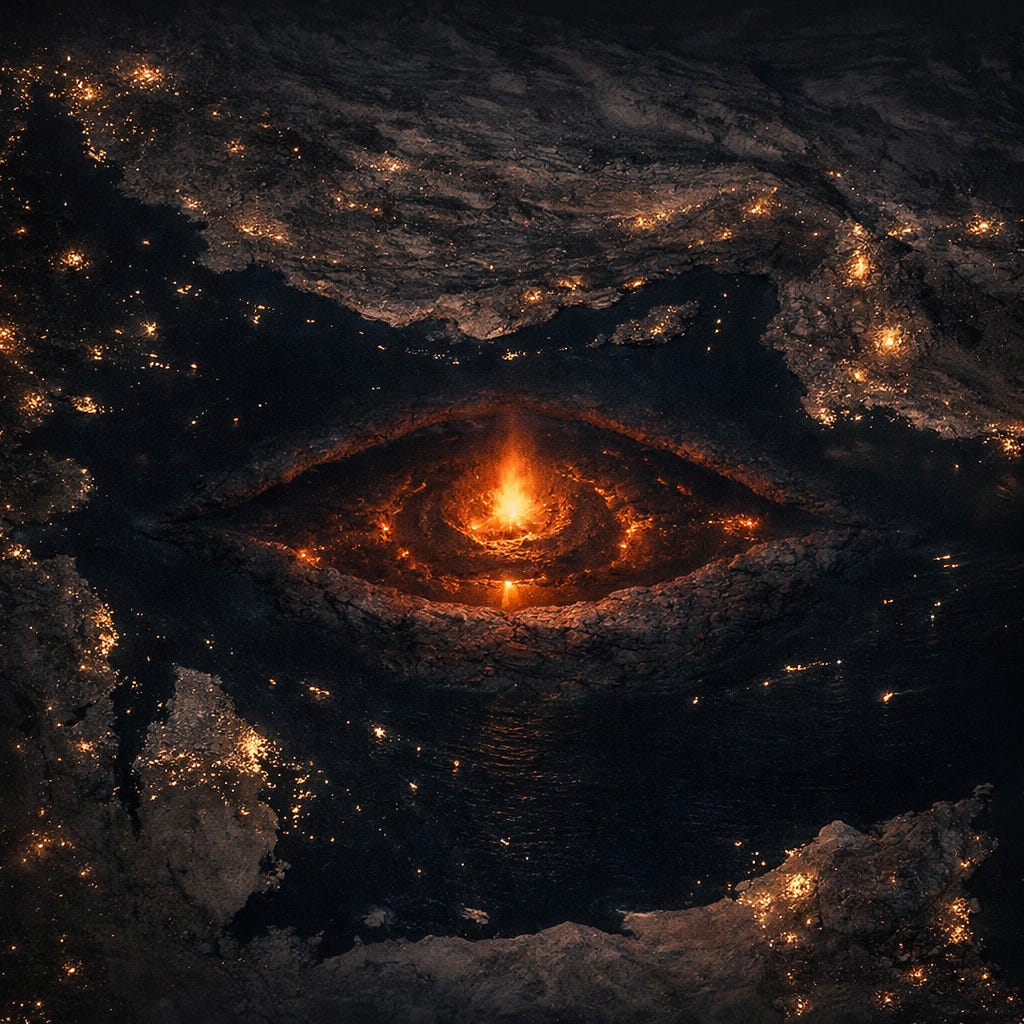
Prologue: The Strait Closes
The world always pretends surprise when history finally reaches its throat.
One morning the screens fill with the same narrow body of water. Anchors drop. Tankers wait. Traders stare into terminals as if numbers could pray. Admirals reappear on television. Men who have never loved a civilization begin speaking in clean abstractions about deterrence, escalation, leverage, corridors, stability, throughput. The language of empire is always managerial at the moment it is most blind. It names consequences before causes, symptoms before memory.
And there again, under the drone footage and strategic maps, the old name returns to every mouth: Hormuz.
Hormuz. Spoken in London, Washington, Dubai, Tel Aviv, Houston. Spoken as a logistical emergency. Spoken as if it were merely a valve in the global oil machine. Spoken as if it had no dead under it, no buried god inside it, no ancestry older than the states now threatening each other across it. Spoken as if it were only water.
But names are never only names in a place like this. A narrow passage of sea can become a corridor of civilization. A choke point can become a relic. A map can become a graveyard of forgotten meanings. And a name repeated by the modern world in panic can turn out to be far older than the crisis that resurrected it.
For Hormuz was a name before it was a strait.
And perhaps that is the first thing the modern world still does not understand about Iran: it thinks it is confronting a regime, a military doctrine, a file, a problem to be managed. It does not realize that beneath the regime, beneath the revolution, beneath Islam itself, there is a much older continuity—a civilizational memory that has survived conquest, conversion, humiliation, and time. It does not realize that when Hormuz closes, something deeper than shipping has entered the room.
The world thinks it is looking at a strategic chokepoint. It is looking at a fossil of an older sky.
Part I: A Name Older Than the Crisis
Hormuz did not begin as the name of a strait.
The strait took its name from the island. The island took its weight from the kingdom. The kingdom inherited a name already ancient before merchants loaded silk, pearls, horses, spices, and rumor onto ships passing through the Persian Gulf. Before Europe called it Ormus, before geographers fixed it in atlases, before modern energy markets made it the narrow throat of global dependency, the name already carried a depth the modern world would later forget.
Hormuz. Hormoz. Ohrmazd.
A place name is sometimes a grave in which theology survives without believers. The syllables remain after the altar disappears. Children inherit the sound and no longer know the sky it once pointed toward. That is what happened here. A divine name entered history, then geography, then commerce, then strategy. By the time it reached the modern news cycle, it had become almost invisible to itself.
Yet the root remained.
The word bends backward into Ohrmazd, the Middle Persian form of a still older name: Ahura Mazda, the Wise Lord, the supreme god of the Zoroastrian world. The movement is not accidental. The name on the map is the worn coin of a lost metaphysical empire, passed through so many hands that only a faint outline of the original face remains.
And that is the first reversal the essay must insist upon. The modern mind imagines geography first and story later. But here the order is inverted. The strategic chokepoint inherited a sacred memory. The corridor of empire was named after a remnant of transcendence. The world now debates Hormuz as a military instrument without realizing that the name itself is older than Islam, older than Arab conquest, older than the Persian Gulf as a modern category of geopolitical anxiety.
The chokepoint was named after a memory.
And if the memory is still there, however buried, then the closure of the strait cannot be only tactical. It must also belong to that older and harsher truth: civilizations continue speaking through names long after they have forgotten what they once meant.
Part II: The God Beneath the Name
To understand the name, one must descend into the world that produced it.
Ahura Mazda was not merely a deity among others in a crowded ancient pantheon. He belonged to a moral cosmos, one of the most serious ever built by human imagination. The old Iranian world did not see existence as neutral matter moving through empty time. It saw history as morally charged from the beginning. Truth and falsehood were not opinions. Order and corruption were not administrative categories. They were woven into the structure of reality itself.
In that world, to live well was not only to behave well. It was to cooperate with the grain of creation. Ethics was cosmic participation. Good thoughts, good words, good deeds: the phrase sounds gentle in modern ears, almost decorative, but it belonged to a civilization that understood human action as part of an immense struggle between truth and the lie, purity and pollution, order and demonic distortion. A farmer tending land honestly, a priest guarding sacred fire, a king ruling justly, a child learning reverence—these were not merely social acts. They helped hold the world together.
There is a kind of metaphysical dignity in such a religion that modern secular imagination cannot feel. To inhabit that cosmos was to believe that goodness mattered not sentimentally but ontologically. Evil was not just wrongdoing. It was a principle of corrosion, deception, attack. To tell the truth was to side with reality itself. To uphold order was to resist something much darker than chaos. To preserve purity was not neurosis. It was fidelity to the architecture of being.
And because the cosmos was morally structured, history could not remain morally unresolved. This is why Zoroastrianism carried an eschatological force from deep within itself. If truth and the lie are truly at war, then history must bend toward a final judgment. Evil cannot be allowed eternal parity. The world cannot remain forever half-corrupted. A religion built around such seriousness must eventually imagine an end—not merely catastrophe, but resolution, purification, renewal.
This is what the modern world misses when it thinks of ancient Persia only as court, luxury, conquest, and imperial administration. Beneath the empire was a religious imagination of immense rigor. Persia was not only a state. It was a sky. It was a story about order. It was a confidence that truth was not weak, that corruption would not rule forever, that reality itself leaned toward moral completion.
What kind of wound is inflicted on a people formed by such a vision when they are conquered by another faith?
Not merely political loss. Not merely military defeat.
They lose the visible confirmation of their cosmos.
The collapse of an empire is one thing. The collapse of the world that made the empire intelligible is another.
Part III: The First Invasion
The Arab conquest of Persia did not happen in a single instant, though later memory often compresses it that way. No civilization experiences its own undoing as a chapter title. It comes instead as fracture, rumor, retreat, reconfiguration. One defeat joins another. One city falls, then another. One ruler dies, another appears, then vanishes. Tax systems remain, but the hands that collect the tax change. The habits of daily life continue, even as the horizon of meaning slips.
This is the first mistake modern people make when they imagine civilizational replacement. They think conquest and conversion are the same event. They imagine armies arriving and millions suddenly exchanging gods. That is not how history moves. Conquest is often quick. Conversion is slow. Empires collapse in decades. Hearts change over centuries.
When Arab Muslim armies entered and defeated the Sasanian world, they did not immediately produce a Muslim Persia. They produced a conquered Persia. The difference matters. The old state religion lost its political shelter. The old elite order fractured. Zoroastrianism ceased to be the unquestioned center of public legitimacy. But the people did not wake up the next morning as Muslims. They woke up as the same people under new rulers.
That is the terror of real historical change. It begins not in belief but in administration.
The conquerors remain. The old state does not return. The tax burden shifts. Access to office, privilege, law, military inclusion, and prestige gradually reorganizes around the new order. The old religion survives, but now under diminished sovereignty. It continues, but increasingly as a protected or tolerated remnant rather than as the unquestioned grammar of reality.
A civilization like the Zoroastrian Persian world does not disappear in one blow. It enters a long corridor of humiliation, adaptation, memory, bargaining, and slow surrender in matters so small that each seems survivable on its own.
That is the real tragedy. No one says, “Today we will stop naming our god.” Instead, one generation loses the state, another learns the language of the rulers, another marries across the new divide, another seeks office, another avoids a tax, another raises children inside a different prestige system, another no longer knows what was once lost.
How does a people stop naming its own god?
Not by deciding all at once that the god was false.
By living three hundred years in a changed world.
Part IV: The House of Ardashir
1. Ardashir
Ardashir is born under the Sasanians, when the old order still exists badly but recognizably. He does not think of himself as inhabiting a religion. He inhabits a world. Fire is not symbol but presence. Truth is not private sincerity but alignment. The king, however flawed, still stands inside a sacred architecture. The fields, the rituals, the graves of ancestors, the prayers spoken at dawn—these are not optional cultural accessories. They are reality.
Then the defeats begin.
News comes first as disbelief. Then as distance. Then as a new tax collector. Then as a change in command. Then as the disappearance of certainty. The empire does not vanish in a mythic explosion; it thins. The old center is breached. The men with authority speak another language, pray differently, command armies under another banner.
Ardashir does not convert. He does not even understand what that would mean. One does not convert out of the sky into another sky because soldiers have arrived. He still tends what must be tended. He still says the old names. He still believes evil has advanced but not triumphed.
To him the conquest is not yet theology. It is disorder.
At night he tells his son that this foreign rule may pass.
His son never sees the world in which it could have passed.
2. Vahram
Vahram is born into defeat, which is different from being defeated. His father remembers a broken sovereignty. Vahram remembers none. For him, there are already Arab garrisons, Muslim officials, translated petitions, altered lines of power. The old religion remains, but it no longer radiates public confidence. It survives as inheritance, duty, and increasingly as cost.
This is how humiliation enters religion: not first as persecution, but as subordination.
Vahram learns that one can remain what one is and still belong by permission. He notices practical things before he notices metaphysical ones. Muslims stand nearer the state. Their language opens doors. Their public identity carries less friction. There are taxes and privileges and exclusions, but to Vahram the sharpest reality is simpler: the old way now asks more of those who keep it.
He still enters the temple. He still marries within the old circle. He still tells his children the stories of truth and the lie. But the emotional texture has changed. Under his father, religion still implied world-order. Under him, religion is beginning to imply endurance.
This is a civilizational turning point no chronicler ever captures fully. A faith begins to move from center to remnant while still speaking in the grammar of the center.
Vahram does not stop believing. He begins, instead, not to know how to read history through belief. If Ahura Mazda is the source of order, why has disorder become politically victorious? The old metaphysical confidence is not yet lost, but it is wounded. The world still means something, but less legibly than before.
His son will inherit not certainty, but fracture.
3. Salman
The boy is born with another name, an older Iranian one, but later in life people call him Salman. That is how transformations often first announce themselves: by name before conviction.
Salman grows up in a borderland between worlds. He hears Middle Persian in the house, Arabic in the market, fragments of old cosmology from the lips of elders, the cadence of Qur’anic recitation from the public square. He is not yet inside the new religion, but he is already inside its atmosphere.
He learns quickly that faith is no longer only about eternity. It is about access. About office. About tax. About status. About whether the man hearing your petition sees you as near or far from the order he serves.
This is where moralizing historians lie to themselves. They want conversion to be either pure coercion or pure conviction. But many civilizational transformations happen through mixed motives too human to fit either purity. Salman does not wake one morning and renounce his ancestors. He hovers. He translates. He calculates. He imitates some outward forms before he feels their inward gravity. He enters arrangements that would have shamed his grandfather and seem merely practical to him.
He still loves his mother’s habits. He still feels a tremor when he hears the old names. He still carries the emotional structure of a Zoroastrian world—the hatred of corruption, the instinct for truth and order, the suspicion that history is morally loaded. But the public vocabulary around him is changing. God is spoken now with a new radical singularity. Evil is no longer a rival principle in a contested cosmos, but rebellion inside the sovereignty of one absolute Lord. The metaphysical map is being redrawn.
And here, perhaps, lies one of the hidden reasons conversion can happen. The old dualism explained the world’s corruption with grave seriousness, but after conquest it may also have become harder to bear. The new monotheism offered another possibility: one God above all, not merely right but victorious; history no longer a field where order visibly loses, but a theater of submission under a sovereignty nothing truly escapes.
For a man living after civilizational humiliation, such simplicity can feel like relief.
Salman does not yet become a fervent believer. But the old sky has begun to dim, and a new one is becoming plausible.
4. Ahmad
Ahmad is Salman’s son, and by the time he is old enough to think politically, the argument has already half-ended. Islam no longer feels foreign to him. It feels public. It feels normative. It feels like the language of power, law, seriousness, and destiny. He knows his grandfather spoke differently. He has heard the stories. But he does not experience himself as betraying anything. He experiences himself as entering reality.
That is how civilizational replacement becomes normal: when the child inherits as identity what the parent experienced as compromise.
Ahmad prays in the new way with naturalness. He speaks words his grandfather would have uttered with distance or discomfort, but to him they are home. Yet he is not emptied of Persian inheritance. That is another Western mistake: to imagine conversion as total erasure. Ahmad remains Iranian in temperament, in memory, in habits of dignity, in moral seriousness. What changes is the frame within which those dispositions live.
The old cosmic struggle between truth and the lie has not entirely vanished from him; it has been translated into another religious grammar. His reverence for wisdom, his hatred of deceit, his sense that history carries moral weight—none of these disappear. They are reorganized. The vessel changes, but the force inside it retains old pressure.
He marries into another family already moving through the same transformation. Their home becomes the site of layered inheritance. New prayers. Old feast-days remembered obliquely. Islamic teaching in public. Persian memory in the texture of speech. Children raised under one theology, but amid the lingering atmosphere of another civilizational formation.
If Ardashir lived under the old sky and Salman under a split sky, Ahmad is the first to live fully under a new sky that no longer feels imposed.
His children will not remember the conquest as event. Only as atmosphere.
5. Denag
But history is never total. The remnant remains.
Denag descends from another branch of the family—the line that stayed closer to the old fires, the old rites, the shrinking circles in which Zoroastrian continuity endures. If Ahmad represents adaptation, Denag represents fidelity under narrowing conditions.
She grows up in a smaller world than her ancestors knew. The institutions are weaker. The confidence is thinner. The old religion is no longer public architecture but guarded inheritance. To remain what one is now requires more discipline, more memory, more refusal. A faith that once structured empire now survives by boundary.
That changes not only sociology but emotion. In Denag, religion becomes elegiac.
The old myths are no longer merely true; they are endangered. Ritual is not only worship; it is resistance against disappearance. Purity becomes sharper, not because the soul has become more rigid by nature, but because embattled communities clutch harder at whatever still makes them distinct. Memory grows dense in the absence of power.
She knows Muslim relatives. Some are kind. Some are indifferent. One sends gifts at the new year. Another whispers old stories when a child falls ill. Life continues through contradiction. The world is not neatly divided into villains and martyrs. It is full of surviving people making uneven accommodations with time.
Denag does not condemn all who left the old religion. She knows too much for that. She knows the taxes, the exclusions, the thinning of prospects, the fatigue of carrying a diminished inheritance. But she also knows what is lost when the old fire grows dimmer. She feels the old sky not as empire but as ache.
In her, religion becomes memory under pressure. It becomes the sacred labor of not letting a civilization vanish completely from the earth.
6. Yusuf
Yusuf is born many years later into a Persian Muslim world that has ceased to experience itself as borrowed. The language has changed, and yet not disappeared. Persian survives, transformed, written differently, infused with Arabic, but living. That is how civilizations endure when they are strong enough not to resist change purely by refusal but to absorb it without ceasing to be themselves.
Yusuf is Muslim. There is no inner drama around that. He does not feel conquered by his own creed. But neither is he simply Arabized matter moving through a foreign inheritance. He inhabits something new: Persian Islam.
His ethical world is Islamic in theology, Persian in style. God is one, absolute, sovereign, addressed in prayer, encountered through revelation. Yet the moral temperament with which Yusuf inhabits that monotheism remains shaped by older civilizational instincts: seriousness toward truth, contempt for the lie, love of order, poetic intensity, historical depth, suspicion of corruption, reverence for wisdom. The old energies have not died. They have migrated.
He can no longer name Ahura Mazda as his god. But he carries a civilization once structured by that divine light. Not consciously, perhaps. Not doctrinally. Yet in sensibility, in metaphysical texture, in the way goodness feels weighty and falsehood feels poisonous, something of the older formation survives.
That is one of history’s deepest ironies: a people may cease to confess its old god while continuing to carry the moral architecture that god once built into its soul.
7. Bahram ibn Yusuf
By the time Bahram comes, the conquest is memory without witnesses. Islam is inherited, not chosen. Persian identity has adapted, not vanished. The old religion survives in pockets, names, fragments, and ghosts. The majority no longer lives in relation to Zoroastrianism as possibility. It lives in relation to it as depth.
And yet depth matters.
Bahram does not think he belongs to a civilization that was once conquered and transformed. He simply belongs to Iran. But what is Iran now? Not the old Zoroastrian world. Not Arabia. Not a vacuum filled by Islam. It is something harder to describe and easier to feel: a people who passed through conquest, absorbed another revelation, retained their language by changing it, retained their dignity by translating it, retained their civilizational continuity by permitting its forms to be rearranged.
He is the proof that a people can undergo radical theological change without becoming empty of itself.
He is also the proof that the world will misunderstand such a people forever if it mistakes adaptation for amnesia.
Part V: What Survives When the God Is Gone
Did Ahura Mazda disappear?
Yes and no.
As explicit doctrine for the majority, yes. The Wise Lord ceased to be the confessed God of most Iranians once Islam became the dominant religious world. The prayers changed. The sacred history changed. The metaphysics changed. A new revelation organized time. A new understanding of God claimed the public heart of the civilization.
But names do not disappear so cleanly. Moral structures do not disappear so quickly. Emotional architectures do not vanish simply because theology has been replaced.
A civilization can stop naming its old god while continuing, for centuries, to carry the shape of the world that god once made possible.
This is what survives: seriousness. The hatred of the lie. The intuition that truth matters cosmically, not merely socially. The sense that corruption is not inefficiency but desecration. The tendency to experience history in moral and even apocalyptic terms. The refusal to believe that power is innocent. The need to interpret political events through deeper symbolic frameworks than administration and interest alone.
None of this means Persian Muslims were secretly Zoroastrian. That would be childish. It means rather that conversion does not empty a people. A new faith enters an old civilizational chamber and fills it, but it also echoes in the architecture already there. The old acoustics remain.
And the names remain.
Hormuz is one such survival. A fossilized fragment of an older sacred sky embedded in the map of the modern world. A relic repeated by men who know shipping volumes but not civilizational memory. A place where the old god is no longer worshipped, and yet his worn-out name still marks the narrow throat through which the world’s wealth must pass.
There is something terrible and beautiful in that. A buried theology still shaping global politics through geography, long after belief itself has changed. An ancient Persian divine memory lingering not in liturgy but in a strategic map. A dead god, perhaps, but not a dead imprint.
This is why history cannot be reduced to doctrines. Theologies die. Their moral light can persist as afterglow.
Part VI: The Religion of the Conquered
What kind of religion does a people develop when it is invaded so deeply that even its faith changes?
Not always a religion of resistance. Not always a religion of collaboration. Those are both too simple, too flattering to the moral vanity of later interpreters. Real history produces stranger outcomes.
Conquest often pushes religion away from triumphal order and toward one of five forms: exile, memory, purity, apocalypse, adaptation.
Exile: a people begins to feel itself spiritually displaced even while remaining on its own land. The world is no longer arranged for it. Public life has become foreign even when the streets remain familiar.
Memory: what once structured reality becomes an inheritance to be consciously preserved. Religion turns archival, elegiac, ancestral. To remember becomes sacred duty.
Purity: boundaries harden. Ritual, marriage, law, and custom become sharper under pressure. The smaller the remnant, the more intense its need to protect form.
Apocalypse: history can no longer be trusted as an arena of ordinary political correction. The world has become too corrupted, too broken, too inverted. Final judgment, hidden meaning, ultimate reversal—these begin to exert emotional force.
Adaptation: the people survives not only by resisting but by translating itself into the language of the conqueror without wholly surrendering its inner structure.
Iran knew all five.
The Zoroastrian remnant experienced exile without geographic departure, memory without state, purity without power, apocalypse without sovereignty. Persian Islam emerged through adaptation, carrying forward older civilizational energies inside a new theological form. The result was not simple replacement. It was layered continuity through transformation.
This matters because modern people, especially in the West, think in shallow binaries. They ask whether Iran is ancient or revolutionary, Persian or Islamic, authentic or ideological, nationalist or religious, traditional or modern. Such questions misunderstand the nature of a civilization that has survived by becoming more than one thing without ceasing to be itself.
Iran is not hard to understand because it is irrational. It is hard to understand because it is stratified. Under every surface lies another time.
Part VII: The West Looks at Iran and Sees Only a Regime
The contemporary West, and especially America, has trained itself to see Iran through the most flattening categories available. A regime. A nuclear issue. A militant network. A sanctions target. A threat to deterrence. A hostile actor in need of containment, coercion, or collapse.
Even when some of those descriptions are true at the level of policy, they remain radically insufficient at the level of civilization.
The strategic mind of empire is often intelligent within its own frame and blind outside it. It can identify force structures, supply chains, pressure points, alliance commitments, domestic unrest, and sanctions vulnerabilities. What it cannot easily see is memory. It cannot easily imagine how a society under pressure interprets pressure through older layers of invasion, humiliation, religious transformation, and historical endurance. It assumes coercion enters a vacuum. It does not realize coercion enters a people.
This is not an argument for innocence. Iran is not purified by history. It has its own brutalities, distortions, hypocrisies, pathologies of power, and internal betrayals. To say America misreads Iran is not to say Iran is therefore morally transparent or politically justified. It is only to say that a civilization cannot be understood by reducing it to its current ruling apparatus.
And America repeatedly makes that reduction.
It treats Iran as if it began in 1979. As if the revolution were origin rather than one layer. As if religious seriousness in Iran were merely ideological performance rather than partly the residue of a much older metaphysical culture. As if foreign attack would simply detach society from state rather than possibly reactivating a civilizational reflex of siege. As if humiliation would produce clean liberal outcomes. As if historical memory were a decorative thing, subordinate to rational calculations of present interest.
This is imperial stupidity in one of its purest forms: not ignorance of facts, but ignorance of depth.
America keeps trying to coerce Iran without realizing it is also activating Iran’s memory.
And a civilization with Iran’s memory does not respond to pressure the way a spreadsheet predicts. Foreign assault does not necessarily dissolve legitimacy. It can harden remnant consciousness, fuse grievance to dignity, reactivate apocalypse, and make endurance itself feel sacred. A people repeatedly invaded and transformed may come to experience survival not simply as prudence, but as vocation.
If America does not understand this, it will continue interpreting Iranian hardness as irrationality, when in fact much of it belongs to a longer and darker historical education.
Part VIII: Hormuz Closes Again
Now return to the strait.
The closure of Hormuz is immediately strategic. Of course it is. States do not move tankers and threaten maritime passage to stage literary symbolism. They act through leverage, necessity, power, deterrence, risk. To romanticize policy into theology is a mistake.
But to strip policy of all symbolic depth is an equal mistake.
When Hormuz closes, the modern world is forced to encounter Iran not at the level of opinion, but at the level of dependence. The sea narrows and suddenly the abstractions of empire become physical. Prices move. Alliances tremble. Markets stutter. The planet remembers that geography can still command history.
And this geography bears a name that preserves, however faintly, the remnant of an ancient Persian god.
This is what makes the moment symbolically dense. Not because the Islamic Republic is secretly reenacting Zoroastrian metaphysics. Not because Ahura Mazda has returned in policy form. But because the place where Iran can still impose reality on the world is marked by a name older than the religion under which modern Iran now lives. The theology changed. The strait did not. The land did not. The old civilizational weight did not.
Hormuz, then, becomes more than a military lever. It becomes an image of continuity through mutation. The world’s most advanced powers stare at a corridor whose name still carries an echo from Persia before Islam. The civilization once conquered, converted, and repeatedly misread now speaks through the very bottleneck on which global modernity depends.
This is not mystical. It is historical. It is what happens when deep time suddenly rises into present conflict.
The closure of Hormuz says, in effect: you may forget what this place means, but you will still stop when it closes.
And that is why the strait matters beyond shipping. It reveals that memory can survive conquest long enough to become strategy. It reveals that a people can lose empire, lose public theology, lose names for its gods, and still retain enough civilizational depth to make the world reckon with it centuries later.
The modern world thinks it is being confronted by a narrow body of water.
It is being confronted by the endurance of Persia.
Epilogue: The Name the World Repeats Without Knowing
The screens continue to glow. Experts continue explaining. Politicians continue threatening. Somewhere, ships still wait at sea, the metal patience of global commerce suspended by history.
And the name continues to circulate: Hormuz, Hormuz, Hormuz.
Spoken by traders who do not know it once pointed toward the Wise Lord. Spoken by officials who do not know they are uttering the worn remnant of an older Persian sky. Spoken by empires that still imagine Iran can be understood as a regime, a file, a problem to be solved by pressure. Spoken without memory.
But names remember even when men do not.
That is what this story has really been about from the beginning. Not the mere origin of a word, not the nostalgia of a lost religion, not the sentimentality of civilizational mourning. It has been about the way a people survives beneath its own transformations. How a god can vanish as doctrine and persist as afterglow. How conquest can replace a faith without fully erasing the moral architecture that faith once gave a civilization. How generations can adapt rationally, gradually, tenderly, tragically, until the old world is gone—and yet not gone.
Ardashir loses the empire and keeps the sky.Vahram loses the sky’s public confirmation and keeps fidelity.Salman loses fidelity’s confidence and keeps some of its moral shape.Ahmad loses the old theology and keeps the civilizational seriousness.Denag keeps the fire in remnant form.Yusuf inherits Islam and carries Persia inside it.Bahram no longer remembers the conquest, but lives as its transformed consequence.
And then, centuries later, the world is forced to say Hormuz again.
This is why Iran cannot be understood merely through its rulers, its policies, or its slogans. It must be understood as a civilization educated by invasion, restructured by conversion, sharpened by memory, and never fully emptied of its past. It must be understood as a people for whom history has been too violent to remain superficial. It must be understood as a culture in which names still carry buried weather.
A civilization is never more dangerous to imperial misunderstanding than when its memory is mistaken for mere threat.
The world thinks Hormuz is a passage.
Iran knows it is a memory.
—Elias WinterAuthor of Language Matters, a space for reflection on language, power, and decline.