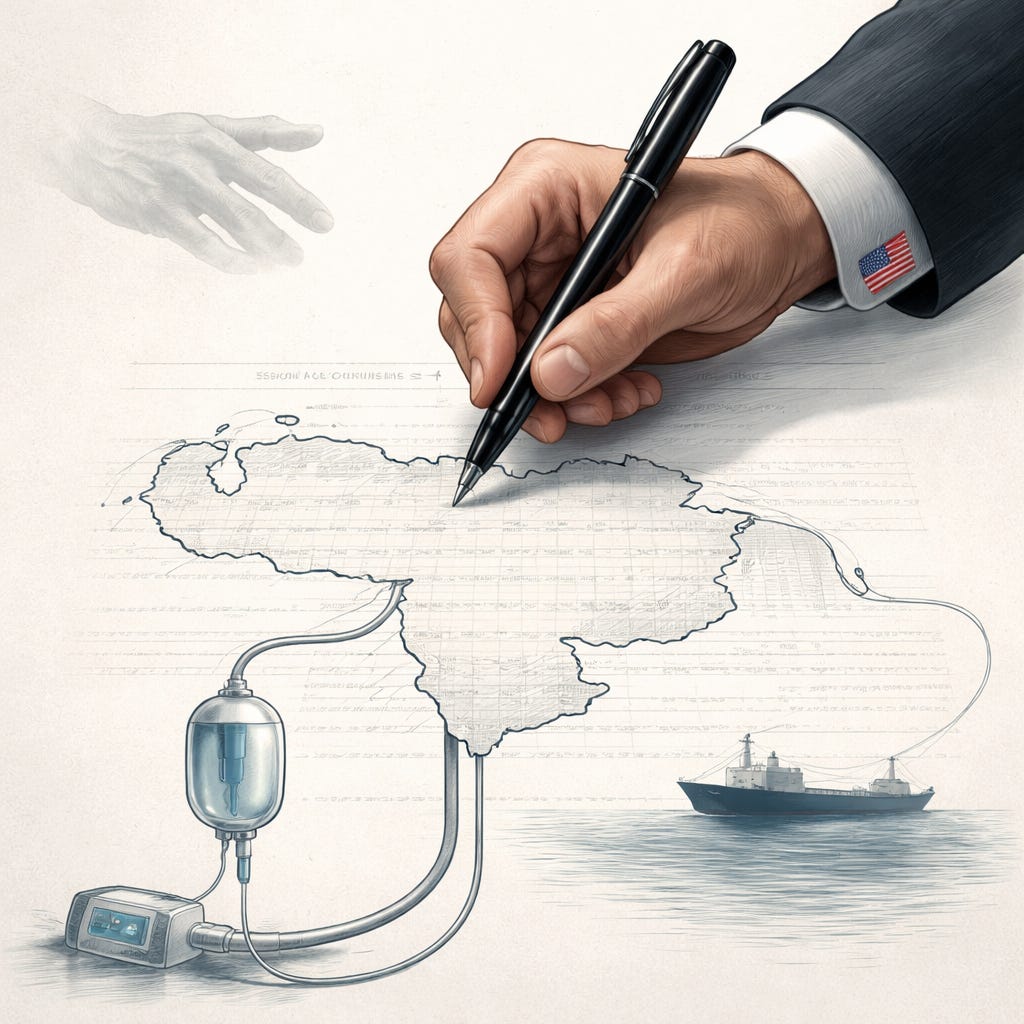
CHAPTER 1 – THE INDICTMENT
The first explosion is small enough that Ana tells herself it’s just another transformer.
Caracas is full of dying transformers—old steel boxes that spit blue light when the grid hiccups. From her apartment balcony she’s seen them go in the distance: a flash, a muffled thump, then a neighborhood sinking into darkness. But this one doesn’t sound right. It’s too low. Too deliberate. The windowpane trembles; a second later a car alarm starts screaming down on the street, then another, then a chorus. Somewhere to the east, a dog howls as if the sky itself offended him.
Ana sets her coffee down on the windowsill. The mug leaves a brown ring on the copy of the constitution she’s been pretending to read. Another boom, closer now. She feels it through the floor. Her notebook—a small, black one she treats like a lucky talisman—slides half an inch and stops.
She grabs her phone before she’s fully aware of moving. Thumb flicks, camera up, streaming app live. “Caracas, Centro, 11:42 p.m.,” she mutters, tagging the feed for the few thousand people who still tune in to La Voz de La Ciudad. The connection hesitates, then accepts. “Something’s happening near Miraflores,” she says, breath fogging the glass. “I don’t know what yet—”
The third boom cuts her off.
Her building is nine stories. On the roof, you can see everything that matters: the presidential palace, the stacked apartment blocks, the black mountains that pen the city in like a bowl. She doesn’t think. She just runs, notebook shoved into her back pocket, phone clutched in her hand. Up the warm stairwell that smells of old water and frying oil, past a neighbor’s door plastered with a sacred heart sticker. Power flickers once, twice, but holds.
By the eighth floor her lungs burn. By the ninth she hears the helicopters.
They come from the west, low and fast, blades beating the air into submission. The sound crawls down her spine, instincts older than electricity waking up. On the roof, the air is thick with diesel and humidity. The city below glows orange, yellow, sickly white. The palace sits in the middle like a spilled jewel—floodlit, guarded, flanked by the dark river.
One helicopter is already there, a black insect hovering over the compound. Two more circle, banking hard. Beyond them, faint strobe flashes—muzzle flare?—crumble the horizon. Ana holds her phone up with one hand, the other clamped on the cracked parapet. “It’s not fireworks,” she says into the wind. “There are at least three helicopters over Miraflores. I see lights near the south gate. I hear—” Short, precise bursts of sound cut through everything else. “It sounds like gunfire.”
The chat on her screen fills instantly. What happened? Fireworks? Is it the opposition? They said US ships— Her neighbor’s kid, fourteen and permanently online, bursts onto the roof with his own phone. “Señorita Ana!” he yells. “Telegram says it’s the gringos. Special forces.” He shoves his screen toward her: rumors flood past—U.S. ships off the coast, “precision operation,” a “joint task force” with three flags pasted side by side.
She doesn’t want rumors. She wants facts, and tonight facts are moving under those rotors.
“I’m going down there,” she says, already running for the stairs again. “You’re crazy,” the boy calls after her. “Probably,” she throws back.
The chat explodes with NO!! and BE CAREFUL. One comment, from an old contact abroad: If you can get closer, do. No one else we trust is live. Battery at fifty-eight percent. It will have to be enough.
Across an ocean, in a room with no windows, Tom Bennett’s computer screen updates with an audible click.
For six hours he’s been watching the status line on the DOJ internal portal: UNDER SEAL. Now a new line appears.
United States v. Rafael Domingo Márquez et al. – UNSEALED.
Tom’s throat goes dry. He doesn’t see the explosions; he hears them faintly on the muted TV outside his office, a cable anchor fumbling through “unconfirmed reports.” But the real detonation, in here, is a metadata change.
He clicks the case file. The indictment is 112 pages of familiar text: narco-terrorism, conspiracy to import cocaine, money laundering, material support. His own footnotes are still there, demarcating evidence chains that run from Venezuelan shell companies to front shipping firms to small banks in Cyprus. What’s new is the banner on the memo in his inbox, time-stamped 11:41 p.m.:
At 0000Z, the Attorney General will announce unsealing of indictments against Rafael Domingo Márquez, President of the Bolivarian Republic of Venezuela, and key members of his regime. The announcement will coincide with the execution of coordinated enforcement actions in the Western Hemisphere in cooperation with domestic and foreign partners.
He scrolls to the talking points: No one is above the law. This is not about politics. We will use all lawful tools. He takes off his glasses, rubs his eyes, hears the newsroom TV: “…explosions reported near the presidential palace…” He steps into the outer bullpen. Colleagues stare at the screen: shaky footage of the palace lit against the night, a helicopter a blinking dot.
“Looks like they went kinetic,” someone says. “Kinetic,” Tom repeats under his breath. A word they use to make force sound like physics instead of pain. His phone buzzes. AG moved the presser up. Need updated sanctions exposure notes in five minutes. He looks once more at the TV—smoke blooming over the palace walls—then turns back into the windowless room where war is written as crime.
By the time Ana reaches the palace district, the police have thrown up a perimeter.
Not an orderly one. This is Venezuela: lines of riot shields drawn in crooked arcs, officers shouting contradictory orders, sirens bleeding together. Still, it’s a perimeter—a ring of blue uniforms around a smaller ring of green, and inside that, floodlit walls and smoke. She tucks her battered press card into the holder on her chest. It’s expired; in this city, laminated plastic is mostly theater.
“Press!” she calls in Spanish, pushing toward the thinnest section of shields. “I’m accredited.” A young officer with acne and fear in his eyes holds up a hand. “No entry,” he says. “Orders from above. Foreign operation.”
Foreign operation. “What does that mean?” she asks. “Who’s inside?” He glances over his shoulder, as if the answers might be printed on the smoke. “I heard Americans,” he says, too low. “Maybe special forces. I don’t know.” “You saw them?” “I saw men with different gear. They came in on the north side, with our guys. They had patches.”
“Flags?” she pushes. He shakes his head, as if he regrets saying anything. Behind her, people surge forward, phones held high. A chant starts and fails, then starts again: Fuera, fuera… It’s not clear who they want out—the president, the Americans, everyone.
Her phone buzzes against her palm, the live feed comments layering over the scene. She keeps it low, filming the shields, the strip of roadway, the flashes beyond the gate. A shot cracks from inside. Not a burst, a single sharp report that cuts through noise like a pin through skin. The crowd quiets for a heartbeat. Then a automatic burst answers, vicious, scraping the air.
“Back,” the officer urges. “Go home.” She takes a step closer instead. “Who gave the order?” she asks. “Our government or theirs?” His hand tightens on his baton. “Orders from above,” he repeats, and there’s the same confusion in his eyes she feels in her gut, the sense that the map of reality has shifted in a way no one explained to them.
Between uniforms, she catches half a second of silhouettes: bulkier helmets, different posture, weapons tucked in with a training her own forces don’t have. Light catches a patch on a sleeve—pale shape on dark fabric. The image jerks as someone jostles her. When she finds the frame again, they’re gone.
Midnight.
On state TV, the broadcast fizzles back to life. In the crowd, someone holds up a portable radio; a woman balances a cheap TV in her window so half the block can see. Ana lifts her phone to capture both—the flickering screen, the sea of faces turned up to it.
The anchor’s voice trembles. “En este momento, el Fiscal General de los Estados Unidos está anunciando cargos criminales contra el ciudadano Rafael Domingo Márquez…” On a split screen, the U.S. Attorney General steps to a podium, flags behind him. Two feeds, two languages, same message.
“Tonight,” he says, “we announce that no one, no matter how powerful, is above the law.” The translator overlays: ninguna persona, sin importar cuán poderosa, está por encima de la ley. On the other half of the screen, a helicopter lifts out of the palace courtyard, a small dark shape under it. “While serving as President of Venezuela,” the AG continues, “Márquez led a violent narco-terrorist conspiracy…” Another convoy snakes out of a side gate, lights off, moving fast.
There. The kidnapping, live and legal.
Ana zooms until the image breaks into squares of color. Somewhere in that grain, a man is pressed to a vehicle floor, wrists bound in plastic, ears ringing with words about justice. Beside her, the young officer stares at the TV. “They didn’t tell us,” he murmurs. “Tell you what?” “That they were coming for him like… like a criminal. We thought maybe negotiations. Not this.”
In Washington, reporters shout over each other. “Is this an act of war?” “Did the President authorize boots on the ground?” “Why a U.S. court instead of an international tribunal?” The AG gives a patient, practiced smile. “This is a law enforcement action,” he says. “A criminal indictment. The United States has jurisdiction because the conspiracy targeted our country and our citizens. Criminals do not get to hide behind sovereignty. Sovereignty is a responsibility, not a shield.”
Ana hears the Spanish version land on the crowd like a dropped stone. Around her, people murmur. “Cocaine? That’s Colombia.” “This is b******t.” “Maybe it’s true.” Her chat scrolls: They kidnapped him. Finally, justice. Are we at war? She types with her thumb, still recording smoke and lights. They say it’s law enforcement, not war. Here, it feels like both. Send. For a moment the upload spins, then crawls forward and is swallowed by the world.
Overhead, the last helicopter banks away, its rotors beating the night into a new shape.
CHAPTER 2 – THE ACCOUNT
By morning, the city looks hungover. Smoke over Miraflores has thinned to a gray smear. Newsstands tape up front pages with the same blurred photo of the convoy. Headlines can’t decide what happened: PRESIDENT IN U.S. CUSTODY, NARCO-TERRORIST MARQUÉZ TO FACE JUSTICE, WHO GOVERNS NOW?
Ana buys the smallest paper with the loudest question. The kiosk owner shrugs. “At least they didn’t bomb the whole place,” he says. “Small miracles.” She tucks the paper under her arm, scrolls her phone as she walks to the metro. Clips from the AG’s statement loop. Overnight, rumor feeds have reached their own verdict: half the country calls it liberation, the other half kidnapping.
As she descends into the stale metro air, a notification slides across her screen.
U.S. TREASURY ANNOUNCES NEW MEASURES TO “PROTECT VENEZUELAN OIL REVENUES FOR THE VENEZUELAN PEOPLE”
She taps. The statement is full of calm words: escrow, transparency, humanitarian purposes. And the phrase she’s learned to distrust: for the Venezuelan people. She saves it. Later. For now, she has a meeting—if anyone at PDVSA still dares talk.
Tom hasn’t slept. He spent the night in the Treasury building, drafting the memo that will accompany the new sanctions package. Now he sits in a glass-walled conference room with a view of the Mall he barely sees. Coffee goes cold at his elbow. The table is ringed with badges: State, NSC, DOJ, Energy, USAID.
On the screen, a simple diagram: a crude cartoon of a barrel, an arrow, a bank. BARREL → BUYER → ESCROW. Someone from State is talking: “…maintain production to avoid collapse, while ensuring the regime doesn’t touch a cent. Route payments into blocked accounts, released only for vetted humanitarian and reconstruction spending. We show we’re not punishing the people, just the criminals.”
She glances at Tom. “Can you walk everyone through the mechanics? Plain English.” He stands, straightens his tie, goes to the screen. “This is the proposal,” he says. “Oil exports continue under a general license. Only approved buyers can lift Venezuelan crude—companies that agree to pay into designated escrow accounts in New York and Europe.”
He taps the bank icon. “Those accounts are legally owned by a Venezuelan entity we recognize as legitimate—first the Interim Council, later a transition government. But disbursements require joint sign-off by that entity and a U.S.-appointed fiduciary.” A NSC staffer frowns. “A what?” “A trustee,” Tom says. “Think of it as bankruptcy. The company exists, but someone else watches the books until it can be trusted again.” The colonel from SOUTHCOM chuckles. “So we’re putting Venezuela in Chapter 11.”
USAID asks, “What can the money be used for?” “Approved imports, critical infrastructure, certain debts,” Tom replies. “Usage decided jointly by the Venezuelan side and the fiduciary.” “Who is the fiduciary, exactly?” someone asks. “We’re still working through names,” says State. “Big firm, global footprint, reassuring to markets.”
Tom looks at his own slide, the neat arrows. BARREL → BUYER → ESCROW. He knows what’s missing: the lines that lead from that bank to a diesel tank under a hospital, a fuel pump in Havana, a queue in Petare. His job, though, is to keep the diagram clean.
In Bogotá, Luis Herrera wakes up in a beige hotel room with three voicemails. Economic conferences, panels, exile meetings—rooms that love his charts more than his country ever did. He plays the messages in order.
“Dr. Herrera, we’d love your take on the events in Caracas for a panel…” Delete.
“Señor Herrera, this is the Venezuelan Business Council. We’re drafting a statement supporting a Transitional Council—” Delete.
“Dr. Herrera, my name is Michael Reed from State. We’d like you on a coordination call about economic stabilization scenarios for Venezuela. The Interim Council has requested input from experts like yourself.” Pause. “It’s important.”
Luis stares at the ceiling. He has spent a decade writing about reform, sane energy policy, anti-corruption, how to rebuild PDVSA. He never imagined step one would be a president taken away in someone else’s helicopter and a trial in someone else’s court.
His email pings with the call link. Subject: VENEZUELA – ECONOMIC STABILIZATION CALL. He clicks Accept.
Later, on screen, the grid of faces appears: professors in Chicago, former central bankers in Madrid, young think-tank economists, and Michael from State, all teeth and mid-Atlantic vowels. Also a new face: Tom, under fluorescent light, name captioned “U.S. Treasury.”
Michael opens. “We’re living history,” he says. “Our job is to make sure this moment leads to a better future, not more suffering.” He looks into his camera like he’s saying it for the tenth country. “Tom, can you walk us through the revenue protection mechanism?”
Tom’s diagram appears again, now in exile land. “The core idea is to prevent diversion of oil revenues to corrupt actors while ensuring funds are available for essential needs,” he says. “Certain companies purchase crude under license, pay into accounts in trusted jurisdictions. Funds are earmarked for Venezuelan needs, released upon joint authorization by your future government and an independent trustee.”
“Guardianship,” the Madrid economist mutters. “For a country.”
“Temporary guardianship,” Michael says quickly. “Benchmarks, sunset clauses. This is about protecting Venezuelans from thieves.” Luis listens, feeling two truths fight in his chest. He knows how much was stolen. He also knows that whoever controls the account controls the rhythm of breathing.
“When would this start?” he asks.
“Immediately,” Tom says. “There’s momentum.”
“Do Venezuelans inside the country have a say?” Luis asks.
“You’ll be their representative,” Michael says smoothly. “That’s why your participation is crucial. If you’re not at the table, others will be.”
Luis looks at his reflection in the corner of his screen—serious, respectable, exactly the kind of man donors like. He wonders, not for the first time, if “being at the table” always comes with the same invisible bill.
At PDVSA’s office in Caracas, the air conditioning smells like old plastic. The lobby is half-empty; those who still come speak in low voices. Ana flashes her lapsed press card at the receptionist. “Interview with Señor Vargas,” she lies. The woman squints, then relents. “Fifteen minutes,” she says. “If he throws you out, I never saw you.”
Vargas is in a corner office full of dusty model tankers. He shuts the door behind her. “Are you insane?” he hisses. “They’re watching everyone.” “They always were,” she says, setting a thermos on his desk. “Coffee.”
He eyes it, then her. “You think I can be bribed with caffeine?” “Yes.” He pours. “What do you want?” She shows him the Treasury statement on her phone. “‘Protect our oil money in escrow accounts.’ What does that mean for you?”
He reads, lips moving. “They already control most of the ways we get paid,” he says. “Insurance, shipping, banking. Now they want the money itself.” “Will you keep exporting?” “If someone’s allowed to buy, we’ll sell. Tanks are full. Workers need salaries. But the money…” He taps the word ESCROW. “The money goes there first. Then, if we behave, some comes back.”
“You make it sound like an allowance,” she says. “It is an allowance,” he replies. “We used to have a bad father in the palace. Now we have a new one somewhere else. Maybe this one steals less. But don’t confuse that with growing up.”
He glances at the closed door. “Write that if you dare.”
Weeks later, Ana stands in a fuel line that curves for blocks: doctors, taxi drivers, mothers, all holding containers. A loudspeaker from inside the depot crackles: “Limited quantity today. Two gallons per person.” Groans ripple through the line. A man behind her complains loudly about Yankees and blockades. The woman ahead counters about Venezuelan thieves. “Thief in a red shirt, thief in a blue one,” the man says. “What’s the difference?” “A generator that works,” Ana hears herself say. He glares. “You think this is necessary?”
“I think speeches don’t run pumps,” she answers. “Diesel does.” She looks up at the wall. Old paint still reads PETRÓLEO ES SOBERANÍA. Someone has spray-painted over it in thicker letters: SOBERANÍA PARA QUIÉN? She snaps a photo for later.
Somewhere, in a conference room, Tom puts the phrase “manageable regional impacts” into a memo about fuel shortages. Somewhere, Luis argues for shorter escrow terms and gets overruled. The barrel still moves; the account still waits.
CHAPTER 3 – THE SHADOW FLEET
The sea didn’t care who ran Caracas. It rolled just the same around the hull of the Orpheus, a rust-streaked tanker flying the bright red flag of Mongolia—a country it had never seen. The ship lay at anchor off the Venezuelan coast, slow-swiveling on its chain, waiting.
Captain Farid Mansour sat in the bridge chair with a chipped mug of coffee and a worn paper chart across his knees. He trusted paper. The lines on it told an honest story: depths, shoals, lanes. The tablet on the console told a different one: blinking AIS icons, digital names that could be changed in a menu.
Behind him, his new third officer cleared his throat. “Captain?” “Yes, Miguel?” Farid kept his eyes on the radar. “Message from the agent,” Miguel said, holding out a cheap phone wrapped in plastic. “Schedule confirmed. STS at 23:00. Coordinates attached.”
Farid read the text from “Alfa Logistics,” a ghost company that lived in no real registry: BUNKER OP 2300Z; COORDS; CALLSIGN AZURE SEA; NO AIS DURING OPS; NO LIGHTS; NO PHOTOS. He tapped the coordinate. A patch of blue nothing lit up on the map. “Good,” he said. “Send reply.”
Miguel hesitated. “Captain… can I ask what exactly we’re doing? I mean, I know we’re loading crude, but this STS… the Mongolian flag… the agent’s messages… Everyone says things are different now. More dangerous.”
Farid folded the chart and led him out onto the bridge wing. The air smelled of salt and oil. Below, deckhands checked hoses and valves. Beyond the railing, small boats cut white scars on gray water.
He pointed south, where the coast was a faint smudge. “That’s where the oil comes from,” he said. “It goes from the ground into pipes into that offshore terminal they built before your father had a beard. We take it on board this afternoon. The ministry calls it Merey blend when it wants to sound respectable.” Miguel smirked; everyone knew Merey was thick, sour, hard to sell.
Farid pointed north, to the invisible horizon. “That’s where the money used to be,” he said. “Europe, the States, balance sheets. But now those numbers don’t like your flag or your president, wherever they’ve put him. The world still burns fuel, so someone like me moves it for someone like them, and you get paid better than a teacher. That’s the miracle they don’t put on the news.”
“And the STS?” Miguel pressed. “Ship-to-ship,” Farid said. “We load under one story, sell under another. We meet a second tanker in the dark, turn off AIS, and pass the oil like a secret.”
“How is that legal?” “Legal?” Farid chuckled softly. “The sea doesn’t care about legal. What matters is who’s willing to insure the risk and who’s willing to buy the story.”
He handed Miguel the phone. “Open the AIS app.” On the screen, triangles scattered along the coast, each with a name, flag, destination. “Find us,” Farid said. Miguel zoomed and tapped. ORPHEUS, Flag: Mongolia, Destination: Awaiting orders. “Good,” Farid said. “Now watch.” He toggled the AIS transmitter. The triangle blinked off. On the radar, though, the ship remained a bright smear. “Now we exist only on paper in offices that don’t talk to each other,” he said. “If we hit something, if we spill, if we’re boarded, we’re a ghost with no witnesses. That’s why our owner gets paid. That’s why you get paid. The Americans say they’re fighting drugs. Sometimes they are. Sometimes they’re fighting crude. The routes are the same. The money is the same. Only the story changes.”
Miguel looked out at the flat expanse. “Do you feel like a criminal?” he asked. Farid shrugged. “I feel like a captain who has to wire money to a sister in Beirut and a son in Marseille. The law can’t tell the difference. You need to decide if you can.”
On his lunch break in Washington, Tom skims an intelligence brief between bites of a bad sandwich. Increased AIS-dark activity in Caribbean associated with tankers previously engaged in Russian and Iranian trades. Vessels appear to be integrating Venezuelan crude into mixed-origin cargos through STS in international waters. Satellite images show two tankers, hulls almost touching, hoses arcing between them. Recommendation: expand sanctions designations to cover shipping firms, insurers, owners; increase interdiction; emphasize “crackdown on narco-smuggling networks by sea.”
In the vernacular of his world, people like Farid are “maritime facilitators.” He opens a draft designation list. One of the proposed targets is Azure Maritime Transport Ltd., Limassol. Associated vessel: Azure Sea. The name rings faintly from the satellite caption. He hesitates, then moves it into the “recommend” column. Somewhere, a banker will get a list. A clerk will tick a box. A captain will hear that his ship can no longer dock without risking seizure.
At the offshore terminal, the sea smells of crude even before they connect. The Orpheus nudges into position under the eye of a sleepless pilot. Rusted loading arms swing out. Fat hoses lock into place. Thick, heavy oil starts surging into the tanks with slow unstoppable force.
Miguel watches the gauges climb. “My mother called,” he says quietly to Farid. “She heard on TV that Americans will ‘protect our oil’ now. She asked if that means we’re criminals.”
“People always need villains,” Farid says. “Yesterday it was your president. Tomorrow it may be us. That’s why this ship is Mongolian and the company is Cypriot and the insurance broker is in Dubai. When everyone is from everywhere, no one is from anywhere.” Miguel forces a smile. “Do you ever think of doing something else?” he asks. “Every time I sign on,” Farid answers. “And every time I send money home, I remember why I didn’t.”
By sunset, the Orpheus is heavy and low in the water. At 22:50, Farid kills AIS for real. The radar shows a lone blip approaching on a converging course. “Azure Sea, Azure Sea, this is Orpheus,” he calls on VHF. The reply crackles back: Greek-accented English, coordinates, instructions. Lights off at ten cables.
Out on deck, they work by red lamps and memory. Fenders hang like giant bruises between the hulls. Hoses move across the gap. Pumps thrum. The crude slips across in the dark, changing paperwork nationality. Above, a slice of moon breaks through clouds. For a second, Farid imagines the satellite view: two shadows hugging in a part of the ocean where ships don’t usually dance.
“Make it quick,” he murmurs. He can’t shake the feeling that somewhere, someone who doesn’t know his name is already drawing an arrow between these two blips.
By dawn, Azure Sea is gone, heavier, bound for a refinery whose compliance officer will file forms that say “mixed origin” and sleep just fine. The Orpheus remains, lighter, with a promise of payment and a slightly higher chance of appearing in a headline.
Weeks later, anchored off another forgettable coast, Farid gets a message: HEARD ABOUT AZURE SEA. SEIZED OFF BARBADOS. SAY THEY FOUND ‘DRUGS’. CREW IN JAIL. BE CAREFUL. He folds the phone shut. On deck, Miguel paints over a fresh scrape.
“Bad news?” the younger man asks. “News,” Farid says. “Our friends are guests of someone’s justice now.” “For oil?” “For oil, for being in the wrong place with the wrong story, for needing money. They will say cocaine, because that word travels faster. Either way, the cell is the same.” He looks at Miguel. “There will be more jobs,” he says quietly. “More dangerous, more profitable. You’ll have to decide how much risk your debts are worth.”
“And you?” Miguel asks. Farid takes a long drag of his cigarette, exhaling toward the line where sea blurs into sky. “I decided long ago I’d quit while I still had the choice,” he says. “The trick is recognizing when that choice is real and not a story you tell yourself.”
CHAPTER 4 – WE’LL RUN IT
Rachel Cole liked checklists. On the wall of her office inside the Stabilization Compound, laminated sheets under clear plastic made a grid. Under each heading—POWER – CARACAS, FUEL – NATIONAL, SECURITY INCIDENTS – WEEKLY—three boxes waited: RED, AMBER, GREEN. At 07:30, week three of the mission, most marks were in red or amber.
She sipped coffee from the same chipped mug she’d carried through Helmand and Mosul, uncapped a marker, and wrote across the top: WEEK 3 – STABILIZATION. Out in the corridor, a TV played a clip of the U.S. President at a rally, on loop: “…we’re going to run Venezuela for a little while. We’re going to get it back on track. We know how to do it.” The chyron: WE’RE GOING TO RUN THE COUNTRY.
The first time she’d heard it, Rachel had groaned. It sounded colonial, arrogant, like thirty million people were a malfunctioning app. After three weeks of overflowing inboxes and half-broken ministries, she heard something else in it: we’re going to be blamed for this mess, whether we admit we’re running it or not.
A Marine poked his head in. “Ma’am, the 0800 country team is assembled.” “On my way.” She grabbed her notebook—the same battered Moleskine she’d been re-labeling for a decade, white tape over old mission names—and a fresh set of markers. Checklists, then meetings. That was how you kept anything from falling apart.
The briefing room had no windows. Flags stood in the corners: Venezuelan, U.S., UN, a blue banner with the Stabilization Mission logo. Around the table sat the usual mix: USAID, embassy political, SOUTHCOM colonel, Treasury’s local rep, two Venezuelan faces from the Transitional Council. Rachel brought up the dashboard on the screen: five indicators, all sliding between red and amber.
“Power first,” she said. “We’ve got full service back to the central hospital cluster and most of the administrative district. Still seeing major outages in the western barrios. The grid’s old; we’re patching with duct tape and prayer.” A few tired smiles. Next slide. “Security: incidents are down where we have joint patrols, up where we pulled back to cover the palace and fuel depots. Police are exhausted. Guard units are edgy. We need to rotate before someone does something on camera.”
She clicked to fuel. A map with red and green patches appeared. “You’ve all seen the lines,” she said. “Black-market prices are up fifty percent in some cities. At the moment, we’re dumping fuel into city queues with no targeting. The rich guy’s SUV and the nurse’s scooter stand in the same line. Meanwhile, we can’t keep generators running in hospitals or water plants because they compete for the same supply.”
The Transitional “Infrastructure Minister,” Delgado, frowned. “My brother waited eight hours yesterday,” he muttered. “Exactly,” Rachel said. “That’s why we need to redistribute. I’m proposing we cut retail subsidies in Caracas by fifty percent for sixty days. Raise pump prices in the capital, earmark actual liters for critical infrastructure nationwide.”
“The city will explode,” said the young Social Cohesion Minister. “People already think you’re running everything. Now they’ll know it.” “People already blame you,” Rachel said calmly. “We can be popular for three weeks or keep ICUs running for three months. We don’t get both. USAID can support a temporary voucher program. Treasury, can we protect a small pool for that?” Treasury’s rep nodded cautiously. The colonel tapped his pen. “We’ll need riot control capacity,” he said. “We plan for it,” Rachel answered. “But we lead with communication, not batons.”
She looked at the Venezuelans. “You sell this,” she said. “On TV, radio, everywhere. We’ll stand next to you. But the face has to be yours.” Delgado exhaled. “Fine,” he said. “But you’re on the stage with us. I’m not catching tomatoes alone.” “We’re in this together,” Rachel said, thinking how that word stretched and frayed under pressure.
For the first time, Ana walks into the Stabilization Compound instead of filming its walls from outside. Checkpoint with National Guard. Checkpoint with Marines. Metal detector, bag scanner, English signs with Spanish underneath. Her contact, Pilar—from State but Venezuelan by vowels—meets her inside. “Town hall,” Pilar says. “Council announces fuel changes with the Mission. Q&A. Transparency, unity, all that.”
Inside, the air is cold and smells faintly of disinfectant and good coffee. Posters: STABILIZE → TRANSFORM → SUSTAIN. ACCOUNTABILITY IS OUR MISSION. English first, Spanish second. It feels like an embassy swallowed a piece of her city.
In the small auditorium, cameras set up, cables snake across the floor. On stage, six chairs, a podium, a screen. Rachel stands with Delgado and the Social Minister, talking quietly. Up close, she looks more human than the abstraction Ana has been cursing: brown hair pulled back, suit a little wrinkled, tired eyes, a mission badge turned backward on its lanyard so the logo doesn’t show in photos.
Rachel presents the chart: “Right now, more than forty percent of refined fuel is used for private transport in Caracas. Less than ten percent goes to hospitals, water plants, essential logistics.” Her Spanish carries a faint Midwestern cadence. “This measure is about reallocating limited resources so essential services keep functioning,” she says. Delgado follows, voice shaky, asking citizens for patience. The Social Minister talks about vouchers and bus routes.
Hands go up. Foreign correspondents ask about the IMF, investors, long-term reform. Ana raises hers. “Ana Rojas, La Voz de La Ciudad,” she says into the mic. “My readers spent last night in gas lines. Today they hear fuel will be more expensive in Caracas, decided in a building guarded by foreign soldiers. Do you understand why they might feel this country is being run from here, not from the streets?”
Murmurs. Rachel meets her gaze. “Yes,” she says simply. She steps closer to the edge of the stage, away from the slides. “Look, we didn’t come here to micromanage your lives forever. But right now, your institutions are damaged, your finances are under external control, and your previous government hollowed out basic services. You still have a government. You’ll have elections. But until the fire is out, someone has to hold the hose and decide where the water goes.”
She pauses. “I know how our President sounded when he said ‘we’re going to run the country,’” she adds. “I cringed too. It makes my job harder. In practice, my team is here to help your leaders make hard decisions. Yes, we drink better coffee than people in gas lines. That feels wrong. I know. But walking away would feel worse.”
Ana doesn’t let her off. “Who decides when you leave?” she asks. Rachel hesitates just long enough to notice. “That will be a joint decision,” she says. “Between your elected government and the international community. There’ll be benchmarks, timelines…” The usual words. Benchmarks. Sunset clauses. Ana writes them down, tasting the hollowness.
After the town hall, Pilar tries to herd Ana out. Ana peels away. “Two minutes with Ms. Cole,” she insists. “Off the record, if she wants.” Pilar looks like she’d rather be anywhere else, but she asks. Rachel agrees, surprising them both.
In a small side room, Rachel sets her tablet on the table. “Off the record,” she says. “I don’t have the energy for talking points.” “Then I won’t record,” Ana says. “Just notes.”
“You sounded very sure up there,” Ana says. “Charts, ‘this is what adults do.’ Are you as sure as you sound?” “No,” Rachel admits. “But I don’t get to sound unsure. If I wobble, everyone wobbles.”
“They call this place the foreign fortress,” Ana says. “People say decisions about their lives are made in rooms with generators and air-conditioning by people who will fly home when it gets really bad. What gives you the right?”
Rachel looks at the table, fingers tracing an old scratch in the wood. “I watched your grid maps before I came,” she says. “Hospitals losing power mid-surgery. Water pumps failing. I watched your budget numbers. I watched your president sign contracts that were theft wrapped in slogans. I believe in competence. In not letting people die while leaders give speeches. Does it matter that I’m American if the infusion pump stays on?”
“Yes,” Ana says. “Because you can leave and we can’t. Because our failure becomes proof in your story about being the adults in the room.”
“Maybe we cling to that story because we don’t feel like adults at home either,” Rachel says. “Have you seen our roads? Our hospitals?” “I’ve seen your drones,” Ana replies. Rachel huffs a laugh. “Those we know how to run,” she says.
They sit in a small silence. “Look,” Rachel says. “I’ve read the essays about empire and hegemony. I don’t have time to argue them. I have substations to fix and fuel shipments to reroute. You want to write that we’re arrogant? Fine. But if we don’t make these calls, who does?” “Maybe we will,” Ana says. “Badly, then better.” “Maybe,” Rachel says. “If someone keeps the lights on long enough for you to learn.”
Back outside, the heat hits Ana like a wet cloth. Three blocks away, a fuel line is already forming. Rumors move down it faster than cars. “They’re raising the price,” someone says. “They said it’s temporary.” “Temporary like the last twenty years,” another mutters.
A bus rumbles past with a billboard strapped to its side: DELGADO & TEAM – EMERGENCY MEASURE, SHARED SACRIFICE. A boy in line spits at it. Ana’s phone buzzes with a news alert: Small protests break out in eastern Caracas over fuel price hike. She glances back at the compound, concrete walls bright against the sky. Inside, she knows, someone is moving a marker on a checklist from RED to AMBER.
That night, Rachel stands alone in front of her board. POWER – CARACAS: AMBER. FUEL – NATIONAL: RED edging to AMBER. She circles the new colors. Then she uncaps a marker and writes a new heading: PERCEPTION – LEGITIMACY. She draws three boxes beneath. No data, no metrics, no charts. After a moment, she marks the first one with a small X in red. Then she caps the marker, turns out the light, and leaves the boards glowing faintly in the dark like a constellation of decisions no one outside the walls will ever see.
CHAPTER 5 – COLLATERAL
The generator dies halfway through the second bag of blood.
For a heartbeat, the operating room holds its breath. Then the overhead lamps flick off. Monitors go black. The suction machine stops with a wet gurgle. In the sudden dimness, a small green emergency light over the door clicks on, tinting everything a sickly olive.
“¡No me jodas!” the surgeon snaps. “Hold, nobody move. Hold pressure.”
Marisol’s hands are already deep in the patient’s abdomen, fingers slick with warmth, pressing on the pulsing artery. She feels life pushing back against her palms, oblivious to grid failures and sanction memos.
“Generator?” she asks. “Should come back,” the anesthesiologist says, too calm. “Give it a second.”
They count silently. One, two, three. The air grows heavy without the AC. The smell of blood and cauterized tissue thickens. Nothing.
“Phone,” the anesthesiologist barks. A nurse hands over a cheap smartphone. He flips on the flashlight and props it on the IV pole so its narrow beam angles into the wound. “Better than nothing,” he mutters.
Sweat slides down Marisol’s spine. She has been a nurse long enough to remember when outages were rare, when Venezuelan oil shipments kept the hospital generators full. Those stories now sound like cheap nostalgia told over bad coffee.
By the time the generator coughs, sputters, and grudgingly returns, six minutes later, the patient is still alive. It feels to Marisol less like grace and more like narrowly escaped theft.
After her shift, she stands in the hospital courtyard, smoking a cigarette she promised her nephew she’d quit. The building behind her is a tired gray block. A mural of Cuban and Venezuelan flags peels on one wall, the paint lifting at the edges like promises that forgot what they were supposed to mean.
In the distance, blackout pockets mark the city like missing teeth. The faint hum of private generators fills in some gaps. Beside her on the bench, Eloy, thin enough to snap, stares at his hands. “Third outage this week during surgery,” he says. “They call it rationing.”
“They can call it poetry,” Marisol says. “The blood doesn’t care.”
“My cousin at the power company says they’re low on fuel,” he adds. “Less diesel. Less everything. They blame sanctions. They blame our thieves. Depends which station you listen to.”
She exhales smoke toward the sky. “There’s enough blame to fill all the tanks,” she says. “Doesn’t help when I’m holding a kid’s artery between my fingers.”
Her phone buzzes. A voice message from Ana. She puts in one earbud and hits play. Ana’s voice comes through, tired but sharper than ever. “Prima, I saw the clip you sent of the blackout. I’m sorry. I know ‘sorry’ is cheap. We had the fuel announcement today. They say higher prices in Caracas will keep hospitals like yours running. I walked past an eight-block line and heard people say they’ll sell their fuel to buy food. So I don’t know who it helps. I was inside the compound. Talked to the American woman. She says they’re here to hold the hose while the house burns. They have grids on the wall. Red, amber, green. No box for ‘Marisol holds a phone over an open chest.’ Send me what you see. I can write about graphs. I need to write about you.”
Marisol pockets the phone without answering. Not yet.
The next morning, she is in a fuel line of her own. Not for a car—she doesn’t own one—but for a plastic jerrycan labeled DIESEL. Staff are allowed to fill a small amount “when available” for scooters, home generators, whatever keeps life stitched together.
The line outside the depot is a cross-section of the city’s exhaustion: doctors in white coats, women in house dresses, men in stained overalls. Everyone cradles a container like a fragile organ. “Limited quantity today,” a loudspeaker announces. “Two gallons per person.”
A man behind her grumbles loudly. “They say it’s the Yankees again,” he says. “Blocking Venezuelan oil, so we stand here with our cans while they sit with their air-conditioning.” The woman ahead turns. “My sister says our own thieves stole half before the Yankees even sneezed,” she says. “Now the Americans steal the rest. We get fumes.”
“Thief in a red shirt, thief in a blue one,” the man says. “What’s the difference?” “A generator that doesn’t die on my table,” Marisol mutters. He rounds on her. “So you think we deserve this? That we must pay for their politics?” “I think the generator doesn’t run on guilt,” she replies. “It runs on diesel. Whatever language brought it here.”
At the gate, a soldier with a clipboard checks names. “Name?” “Marisol Rojas. Hospital San Miguel.” “Staff priority,” he says. “Two gallons. Next!” She watches the thin stream of diesel pour into her can. On the depot wall, the slogan PETRÓLEO ES SOBERANÍA has been half-covered by fresh paint: SOBERANÍA PARA QUIÉN?
She snaps a photo and finally sends Ana a short message: Here’s your sovereignty.
That night, she records a voice message on the floor of her apartment, back against the wall, window open to the dark. “You asked what I see,” she says. “Today I saw a man nearly die because the generator coughed at the wrong time. We moved babies in incubators by hand. I hear Radio Rebelde say this is the price of dignity. I hear your news say it’s needed to make bad regimes fall. I hear Americans call it ‘unfortunate spillover.’ I see a boy’s chest not rise under my hand.”
She pauses. “Maybe your fuel hike will help us,” she adds. “Maybe the next shipment will actually arrive. But the diesel in our tank does not care who is guilty. It only knows empty.” She stops, deletes that last sentence, re-records. This time she leaves it in.
A week later, a blackout hits at the worst possible moment. ICU. Night shift. Storm outside. The thunder has been grumbling for hours. The rain comes in heavy sheets, slapping the windows. Inside, machines beep their ragged chorus. A baby in an incubator fights for each breath, ribcage pulling in too far.
The lights flicker once, twice, then go out. The generator does nothing. Silence where there should be mechanical sighs. “Flashlights!” someone shouts. Phone beams dart. Screens stay dark. The ventilator at bed four wheezes and dies.
Marisol goes straight to the incubator. No power means no heat, no alarms, no oxygen pressure. The baby’s chest is still. “Manual bag,” she snaps. A respiratory tech slaps a hand resuscitator into her hand. She seals the mask over the tiny face and squeezes. Ribs rise. “Again.” They find an old battery-powered monitor in a cupboard, plastic yellowed with age. Someone fumbles with leads; someone else runs downstairs to scream at the generator tech.
Minutes stretch, measured in squeezes and shallow breaths. Marisol’s shoulder burns. The baby’s heart rate blinks onto the small screen at last, a fragile line. Downstairs, a diesel engine finally coughs awake. Lights stutter back, weaker than before. Machines reboot with offended beeps.
Later, when the baby finally stabilizes enough that she can step away, Marisol slides down the corridor wall and types a message to Ana with shaking thumbs: They call it spillover. Today spillover almost had a name and a face. If he dies, he won’t be a martyr. He’ll be a rounding error.
In Washington, at his kitchen table, Tom reads a draft titled REGIONAL HUMANITARIAN IMPACTS OF VENEZUELA SANCTIONS. There have been reports of fuel shortages in certain allied countries previously benefiting from subsidized Venezuelan oil (e.g., Cuba). These impacts are assessed as limited and manageable. Short-term disruptions have been mitigated through local rationing and alternative sourcing. Any remaining hardship is an unfortunate but acceptable cost of maintaining pressure…
Unfortunate but acceptable. Acceptable to whom? His personal email pings. An encrypted message from Ana, nothing in the subject line, just one sentence: Do you know what your “spillover” looks like in an ICU in Havana? He closes the laptop and stares at the dark window. Washington glows steady and indifferent outside. Somewhere else, a nurse is squeezing air into a baby’s lungs with her tired hands, and that moment will be summed up in two words in a memo: unfortunate, manageable.
He has a guitar leaning in the corner he rarely plays anymore. He thinks about picking it up, finds he doesn’t have the heart. Instead he writes a note on a sticky and slaps it onto the humanitarian impacts memo: We need better words. Or fewer.
CHAPTER 6 – THE TRIAL
The federal courtroom is colder than necessary. Maybe, Tom thinks, it keeps the jurors awake. Maybe it reminds the defendant he’s far from home. The seal of the United States hangs over the judge’s head. Flags flank the bench. Below them, behind bulletproof glass, sits Rafael Domingo Márquez.
He doesn’t look like the swaggering man from Venezuelan state TV or the cartoon villain of foreign editorial cartoons. Just an older man who hasn’t slept. Gray at the temples. Jaw clenched. Orange jumpsuit under a plain jacket the defense insisted on. A thin chain is visible at his ankle when he shifts.
“United States versus Rafael Domingo Márquez,” the clerk intones. It sounds absurd when you think about it: a nation’s name against one man’s. The judge, iron-gray hair, serious, turns to the jury. “You are here to decide whether the government has proved that the defendant committed the crimes charged,” she says. “You are not here to judge foreign policy. You must set aside any feelings about politics, about Venezuela, about anything outside the evidence.”
In the second row, Ana writes that line down: set aside any feelings about foreign policy. She wonders if that’s ever been possible outside this room.
Her FOREIGN MEDIA badge took three security checks and a phone in a locker to earn. The room smells faintly of coffee and disinfectant. On the government’s side sits a neat row of suits; behind them, an “agency staff” bench where Tom sits, his Treasury badge small and self-effacing. When their eyes meet, he nods slightly. She doesn’t nod back.
The prosecutor’s opening is polished. “This case is about a man who turned a nation into a criminal enterprise,” he tells the jury, pacing slowly. He points at Márquez. “While holding the highest office, the defendant used the machinery of the state to flood our country with cocaine and partner with terrorist organizations.” A graphic appears: names and arrows, MÁRQUEZ at the top. “You will hear from insiders. You will see bank records. You will hear experts explain how this conspiracy operated. This is not about politics. It is about crime. Sovereignty is not a shield for criminality.”
The defense’s opening is narrower, wearier. “You will hear a story from the government,” the attorney says. “Cartoon villain, heroic prosecutor. Stories are not evidence. My client is a former head of state taken from his country by force, brought here in chains, and tried under laws he never consented to. This court is being asked to do something unprecedented: sit in judgment over a foreign president as if he were a mob boss. That matters. Not just for him. For the world you live in.” The judge’s mouth tightens at that, but she says nothing.
Over the following days, the government calls agents and informants. An FBI agent walks the jury through intercepted messages about “white cargo.” A DEA analyst explains routes on maps, arrows flowing from Colombian fields to U.S. cities via Venezuelan ports. Then a procession of “former insiders” takes the stand, each with their own deal: a security official now in witness protection, a shipping manager avoiding a long sentence. Their stories are detailed, plausible, carefully shaped.
Ana listens, filling pages. She notes when details feel too clean, when timelines conveniently align. In the margins, she writes: Every witness in this room belongs to someone.
When Treasury’s turn comes, they call Tom’s boss first, Assistant Secretary Doyle. “Our office identifies illicit financial networks,” she tells the jury. “We found that the Venezuelan state, under Mr. Márquez, systematically diverted oil revenues to support narcotics trafficking and evade sanctions. The state itself functioned as a cartel.” On cross, the defense tries to pry open the gap between financial patterns and lived reality. “Did you consider bringing this to an international court?” “Beyond my remit.” “Did you consider it might be seen as an act of war?” “Objection.” “Sustained.”
Then it’s Tom’s turn.
On the stand, under the judge’s neutral gaze, the prosecutor leads him through his résumé. Analyst. OFAC. He explains, in calm tones, how he and his team followed money: shipping invoices, bank records, corporate registries. How they saw discounted oil shipments, payments routed through secrecy jurisdictions, funds landing in accounts tied to Márquez’s circle.
“Based on your analysis,” the prosecutor asks, “what did you conclude?” “That the state apparatus was being used to facilitate and conceal criminal activity under the leadership,” Tom says. His voice sounds like a memo read aloud.
The defense attorney approaches, gentle at first. “You’re an analyst,” he says. “You look at numbers. You’ve never been to Venezuela.” “No,” Tom says. “You don’t speak Spanish fluently.” “I can read documents,” Tom says. “Your ‘criminal state’ conclusion was based on patterns, not on observing life there.” “Yes.”
“Were you aware,” the defense goes on, “that your work would be used to justify actions beyond sanctions? Indictments. Arrests. Operations in a foreign capitol?” “Objection,” the prosecutor snaps. “Speculation.” The judge allows a narrow answer. “I knew law enforcement might use our analysis,” Tom says. “Were you surprised when Mr. Márquez was seized by U.S. forces?” “Yes,” Tom admits. The room softens almost imperceptibly.
“Did you consider that the measures you recommended might harm ordinary Venezuelans and people in other countries that depended on Venezuelan oil?” the defense asks. The prosecutor objects again. The judge allows a brief answer. Tom thinks of memos with phrases like “unfortunate but acceptable,” of Ana’s email, of Marisol’s unseen hands. “We considered humanitarian impacts,” he says. “We didn’t avoid them entirely.” The room goes very still.
On redirect, the prosecutor pins the message back down. “Your awareness of impacts doesn’t change your conclusion that the defendant’s conduct justified strong measures under U.S. law, correct?” “We believed a strong response was warranted,” Tom answers, choosing each word.
At lunch, Ana corners him in the cafeteria by the bad coffee machine. “You looked like you swallowed glass,” she says. “You weren’t supposed to see that,” he replies. “You admitted there were humanitarian impacts,” she says. “That’s more than most of your colleagues have done on the record.” “On cross,” he says. “In an answer my side would erase from the transcript if they could.” “Juries remember those moments,” she says. “I hope so,” he says. “Though I don’t know what I want them to do with it.”
“Acquit him?” she suggests. He shakes his head. “He’s not going back to being president either way,” he says. “I’m not sure what ‘not guilty’ means when you’ve already been taken in a helicopter.” They walk toward the courtroom doors. “Do you think this trial changes anything?” she asks. “In here, it sets a precedent,” he says. “Out there, it tells every leader of a weak country how far our jurisdiction thinks it reaches. And it tells people under them that their suffering is evidence in someone else’s story.” “You sound like you should be on my side,” she says. “I don’t know what side I’m on,” he answers. “I just know the words we’re allowed to use in here aren’t big enough for what’s happening.”
In closing arguments, the prosecutor tells the jury to stay narrow. “Don’t be distracted,” he says. “The defense wants you thinking about politics. You’re here to decide whether this man committed crimes. The evidence says yes.”
The defense urges them to widen their gaze. “You’re being asked to convict a foreign president in a U.S. court,” he says. “Once you accept that framework, it doesn’t stop here. Imagine some future court abroad deciding our leaders are criminals under their law and coming for them. If you believe the government has proved every element, you must convict. That’s the law. But if something in you says this feels bigger than our statutes, listen to it.”
The judge repeats the instructions: elements, burden, evidence. Not feelings. Not geopolitics. The jury files out. Cameras wait outside. Protesters hold opposing signs: JUSTICE FOR NARCO-TERROR, NO ONE VOTED FOR THIS TRIAL, YOUR SANCTIONS, OUR DEAD.
In an ICU in Havana, a nurse checks a generator fuel gauge and has no idea a jury is debating the man whose signatures helped decide whether her tank is full.
CHAPTER 7 – THE TRANSITION
When the verdict finally comes, Caracas barely looks up. Electricity has been patchy all week. Food prices are climbing. Most people are tired of screens.
In her apartment, Ana watches the stream stutter. The jury foreman pronounces the word “guilty” over and over; the translator flattens it into culpable. Narco-terrorism conspiracy. Kingpin. Material support. Márquez sits still in his glass box, face unreadable. Outside the courthouse, one group cheers. Another chants “Justice, not kidnapping.” In Washington, Tom watches on a muted hallway TV. Colleagues murmur about history and precedent.
At the Stabilization Compound, Rachel’s team puts the stream on a side screen. “Symbolic,” the political officer says. “Helps us with Congress.” Rachel updates her board. The verdict doesn’t change how many transformers are burning out this week.
In Havana, the clip plays hours later with state commentary about imperial courts. Marisol catches a glimpse between cases. “‘Narco-terrorist president to face justice abroad,’” the announcer says. “‘The empire shows its claws.’” A nurse in the break room rolls his eyes. “Justice doesn’t reinforce our generator,” he mutters.
Months pass. The trial becomes part of the background noise of history.
One year later, banners flutter over Caracas. DEMOCRACIA RESTAURADA. NUEVA VENEZUELA. Election posters coat walls, faces grinning from every color on the ideological spectrum, all promising change.
Turnout is decent. Not euphoric, not despairing. People stand in yet another line, this time for ballots instead of fuel. Luis votes at a school in a middle-class neighborhood, cameras trailing. “Today is about Venezuelans taking ownership of their future,” he tells reporters. “We’ve lived too long in emergency.”
He’s on the ballot himself, of course. Not as president, but for Congress, though everyone already calls him Finance Minister. The creditors greet him that way on their video calls. “Congratulations, Minister,” they say before it’s official.
The new coalition wins—a pro-business, pro-reform bloc anchored by exiles and urban professionals. The old ruling party limps into second place, leaderless. The Interim Government becomes just “the government.” International observers nod approvingly. Statements flow in: Democracy restored. End of an era of criminality.
Two days later, in a hotel ballroom with chandeliers that didn’t flicker through any of the crises, Luis signs the Framework Agreement on Venezuelan Reconstruction. The document is thick. He has read every page twice. On stage with him are representatives of the IMF, World Bank, “Friends of Venezuela,” and the U.S. Ambassador. Camera flashes turn the scene into a slideshow.
Prioritization of debt service to restore market access.Commitment to fiscal discipline.Continuation of escrow mechanism with graduated benchmarks.
His pen hovers over the clause circled in red.
The escrow accounts established for safeguarding Venezuelan oil revenues shall remain in place for a period of not less than five years, subject to review. Disbursements require joint authorization by the Venezuelan Ministry of Finance and the International Fiduciary Committee.
He’d pushed for three years. He got five and the word “review.” He signs.
Later, in his new office, the copy of the agreement lies open. Outside, aides bustle. Inside, it’s quiet enough to hear the air-conditioning. Ana stands across from him, notebook closed on her lap for once.
“Congratulations,” she says. “You’ve made us solvent.” “I’ve made us less immediately dead,” he says. “Solvency is aspirational.”
She taps the red-circled clause. “Five years minimum,” she says. “Our oil money goes to New York and Brussels first. Debt service comes before almost everything. ‘Social spending’ needs approval. Who asked anyone in Petare if they were willing to trade control for this?” “Nobody asked them when the last government stole everything,” he says. “At least this way there are limits, conditions, audits.”
“Written by whom?” “We were in the room,” he says. “Me. Other Venezuelans.” “With default aimed at your head,” she says. He bristles. “What would you have done?” he snaps. “Told them to go to hell? Watch imports stop? Write a glorious essay about dignity on an empty stomach? I’m not one of your prophets. I’m the guy who has to keep the lights on.”
His own choice of words surprises him. Ana tilts her head. “You read prophets,” she says softly. “You quoted one.” He waves it away. “Old essays,” he mutters. “From another era. They don’t help much with bond spreads.”
She lets the moment pass. “I know you’re not a villain,” she says. “You’re trying to keep us breathing. I also know creditors don’t forget their own interests. There’s a difference between restructuring and receivership.” He looks at the signature lines. “Every time I sign a budget from now on,” he says, “someone else signs too. Their name just doesn’t show on the official copy.”
“You could say that,” she says. “On camera.” He laughs once, without humor. “I can’t afford that kind of honesty,” he says. “Not yet.”
At a rooftop bar in eastern Caracas, the city looks almost normal. Music, clinking glasses, a soft breeze. Foreign consultants, NGO staff, local entrepreneurs trade stories. From up here, hunger is hypothetical.
Rachel leans on the railing with a drink, mission badge tucked into her pocket. In two days she flies out. Her suitcase is half-packed; her notebook is nearly full. Her checklists at the compound are as green as they’re going to get. POWER – CARACAS: mostly green. FUEL – NATIONAL: amber bleeding toward green. SECURITY: never as stable as the slide says. PERCEPTION – LEGITIMACY: she stopped pretending to color that one.
Ana joins her. “Last tour of duty?” she asks. “Last night here,” Rachel says. “Then a debrief where someone puts our mess into bullet points.” She takes a sip. “They’ll call it a model.” “For what?” Ana asks. “For next time,” Rachel says. “Somewhere else.”
“How’s your cousin?” Rachel asks after a moment. Ana’s eyebrows rise. “You remembered.” “The ICU nurse in Havana,” Rachel says. “The one whose messages you showed me. I think about her every time someone in DC says ‘manageable impact.’” “Blackouts are less often,” Ana says. “Some fuel is trickling back to them through these ‘humanitarian channels’ you all like. The generator coughs less.” “That’s something,” Rachel says. “Yes. Something.”
“You’re going to write about this,” Rachel adds. “I can see it. The way you stare at people like they’re paragraphs.” “I’ll write something,” Ana says. “I don’t know who will publish it.” “You going to make me the villain?” Rachel asks with a crooked smile. Ana considers. “No,” she says. “You’re more useful than that.” Rachel laughs. “I’ll take that as a compliment.” “You shouldn’t,” Ana replies. They both smile anyway.
“Good luck,” Rachel says quietly. “Try not to let them run you forever.” “You too,” Ana says. “Try not to run too many countries at once. It’s bad for the nerves.”
In Havana, Marisol eats a stale sandwich on the hospital roof with Eloy. The view is the same as always: low buildings, laundry lines, stubborn sky. “News says Venezuela’s free now,” Eloy says. “New government, new agreements.” “News likes declaring people free exactly when they’re tied to new things,” Marisol says. “They say the oil will flow differently,” he goes on. “Maybe we get more fuel under ‘humanitarian arrangements.’”
“The last shipment came on time,” she says. “The generator tank is half full. That’s my freedom today.” “Is that enough?” “For now,” she says. “Ask me again during the next storm.”
She scrolls her phone. Ana has sent a photo of a clause from an agreement that mentions “regional humanitarian commitments.” They put you in a footnote, Ana wrote. But at least you exist in ink now. Marisol sends back a photo of the generator’s fuel gauge, needle just above half. This is my ink, she writes.
Tom sits in a conference room in Washington, another slide deck on the screen. VENEZUELA SANCTIONS PROGRAM – OUTCOMES AND LESSONS. “Overall, a success,” his boss says. “We delegitimized a narco-terror regime, supported a transition, safeguarded revenues. The model is being studied as a template.”
Template. The word lands like a stone.
The slide lists bullet points: leadership indicted, transition government recognized, escrow mechanism functioning, humanitarian channels established. At the bottom: documented regional impacts manageable with targeted assistance.
“Tom, walk us through recommendations for applying this elsewhere,” his boss says. He clicks, hears himself talk about scalable revenue controls and aligned legal narratives. Then he goes off-script. “We should be more honest about humanitarian impacts,” he says. “Not just ‘manageable.’ We need mitigation built in, not patched on. And we need to be careful with ‘criminal state’ language. It narrows our options fast.” His boss frowns but writes something down. “We’ll craft the language more carefully next time,” she says. Same architecture. Softer adjectives.
Outside, the river flows, indifferent.
Farid stands on a breakwater in a European port, watching ships come and go. He left the Orpheus months ago after another near-miss. Now he consults for a small shipping firm, grinning inwardly at the absurdity. “Do we take this cargo?” the young owner asks. “Not if you like sleeping in your own bed,” Farid answers, pointing at a vessel on a sanctions list.
On the pier, two sailors talk about Venezuela. “They say it’s open again,” one says. “Good money.” “They say that,” the other replies. “But someone else still signs the papers. I’ll take a different job.” Farid lights a cigarette and smiles to himself. The ghosts, it seems, learn.
A month after the election, Ana meets the Old Man in a café that has survived all governments. He’s not that old—white hair, sharp eyes. He sips black coffee and reads an actual newspaper. “You must be the journalist who made Rachel Cole curse,” he says when she introduces herself. “She says you asked her the only useful question.” “What gives you the right?” Ana says. “That one.”
She places a thick, battered notebook on the table. Scenes, interviews, memos, voice transcripts, diagrams of escrow flows and tanker routes fill its pages. “I don’t know what this is yet,” she says. “Reportage, novel, complaint.” He flips through a few pages. “You don’t want a biography of a man,” he says. “You want a biography of a mechanism.”
“I want to show how the money moved,” she says. “How signatures moved. How the same people show up in different rooms with different titles.” “Then you have to pick your vantage points,” he says. “The journalist on the roof. The analyst in the windowless room. The minister with a pen in his hand. The nurse in the dark. The captain in the AIS gap. Put them where the currents meet.”
He grabs a napkin and writes quickly: THE INDICTMENT. THE ACCOUNT. THE SHADOW FLEET. WE’LL RUN IT. COLLATERAL. THE TRIAL. THE TRANSITION. “Seven moves,” he says. “Neat. The world will give you the mess.” She snorts. “Neat feels dishonest,” she says. “Structure is not honesty, it’s mercy,” he replies. “You can’t give readers the whole chaos. You give them bones and let them feel the weight.”
“And what do I call it?” she asks. He smiles, tired. “That’s your job. But somewhere in your book you must ask, in plain words, who holds the pen.”
That night, at her small table, Ana opens a new document. Her lucky notebook lies next to the laptop; she taps it twice—a private superstition—before she starts. The cursor blinks. She thinks of helicopters over the palace, of a signature in a courtroom, of a red mark on a checklist, of a child’s ribcage lifting under someone’s hand.
She types: The night they kidnapped the president, they called it law. The sentence sits on the white screen, stark. She smiles despite herself. She types a working title: Who Holds the Pen. Under it, a line: A novel of Venezuela, oil, and new empire.
Outside, the city hums under wires held together by old habits and new contracts. In some office in New York, a fiduciary committee weighs a request to release funds for a water plant. In Havana, a nurse checks a fuel gauge. In a port, a captain hovers over his AIS control. In Washington, an analyst opens a fresh file on another country.
Ana keeps writing. She doesn’t know yet who will read it or which shelf it will sit on. She only knows empires write themselves into indictments, escrow agreements, and press releases. Someone, she thinks, has to write what it felt like underneath, where signatures turned into power outages and court dates into fuel lines.
On the last line of the first page, almost as an afterthought, she writes: They say our oil finally belongs to us again. On the paperwork, it does. In the street, it still feels like we are living on someone else’s receipt.
—Elias WinterAuthor of Language Matters, a space for reflection on language, power, and decline.