Dear Human is a Verb Community—
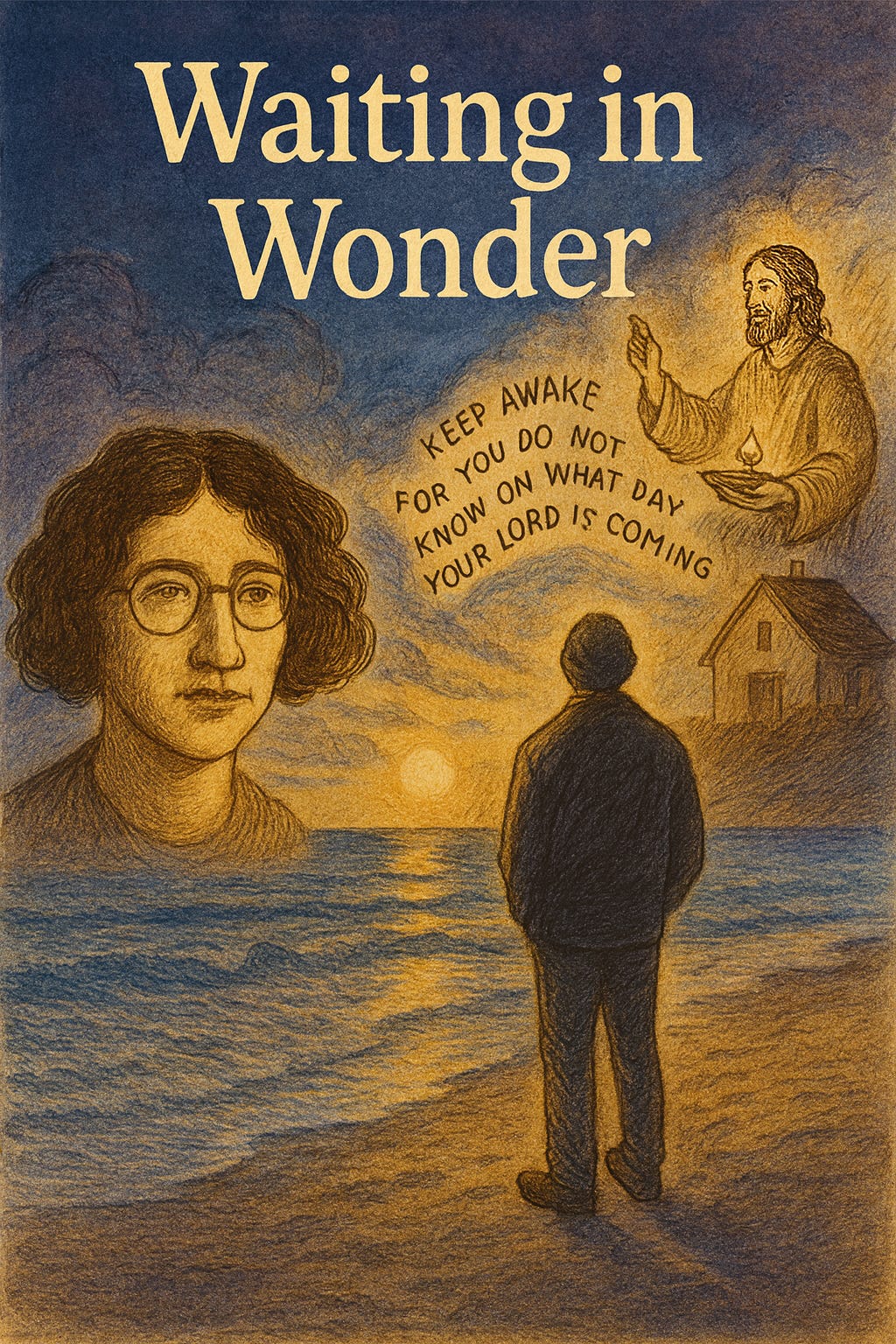
I’ve been working on an Advent resource with a group of colleagues from ENC over created my first-ever storytelling podcast mini-series called Waiting in Wonder. Each episode follows a story of one of my ENC Religion colleagues, a gospel story, and a Woman Christian Mystic who lived in a time of disruption.
Episode 1: Waiting without Turning Away: David Young, Simone Weil, and Matthew Ch 24
Episode 2: I Got You: Mat Thomas, Catherine of Siena, Mathew Ch 3
Episode 3: Julene Tegerstrand, Etty Hillesom, Matthew Ch 11
Episode 4: John Nielson, Julian of Norwich, Matthew Ch 1
I’m thrilled to share the first episode with you. If you like what you hear, will you share it with a few people?
I’d love for this series to be a blessing to many this Advent/Christmas season. I’ll be sharing the second episode during the week of Thanksgiving!
Peace,
Julene
About Waiting in Wonder: Advent Resource
Waiting in Wonder: A Journey Through Advent is a resource created for the New England District Church of the Nazarene by the former Religion and Culture faculty at Eastern Nazarene College. It is a free resource designed to guide you and your community through the four weeks of Advent. It has a wide range of resources for pastors, teachers, small group leaders, and anyone who wants devotional tools to journey through this sacred season. This podcast episode is part of a 4-part mini-series developed for that resource.
Summary of Episode 2
In this first episode of Waiting in Wonder, Julene talks with her friend Pastor David Young about what it means to slow down and pay attention during Advent. David shares how beauty, loss, and waiting have shaped his faith and how learning to “waste time” with God has become a way to stay awake to what really matters.
Drawing from Matthew 24 and the writings of Simone Weil, this conversation invites us to notice our hunger for God, to resist hurry, and to see everyday moments as places where love quietly arrives.
Key Themes
* Attention as prayer and resistance
* Simone Weil’s wisdom on hunger and presence
* Beauty as a teacher in a culture of striving
* Waiting as spiritual discipline and human honesty
* How loss reorients our priorities and our seeing
Scripture & Spiritual Voices
* Gospel Reading: Matthew 24 : 36 – 44
* Wisdom Voice: Simone Weil, Waiting for God
Guest
Rev. David Young is a pastor and teacher, co-pastoring at North Street Chapel in Hingham, Massachusetts. His reflections on beauty, loss, and waiting invite us to slow down and see the sacred in everyday life.
Host
Dr. Julene Tegerstrand is a spiritual director, leadership educator, and co-founder of Everyday Peacemaking. She helps people cultivate inner stillness and presence in volatile and uncertain times.
Practice Invitation
Take five minutes outdoors this week.No phone. No list.Notice three beautiful things.Whisper, “I receive this.”Let your waiting become prayer.
Quotation
“Waiting isn’t wasted time.It’s the soul staying alert, refusing to trade mystery for speed.”— Julene Tegerstrand
Credits
Original music: Waiting in Wonder by John NielsenProduced by Julene Tegerstrand and Everyday Peacemaking
Connect
Explore the full Waiting in Wonder Advent resource by signing up for access here.
Full Transcript
David Young:It was 75 degrees and sunny with a nice light ocean breeze—perfect. Just enough clouds in the sky to be beautiful. I looked out across Wollaston and thought, I can’t believe I get to live this close to water. I was taking it in—there to be present, have undivided attention, and notice the world. And I said to God, What am I supposed to do with all this—this beauty?
Julene Tegerstrand:That’s my friend, David Young. He’s a pastor and teacher, co-pastoring at North Street Chapel in Hingham, Massachusetts. His question that day—What am I supposed to do with this beauty?—became the seed for this Advent series.
You’re listening to Waiting in Wonder, a four-part podcast miniseries sponsored by the New England District Church of the Nazarene. I’m Julene Tegerstrand, a spiritual director, leadership educator, and co-founder of Everyday Peacemaking.As you listen, we hope each episode invites you into sacred space. Each week we’ll weave together three voices:– a gospel text to anchor us,– a voice of wisdom from Christian history to expand our imagination, and– a story from one of our pastors, teachers, or friends here in New England.Together, these voices invite us to wait—not in fear or hurry, but in wonder—awake to how God quietly arrives in the ordinary.
In this first episode we begin with Matthew 24, where Jesus says keep awake. We’ll listen with Simone Weil, who taught that attention is a form of love, and we’ll return to David’s story—from loss to a new way of seeing beauty.
When David asked, What am I supposed to do with all this beauty?—I saw myself in that question. It’s a reflex so many of us have: to turn gifts into projects, to translate wonder into usefulness. Even standing before a sunset or mountain view, our first instinct is to take a picture, even though the photo can never capture what we’re standing in.
That day on the jetty, David was practicing what he called wasting time—and doing it in God’s beauty.
David Young:I’m a very task-oriented person. Having a to-do list and checking things off makes me feel accomplished. There’s always the temptation to be more productive, to get two or three things done at once. To give undivided attention is seen as a waste of time—or at least a luxury, a privilege.
Julene Tegerstrand:French writer Simone Weil once wrote, “The danger is not that the soul doubts whether there is bread, but that it persuades itself it is not hungry.”When I first read Weil, I didn’t expect to hear her 1940s echo of our own experience. She was a philosopher who refused to stay safe while her country went to war—teaching by day and working factory shifts by night. She believed ideas were only true if they could stand in the presence of pain.
For Weil, a way to wake up was to cultivate attention: “Attention is the purest form of prayer.” To pay attention without turning away—that was her act of resistance. And it’s ours too: to look at beauty and pain and not turn away.
Advent is the season for attending to our hungers and making room for wonder. The church calendar invites us to slow down—and it’s profoundly counter-cultural.
I asked David to share what Advent means for the church.
David Young:The church year patterns our life after Jesus’s life—Christmas, Epiphany, Lent, Easter, Pentecost. It bends time around his story. What’s fascinating about Advent is that we don’t start at Christmas; we start by waiting. For four weeks, every year, the church says, Wait. Because waiting has value, even though our society treats it as a waste of time.
Julene Tegerstrand:When you hear Advent, what image comes to mind? A manger? Mary and Joseph? Yet Matthew 24 surprises us:
“Two will be in the field; one will be taken, one left… Keep awake, for you do not know on what day your Lord is coming… Therefore you must be ready.”
David Young:In Greek, keep awake means keep guard. Someone on guard must give undivided attention because others’ well-being depends on it. That’s challenging today—everything divides our attention. We’ve eliminated waiting; we want instant answers, instant deliveries, instant meals. But that shapes our imagination for God’s work, making us expect spiritual growth to happen like fast food or Amazon Prime. Scripture tells a slower story—Abraham dies with only one son. God’s promises unfold over lifetimes. That’s the value of Advent.
Julene Tegerstrand:Before we move on, take a deep breath. Notice the waiting already woven into your life—a hope half-formed, a prayer unanswered. What if instead of rushing past it, you gave it your full attention?
If Abraham lived in our world, he’d probably refresh the page: still processing a great nation. But God’s promises come by seasons—slow, human, alive.
Our culture prizes production over presence. David knows this tension well.
David Young:I’m an Enneagram 5—the Investigator. My core desire is to be competent; my core fear is not being competent. That desire runs deep in me. I want to do things well, to be the expert. It’s also embedded in American culture—our imagination of success defines us by productivity.
Julene Tegerstrand:Every lesson about waiting eventually stops being theoretical. For David, it came through disruption. In 2011 he was pastoring in Illinois and waiting to hear from PhD programs. Then his father had a stroke—and everything shifted.
David Young:I’d just visited him; he seemed better. I went home to Illinois to prepare for our move to Boston for my PhD. We’d talked on Skype that day—he looked great. A few hours later, nurses called: your dad’s passing away. By the time I finished asking how much time he had, he was gone.
Julene Tegerstrand:Have you ever had a moment when everything urgent falls silent? When your lists look small in the face of loss? That’s the waiting without an answer.
David Young:That was when I realized how unaccustomed I was to waiting for my desires to be fulfilled. It’s shaped me ever since. I’m not anxiety-free, but less anxious now. When my dad died while I was waiting for PhD acceptance letters, it re-oriented everything—what mattered, what didn’t.
Julene Tegerstrand:After his dad’s death, life felt different. Maybe that’s what Advent teaches too: sometimes it takes losing control to remember what waiting really is—a way of saying, I can’t fix this, but I can stay awake to what’s here today.
David Young:When my wife and I talk now, I often say, I don’t want to ride that emotional roller coaster. Someone once told me, ask, “Is this a three-day problem?” If not, let it go. That perspective helps. Waiting becomes a spiritual discipline that prepares us for the moments we have no choice but to wait—illness, infertility, unanswered longing. Practicing waiting prepares us for real life.
Julene Tegerstrand:And there are quieter opportunities to practice waiting—the ordinary pressures to keep accomplishing when the soul is asking for rest.
David Young:When I get too busy, pinging from task to task, I feel disintegrated. I have to step back. When I do, clarity returns.
Julene Tegerstrand:When you give yourself permission not to accomplish, you gain clarity about what truly matters and what’s yours to do.
David Young:Exactly. When I don’t, I drift—living by what I think others expect of me.
Julene Tegerstrand:So we find David back where we began, at Wollaston Beach—but now we’ve walked with him through hunger, attention, waiting, and loss.
He’d spent a day in deep conversation, then went for a run. Instead of heading home, he walked out on a jetty and stood there.
David Young:I was there to be present, have undivided attention, notice the world. And again I asked, God, what am I supposed to do with all this beauty?And God said, What are you talking about? Enjoy it.I was being invited to listen—to recognize the value in simply waiting and noticing beauty, not producing anything.
Julene Tegerstrand:That’s attentive waiting—the kind of seeing that refuses to swallow beauty, that lets desire stay open. It’s what Jesus means by keep awake. Waiting isn’t wasted time—it’s the soul staying alert, refusing to trade mystery for speed.
David Young:Maybe part of Advent’s wisdom is this: we can’t see Jesus clearly in other seasons unless we first take a posture of waiting.
Julene Tegerstrand:Advent begins in the dark—with attention, hunger, and the courage to wait for what we cannot yet see.
This week’s practice is simple:Take five minutes outdoors. No phone, no list. Notice three beautiful things. When you notice one, whisper, I receive this.
May your waiting be honest.May your hunger stay awake.May you notice when love draws near.
Presence might be the holiest work of all.Thank you to David Young for sharing his story, to John Nielsen for the song Waiting in Wonder, and to the New England District Church of the Nazarene for supporting this project.
Next week Pastor Mat Thomas joins us with a story of a little boy running across the sanctuary and wrapping his arms around Matt’s legs—like God saying, I’ve got you.Until then, may you find stillness, beauty, and love drawing near.
More about the guest:
David Young, is co-pastor with Jacob Hafler at North Street Community Church of the Nazarene in Hingham, MA. He also serves on the New England District NDI Council and Board of Ministry and teaches for Northwest Nazarene University’s online Christian Ministry program. Previous ministry roles include Dean of the Chapel and Associate Professor of Biblical Literature at Eastern Nazarene College as well as Pastor of Clinton First Church of the Nazarene in Clinton, IL. Dave is a graduate of Boston University School of Theology (Ph.D., New Testament and Early Christianity), Nazarene Theological Seminary (M.Div.) and Eastern Nazarene College (B.A., Theology and Philosophy). He met his wife, Jessica, while they were both students at ENC. They have three remarkable children; Hannah, Malachi, and Esther. Dave loves basketball, biking, pizza, tacos, and New England summers (New England winters are another matter), and studying scripture.