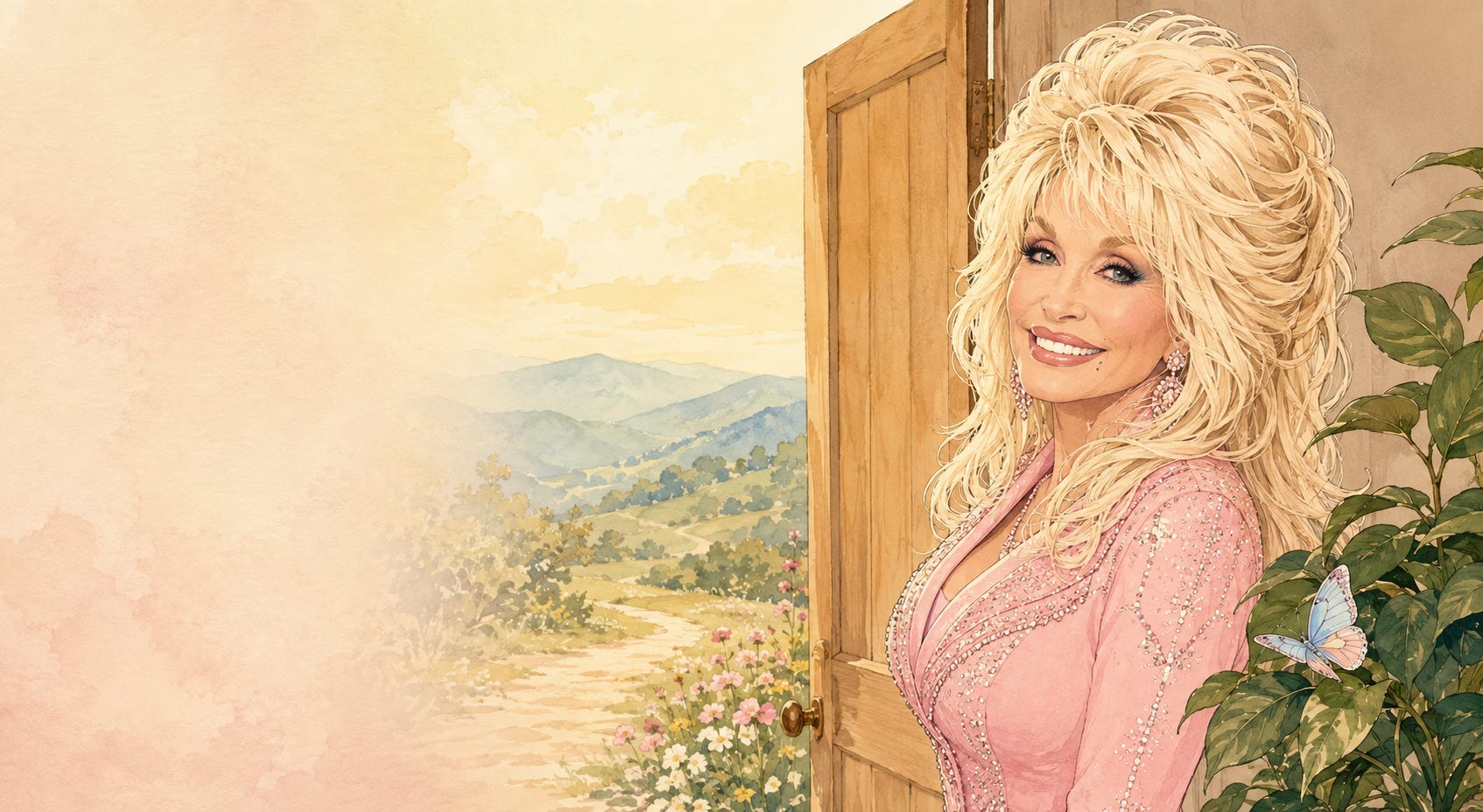
Since Dolly Parton passed, people have shared story after story about her genuine, heartfelt kindness. It reached people as naturally in private as it did in public, embracing celebrities and strangers alike. Dolly’s kindness seemed to come from a deeply held belief that people—all kinds of people—were worth loving.
Dolly was openly Christian, and she expressed her faith through acceptance. Long before acceptance was fashionable, particularly in country music, she welcomed her gay fans wholeheartedly. She understood something many people who stand in the pulpit are still learning. A pulpit can preach love, but people recognize love by the way they are treated.
The title of this essay, “The Church of Dolly,” reflects the way she practiced her faith. She welcomed everyone and refused to judge. She treated kindness as something sacred. Hers was a faith revealed not by whom you declared morally or spiritually unacceptable, but by how generously you loved.
Throughout her life in the limelight—and even after her death—some people claiming to speak for Christianity insisted that Dolly could not have been a “true Christian” because she supported the
LGBTQIA+ community. But Dolly answered them this way: “Love is love.” People do not control whom they love, and same-sex couples should be allowed to marry. She added: “I believe in God. I think God is the judge. I don’t judge or criticize, and I don’t think we’re supposed to.”
Her kindness was not merely generosity toward people who loved her. She maintained it even when people were actively trying to insult or condemn her—which is a much harder kind of kindness.
No membership requirements. Everyone belonged. No interrogation at the door. Come as you are. There will probably be rhinestones.
Her Imagination Library may be the most extraordinary example of how her mind worked. Dolly knew that her father had never learned to read, so in 1995 she began mailing books to young children in her home county in Tennessee. The idea grew beyond anything most people could have imagined. Eventually, children in five countries could receive a free, carefully chosen book every month from birth through their fifth birthday, regardless of their family’s income.
Who thinks of that?
Who thinks: A child needs books, so I am going to make sure one arrives at that child’s home, with that child’s own name on the package, every single month?
A mother recently posted that her little boy was heartbroken when Dolly died because he believed she had personally chosen and sent those books to him. He believed Dolly Parton knew who he was and liked him.
Of course, Dolly did not personally select and mail each child’s book. The program she created handled the book selections and monthly mailings. But the little boy’s belief made perfect sense because personal, attentive kindness was exactly what people believed Dolly capable of. That was the kind of person she had shown herself to be.
And he was not the only child who felt that connection. After Dolly died, I discovered her song “Light of a Clear Blue Morning” through a video of a tween girl filming herself in the backseat of a car as someone drives. She sings along with Dolly, smiling the entire time. Her face is pure joy. She even mimics Dolly’s laugh a couple of times during the song. Oh, that iconic laugh! The song was released in 1977, yet here was a child from an entirely new generation connecting with it—and loving Dolly. Grandparents love her. Parents love her. Now their children love her. To remain that beloved across so many generations is extraordinary. Indeed, that is rare—but so is Dolly. That is why we all miss her so much.
And the books were far from her only act of generosity. After the devastating 2016 wildfires in East Tennessee, her My People Fund provided displaced families with monthly payments—no strings attached. She donated $1 million to COVID-19 research at Vanderbilt—funds that helped support early testing of the Moderna vaccine. Years earlier, her foundation created a “Buddy Program” that promised students money if they helped each other stay in school and graduate. The dropout rate in those participating classes fell dramatically.
That is kindness with its sleeves rolled up.
But this really isn’t an essay about Dolly Parton. It is about the choice she demonstrated over and over again: the choice to make life a little less difficult for somebody else.
We need that choice now.
We live in a time when rudeness is treated as entertainment. People laugh at humiliation, reward cruelty with attention, and call insults “honesty.” We have watched the president of the United States mock a disabled reporter, call a female reporter “piggy,” and tell another reporter she was a “terrible person” simply for asking a question.
Whatever our politics may be, that behavior matters. When the most powerful person in the country treats humiliation like a punch line, people receive the message. If he can do it, why can’t I? If the crowd laughs, how bad can it be?
Children receive that message especially clearly.
My son works as a restaurant server. Recently, he waited on a large, loud family that had rented a party room and seemed determined to take over the entire restaurant. They stood on the stairs while servers were trying to carry food, making an already difficult job even harder.
But the worst part was a little girl at the table who was deliberately rude to my son. She thought it was funny.
So did her mother.
Instead of correcting her daughter, the mother laughed. She was not teaching that child how to be strong, confident, or clever. She was teaching her that another human being’s discomfort could be used as entertainment. And then we are shocked when that lesson takes hold and becomes what popular culture has come to call “Karen” behavior.
For what? A moment’s laughter?
What if, someday, that little girl is the server? What if she comes home and tells her mother about a family who treated her as if she were beneath them? Would it still be funny?
Since when is rudeness funny? And why have we decided that kindness is somehow corny, weak, or naïve?
Kindness is not weakness. It does not mean allowing people to mistreat us. It does not require silence in the face of injustice. Sometimes kindness is soft. Sometimes it is fierce. Sometimes it is a book arriving in a mailbox. Sometimes it is moving out of a server’s way. Sometimes it is correcting your child even when everyone else is laughing.
Researchers have found that rudeness is contagious. A person who experiences it, or even witnesses it, becomes more likely to carry it into the next interaction. We know this without needing a study. One person snaps at a cashier; the cashier loses patience with the next customer; that customer goes home irritated and speaks sharply to a child—and the child learns something.
There is an old expression for a particularly ugly version of this: “kick-the-dog syndrome.” It is a recognized popular expression, and the formal psychological term is “displaced aggression.” The American Psychological Association defines it as directing hostility away from the source of our anger and toward another target—often because the original source feels too powerful to confront.
The boss humiliates the employee. The employee cannot—or will not—challenge the boss, so he goes home and snaps at his wife. She loses patience with their child. The child, having no one smaller to take it out on, kicks the dog.
The anger keeps traveling downhill until it lands on the one least able to fight back.
It is an awful image. It is supposed to be.
We may not literally kick the dog, but we pass our hurt along all the time. We hand it to someone who had nothing to do with causing it, simply because that person is nearby—or because we think they cannot do anything about it.
But every person in that chain has the power to break it.
But kindness travels, too.
Holding a door. Paying a sincere compliment. Thanking the person who brings your food—and looking at them when you say it. Letting someone merge in traffic. Waving thank you when someone lets you merge. I love that little wave. I admit, I’m always a bit disappointed when I don’t get one. Returning the shopping cart. Checking on the lonely neighbor. Sending the thank-you note—or email or text—because kindness should be acknowledged when we receive it, too.
Small things are not small when they alter the way another person moves through the rest of the day.
I think that old bumper sticker got it right: PRACTICE random acts of kindness.
Kindness is a practice. Kindness can be modeled from president to citizen, employer to employee, and parent to child. Every one of us is teaching by example, all the time.
Dolly Parton showed what happens when kindness becomes a way of life. In her hands, kindness became action—a book in a child’s home mailbox, a welcome offered just when someone needed one. The Church of Dolly lives on each time someone notices who might need a little love—and acts. Its doors remain open, and everyone belongs.