Twenty twenty five ended the way years now tend to end: not with a bang or a benediction, but with a long exhale. We are told, endlessly and with a certain moral scold, to let go. Of grievances. Of habits. Of people. Of the past itself. The phrase has the texture of self-help, but also the faint menace of surrender. Letting go, in the popular telling, is a soft capitulation—hands raised, spine bent, history erased.
But there is a more adult, more useful verb waiting in the wings.
Regulation.
You don’t give up. You regulate. You parse. You behave like a sailor who knows that storms are not arguments to be won but conditions to be read. Climate changes. Norms mutate. Power shifts. The intelligent response is not denial or despair but calibration—small, precise adjustments that keep the vessel moving toward something resembling joy.
“You can’t turn an ocean liner on a dime” - President Barack Obama
“You can’t stop a train wreck with a scream” - Mindchimes Carl Cimini
This is not stoicism. It is craftsmanship.
What, then, are we releasing as the calendar turns—not theatrically, not performatively, but with intention?
First, the fantasy of moral purity. The last year has been thick with litmus tests and loyalty oaths, a culture convinced that righteousness is brittle and must be defended by shattering others. Letting this go does not mean abandoning values; it means abandoning the childish belief that values require perfection to survive. A healthier world is built by people who are ethically serious and emotionally supple—capable of holding contradiction without combusting. Regulation here looks like curiosity replacing condemnation, listening as an act of strength rather than concession.
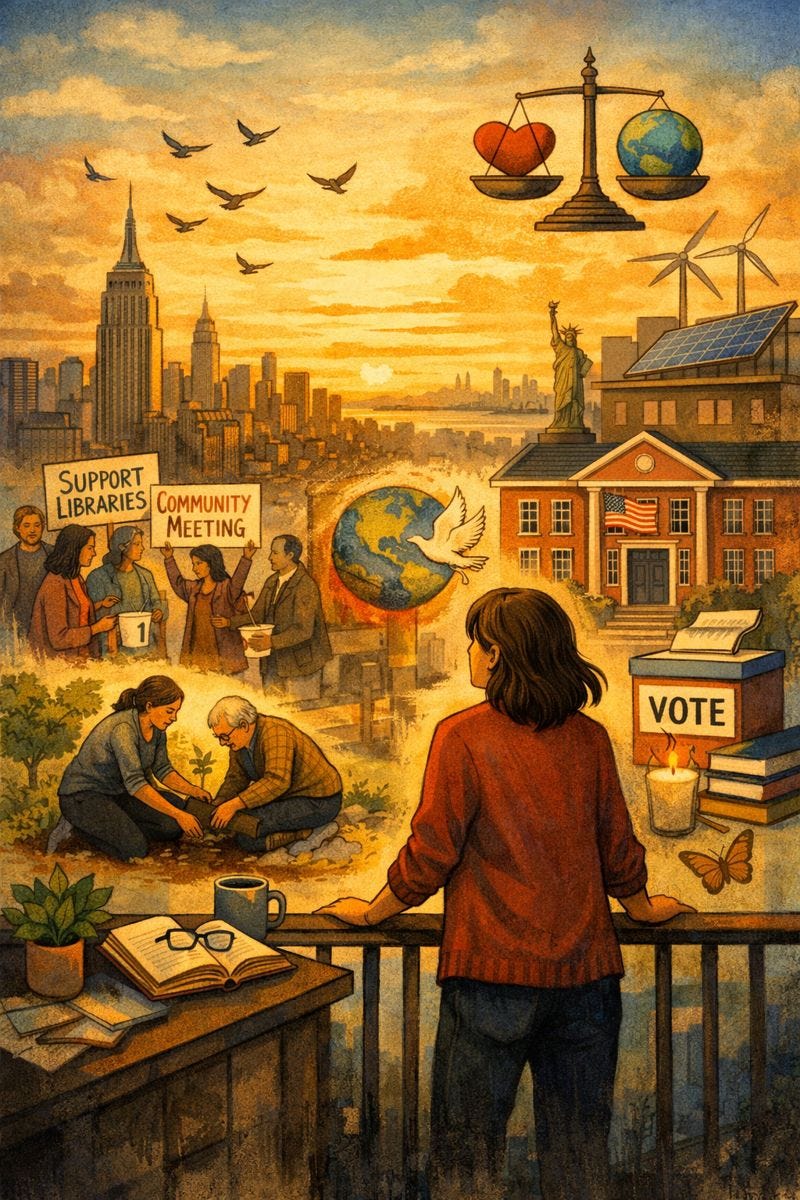
Second, the tyranny of outrage as a substitute for action. Outrage has its place—it is the smoke that tells us a fire exists—but too often we have mistaken the smoke for the work. The new year demands fewer viral condemnations and more local repairs: school boards attended, libraries defended, unions supported, neighbors fed. The world does not improve because we are loudly correct; it improves because we are stubbornly useful.
Third, the notion that joy is indulgent or unserious. This may be the most corrosive lie of the era. Joy is not a retreat from responsibility; it is fuel. Movements that cannot laugh, love, or rest eventually rot into dogma. Personal joy—carefully tended, deliberately chosen—is not selfish. It is renewable energy. It keeps people human in systems designed to exhaust them. Regulation here means noticing what drains you versus what restores you, and choosing accordingly, even when the culture rewards burnout as virtue.
There are practical ways forward, modest but potent. Consume less noise and more depth: fewer algorithmic panics, more long-form thinking. Invest in institutions that outlive moods—public schools, local journalism, mutual aid networks. Practice “slow citizenship”: voting, yes, but also mentoring, teaching, showing up consistently rather than spectacularly. Speak with precision. Act with patience. Refuse the false urgency that demands instant reaction at the expense of considered response.
Most of all, let go of the idea that the world is repaired in grand gestures. History suggests otherwise. It bends because enough people, in enough places, make small, sane adjustments toward decency. They regulate. They parse. They adapt without surrendering their north star.
The new year does not require reinvention. It requires alignment.
Move toward personal joy—not as escape, but as compass. Tweak what no longer fits. Adjust to the weather without forgetting where you’re going. The work ahead is not to become someone else, but to become more precisely yourself, in service of a world that badly needs fewer slogans and more steady hands.
Thanks for reading and let live twenty twenty six a more demanding, more focused and more joyous. The best revenge is living well, don’t give that up.
Thanks for reading and please support my Substack
Carl’s Mind Chimes Magazine is a reader-supported publication. To receive new posts and support my work, consider becoming a free or paid subscriber.