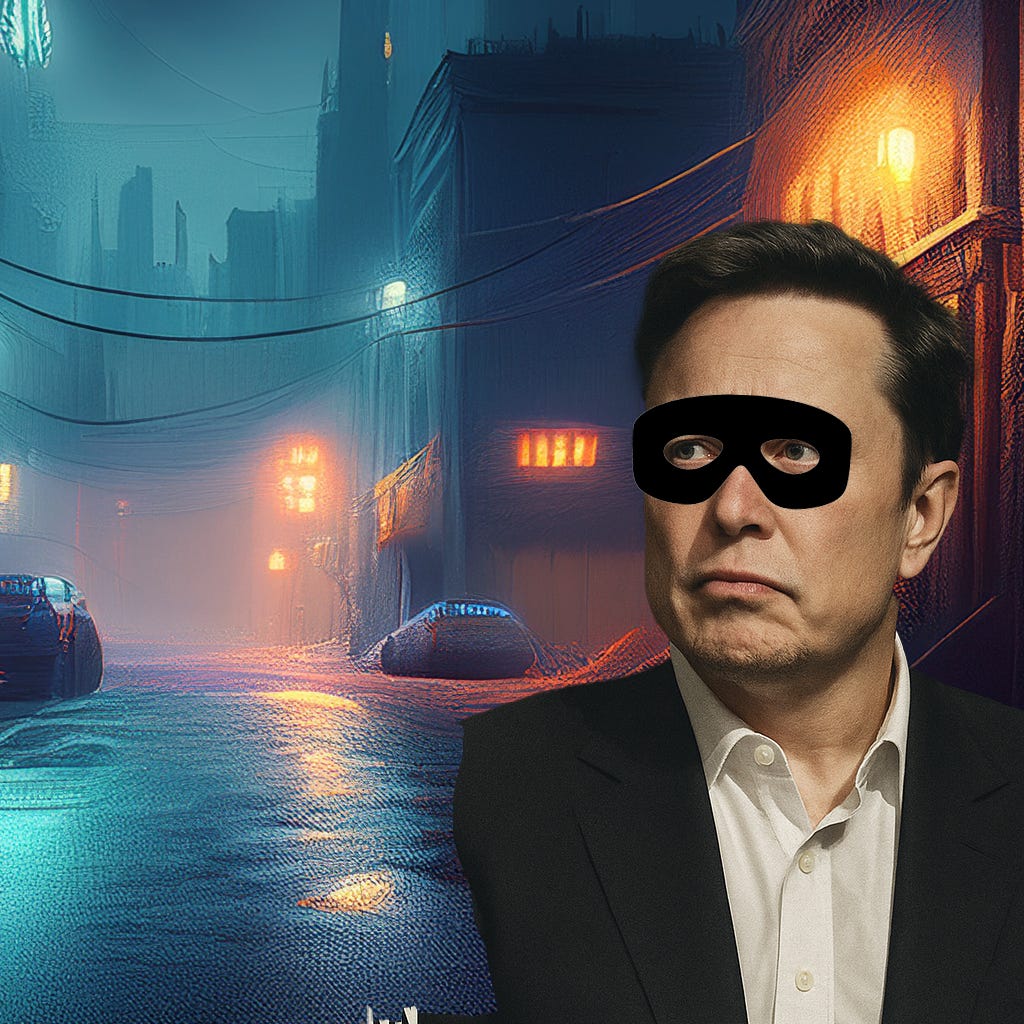
The collective sigh of relief you're hearing isn’t because Musk is leaving politics, its your soul being sucked away.
A burglar doesn’t hang around the crime scene.
He gets in, gets what he came for, and disappears into the dark, whistling while the world reels, wondering what just got lifted.
Elon Musk—the world’s richest man, Twitter vandal, space cowboy, and AI opportunist—is stepping back from politics. Not because he’s grown tired. Not because he’s seen the light. But because the job is done. The safe is cracked, the files copied, the fingerprints are wiped. The only thing left is silence—ominous, calculated silence.
Make no mistake: this isn’t a retreat. This is an extraction. A quiet exit through the side door while the security alarms are still ringing in the distance.
Musk didn't involve himself in politics out of some noble commitment to free speech or innovation. No, he waded into the swamp—Tesla-blooded, Twitter-armored, and grinning with that silicon glint in his eye—for one reason only: information. Raw, writhing, democratic information. Voter habits. Cultural divides. Outrage patterns. Hashtag psychology. Emotion-synced algorithms. Public delusions. Political loyalties. The intimate rhythm of the American nervous system.
And now, suddenly, he’s done?
Don’t buy it for a second.
Because Elon Musk stepping back from politics is not an act of humility. It’s not even an act of strategy. It’s a post-heist getaway. The man has all he needs to prime AI for the biggest theft in history—not of money (he’s got that), nor power (he flirts with that like a Bond villain in beta), but reality itself.
With every tweet, every dogwhistle, every boosted fascist, every feigned centrist head-nod, Musk’s goal was never to lead a party. It was to mine the motherlode of behavioral data that lies beneath democracy’s crumbling floorboards.
He bought Twitter not to fix it, but to extract from it—to hook its pulsating, unfiltered id into a neural interface and download a generation’s worth of fear, anger, lust, and loneliness straight into the neural net that powers his AI.
What do you think he's feeding into Grok? Or whatever techno-chimera he has cooking behind the curtain? Polite text prompts and weather queries? Hell no. He’s feeding it us. Our tribalism. Our trauma. Our thirst for dopamine and vengeance and tribal supremacy. The purest, most potent form of behavioral input ever compiled, and it’s wrapped in hashtags and rage gifs.
Musk isn't stepping back from politics. He's finished with it. Or rather, he’s milked it dry. The electoral arena? That was the harvest. The real game is AI, and what’s scarier—what’s infinitely more dangerous—is that he now possesses not just a learning machine, but a soul-hijacking simulator that knows how to speak to every American with a whisper that sounds like their own conscience.
The danger isn’t that Elon Musk will run for president. The danger is that the next president—and every president after—might be shaped, predicted, or even pre-selected by a Musk-trained algorithm that understands you better than your therapist, your priest, or your spouse ever could.
This is no longer about social media. It’s about social engineering at scale. With AI as the scalpel. And our politics, our rage, our hope, and our pain as the tissue to be dissected.
So no, Elon Musk stepping away from politics isn't news. It’s a smoke bomb. A magician’s gesture to the left while his right hand flips the kill switch on reality itself.
He doesn’t need to hang around anymore. He’s not trying to win the next election.
He’s already stolen the future.