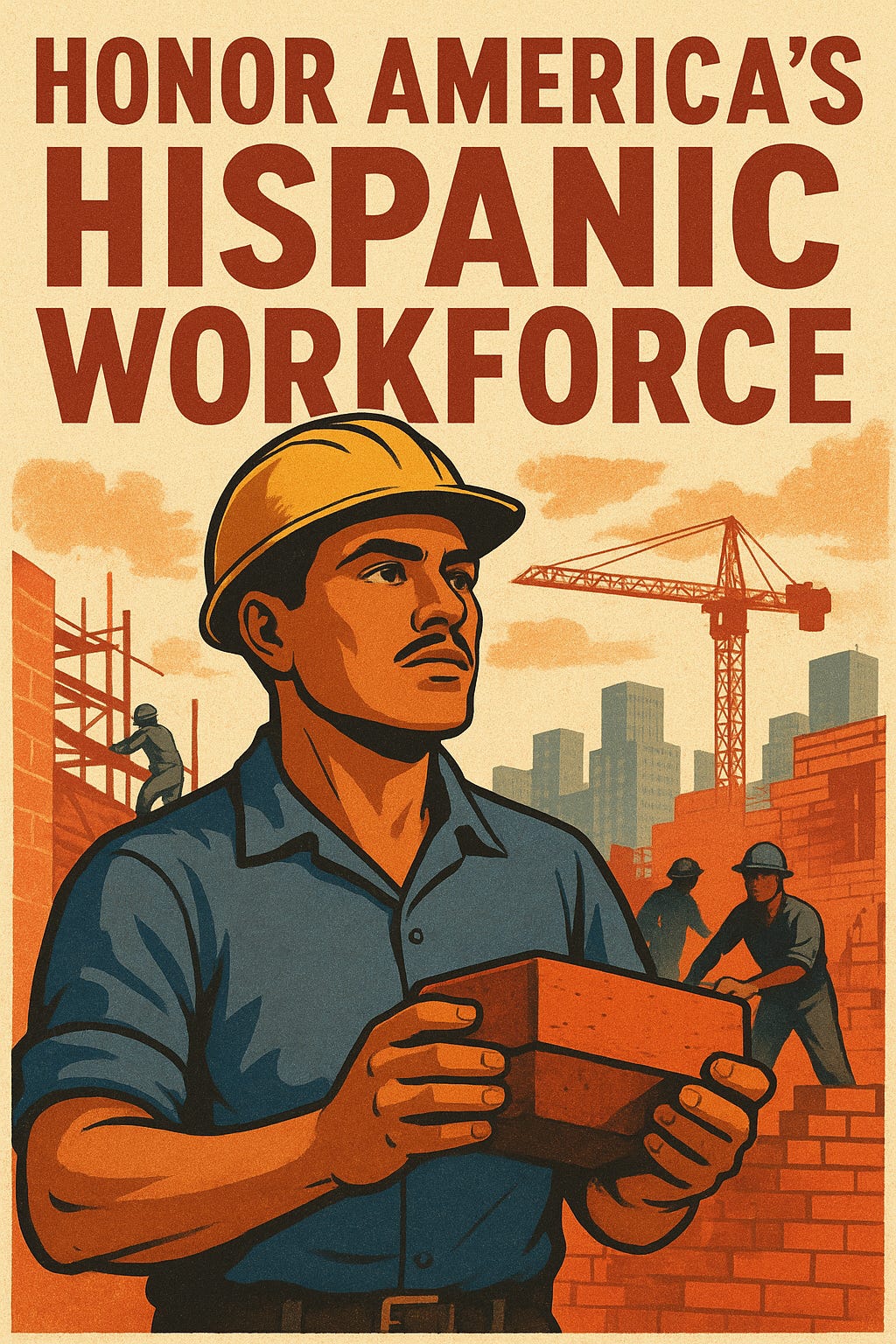
THE QUIET ARCHITECTS OF AMERICA’S TOMORROWA Mind Chimes Essay
There’s a certain hour in the American morning—the hour before the coffee shops unbolt their doors, before the sidewalks hum, before the nation fully puts on its face—when you can see the country being held up by the hands that most of our politics refuses to see. A van door slides open. A work boot touches the pavement. A lunch pail swings. And in that unselfconscious moment, the truth stands bare: America still depends on immigrant labor just as absolutely as it did a century ago.
The faces have changed. The work hasn’t.
Today it is the Hispanic workforce—Mexican, Dominican, Salvadoran, Puerto Rican, Honduran, a quilt of nations—who bear the greatest weight of our infrastructure, our agriculture, our construction, our domestic labor, our kitchens, and our care industries. They stand precisely where the Italians once stood, where the Poles, the Slovaks, the Irish, the Croats, the Greeks, the Welsh miners, and the Hungarian steelworkers stood before them: at the bottom rung of a ladder that has always been both a promise and a dare.
It is fashionable, in certain corners of the nation, to pretend that this ladder no longer exists—that the American Dream is some kind of romantic fiction, a sepia-toned myth invented by civics textbooks and tired politicians. But when you watch these workers gather at dawn, shrug against the cold, and step into the long day ahead, you are reminded that the ladder never disappeared. It simply moved—and they found it.
And yet, astonishingly, they are met not with gratitude but with suspicion. Not with opportunity but with police lights. Not with policy but with panic. In some states, they are chased through neighborhoods by armed patrols deputized by politicians hungry for applause lines. Their homes are raided, their workplaces stormed, their very presence recast as a criminal intrusion on ground soaked with the sweat of their predecessors.
America, in its more shameful moods, is a country that forgets too easily. It forgets the Slavs who kept Pittsburgh’s steel mills alive through unending shifts. It forgets the Welsh miners who tunneled into Appalachian darkness with nothing but a pickaxe and a prayer. It forgets the Italian masons who raised our cities brick by brick, often in weather so cold their hands bled through their gloves. These were not glamorous tasks. These were not celebrated jobs. But they were the jobs that built the bones of the nation.
And now, here we are again—only this time, the workers are speaking Spanish while doing the same vital work. The story hasn’t changed. Only the accent has.
The United States thrives when it allows people to step onto that humble first rung. When it offers safety instead of fear, lawful pathways instead of labyrinths, dignity instead of demonization. Each generation of immigrant laborers has proven the same truth: given a foothold, they will climb. And when they climb, the country climbs with them.
The grandparents of yesterday paid college tuitions with double shifts, union cards, and battered lunch buckets. They bought the starter homes whose porches later held first-generation college graduates. They stitched themselves into America through sheer willpower and rotary-club English. Their dreams were paid for with overtime hours and with the kind of physical labor that leaves its signature on the spine.
The Hispanic workforce is repeating that story with absolute fidelity. They are sending their kids to universities. They are buying homes. They are anchoring communities that had been left for dead by deindustrialization. They are opening businesses in storefronts where the lights had gone out years before. They are—quietly, steadily—reviving the American middle class from the bottom up.
And yet, we have leaders who greet this rebirth with rage. Leaders who build careers by promising to punish the very workers whose sweat props up the economy. It is a kind of national amnesia so profound it borders on performance art.
But America has always had two faces: the fearful one that distrusts the newcomer, and the hopeful one that bets on them. History shows, again and again, that only one of those faces builds something worth keeping.
The question now is which face we intend to show.
Because the story of America’s Hispanic workers is not just an immigrant story; it is a future story. A story about who we are becoming, and who we refuse to become. A story that asks whether we still believe in the alchemy that once turned steelworkers’ children into doctors, miners’ sons into professors, bricklayers’ daughters into filmmakers and engineers.
The truth is simple: America rises when its workers rise. All of them. Without exception.
If we extend to today’s workforce the same battered, imperfect, but profoundly powerful opportunity that earlier immigrants clawed onto, they will do what every generation before them has done—pull the country forward.
And if we deny them that chance, then it isn’t their future we imperil.It’s our own.
This is the Mind Chimes moment: the reminder that progress does not come from nostalgia or fear, but from the courage to remember who built this place—and who is still building it, every single morning, before the sun fully remembers how to shine.
In the end, the measure of a nation is not taken in its rhetoric but in its treatment of those who labor, unseen, on its behalf. If we cannot find the will to honor the people who sustain our fields, our cities, our homes, and our hopes, then we risk diminishing not only their future but our own. The work continues. The responsibility is ours. And the story—America’s story—is still being written.
Thank you for reading Mind Chimes. If this piece resonated, share it, discuss it, and let it echo outward.
Dues are due by quite a few we know who and so do you! So, please Subscribe and Share join me on this great journey upholding Democracy and human rights.