By Carl Cimini
Now, Ira Murphy didn’t have much use for fair play, nor did fair play have much use for him. He was the kind of boy who could knock the wind out of a grown man before his voice had even finished cracking, the kind who knew how to set a fire but not how to spell “arson.” Teachers tried for a while, God bless ‘em, but he slipped through their fingers like muddy water, and by the time he left school for good in the eighth grade, no one much expected to see his name anywhere but in a police blotter.
Now, you might think that’s where Ira’s story ends—a bad seed growing into a rotten tree, same as his daddy, his granddaddy, and whatever nameless men came before them. But times had changed. In the old days, a boy like Ira would’ve ended up breaking rocks or digging ditches, putting all that mean energy into something that kept his hands too tired for trouble. But in these days, well, there were others who had a use for boys like Ira.
They were the kind of fellows who spent their childhoods in dim bedrooms, the glow of a computer screen their only light, their mothers their only conversational partners. They nursed grudges like they were bottle-fed on ‘em, watching from the sidelines as the world danced and laughed without them. They weren’t strong, they weren’t brave, but by God, they were patient. They had plans, blueprints drawn up in bitterness, and what they needed were hands to do the dirty work.
So they found their Ira Murphys—boys too wild to know better, too mean to care. They whispered in their ears about who was to blame for their lot in life, pointed them toward the folks who had something they never did—happiness, ease, connection. And Ira, who never did much thinking of his own, listened.
But here’s the thing about America—she don’t belong to the Ira Murphys or to the shut-in schemers. She belongs to the rest of us, the ones who grew up with scraped knees and bad haircuts, who knew a little trouble but not too much. The ones who learned kindness from their fathers and common sense from their mothers. The ones who figured out early that life ain’t fair, but you don’t make it better by dragging everyone else into the mud with you.
And so, while the Ira Murphys of the world stomp and sneer, and while the bitter little men in dark rooms spin their webs, the rest of us keep on. We build, we work, we love. We pass on to our children what was passed on to us: that a fair shake and a helping hand are worth more than all the anger in the world.
And in the end, that’s why the Ira Murphys always lose. Because America ain’t built for the bitter, the cruel, or the conniving. She’s built for the rest of us.
Ira Murphy didn’t think much about the world beyond his small, mean corner of it. Thinking wasn’t his strong suit. Feeling—that deep, gut-level resentment—was. And for years, that was enough.
But times changed. The world started moving in ways Ira didn’t understand, in directions that felt like they were leaving him behind. He didn’t have the words for it, but he knew it wasn’t fair. And then one day, someone came along who did have the words. Someone who knew exactly how to make a man like Ira feel powerful again.
Now, Donald Trump wasn’t like Ira Murphy. He didn’t grow up scrapping in the dirt. No, he was one of those kids who spent his youth scheming, watching, and learning how to bend the rules without breaking a sweat. He was never the strongest, never the fastest, never the most talented—but he didn’t need to be. Because he had something better: the ability to turn his own bitterness into a weapon, sharpened by resentment and aimed at men like Ira Murphy, men hungry for a reason to fight, men to do his bidding.
When the call came on January 6, Ira Murphy and the thousands like him didn’t hesitate. They swarmed the Capitol like a pack of starving dogs, smashing, screaming, believing—just for a moment—that they were finally the ones in charge. That they had taken back something, even if they couldn’t quite name what it was.
And where was Trump? Not in the crowd, not in the chaos. He was watching from a safe distance, just like he always had. The childhood cowardly brat himself turned would-be king, smirking as the minions did his dirty work, feeding them lines, winding them up, and setting them loose.
But here’s the thing: history has never been kind to the Iras of the world. The men who throw the punches are always the ones left holding the bag when it all falls apart. The schemers? They slip away, rewrite the story, find new pawns. And America—messy, imperfect, but built on the backs of better men and women—keeps moving forward, leaving them both behind.
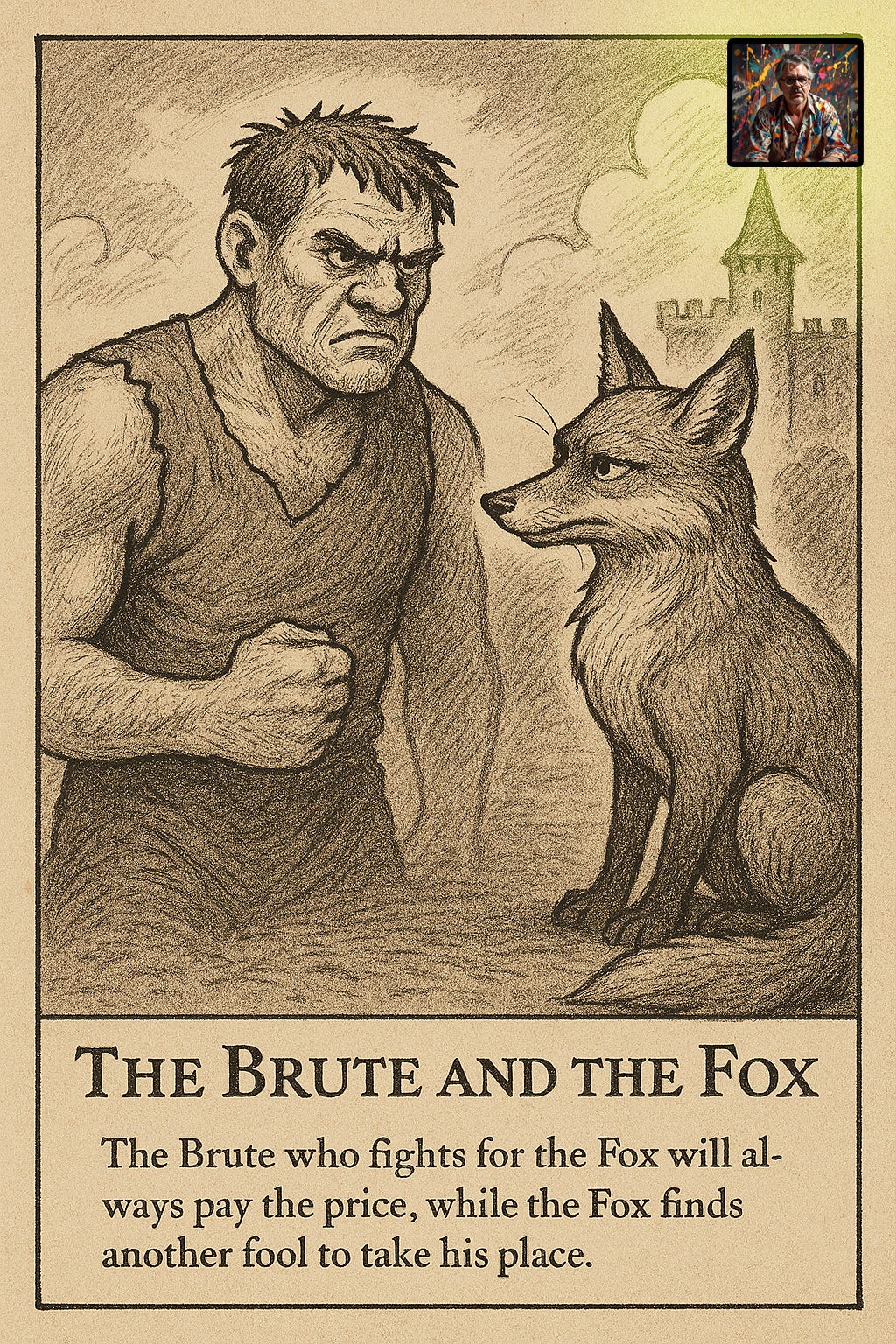
Once, in a vast and restless land, there lived a Brute named Ira. Ira had been raised on hardship, taught to use his fists before his words, and he believed that strength alone would earn him a place in the world. But no matter how hard he fought, the world did not seem to care.
For those who capitulate and kiss the ring. “One day, a Fox came to Ira. The Fox had never lifted a hand in labor, nor had he ever fought a battle himself. But he knew how to whisper, how to stir a storm in men’s hearts without ever stepping into the rain.
“The world has taken from you,” the Fox said, his golden tongue glistening. “It is not you who are weak—it is them who have stolen what is rightfully yours.”
Ira did not ask who they were. It did not matter. He was tired of feeling small, tired of losing. So when the Fox told him to fight, he did. He and others like him stormed the great halls of the land, breaking and shouting, believing themselves to be kings reclaiming a stolen throne.
But when the dust settled, the Fox was nowhere to be found. He had never entered the fight—only watched from afar, as Foxes do. And when the rulers of the land came to cast judgment, they did not seek out the Fox. No, they took the Brutes, for they were the ones with dirt on their hands, the ones who had bled and destroyed.
As Ira sat in his cage, he wondered where the Fox had gone. He did not yet know that Foxes always escape, slipping into the shadows, ready to whisper into new ears when the time is right.”
Moral: The Brute who fights for the Fox will always pay the price, while the Fox finds another fool to take his place.
BTW, apologies over the past week I’ve been away doing a home renovation and that’s finally over so I’m back in the saddle and the keyboard feels good. Thanks for reading as always and continue to enjoy my mind chimes as always.
Carl’s Mind Chimes Magazine is a reader-supported publication. To receive new posts and support my work, consider becoming a free or paid subscriber.