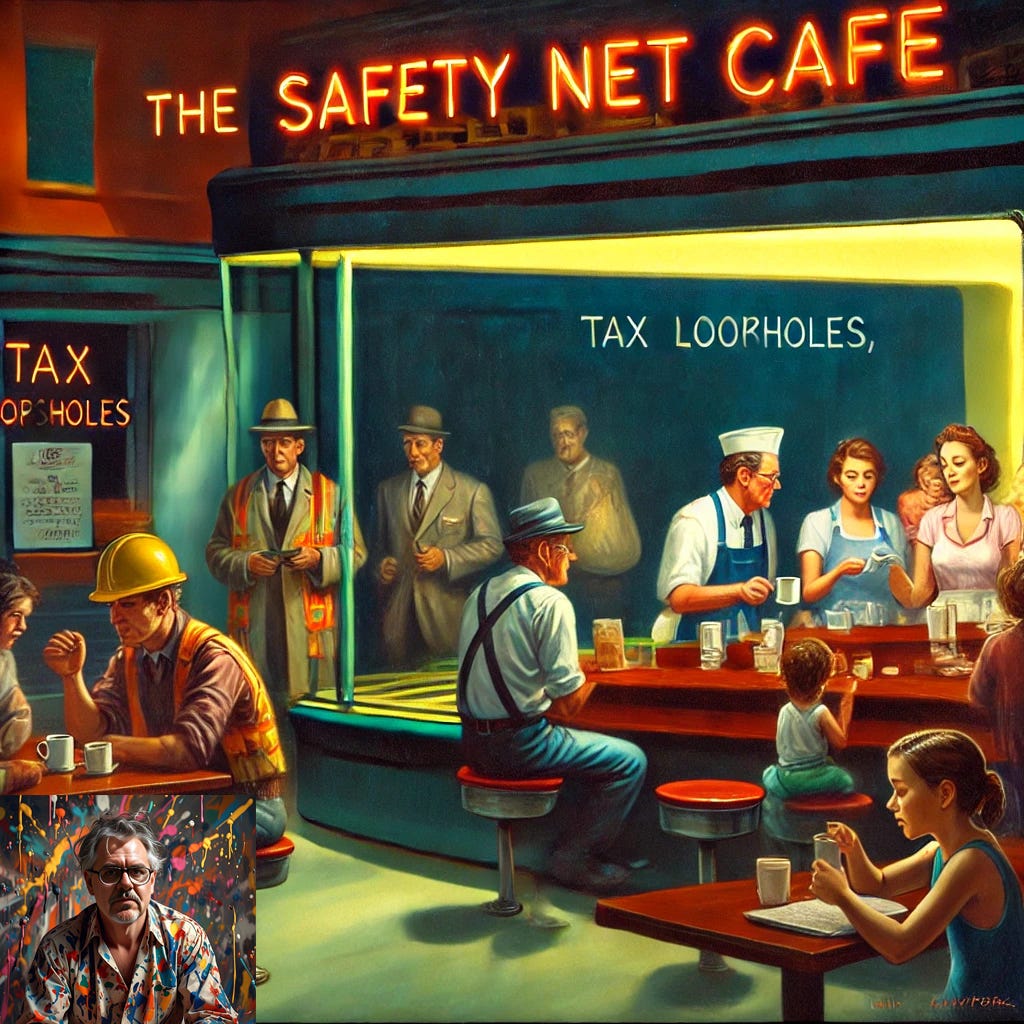
The Great American Grift: How the Real Waste Isn’t Where You Think It Is
By Carl Cimini
Carl’s Mind Chimes Magazine is a reader-supported publication. To receive new posts and support my work, consider becoming a free or paid subscriber.
For decades, Americans have been conditioned to believe that the biggest threat to the economy isn’t corporate greed, unchecked speculation, or tax avoidance by the ultra-wealthy—but rather, food stamps, public schools, and Social Security. The idea that government programs are bloated, wasteful, and riddled with fraud has been repeated so often that it’s taken as gospel. But the numbers—and reality—tell a different story.
Government as Protector, Not Employer
Despite what politicians claim on the campaign trail, the government is not a "jobs program" in the way they suggest. It does not exist to guarantee employment, nor is it some unchecked force that smothers economic growth. What it does, in large part, is protect workers, the poor, and the middle class from the kinds of systemic abuses that unchecked capitalism breeds.
Consider Social Security, Medicare, Medicaid, unemployment benefits, and food assistance. These programs keep tens of millions of Americans from falling into poverty each year. A 2022 analysis from the Center on Budget and Policy Priorities found that Social Security alone lifts 21.7 million people out of poverty annually. SNAP (food stamps) helps 4 million children avoid food insecurity. These are not luxuries; they are lifelines.
The Backbone of the Economy: The Three-Letter Agencies
While politicians love to rail against "big government," they conveniently ignore how essential federal agencies are to the smooth operation of the American economy. These agencies don’t just regulate—they provide the guardrails that prevent corporate abuses, keep consumers and workers safe, and ensure that markets function fairly. Here’s what some of them do for everyday Americans:
Occupational Safety and Health Administration (OSHA)
* Reduces workplace injuries and deaths, ensuring businesses don’t cut corners on worker safety.
* Helps prevent catastrophic industrial accidents that could cripple local economies.
* Protects whistleblowers who report dangerous working conditions
.
Environmental Protection Agency (EPA)
* Regulates pollutants in air and water, preventing widespread health issues.
* Ensures corporations pay for environmental damages instead of taxpayers.
* Prevents industries from dumping toxic waste into communities.
Securities and Exchange Commission (SEC)
* Ensures fair financial markets by cracking down on insider trading and corporate fraud.
* Protects small investors from being exploited by hedge funds and investment banks.
* Requires companies to disclose financial information so shareholders aren’t misled.
Federal Deposit Insurance Corporation (FDIC)
* Guarantees bank deposits up to $250,000, preventing bank runs and economic collapse.
* Ensures financial institutions are stable so people don’t lose their savings overnight.
Food and Drug Administration (FDA)
* Regulates the safety of food, medicine, and medical devices.
* Prevents foodborne illnesses and unsafe drugs from hitting the market.
* Ensures accurate labeling so consumers know what they’re buying.
Federal Aviation Administration (FAA)
* Regulates air travel safety, preventing crashes and accidents.
* Inspects airlines and aircraft to maintain safety standards.
* Develops air traffic control systems that keep flights running smoothly.
National Highway Traffic Safety Administration (NHTSA)
* Mandates vehicle safety standards, ensuring cars are built to protect drivers and passengers.
* Issues recalls for dangerous automobiles before they cause mass casualties.
* Conducts crash tests to improve overall road safety.
Centers for Disease Control and Prevention (CDC)
* Tracks and mitigates disease outbreaks, preventing public health crises.
* Researches and recommends safety measures for infectious diseases.
* Provides emergency response during pandemics and other health disasters.
Consumer Financial Protection Bureau (CFPB)
* Protects consumers from predatory lending practices.
* Regulates credit card companies and payday lenders to prevent exploitation.
* Helps Americans recover from financial fraud and identity theft.
Department of Justice (DOJ) & Federal Trade Commission (FTC)
* Enforces antitrust laws, preventing monopolies from crushing competition.
* Prosecutes corporate fraud, ensuring accountability for financial crimes.
* Protects consumers from deceptive business practices and scams.
Without these agencies, the economy would resemble a lawless Wild West—where banks could gamble away your money, companies could dump chemicals into drinking water, and financial fraud would run rampant. These protections don’t hinder capitalism; they make it possible for markets to function fairly.
The Myth of Government Waste and Fraud
Despite these benefits, Republican politicians—alongside billionaires like Donald Trump and Elon Musk—continue to paint government programs as wasteful. Yet, federal anti-poverty programs account for an estimated fraud rate of just 1.5%, according to the Government Accountability Office. Compare that to corporate fraud, which costs the U.S. at least $300 billion annually through tax evasion, financial misreporting, and corporate malfeasance.
Medicare fraud, often cited as a major source of waste, does exist—but largely at the hands of private healthcare providers, not beneficiaries. The National Health Care Anti-Fraud Association estimates that Medicare fraud costs taxpayers about $60 billion a year. That sounds like a lot—until you remember that Fortune 500 companies underpay their taxes by an estimated $90 billion annually, according to a 2021 study by the Treasury Department.
It’s Not About Taxes—It’s About Who’s Paying Them
The issue isn’t just how much the government collects—it’s who is shouldering the burden. Over the past 40 years, tax cuts for the wealthy have systematically shifted the burden downward. The top marginal tax rate—the rate on the highest portion of income—was 91% under Eisenhower. Today, it’s 37%.
Meanwhile, a worker making $50,000 pays payroll taxes on every single dollar they earn. A billionaire, however, can shield much of their wealth in stock holdings and pay nothing in Social Security taxes after their first $168,600 in income.
How the Rich Get Richer—For Generations
Every dollar earned above the highest tax rate doesn’t just stay in a bank account; it multiplies. It gets invested in real estate, hedge funds, and private equity. It is passed down in trusts, avoiding estate taxes through loopholes.
Billionaires like Musk and Trump, both of whom have personally benefited from government subsidies, love to decry "big government waste" while taking advantage of tax breaks, deregulation, and corporate welfare.
* Tesla has received $2.4 billion in government subsidies.
* Trump’s businesses benefited from over $885 million in tax breaks and incentives.
When the government helps the wealthy, it’s called “investment.” When it helps the poor, it’s called “waste.”
The Real Question: Who Do We Want Government to Serve?
The debate over government spending is not about waste or efficiency—it’s about priorities. Do we want a government that ensures a safety net for workers, or one that preserves wealth for a privileged few? Because the reality is, waste exists—but it’s not in food stamps or unemployment insurance. It’s in corporate handouts, tax loopholes, and an economic system designed to protect inherited wealth at all costs.
If America is truly a meritocracy, then let’s have an honest conversation about where our tax dollars go. And let’s stop pretending the biggest problem with government programs is that they help too many people who need it.
Carl’s Mind Chimes Magazine is a reader-supported publication. To receive new posts and support my work, consider becoming a free or paid subscriber.