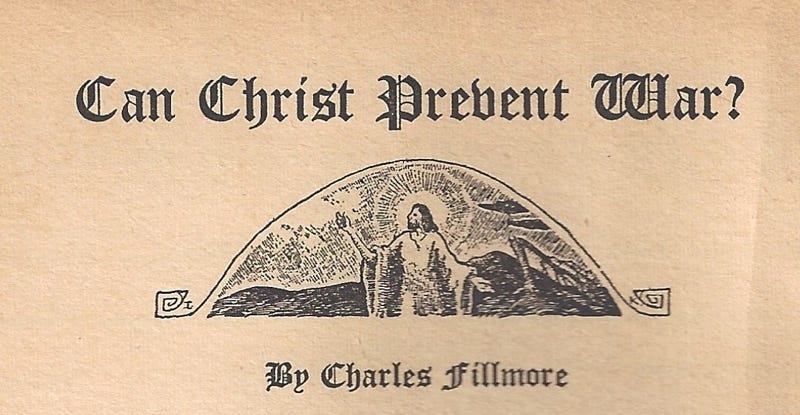
In December 1937, as Europe drifted toward catastrophe, Charles Fillmore published a striking essay in Unity Magazine. He asked a question most religious leaders avoided: Can Christ prevent war?
The signs of crisis surrounded him. Fascist regimes tightened their grip across Europe. The Great Depression still scarred the global economy. Dictators promised national rebirth through discipline, violence, and national glory. Churches prayed for peace while governments stockpiled weapons.
Thanks for reading! Subscribe for free to receive new posts and support my work.
The Italian political thinker Antonio Gramsci described moments like this with brutal clarity:
“The old world is dying, and the new world struggles to be born. Now is the time of monsters.”
Gramsci saw these periods as an interregnum—a dangerous interval when old institutions lose authority but no new order has yet taken their place. In that vacuum, politics fills with improvisations: strongmen, demagogues, and movements that promise salvation through force.
Fillmore recognized the same crisis, though he spoke the language of spiritual life rather than political theory. If Christianity truly believed in the living power of Christ, he asked, why did the nations of Christendom march so confidently toward war?
He refused the easy answer that politics alone had failed. Fillmore traced the crisis deeper, into the spiritual consciousness of modern civilization itself.
Christianity, he argued, had shifted its center of gravity. Churches celebrated the historical Jesus while neglecting the living Christ mind that Jesus revealed. Prayer became petition. Faith became memory. The spiritual discipline that Jesus practiced—an inner alignment with divine intelligence capable of transforming human consciousness—largely vanished from public life.
A civilization organized around fear, rivalry, and domination inevitably reproduces those forces in its institutions. Economic struggle becomes class conflict. Political rivalry becomes nationalism. Nationalism becomes war.
Yet Fillmore did not see the crisis only as collapse. He also saw latent life within the wreckage.
The prophet Isaiah offered a striking image:
“There shall come forth a shoot out of the stock of Jesse.”
The tree appears cut down. Only a stump remains. Yet hidden life still pulses in the roots, waiting to break forth again.
Gramsci’s “new world struggling to be born” and Isaiah’s “shoot from the stump” describe the same historical mystery from different angles. Periods of breakdown often conceal the beginnings of renewal.
Fillmore believed that renewal begins within the human spirit. When the Christ mind awakens within individuals, it reshapes the social world they create. The inner life becomes the seed of a new civilization.
Fillmore wrote these words on the eve of World War II, when many still hoped the storm might pass. It did not.
Yet the question he raised has never disappeared. In every age of upheaval humanity must decide what will emerge from the crisis: monsters—or the first shoots of a new world.
What follows is Fillmore’s essay as it appeared in the December 1937 issue of Unity Magazine. Section headings have been added for readability.
By Charles Fillmore
Published in Unity Magazine, December 1937
The World Powers and the Church Are Powerless to Prevent War
ISAIAH prophesied that there should come forth a shoot out of the stock of Jesse, a Redeemer and Saviour, whose judgment and whose spirit of peace would reconcile the whole world. All Christians have expected Jesus Christ and His people to bring about the results prophesied by this great poet and prophet. But where are the evidences? Where is the failure, and who is responsible?
Now we know that Jesus was not a great warrior. We don't think of Him as in the Alexander or the Napoleon class. We cannot conceive of Jesus slaughtering, like Napoleon, three thousand Turkish prisoners, because he did not want to be bothered with feeding them. Yet how do we reconcile the claim of Jesus to all power in heaven and in earth with the terrible slaughter of Christians in the great World War?
In Europe where the war began is the home of the three great branches of Christianity, the Catholic Church, the Protestant Church, and the Greek Church. Tens of thousands of educated priests and ministers of these churches pray daily and have prayed for centuries to Jesus Christ for His intervention in the affairs of the world, but right in the face of these prayers the rulers of the nations of Europe are going forward building up tremendous armies and the most destructive engines of war ever known; and strange to say, this Prince of Peace, who has all power in heaven and in earth, and His millions of followers do not stay the expectation of war.
Yet whole nations will be impoverished by war and commerce will be demoralized, and despair marks the faces of financiers everywhere in the anticipation of a gigantic struggle. Also today dictators the world over are frantically beating the air in their attempts to satisfy the discontent and revolutionary demands of the unemployed.
And why, you ask, this impotency?—this army of claimants to great power among men, yet so helpless in a world of which they claim the Creator was the source, which He still rules, and which, our prophet says, “he shall smite … with the rod of his mouth” (Isa. 11:4)
We cannot help but think that there is something radically wrong with this army of the Lord. His representatives are evidently not understanding or carrying out the orders of the Prince of Peace. They are listening rather to the war cry of the insane destroyers of the world's civilization. Instead of praying for universal peace, for the reign of peace and love, they are praying for the victory of their armies.
The Christian Church Doesn’t Really Believe Peace Is Possible
In ignorance of the principles which Jesus taught, Christians have worshipped and looked to His personality and told us about His miracles that occurred nineteen hundred years ago. Now with the millions of ministers, billions of church property, and the largest following of any religion in the world, Christ is not given any place or power as a living presence in any government of the world.
They celebrate the birth of Jesus Christ with elaborate displays of loyalty to Him and His work. Mention the fact of His birth to the average Christian, and he will associate it solely with the advent of Jesus of Nazareth and none other.
Not only is the Christ mind that Jesus brought to light ignored, but the work of Jesus in demonstrating that Christ mind is banished with the claim that Jesus died on the cross and that He went away to heaven.
Thus not only the foundation principles of Christ are ignored but the greatest issue of all time is overlooked; that is, the overcoming of death and the restoration of life to His body, as accomplished by Jesus.
So we find that the average Christian does not really believe, as taught by Paul, that Christ should be “formed” in man (Gal. 4:19), nor does he understand the scientific law that Jesus demonstrated when He restored life to His crucified body.
In the face of this impotency of the followers of Jesus to live up to His teaching is it at all strange that the practical men of the world look upon the Christian church as a form of worship having no relation to affairs of state or everyday practical life?
In our daily papers and other periodicals giving the proceedings of our lawmakers, do we find any reference to divine law? It is universally assumed that God plays no part in the affairs of any government on earth.
Prayer Is Necessary for Freedom
Should Paul make the plea today that he made before Festus and Agrippa, that he had seen and talked with Jesus, he would doubtless be promptly adjudged of unsound mind and incarcerated in an insane asylum.
It is true that one may talk and write of supermundane things, but no court of law, scientific body, or government executive will take seriously any claim of any man that he possesses powers beyond the dead level of mediocrity.
Prayer plays no part in the mental action of the men of affairs. Prayer is considered with indifference because it is generally taken for granted that prayers are not necessary.
The fact is that prayer is not understood. The great majority of persons think that prayer is merely asking God for something you want and have been unable to get in any other way.
One who has come under the mental discipline covered by the word prayer discerns that it includes the activity of the mental faculties that cannot be described in words. No human language can tell of the connection that takes place on the inner planes of mind when one in deep meditation makes conscious contact with spiritual light.
Prayer is not supplication, a begging God to give things to man. Prayer at its highest is the entry of the ego into a realm of mind forces that, rightly projected, change the character of every cell in brain and body.
One who has mastered even the primary technique of prayer has made contact with the spiritual ethers that connect all minds, high and low, and by means of which great reforms for the good of man can be projected into the world's thought ethers, as Jesus Christ prayed.
He prayed whole nights. He was not begging God over and over again to do what He asked. Jesus Christ was laying hold of the thought forces that bind the whole human family in the bondage of their own making, and He was setting them free with the freedom of His spiritual understanding.
And every man in his prayers might recognize and take advantage of that freedom. It will never be thrust upon man or any one without his asking; without the open mind.
We Have a Stump of Jesse That May Be Quickened
So here we have the key to the situation that this God that we are praying to, this Prince of Peace that we are invoking, is under law—divine law.
In his prayers Isaiah, the poet and philosopher, had a perception of the spark of divinity through which man may quicken the mortal into the divine.
This shoot that was to come out of Jesse means that there is an everliving principle in man that has been submerged. It has been cut down and merely a stump exists today in human consciousness; but there is enough virile energy in that stump, if it were quickened, to bring forth the real man, the fruit, which is Christ.
“And there shall come forth a shoot out of the stock of Jesse, and a branch out of his roots shall bear fruit.
And the Spirit of Jehovah shall rest upon him, the spirit of wisdom and understanding, the spirit of counsel and might, the spirit of knowledge and of the fear of Jehovah.”
(Isaiah 11:1–2)
This has always been interpreted as referring to Jesus of Nazareth. There is no evidence that Isaiah had any personality in mind when he was inspired to write these words.
He saw that awaiting man's appropriation, there was a great universal principle, the Spirit of Jehovah, and when this was quickened in man he would rise to a divine standard, where he would judge after his inner intuition, knowing that love would bring peace between man and man.
He would not judge upon external evidence nor after the sight of his eyes, neither decide after the hearing of his ears.
When the Stump Is Quickened We Will Have a Guide to Peace
Jesus laid down that law in order that we should not judge according to appearances. He said we had ears but we heard not.
In other words, we must look upon all this as representing a principle, a universal principle of righteousness; and we must realize that this principle, if it is quickened in man, will prove for him a great guide; and that through this inner quickening, this conviction of spiritual Truth, man's word will become more potent.
The words that he speaks will do away with the sin. It is not that the Christ word shall destroy people—the wicked—but, as Ferrar Fenton translates it,
“By the rod of His mouth He will conquer the world,
And its Wickedness slay by the breath of His lips.”
You can see that the original writings were all based upon principles and not personalities.
We are also taught by this same prophet that, not only in the world outwardly but especially within man, the animal forces shall be pacified:
“And the wolf shall dwell with the lamb,
and the leopard shall lie down with the kid;
and the calf and the young lion and the fatling together;
and a little child shall lead them.”
(Isaiah 11:6)
This is poetical; it is not to be taken literally. It deals with principles: with the wolf, the devouring element in man, and with the innocent, loving nature of the lamb: they shall become unified in man's consciousness.
When we have produced this unity we shall find that the childlike mind will be restored to us.
As we study the whole lesson, then, we find that it deals with wonderful principles that are idealized and yet not carried out.
Jesus taught that we should take up serpents with impunity, and if we drink any deadly thing it should not hurt us. Here again Isaiah calls our attention to the same truth:
“The sucking child shall play on the hole of the asp,
and the weaned child shall put his hand on the adder's den.
They shall not hurt nor destroy in all my holy mountain;
for the earth shall be full of the knowledge of Jehovah,
as the waters cover the sea.”
(Isaiah 11:8–9)
This beautiful, poetical vision of Isaiah's is capable of expression in the world today.
If our world leaders would only see that there is a power behind this world chaos that, if invoked or even consulted, would straighten out everything for us! Sooner or later we must come to a recognition of that guiding power.
We must incorporate it into our civilization.
Then we shall have world peace, and then we shall know what it is to celebrate the birth of the Christ mind. We shall know what it is to reincarnate in our mind and in our life that wonderful Spirit which was in the Lord Jesus Christ.
Thanks for reading! Subscribe for free to receive new posts and support my work.