Introduction: Passion, Providence, and the Architecture of Feeling
In the early nineteenth century, amid the upheavals of industrialization and revolution, Charles Fourier proposed a startling premise. The disorder of society did not arise from flawed human nature but from a misalignment between human passions and the structures meant to contain them. Where others preached restraint, Fourier preached orchestration. Where others saw desire as a problem, he treated it as a divine instrument waiting for the right arrangement.
Fourier’s project belongs to a broader current that Catherine Albanese later named “American metaphysical religion.” This tradition insists that mind, matter, and spirit interpenetrate. It rejects a rigid divide between the material and the divine and instead treats the world as charged with meaning, correspondence, and possibility. Fourier stands at an important threshold in this history. He does not speak the later language of “mind power” or “mental causation,” yet he lays down a cosmology in which attraction governs everything from the stars to the human heart. The same force that binds planets in their courses animates desire, labor, and social life.
This is where his thought intersects with what can be called critical enchanted materialism. Fourier refuses both crude materialism and abstract spiritualism. Matter is alive with tendency and relation. Passion is not merely psychological. It is ontological. Social arrangements are not neutral containers. They either harmonize with the deeper currents of existence or distort them. In this way, Fourier offers a critique of early capitalism that is not only economic but metaphysical. Poverty, alienation, and monotony appear as symptoms of a deeper dissonance between the divine order of attraction and the artificial systems imposed by civilization.
Fourier’s influence did not remain confined to utopian communities or socialist theory. His emphasis on attraction, harmony, and the reorganization of feeling flowed into the religious and philosophical movements that would reshape American spirituality. Through currents such as Spiritualism and, more specifically, Harmonial philosophy associated with figures like Andrew Jackson Davis, the idea took root that the universe operates through subtle laws of correspondence and attraction. These movements translated Fourier’s social metaphysics into a language of vibration, sympathy, and inner alignment.
From this soil emerged what might be called the affective strand of New Thought. In contrast to later, more strictly noetic formulations that emphasize belief or mental assertion, this stream centers on feeling, resonance, and attunement. It appears clearly in the work of Ralph Waldo Trine, whose vision of harmony depends on bringing one’s inner life into alignment with a larger spiritual order, and in Wallace D. Wattles, who frames desire itself as a creative force that participates in the generative activity of the universe. In both, one hears an echo of Fourier’s conviction that attraction is primary, that it precedes reason, and that it can guide human life when properly understood.
To read Fourier, then, is to encounter an origin point. His “law of attraction” is not the simplified slogan of later popular spirituality. It is a comprehensive theory of the cosmos, society, and the passions. It binds theology to political economy, architecture to desire, and divine providence to everyday labor. The selections that follow reveal a thinker attempting nothing less than a total reorganization of human life, grounded in the belief that the forces moving within us are the very forces that move the universe.
Textual Note on Source and Translation
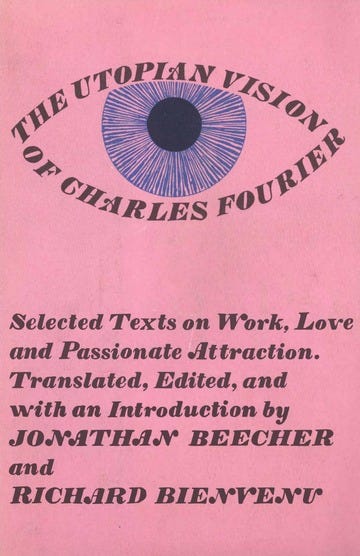
The following selection is drawn from The Utopian Vision of Charles Fourier Selected Texts on Work Love and Passionate Attraction, a modern English-language anthology of writings by Charles Fourier.
This volume presents selections from Fourier’s major works, including Le Nouveau monde industriel et sociétaire (1829), in translation and edited form. It represents the first substantial new English selection of Fourier’s writings in the twentieth century and was designed to highlight those aspects of his thought most relevant to modern social theory, especially his doctrines of passionate attraction, social harmony, and the critique of civilization.
All excerpts reproduced here follow the wording of that edition, with minor corrections to typographical and OCR errors for clarity. Editorial notes and footnotes in the original volume have been omitted unless otherwise indicated.
Charles Fourier, The Utopian Vision of Charles Fourier: Selected Texts on Work, Love, and Passionate Attraction, ed. and trans. Jonathan Beecher and Richard Bienvenu (Boston: Beacon Press, 1971).
METAPHYSICS AND THEODICY
God and His Properties
The multitude has perennially been deceived into thinking that the designs of God are impenetrable, that men should not even seek to know God. Common sense suggests the contrary; it obliges us to begin our studies with the simplest of all our problems: the problem of God.
In antiquity the Creator was travestied by fables which confounded Him with a horde of 35,000 false gods, each more ridiculous than the others. At that time it was assuredly difficult to study the designs of God, to make some sense out of the celestial masquerade. Thus Socrates and Cicero confined themselves to gaining detachment from the follies of their age, and to adoring the unknown God without making further investigations which would have been thwarted by the spirit of the time. Socrates was nonetheless the victim of his age.
Now that these superstitions have been dissipated and Christianity has brought us back to sound ideas, to the belief in a single God, we have a sure guide in undertaking the study of nature. Starting with the principle that all enlightenment must come from God, and that reason can only foster enlightenment insofar as it conforms to the dispositions of the Creator, it remains for us to determine the essential properties of God: His attributes, His designs, and His methods of achieving the harmony of the universe. On this score, certain rules which are already known can lead us to the discovery of those which remain unknown.
In dealing with this question one must proceed by degrees and begin by analyzing a very small number of the properties of God, focusing on the most evident, such as the following:
* The integral direction of movement
* Economy in the choice of means
* Distributive justice
* The universality of Providence
* Unity of system
1. The Integral Direction of Movement
If God plays the most important role in the direction of movement, if He alone is master of the universe, the sole creator and dispenser, it is up to Him to direct all aspects of the universe, among others the most noble aspect, that of social relations. It follows that the laws governing human societies must be the work of God and not of men. If we are to guide our societies toward the good, we must seek the social code that God was bound to compose for us.
2. Economy in the Choice of Means
If the mechanism of societies is controlled by God, it should be distinguished by the economy in the choice of means that we attribute to Him in naming Him the supreme economist. But the principle of economy requires Him to work with very large social groups, and not with the smallest which we name “the family” or “the conjugal household.” Above all, the principle of economy requires God to choose passionate attraction as the driving force in human affairs.
3. Distributive Justice
There is not a trace of it in civilized legislation, which increases the poverty of men in proportion to their industriousness. The first sign of justice should be to guarantee the people a minimum which would increase in proportion to social progress. Is there any justice in a state of affairs where the progress of industry does not even guarantee the poor a chance to obtain work?
4. The Universality of Providence
Divine Providence should be extended to all nations, to the so-called savages as well as to the civilized. The savages are truly free men, and any industrial system which they reject is contrary to the designs of God. The form of industry which we offer them, agricultural fragmentation and domestic isolation, is not part of the providential plan, for this system fails to satisfy the impulses given by Providence to those who are closest to nature.
The same can be said of any order based on violence. Any class that is constrained directly, as are slaves, or indirectly, as are wage-earners, is deprived of the support of Providence, which has no other agent on this planet than attraction. Therefore, the civilized and barbarous order, which is based uniquely on violence, is contrary to the designs of God; and there must be another system applicable to all classes and to all peoples, if it is true that Providence is universal.
5. Unity of System
This implies the use of attraction, which is the known agent of God, the mainspring of the social harmonies of the universe, from those of the stars to those of the insects. It is thus by the study of attraction that we must seek the divine social code.
THE DIVINE SOCIAL CODE
Destiny! The word sounds ridiculous. Anyone would fear to be taken for a visionary if he did not scoff at the idea of a pre-established destiny, of a divine and mathematical theory concerning the relations of societies and the mechanism of the passions.
Nevertheless, how can one suppose that an eminently wise being could have created our passions without having previously determined their uses? Could God, who has spent an eternity creating and structuring worlds, have been unaware that the first collective need of their inhabitants is for a code regulating the social relations of men and their passions?
Under the guidance of our self-proclaimed sages, the passions merely engender calamities which make one wonder whether they are the work of Hell or the Deity. Try out successively the laws established by the most revered of men, by Solon and Draco, by Lycurgus and Minos, and the result will always be the nine calamities which constitute the subversive mechanism of the passions. Should not God have foreseen the shameful results of man-made laws? He could have observed their effects on the billion globes created prior to our own.
He should have known, before creating us and endowing us with passions, that human reason would be insufficient to harmonize the passions and that humanity would need a legislator more enlightened than itself.
Unless one wishes to regard God’s providence as insufficient, limited, and indifferent to our happiness, it follows that God must have devised for us a passional code, a system for the domestic and social organization of all humanity, which is everywhere endowed with the same passions.
How can we suppose God to be more imprudent than the least experienced among us? When a man gathers building materials, does he not always make a plan for their use? What would we think of someone who bought stone, timber, and supplies for the construction of a large edifice without any idea of the kind of building he wished to construct? We would take him for a madman. Yet this is the degree of ineptitude that our sophists attribute to God in supposing that He could have created the passions, attractions, character traits, instincts, and the other materials of the social edifice without having made any plans as to their use.
God must have composed a passional code regulating our domestic, industrial, and social relations. How then can we suppose that He wished to hide this code from man, the only creature who needs to know it? He has not concealed from us a much less important branch of the laws of movement, that of material gravitation and the celestial harmonies. Since the time of Isaac Newton, He has initiated us into the mysteries of the equilibrium of the universe, which had previously been regarded as unfathomable.
Why should we suppose that He wishes to deny us knowledge of the system which He must have composed concerning the mechanism of the passions and of societies? For what reason would He refuse us the science which is most directly concerned with our needs, with our industrial relations?
THE LAW OF ATTRACTION
We already know that God relies solely upon the force of attraction in guiding the movements of the planets and the suns, which are creatures immensely greater than ourselves, and in guiding the insects, creatures far inferior to us. Could man alone be deprived of the fortune of being guided toward social good by attraction? Why should there be a break in the chain of the system of the universe?
Attraction is the divine guide of the stars and the animals, and it suffices to place them in harmony. Why should it not be equally sufficient for man, whose place in the universe is midway between the planets and the animals? Where is the unity of the divine system if the mainspring of general harmony, attraction, is not just as applicable to human societies as it is to the stars and the animals?
Philosophical wisdom and civilization come from men, and attraction comes from God; for it acts prior to reason, and even prevails over the reasoner who has decided not to obey it. Thus it comes from a power superior to reason and human wisdom. This power can only be God. If attraction gives rise to evil in civilized, barbarian, and savage societies created by man, is this not an indication that these societies are incompatible with the designs of God?
Nature shows us, through the example of animals, that if passionate attraction leads to harmony, it does so conditionally, provided the prerequisites of harmony are available. Thus bees can build a hive only when they find flowers, which are the chief element of their social mechanism. Similarly, beavers could not establish their industrious society in a country lacking wood. For these species, such materials are essential conditions of harmony.
Human beings are in a similar position. Their attraction can attain its goal, universal harmony, only when the two prerequisites of harmony are available. These are luxury and theory. You have already created luxury, which is the more important of the two agents. It remains for you to discover the theory.
Without both means at your disposal, you are like beavers who find wood without water or water without wood, and are unable to organize their society. Despite the increase in luxury and the development of the arts, you have not escaped the poverty that besets the majority of society. You possess luxury without the means to use it.
This means is the theory of social harmony, which must bring a greater or lesser degree of luxury to all inhabitants of the globe. Reflect upon this truth: the birth of social happiness depends on two discoveries:
* Luxury, without which harmony cannot be organized
* The theory of harmony, without which luxury cannot be used
Since attraction is ineradicable, it works ceaselessly in men and animals. It is the source of their happiness in harmony and of their misfortune when the conditions of harmony are absent.
When these conditions are lacking, attraction becomes a cause of disorder. The fault lies not in attraction, but in circumstances. Man is the only creature whom attraction constantly directs toward disorder. This indicates that a subversion has occurred in the mechanism of human passions. This subversion is the condition of existing societies.
Since you are unable to repress the passions, you seek to adapt them to established laws and customs. You would do better to change circumstances so that they conform to the designs of attraction.
Thanks for reading! Subscribe for free to receive new posts and support my work.