The Architecture of Harmony: Fourierism, Spiritual Reform, and the Dream of a New Society
“Where there is no vision, the people perish” (Proverbs 29:18). Antebellum America answered that warning with plans, measurements, and walls meant to carry a new spirit.
In the decades before the Civil War, the United States became a proving ground for social and spiritual experiment. Markets expanded, cities grew, and inequality sharpened. Many reformers saw more than economic change. They saw a world losing its sense of meaning, a society bending toward what they called Mammon. In response, they asked a daring question. What if society could be rebuilt in form as well as in spirit?
Thanks for reading! Subscribe for free to receive new posts and support my work.
One of the most influential answers came from Charles Fourier, brought into American life by Albert Brisbane. Brisbane’s Concise Exposition of the Doctrine of Association (1843) translated Fourier’s system into a practical vision that could be built, inhabited, and tested. It helped inspire communities such as Brook Farm and the North American Phalanx, where reformers sought to give physical shape to harmony.
Fourierism carried a deeper claim than economic reform alone. It worked as a form of critical enchanted materialism. It challenged the idea that matter exists only as property or profit and insisted that the material world holds meaning, relation, and power. The Fourierists understood matter and spirit as intertwined and responsive to one another. Human passions, natural forces, and built environments belonged to a single living order. To reorganize labor and daily life meant participating in a wider alignment that touched both the visible and the unseen.
Architecture became the field where this vision took form.
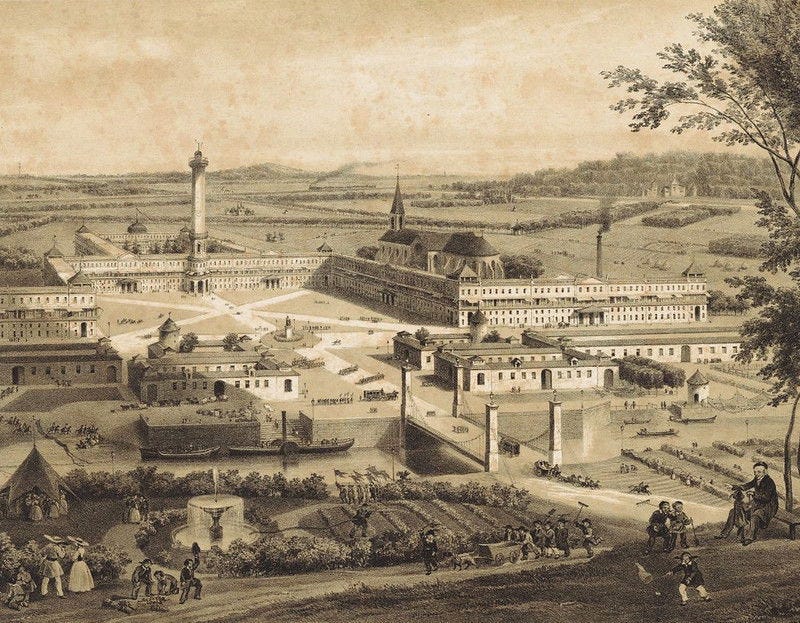
The Phalanstery, the great communal edifice of Association, gave this philosophy a body. Its corridors, halls, and wings were arranged to guide movement, encourage cooperation, and cultivate shared life without erasing individuality. The building expressed a belief that structure could educate desire and that beauty could sustain social unity. The ground plan of the “Edifice of an Associated Township” served as a kind of material theology. It mapped a world where warmth, efficiency, sociability, and dignity were woven together in a single design.
This vision moved within a broader current of spiritual searching. Transcendentalism affirmed the presence of the divine in nature and in the self. Spiritualism taught that unseen realities pressed upon daily life. Fourierism joined this current with a practical aim. It sought to organize these insights into the routines of work, habitation, and community. It treated the built environment as a medium through which higher laws could be expressed and experienced.
Brisbane’s Edifice stands at the meeting point of these currents. It brings together social theory, spiritual aspiration, and architectural design in a single vision. It imagines a society where unity appears in visible form, where daily life reflects a deeper order, and where matter itself participates in meaning.
What follows is a corrected transcription of Brisbane’s description of that Edifice. Read it as a plan and as a testimony. It shows how reformers of the antebellum era sought to build not only new communities, but a new relation between the material world and the life of the spirit.
THE CORRIDORS OR COVERED COMMUNICATIONS
One of the most convenient and beautiful features in the material arrangement of the Edifices of Association will be a large and spacious Corridor, or enclosed Portico, which will wind around one entire front of the building, and will form an elegant covered communication, which will lead to, and connect, all parts of the Edifice—the public halls and saloons, the exchange, reading-rooms, private apartments, halls of industry, etc.
The Edifice of an Association may be compared to a town under one roof, and it must have an avenue or public way, corresponding to a street, which will form a means of communication with all quarters of the building; this avenue is the Corridor or enclosed Portico, which, in a large Association, should be about twenty-four feet wide; by means of it, the inhabitants could, in the depths of winter, visit each other, go to parties, public assemblies, concerts, lectures, etc., without knowing whether it snowed or rained, or whether it was cold or blustering.
What an advantage, what a source of comfort it would be to have, instead of an open street, exposed to the hot sun in summer and to the cold in winter, and which is always either dusty or muddy, a spacious and elegant Corridor, forming, besides a most convenient and comfortable mode of communication, a delightful place of promenade, a place for exhibitions of works of Art and Industry, and useful for other public purposes! How much unnecessary disease would also be avoided by such covered communications, for we may safely estimate that one-half of colds, consumptions, pleurisies, and rheumatisms, is the result of exposure and sudden changes of temperature! What an economy also in carriages and in the various means of protection, such as cloaks, furs, umbrellas, overshoes, etc., to which we must now resort to protect ourselves against the weather in going from our houses into open and exposed streets! If people would but reflect with impartiality upon the immense economies, the comfort and convenience, the saving of time and sickness, which would result from the combined and scientific system of architecture of Association, they would be enthusiastic in their admiration of it, and would condemn utterly our present defective and unhealthy system of building.
The Corridor of a large Association should be, in the centre of the Edifice, about twenty-four feet wide, and in the wings eighteen. In a small Association, such as would be first established, it could be much narrower. It would pass along on a level with the first story or on the top of the basement, and not upon the ground, as some openings for carriages must be left through the basement. The Corridor could be placed on the outside of the building, and the top would form a terrace for the second story; or it could be enclosed within the outside walls of the Edifice, and the roof would project over it. In the latter case, it would be the height of the entire building—that is, three stories—and the windows which lighted it should be high and spacious, like those of a church. The doors of the public halls and private apartments would open upon it, as the outside doors of our houses now open into the street; flights of steps would lead from it to the upper stories. In a large and opulent Association, with what elegance could its corridors be fitted up! what an ornament they would be! and what a field for the display of the genius of its artists!
“To pass a winter’s day,” says Fourier, “in the Edifice of an Association,—to visit all parts of it without exposure to the inclemency of the weather,—to go to balls and parties in light dresses without being incommoded by the cold, without knowing whether it rained or stormed, would be a charm so new, that it would be alone sufficient to render our residences and cities detestable. If an Edifice, like that of an Association, were erected in our Societies and adapted to the usages of the present mode of living, the convenience alone of covered communications, warmed in winter and aired in summer, would give to it an immense value. Its rents, for the same quantity of space, would be double those of our present houses.
“If the civilized World, after three thousand years of study and practice in Architecture, has not yet learned how to construct comfortable and healthy residences, it is not very surprising that it has not learned how to direct and harmonize the Passions. When men fail in the smallest calculations in the material order, it is not surprising that they should fail in important calculations in the moral or spiritual order.”
EXPLANATION OF THE GROUND PLAN.
A—Avenue passing between the Edifice and the store-houses, granaries and other out-houses.S—Public Square, formed by the centre and projecting wings of the Edifice.G—Garden enclosed within the central range of buildings; it would contain the greenhouses and form a winter promenade.a, c, b, d—Court-yards between the different ranges of buildings; they are about a hundred feet wide, ornamented with trees and shrubbery, and crossed by Corridors.
P, P, P, P—Large portals or entrances to the Edifice.C—The Church.H—A large Hall for musical representations and festivities.B, C, D,—Granaries, store-houses and other out-buildings.
To avoid giving too great a length to the Edifice, it must be composed of a double range or line of buildings, encircling the court-yards—a, c, b, d, and the garden—G. The broad dark line does not represent the foundation walls of the Edifice, but the entire width of a range of buildings; it is intended, together with the light dotted line around the inside, which is the corridor, to represent a width of seventy-five feet.
Around the inside of the Edifice winds the spacious Corridor or enclosed Portico, which we have described; the reader will see that it forms a belt, encircling all parts of the building and uniting them in a whole.
The ranges of buildings which enclose the garden—G, will be reserved for public purposes. They will contain the Council-Rooms, Reading-Rooms, Library, Exchange, Public Halls, Banquet-Rooms, Salons for parties, social unions and public assemblies, and some of the higher-placed apartments.
The open spaces left between the parallel ranges of buildings should be formed into a hundred and twenty feet wide; they would form elongated court-yards, traversed by corridors, and should be planted with ornamental trees and shrubbery; in association the useful and the beautiful must be in every way combined.
The noisy workshops would be located in the basement of one of the extreme wings; their noise would be lost in this distant part of the Edifice, and would not incommode the inhabitants.
Play-grounds for children would occupy the court-yard of the same wing; such a place would be necessary, particularly in winter.
A portion of the wing opposite the one devoted to noisy occupations, would contain the suites of apartments reserved for travellers and visitors.
The Edifice of an association of the largest description would be about twenty-two hundred feet in length; with these dimensions the grand square enclosed by the two wings each five hundred feet long. As we descend to smaller associations, the size of the Edifice could be much reduced, and for an Association of four hundred persons, a comparatively plain building would answer the purpose.
The gardens should, if practicable, be located behind the Edifice, and not behind the granaries and other out-houses, near which the fields of grain had better be placed. This distribution must, however, be regulated by locality.
The square garden—G, would be planted with evergreens and would contain the greenhouses; it could in winter be enclosed, so as to form a beautiful promenade, where flowers and foliage would charm the eye and perfume the atmosphere. What a source of pleasure and health would a winter garden of this kind be!—and how many similar improvements over the present mode of living could be introduced in Association!
Let Man apply the principles of combination and unity to Architecture,—to the construction of his dwellings, and the greatest improvements in household arrangements, affecting health, comfort and convenience, can be introduced. For instance, the Edifice of an Association could, by means of proper apparatus connected with the large kitchen fires, be warmed throughout in the most efficient, cleanly, comfortable and economical manner, and so as to avoid all danger of conflagrations. No such convenient, safe and economical system can be introduced into the separate dwellings of isolated families; the same number of families that would form an Association must now incur the expense and endure the incalculable trouble of keeping up several hundred little fires.
The Edifice could be supplied with water with equal convenience and economy; pipes containing hot and cold water could be conveyed into all the private apartments, supplying each abundantly, and with baths in addition, if required. What a source of health and cleanliness! and what a saving in the complicated labor of carrying water daily to all the rooms of the Edifice!
This beautiful and economical system would also be introduced in the mode of lighting. A small gas apparatus, the expense of which would be trifling, could be fixed up, and would supply the Edifice with gas in all its halls and salons, as well as its private apartments—could be brilliantly lighted.
What economy in oil and candles, and what a saving of time and trouble in cleaning and trimming daily hundreds of candlesticks and lamps!
In the isolated household, these and numerous other advantages, so important and desirable, and so productive of economy, comfort and health, cannot be attained. So long as the present isolated mode of living continues, dirt, drudgery and disease must necessarily exist, and to an immense extent.
Thanks for reading! Subscribe for free to receive new posts and support my work.