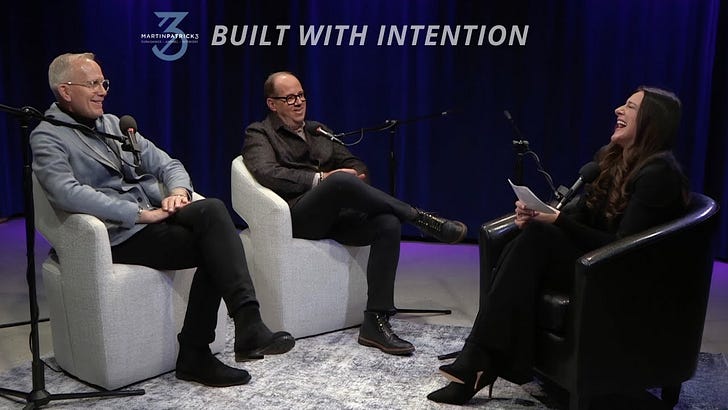
It started the way so many iconic things do: quietly, improbably, and with no one’s permission. An empty brick warehouse in Minneapolis’ North Loop. Two guys. No investors. No outside money. And a vision that sounded almost absurd in 2008—build the most beautiful store in America. Not a boutique. Not a showroom. Not “retail” the way we’ve been trained to think about it. Something else. Something that felt like the coolest living room you’ve ever stepped into—where a man could find everything: clothing, furniture, art, whiskey, watches, cologne… a whole universe under one roof, curated with taste and intention.
Today, that universe has a name: MartinPatrick 3. Forbes called it the hottest retailer in America. It became the most photographed retail space in the Midwest. It survived a recession, expanded in the middle of a pandemic, and still turns away private equity offers. And behind it all are two of my favorite humans: Dana Swindler and Greg Walsh—creatives, builders, business partners, and yes, partners in marriage.
This was their first-ever podcast interview, and I felt so honored to hold the room for it. Because what they’ve built isn’t just a store. It’s a statement. A love letter to design and a rebellion against mediocrity. Also, a reminder that in an age of AI, convenience, and endless scrolling, what people truly crave is still the same: beauty, presence, and real human connection.
They weren’t chasing “retail.” They were chasing a feeling.
When I asked them when they realized MartinPatrick 3 had become something special, Greg said something that made me smile because it explains everything about them: they weren’t watching what everyone else was doing. They were inside their own world—editing, curating, refining. Their compass wasn’t trends. It was taste.They started from design, and they never left it. From the lighting to the books, from the socks to the sectional, everything is chosen with the same question in mind: does this feel beautiful? does it feel right?
That’s why the store changes you. I mean it. I’ve told people before—on a hard day, I want to shower, dress up, put on heels, and walk into MartinPatrick 3 just to recalibrate my nervous system. Because beauty has that power. It changes your posture. Your mood. Your sense of self. It reminds you: you’re alive, and you get to decide how you show up today.
“We weren’t chasing anything. We were building what felt right—and trusting that people would feel it too.”
The part nobody sees: the recession, the fear, the sandwiches.
Here’s what I loved most about this conversation: we didn’t romanticize the journey. We told the truth.
MartinPatrick 3 opened in October 2008—literally the worst timing imaginable. Everything hit the fan. The economy collapsed. People weren’t shopping. They were surviving. Dana and Greg were surviving too. Dana admitted they put safeguards in the lease—an “out” after 12 months. They didn’t want the liability. They were being careful because they had to be. At one point they even put their house up as bank collateral just to keep the business afloat.And then there were the years no one posts about—years of cutting expenses down to nothing, years of making sandwiches instead of going out to lunch, years of “we do not have room to pretend.”That’s the part I want young entrepreneurs to hear: the truth behind the aesthetic. The truth behind the beautifully lit photos.
“We were in survival mode. We cut everything down to nothing—so the business could live.”
Dana’s hidden genius: learning the science so the art could survive.
Dana is one of the most strategic, fiscally responsible people I’ve ever met—and he earned that wisdom the hard way. He didn’t come from retail. He didn’t come from accounting. He came from engineering and finance-adjacent worlds, and then suddenly he’s managing inventory, sell-through, margins, metrics—things no one teaches you in a way that matters until it’s your money on the line.At one point, their CFO quit (because Dana was asking too many questions). Dana went home, grabbed an accounting textbook, read it over the holidays, and figured it out.That is a lost art: figuring it out instead of collapsing. Curiosity instead of helplessness and true responsibility instead of fantasy.
“Retail is art and science. You can have the creative—but you need the numbers for it to work.”
Greg’s gift started at 12—and it never left.
One of my favorite moments in our friendship happened this summer when Dana showed me something Greg made when he was twelve years old: a model home. Not a “cute little kid project.” An immaculate, deliberate, detailed architectural masterpiece.It explained the whole man. Some people are given a breadcrumb early. A talent that whispers: this is what you’re here to do. Greg didn’t have the internet back then. No Pinterest. No tutorials. He built from memory, exposure, instinct—architecture and finishes recalled from homes he’d seen, then expressed through his hands.And you feel that same instinct in MartinPatrick 3. It’s not just taste. It’s vision.
“It wasn’t a hobby. It was a way to be part of the world of design at a scale I could manage.”
Risk, but make it intelligent.
One thing I respect deeply about Dana and Greg is how they talk about risk without glamorizing recklessness. They don’t do the “jump and the net will appear” fairytale. They’re not gambling. They’re not playing entrepreneur on Instagram.Their risk-taking is calculated, layered, and built in smaller moves. A series of decisions that won’t destroy the whole house if one thing doesn’t work.Dana said something important about younger entrepreneurs today: sometimes they make wildly irresponsible moves because the culture tells them bankruptcy is just a reset button. But anxiety kills creativity. If you’re in financial survival, you stop seeing opportunities. You shrink. You can’t build from panic.
“Don’t quit your job to chase an idea that isn’t fleshed out. Show me the numbers. How will you live?”
Their real product isn’t clothing. It’s relationship.
Here’s what people misunderstand about MartinPatrick 3: they think it’s luxury. They think it’s high-end goods. They think it’s a store.But Greg and Dana were clear: they’re not a transaction. They’re not a “run in, run out” place. Their customers sit. Talk. Stay. Get known. There’s a reason it feels like a private club without the arrogance. It’s personal.And in a world heading toward automation, that becomes the true luxury: being seen.
“We’re not a transaction. Our relationships with customers are the point.”
The future: AI rises, and so will the hunger for humanity.
I asked them what they see coming—with AI, with the decline of brick-and-mortar, with the uncertainty in our culture. Their answers gave me hope.Greg said something I’ve been feeling in my bones: there will be a bucking against technology. People will want what’s real. Touch. Presence. Shared space. Human conversation. A store you can feel. A place you can enter and remember you belong to the living.Dana agreed: AI will help with backend ease—finance, accounting, information. But the relationship part will become more important, not less. Restaurants and bars stay busy for a reason: we want each other.I recently tried a robot massage (yes, I did). It was… fine. Mechanical. Cold. A little eerie. And it made something clear: human touch is going to become the real luxury.
“The true luxury won’t be more tech. It will be being together.”
Success, in their words.
Greg’s definition of success stopped me in my tracks because it was so clean, so grounded: success is doing what he loves, every day, and letting it remain connected to design—the thing he’s been drawn to since childhood.Dana’s definition was equally beautiful, in a different way: success is sustainability. Paying vendors on time. No debt. Taking care of staff. Not living on the edge of payroll. Building something that lasts so you can breathe.
“Success is sustainability. Paying people. Taking care of staff. Not living on a treadmill of fear.”
A secret you might not know: they built it with their hands.
Dana and Greg are elegant, sophisticated, impeccably dressed. But the truth is—part of why MartinPatrick 3 exists is because they physically built it. Wood floors. Painting. Sheetrock. Millwork. Ceilings. Lighting. They did what they couldn’t afford to outsource.And they still love working with their hands. At the lake house, after storms knock down trees, they don’t always hire it out. They pull out chainsaws, split wood, chip branches, build, repair, handle power tools like pros. Not because they have to—but because it resets them. It’s mindfulness without branding and presence without performance.It’s the satisfaction of doing something real and seeing the result.
“We’re not doing brain surgery. It can wait.”
If you’re anywhere near Minnesota (or honestly, if you’re willing to fly in like so many people do), go experience MartinPatrick 3 in person. Not just to shop—but to feel what it’s like to walk into a space built with taste, courage, and soul.Because what Dana and Greg have built is rare: something beautiful, sustainable, human, and real. And in the world we’re heading into… that might be the most radical thing of all.
With gratitude,Jasna
____________________________________________________________________________
Discover Minneapolis Podcasts That Go Deeper.If you’re searching for a Minneapolis podcast focused on personal growth, leadership, and intentional living, Rise To More is a Twin Cities podcast rooted in meaningful conversation and real transformation. Recorded in Minneapolis, Minnesota, this self-development podcast offers thoughtful dialogue for listeners who want clarity, confidence, and depth—not hype. Explore one of the most intentional Minneapolis podcasts for leaders, entrepreneurs, and seekers ready to rise.