EPISODE TRANSCRIPT:
Mark Green: I’m your host, Mark Green, and today we’re doing our twice a month podcast, Changing America. Heather McGhee is the past head of the action-tank, Demos, in New York City, past chair of the board ofColor of Change and frequent guest on cable and Sunday shows.
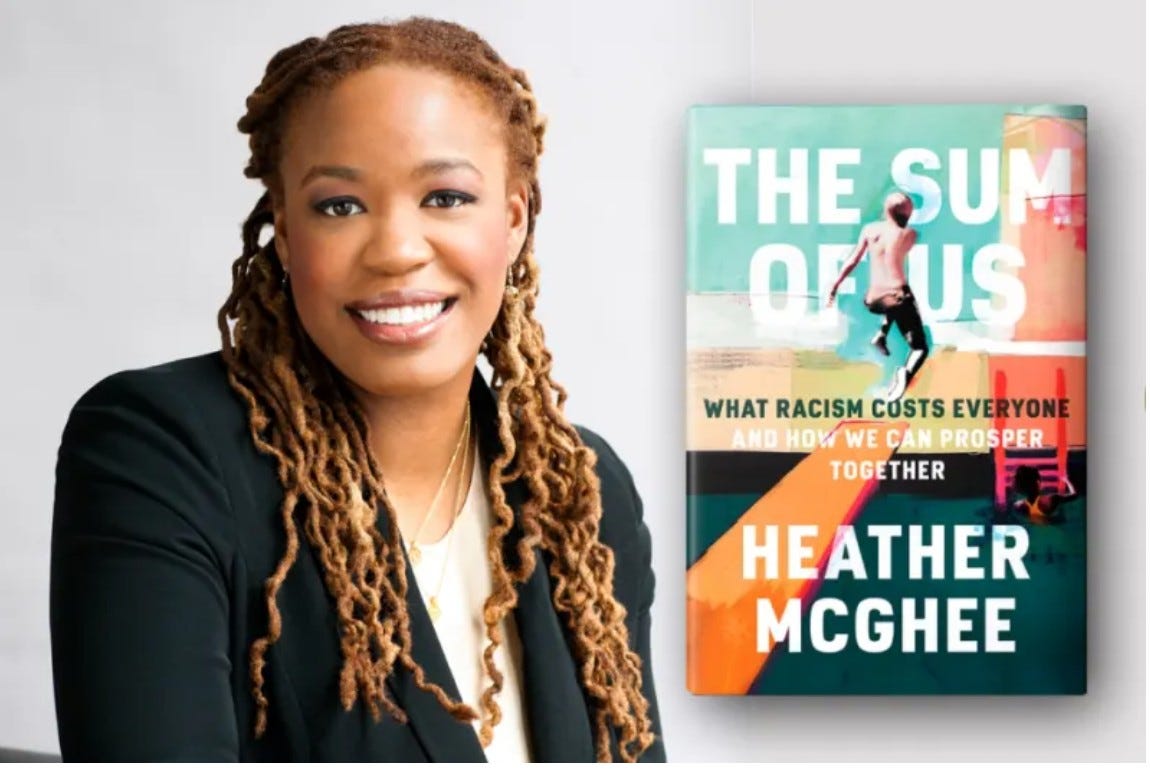
Most significantly, she’s the author of the best-selling, The Sum of Us in 2021 which I read then and thought was in the ranks of books on race by Ta-Nehisi Coates and Isabel Wilkerson. Welcome to Changing America, Heather.
Heather McGhee: Thanks for having me, Mark. It’s good to see you.
Mark: For those who might have slept through the year of 2021, can you remind us what you meant in your book by your powerful frames and metaphors about “drained pools” and the GOP “zero-sum” paradigm on race?
Heather: The Sum of Us is really a book about my journey to figure out why we can’t seem to have nice things in America.
Nice things like clean air and water, free and fair elections, democracy that’s responsive to everyone. You know, great public schools in every neighborhood. a strong middle class that’s growing and thriving and looks like America. That was my career for decades.
I came to the realization that we are being held back from achieving those nice things by zero-sum racial stories, stories that are sold for profit by wealthy and powerful people, and the politicians they pay for, mostly in the right wing but not entirely. And that zero-sum story says that you should fear is the growing presence of people of color, you should fear racial equality because that means that you and your family will be worse off.
When that thinking happens, you end up with lots of self-sabotaging towns and cities across America – not just in the South – which were willing to drain their segregated public swimming pools when threatened with integration.
This metaphor, drained pool politics, for when white Americans instead preferred to go without things that they really need -– healthcare, debt-free college, living wages, environmental regulation, pro-voter policies because of the threat that these are actually going to people of color.
Mark: I have a hard time understanding this entirely. Okay, 400 plus years of racism in the U.S., first formal slavery and then Jim Crow. How do you explain Trump’s continuing racism a mere 165 years after Appomattox and the Civil War Amendments, the same racial divisions, voter suppression and economic discrimination, along the same lines even on the same geographic lines?
Heather: Yeah, if you think about it, it’s not that shocking. We are a very young country. We were founded on this belief in a hierarchy of value along race. That structure was around ensuring that profit center of enslavement and that ideology of racial hierarchy.
And part of the reason we’re fighting that war is that even after the guns were laid down, the South kept fighting [in other ways.] They kept fighting an ideological war, a narrative war, a story war. You know, there are great books about the way that the South actually won the war with their Lost Cause ideology.
I think that drained pool politics helps us understand the ways in which the kind of New Deal era of public goods, the sort of liberal consensus that happened in the first half of the 20th century, really fell apart when wealthy and powerful people were able to use, let’s call it dog whistle politics or this kind of coded racial language to make a story that says that the reason why your family isn’t thriving is because of immigrants.
The reason why your schools aren’t successful and safe is because of Black and brown children or your Black and brown neighbors. That story is still a successful one because it deflects from who’s really responsible.
Mark: Well, you’re referring to right-wing provocateur Lee Atwater, who famously said a few decades ago that Republicans should continue to exploit racial tensions for votes by innuendo rather than simply, you know, using the N word.
It sure seems that the Trump Republicans have adopted and updated Atwater with their relentless campaign and full weight of federal power against DEI – for diversity, equity, and inclusion. How would you advise Democrats to start to deconstruct that slogan and story?
Heather: You know, the folks who are against diversity are against the tide of public opinion. They are against progress. They are against what most Americans know is good for business, is good for our country, is good for democracy, is good for neighborhoods and communities. What we’re seeing right now is not some sort of backlash where the majority of Americans are opposed to the kinds of racial progress that was clamored for by the largest social demonstration movement in American history in the years leading up to and then accelerating after the murder of George Floyd.
This is a sabotage, Mark, by wealthy, powerful people who have always wanted to keep mediocre white men over-represented in the halls of power and keep everybody else under-represented and locked out.
Mark: Hasn’t it been a pretty effective sabotage given that phrase and their implementation of it in their fight against universities, corporations, the Voting Rights Act?
Heather: Yeah, they have been relentless in their desire to use every lever of power that they have to repeal the multiracial progress of the 20th century.
The Supreme Court has repealed affirmative action for everybody except for white men. The federal government has tried to eliminate all forms of equal opportunity and civil rights enforcement through its branches of government, through the DOJ. But you know, at the same time the business community and science say that diversity is good for profitability, it’s good for innovation, it’s good for governance and stability.
You have some sort of financial penalties. It’s shocking what the federal government has done. Yet not every business has gone along, right? Costco said, “We’re sticking with DEI.” JPMorgan Chase said, “We’re sticking with it.” Delta said, “We’re sticking with it.”
And now we’ve seen just recently a new Gallup poll thatsince the Trump victory in 2024, the majorities of Americans – Independents, Democrats and Republicans – have agreed more and more each year that diversity is good for business.
So they are absolutely out of step, but it’s not gonna last because it doesn’t have the majority support in this country.
Mark: Do you think Democratic presidential aspirants in 2028 will pick up on your analysis and suggestions? Becauseeither you’re on defense or you’re gonna retake offense on this?
Heather: They absolutely have to go on offense because it does not work to ignore the central organizing principle of our society.Racism is the Achilles heel in American politics, not the third rail, as if people don’t touch it.
Democrats need to make a multiracial coalition, right? Democrats can never be in power without a multiracial coalition because white men particularly but white women as well have been so well-organized, the majority of them into the right wing. You need a multiracial coalition, and you need a young coalition. Democrats’ victory is contingent on young voters being engaged.
What do we wanna see? We wanna see authenticity. We wanna see courage. We wanna see people who are willing to take on powerful interests. So powerful interests are the healthcare insurance companies. Powerful interests are Wall Street. Powerful interests are the polluters.
But they’re also the racists. We need to say that racism is bad for everybody, that it costs our economy, that it destroys the kinds of coalitions that can help win change for working-class people.
Nobody knows this better than labor organizers who are trying to create multiracial workforces. Nobody knows this better than grassroots organizers who are trying to unite neighborhoods to take them to the state house to lobby for power.
Mark: Were you able to sit down…