Meditation Prologue:
The Gift of Cunda
Welcome to this meditation. Before we begin our practice together, let me share a story that will guide our contemplation - a story about intention, compassion, and the profound grace found in our final offerings.
In the ancient texts of Buddhism, preserved in the language called Pali, we find the account of a blacksmith named Cunda. His name, pronounced “Chunda,” means one who works with metals - a craftsman who transforms raw materials through fire and skill.
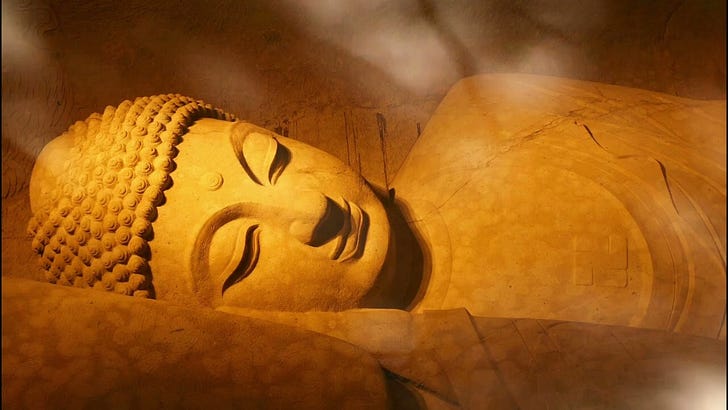
Cunda offered the Buddha his final meal before the Buddha’s passing, which Buddhists call Mahāparinirvāṇa - literally “the great final liberation.” This Sanskrit term describes not merely death, but the complete release from the cycle of rebirth that marks the passing of an enlightened being.
The meal Cunda prepared may have contributed to the Buddha’s final illness. Yet here lies the heart of our meditation: the Buddha did not blame this humble blacksmith. Instead, he sent word back through his attendant, reassuring Cunda that his offering was not a source of regret, but a profoundly meritorious act - as sacred as the meal offered before the Buddha’s enlightenment.
This teaching illuminates something essential about human nature and spiritual practice. In Buddhism, cetana - our intention - carries more weight in shaping our spiritual destiny than the outcomes we cannot control. The Buddha’s final act of compassion was to protect another person from carrying unnecessary guilt.
As we enter this meditation, we invite you to consider your own offerings - the meals you’ve prepared with love, the gifts you’ve given with pure hearts, the acts of service that may not have turned out as expected. Like Cunda, you are invited to release the burden of outcomes beyond your control and rest in the purity of your intentions.
Different Buddhist traditions understand this final passage in their own ways. The Theravāda school sees it as the quiet completion of the spiritual path - “there is no more becoming.” The Mahāyāna tradition recognizes it as a revelation that awakened nature is eternal and present in all beings. The Vajrayāna path describes it as an alchemical dissolution, where the elements of body and consciousness return to their luminous source.
In our practice today, we need not choose between these perspectives. Instead, we can hold space for the mystery - honoring both the ordinary humanity of offering what we can, and the extraordinary grace that transforms our simplest acts into sacred gifts.
Let us begin by settling into our seats, taking three conscious breaths, and preparing to explore what it means to offer our presence fully, without attachment to results, trusting in the inherent goodness of sincere intention.
[Pause for three breaths]
Now, let us turn toward the meditation itself…
Music Cue:
⟡
A Meditator's Meal - Food Poisoning Erased by Grace
⟡
A ritual for perfect practice, imperfectly received -
Begin seated, spine like a bell tower - upright, receptive.
Let each breath arrive as a guest, neither summoned, nor restrained. Let each breath settle easily into the body like a meal offered without expectation.
Invocation
Today, we practice as Cunda cooked: with care, with reverence, and with no guarantee.
We offer our effort to the altar of each living and sacred moment, knowing that even poisons may sometimes be served with Love.
Each breath perhaps our final nutrition...
Each breath our every act's fruition...
Breath Cycle
Inhale: the intention - pure, whole, radiant. Exhale: the outcome - fragmented, flawed, real.
Let each breath be a meal. Let each breath be received.
Let each breath be a first meal.
Let each breath be a final meal.
Let each breath be met with grace.
Let each breath be bade farewell to with equal grace.
Reflection
As you move through this practice, notice the small failings: the distracted thought, the uneven posture, the judgment that creeps in like a spice too strong.
Do not recoil. Do not correct.
Instead, bow inwardly to each failing.
Softly and Silently Say:
"This, too, was offered with care.
with Love."
Compassionate Reframing
Recall the Buddha, ill from the meal, yet turning to Ānanda and saying: "Kunda is not to blame.
His offering was pure."
Let this be your mantra: "My offering is pure, even when the result is not."
Closing
As this, your practice ends, gather the fragments of your efforts like scattered petals.
Place them gently in the smooth bowl of your heart.
They are enough. You are enough.
Bow - not to perfection, but to the grace that meets imperfection with deep reverence.
Thank you.