Prologue:
The ancient Japanese tea ceremony, known as Chadō (The Way of Tea) or Sado, rests upon four profound principles that transcend the simple act of preparing and drinking matcha. These principles - 和, Wa - Harmony; 敬, Kei - Respect; 清, Sei - Purity; and 寂, Jaku - Tranquility - form a complete philosophy for living, one that was formally articulated by Sen no Rikyū, the most influential tea master in history, who lived from 1522 to 1591.
Sen no Rikyū was not merely a practitioner of tea; he was a visionary who transformed the ceremony into something far greater than social ritual. He developed the wabi-cha aesthetic, a revolutionary approach that found profound beauty in simplicity, humility, and imperfection. Rather than the Principles gradually evolving over four centuries, it was Rikyū himself who systematized them in the sixteenth century. What took centuries was not the formation of these ideas, but their endurance and deepening as the foundation of Japanese tea tradition.
The first Principle, 和, Wa - Harmony, extends far beyond pleasant social interaction. It encompasses the Harmony between host and guest, among the guests themselves, and even between the physical elements of the ceremony - the utensils, the tea, the seasonal scroll hanging in the tokonoma (alcove), and the overall environment. Every element is deliberately chosen to create a cohesive and peaceful whole. Within the tearoom, social distinctions dissolve. All participants exist together in a state of mutual appreciation, embodying social Harmony and the gentle blending of disparate elements into unity.
敬, Kei - Respect permeates every gesture and moment of the ceremony. The guest respects the host’s meticulous preparation. The host respects the guests through complete attention to their comfort and well-being. Perhaps most remarkably, deep Respect is extended to the tea utensils themselves. Each implement is handled with reverence, often cleaned ritually before and after use, acknowledging its history and the craftsmanship that created it. This multidirectional Respect cultivates gratitude and heightened mindfulness in all participants.
清, Sei - Purity operates on two interconnected levels. The most visible is physical Purity - the meticulous cleaning of the tearoom and every utensil within it. The host ritually cleanses each item before the guests’ eyes. Before entering the tearoom, guests rinse their hands and mouths at the 蹲, Tsukubai - Stone Basin, symbolically washing away the dust and concerns of the outside world. Yet this physical cleansing points toward something deeper: spiritual and mental Purity. The act of cleaning becomes meditation itself, an effort to cleanse the heart and mind of distractions, ego, and impurity, creating space for a genuine and uncluttered encounter with the present moment.
寂, Jaku - Tranquility represents the culmination of the other three Principles. It is not something pursued directly but arises naturally when Harmony, Respect, and Purity are fully realized. Jaku describes a profound, abiding Tranquility - a sense of quietude that borders on enlightenment. It connects deeply with the aesthetic philosophy of wabi-sabi, the acceptance of transience and imperfection. This is not merely the absence of noise or disturbance, but a deep internal peace that persists amid life’s constant fluctuations. It is the calm, settled mind achieved when the practitioner has fully embodied the preceding Principles. In Japanese aesthetics, Jaku is sometimes spoken as Sabi, forming half of the compound 侘寂, Wabi-Sabi - the beauty of impermanence, imperfection, and quietude.
These four Principles cannot be understood apart from their religious and spiritual context. They are deeply intertwined with Zen Buddhism, and Jaku in particular represents a core Zen ideal. The tea ceremony itself is considered a form of moving Zen meditation, comparable to Zazen, the seated meditation practice. To view these Principles as mere etiquette or cultural refinement is to miss their essential nature. They constitute a comprehensive spiritual and aesthetic path, a way of cultivating the mind and heart through seemingly simple actions performed with complete attention and sincerity.
The tradition of drinking matcha in Japan is genuinely built upon the Principles of Wa, Kei, Sei, and Jaku. They are not decorative additions to the practice but its very soul. Sen no Rikyū’s genius lay in articulating what had been implicit in tea practice and transforming it into an explicit philosophy that could guide not only how one prepares tea, but how one lives. These Principles offer a path toward inner cultivation that begins in the tearoom but extends into every corner of existence, inviting practitioners to find Harmony in their relationships, Respect in their encounters, Purity in their intentions, and ultimately, Tranquility in their being.
Chadō - Matcha Tea Ceremony
a Guided Meditation on Wa, Kei, Sei, Jaku
Find a comfortable position, sitting with a spine that is both dignified and relaxed.
Allow your hands to rest gently in your lap.
Close your eyes, and bring your awareness to the breath.
Not trying to change it, simply feeling the natural rhythm of its flow…
the gentle rise…
the soft fall...
With each exhale, release the concerns of the day.
Allow the sounds around you to simply come and go, like distant wind chimes on a quiet afternoon.
///
Now, in the space behind your eyes, imagine a path. It is not straight, but winds gently through a garden washed in soft, grey light. The stones beneath your imagined feet are worn smooth with age, flecked with moss. The air is cool and carries the clean scent of recent rain. This is the 路地, Roji, the Dewy Path, and it exists only for one purpose: to leave the dusty world behind.
As you walk, feel the weight of your duties, your roles, your titles, your hurry, beginning to slip away with each step. With each rain-freshened breath. You are not arriving for a transaction, but for a moment of shared presence. You approach a simple, weathered bamboo-framed door.
This is the first Principle:
和, Wa - Harmony.
As you kneel before the door, feel a sense of anticipation, not of excitement, but of quiet readiness. You are about to enter a space where every element has been considered to create a whole. The low door requires you to bow, to humble yourself to enter. This is the first gesture of Harmony.
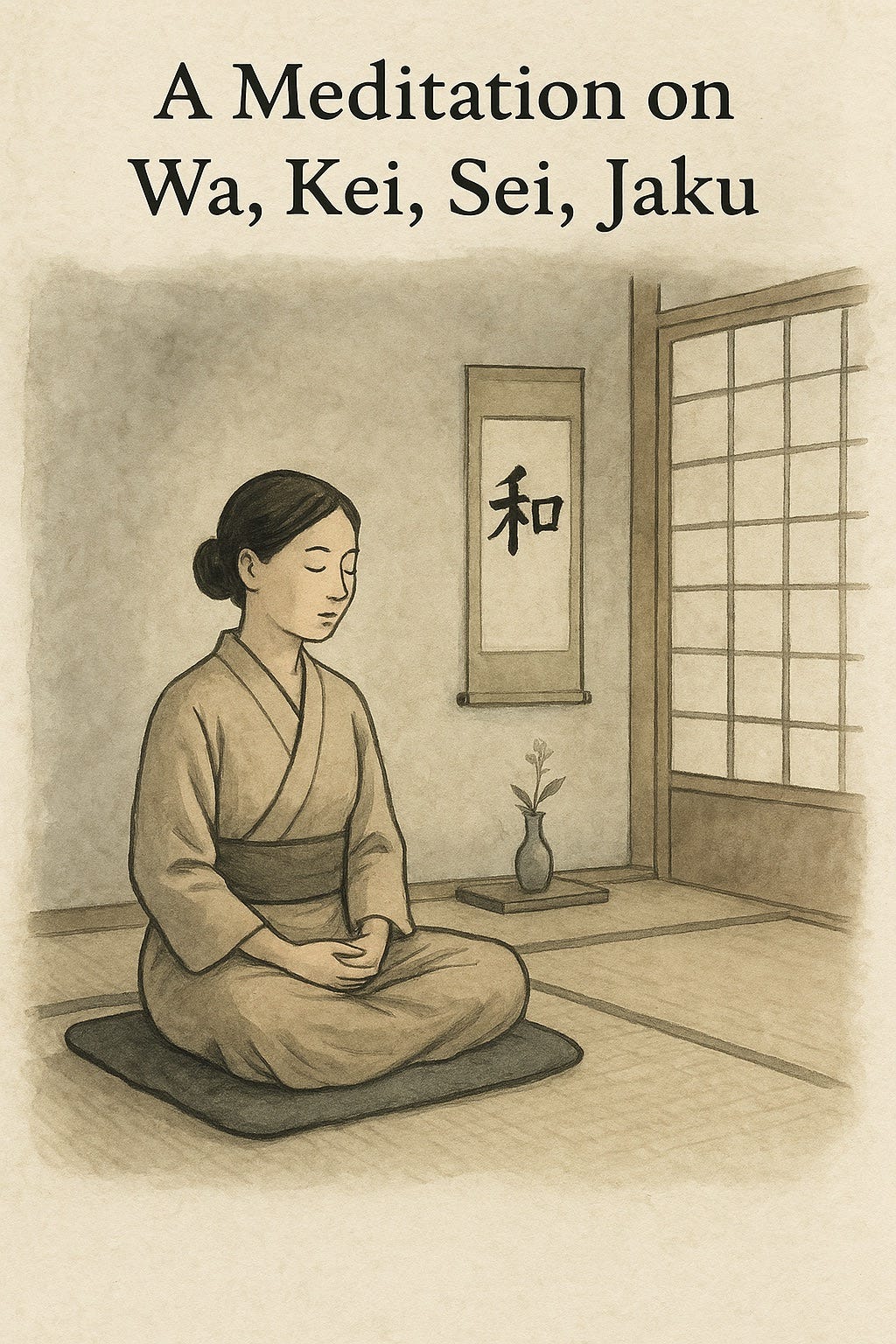
You step inside. The room is small, simple, and profoundly still. A scroll hangs in an alcove, with a single character brushed upon it: 和, Wa - Harmony. A single seasonal flower rests in a humble vase. The light is dim, filtering through a paper window.
Settle here, in this space. Feel how the room holds you. There is no separation between you and the tranquility here. You are not a visitor to this peace; you are a part of it. The boundary between inner and outer begins to soften. This is Wa: the deep, resonant harmony of person, place, & moment, woven into one silent, perfect chord.
///
From this harmony, a natural feeling arises. The second Principle:
敬, Kei - Respect.
Your gaze softens as you notice the details. The way the bamboo ladle rests on the iron kettle. The aged, crackled glaze of the water jar. See them not as objects, but as vessels with a history, each having served this same purpose countless times before.
Now, imagine your host enters. There are no words. Only a deep, mutual bow. There is no hierarchy here. There is only a host who has prepared with their entire heart, and a guest who receives with their entire awareness. This is respect.
Feel a sense of gratitude for the water that will be heated, for the tea that was grown and ground, for the hands that made the bowl you will soon hold. This respect extends to everything and everyone. It is a profound acknowledgment of interconnectedness. You sit, held in this silent web of gratitude, honoring the moment, the craft, and the shared humanity in this room.
///
From this state of respectful gratitude, the host begins to cleanse the utensils. This is the third Principle:
清, Sei - Purity.
Watch the graceful, deliberate movements. A silk cloth is folded and unfolded. The bamboo tea scoop is wiped. The bowl is ritually cleansed with hot water, the steam rising like a gentle prayer. Each motion is not a chore, but a sacred act. Each motion is a purification of the tools, but also of the space, and of the mind.
Now, turn this awareness inward. As the host cleanses the bowl, imagine a warm, golden light gathering at your crown.
With your next breath in, feel this light begin to flow down through your body, like a gentle, internal stream.
As it flows, it collects any mental dust, any agitation, any lingering worry.
With your exhale, see this gathered dust release, dissolving into the air around you.
You are being cleansed. Not because you were dirty, but as an act of preparation, of making your inner vessel clean and ready to receive. This is Sei: the clarity that comes when all that is unnecessary is let go, is cleansed...
///
With Harmony established, with Respect flowing, and with Purity achieved, a deep shift occurs. The fourth Principle emerges not as an action, but as a state of being:
寂, Jaku - Tranquility
The tea is now prepared. It is a vibrant green powder placed into the pristine bowl. Hot water is whisked into a soft, jade froth. The host presents it to you. You bow, receive the bowl with both hands, and turn it gently - a respectful gesture.
Now, you bring it to your lips. Do not rush.
The aroma is earthy, vivid, alive.
As you take the first sip, feel the warmth, the slight bitterness, the profound umami richness on your tongue. In this single taste, the entire ceremony is contained: the Harmony of the elements, the respect for the Leaf, the Purity of the intention.
As you swallow, feel that warmth spreading not just through your body, but through your entire being.
A deep, resonant silence fills you.
The chatter of the mind has stilled.
There is no past, no future.
There is only this taste.
This warmth.
This breath.
This is Jaku. A Tranquility that is not fragile, but robust and enduring. It is the quiet at the center of the universe. It is the peace that transcends all understanding. Rest here, in this profound stillness. Abide in Jaku.
///
The ceremony ends with a final bow. The message is complete, but the feeling remains.
Slowly, gently, begin to bring your awareness back to the room where you physically sit.
Feel the weight of your body on the chair or cushion.
Notice the sounds in the environment.
Carry the essence of the four Principles with you -
Carry Wa, the Harmony that connects you to all things. Carry Kei, the Respect you can offer to every moment and every being. Carry Sei, the Purity of a mind uncluttered by distraction. Carry Jaku, the inner Tranquility that is your true nature.
When you are ready, slowly and with profound respect for your body, open your eyes, returning to the world, refreshed and deeply centered.
どうも有難うございます, Doumoarigatougozaimasu.
Music cues: