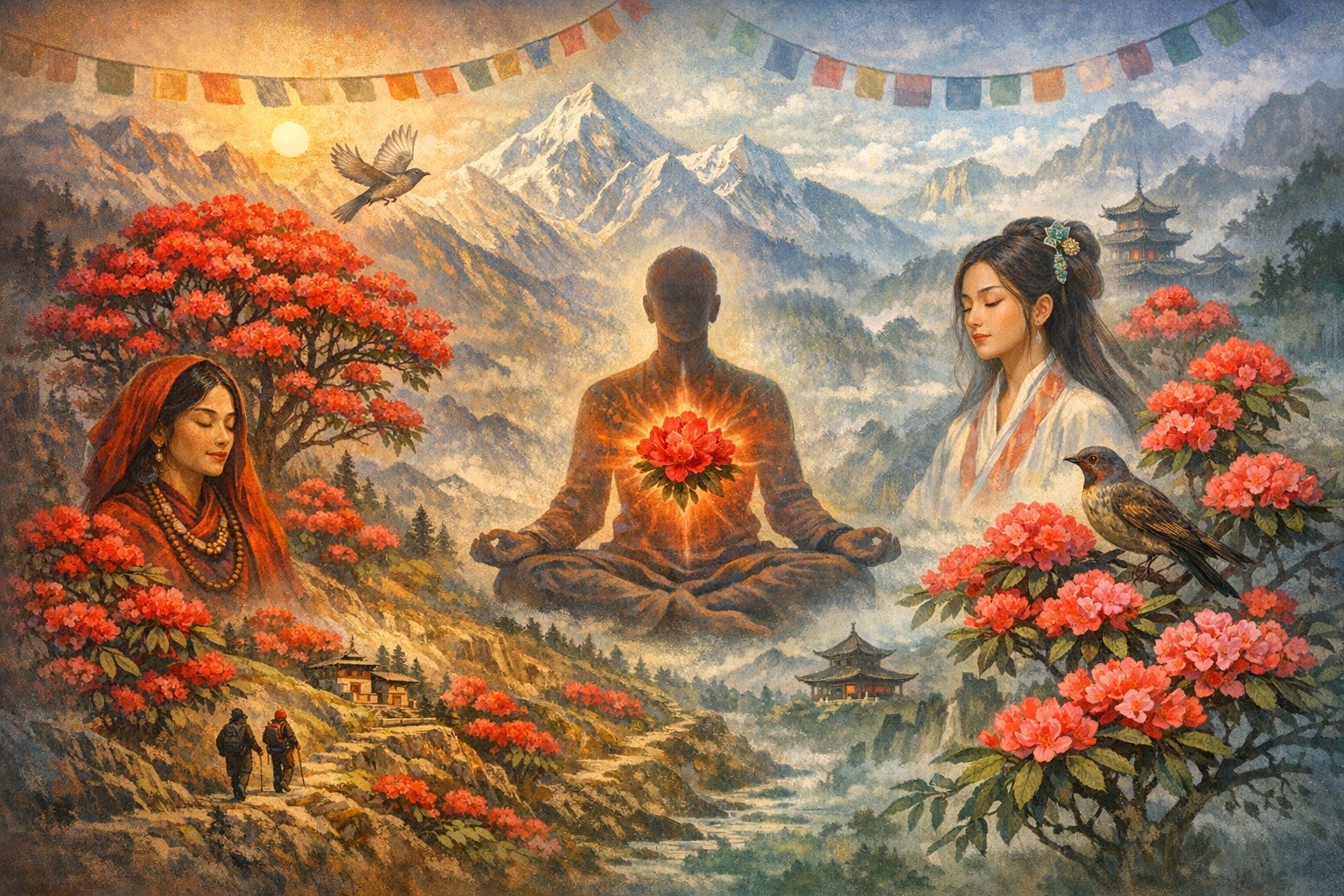
The 杜鵑鳥, Dùjuān niǎo lives in that wonderfully rich corner of Chinese folklore where a creature is never merely itself. It is a threshold‑being, a messenger of longing, a voice that pierces Spring. Its call is not just sound but season, not just season but memory, not just memory but instruction.
Among the oldest and most haunting tales is the story of 望帝 Wàng Dì, also called 杜宇 Dùyǔ. He was a gentle ruler, more farmer than king, teaching his people to guide rivers and coax life from soil. When his work was complete, he abdicated and withdrew into the mountains, choosing the quiet clarity of a recluse. Yet the world below slipped into disorder. He longed to return, but the throne he had relinquished could not be reclaimed. Grief hollowed him. From that grief, the story says, he became the Dùjuān niǎo.
In this telling, the cuckoo’s Spring cry is the emperor calling his people home, or calling for the land to be tended. Some versions say the yearning in that cry is so sharp the bird’s throat bleeds, staining the azaleas red and giving them the name 杜鵑花. The bird becomes a figure of unresolved devotion, the ache of responsibility, the persistence of spirit after form dissolves. It is a Dàoist‑flavored metamorphosis: a sovereign reduced to a single power - voice - and yet that voice shapes the season.
Later Dàoist storytellers softened the tragedy. They said the emperor did not become a ghost‑bird out of sorrow. His heart was simply too spacious to remain in one body. The cuckoo’s call, in this quieter lineage, is not grief but reminder, a seasonal bell that says:
Tend what is yours.
Let what is not yours fall away.
In this reading, the Dùjuān niǎo becomes a Teacher of timing, of return, of the discipline of listening. Its cry is a hinge between worlds - the human world of duty and the natural world of rhythm - and the listener is invited to stand precisely at that hinge, attentive, unhurried, ready to hear what the season asks.
Music cue:
Rhododendron: a Mountain‑Born Meditation
(A Guided Meditation rooted in Nepalese and Chinese folklore, medicine, and seasonal Teachings)
Settle your body... Let the breath widen...
Inhale as if drawing cool air from a high mountain pass. Exhale as if releasing newborn mountain clouds from the chest.
Settle your mind... Let the mind widen...
Let the heart widen...
Let the spirit settle...
Close your eyes...
Imagine yourself standing at the edge of a Himalayan forest. The air is crisp, cool, fresh, thin... The light is startlingly clean. The mountains - all around - rise like ancient guardians. Before you, a single rhododendron tree begins to bloom.
In Nepal, they call it लालीगुराँस, Lālīguras. The red flower of the hills. A sign of Spring. A sign of safe passage. A sign that the mountain is waking from Winter.
Breathe in. Feel the altitude in your ribs. Breathe out. Let the entire body soften.
In Nepalese folklore, the rhododendron is a companion to travelers. Its blossoms mark the path. Its presence signals that the forest is alive and watching. Some say the spirit of the mountain on whose shoulders the rhododendron blossoms rests in its branches. Some say the flowers are offerings left by unseen hands.
Let your breath follow the slow rhythm of ascent:
Slowing.
Surefooted. Steady. Unhurried.
Now, shift your attention Eastward. Across the many challenging mountain passes. Into the mist forests of Yúnnán and Sìchuān.
Here, rhododendron is known as 杜鹃, Dùjuān. A plant of beauty. A plant of medicine. A plant with a story that echoes through Chinese Poetry.
There is an old tale of the 杜鹃鸟, Dùjuān niǎo, the cuckoo whose sorrowful call was said to stain the rhododendron blossoms red. Grief becoming color. Longing becoming bloom. A reminder that beauty often carries a hidden ache.
Let that Teaching settle... Inhale... Exhale...
In traditional medicine, certain rhododendron species warm the body. They move stagnant wind. They ease cold in the joints.
They remind us that healing is not always gentle. Sometimes it arrives with heat. Sometimes with bitterness. Sometimes with the sharp clarity of mountain air.
Place your attention on the center of your chest.
Continue breathing - deeply, easily, slowly...
Imagine a single rhododendron blossom opening there in the heart center. Not dramatic. Not forced. Just a quiet unfolding.
There, in your heart center, always room enough to bloom.
Feel its warmth. Feel its color. Feel its memories
Feel its ancient memories.
Continue breathing - deeply, easily, slowly...
Now, let the Nepalese Teaching return. The rhododendron blooms first at the lower slopes. Then higher up the mountain. Then higher still. A vertical procession of renewal. A reminder that awakening happens in stages. A reminder that the mountain does not bloom all at once.
Breathe with that truth: Inhale. Exhale.
Breathe as that truth:
Inhale.
Exhale.
Continue breathing - deeply, easily, slowly...
Now, let the Chinese Teaching return. Beauty and sorrow are not opposites. They are companions. Like the cuckoo and the blossom. Like the traveler and the mountain. Like the breath and the body.
Continue breathing - deeply, easily, slowly...
Now, let the two lineages braid together in your mind:
Nepalese fire. Chinese mist. One plant. Two cultures.
A single Teaching:
To bloom is to remember where you come from. To bloom is to carry both warmth and ache. To bloom is to rise, slowly, through the mountain of your own life.
Rest in that.
Continue breathing - deeply, easily, slowly...
Let your breath become soft. Let your body feel rooted. Let the inner blossom remain open.
When you are ready, open your eyes. Rhododendrons mark the mountain passes...and show your path ahead.
Thank you.