Introductory essay:
The Mountain and the River: an Introduction to Fudōshin
不動心, Fudōshin is often translated as the “immovable mind,” yet this stillness is not the static rigidity of a stone, but the profound stability of a mountain. It describes a mental state that remains calm, clear, and unwavering regardless of the weight of pressure, the sting of fear, or the jarring nature of sudden change. In the context of Japanese 武道, Budō, this is not an emotional hardness or a lack of feeling; rather, it is a dynamic stability rooted in deep awareness. The mind in the state of Fudōshin does not cling to anger, anticipation, or hesitation, but instead responds naturally and fluidly to whatever arises in the present moment. Whether one is surprised, attacked, or challenged, the centered practitioner neither freezes in terror nor rushes in panic, but maintains a focused and unshakable composure.
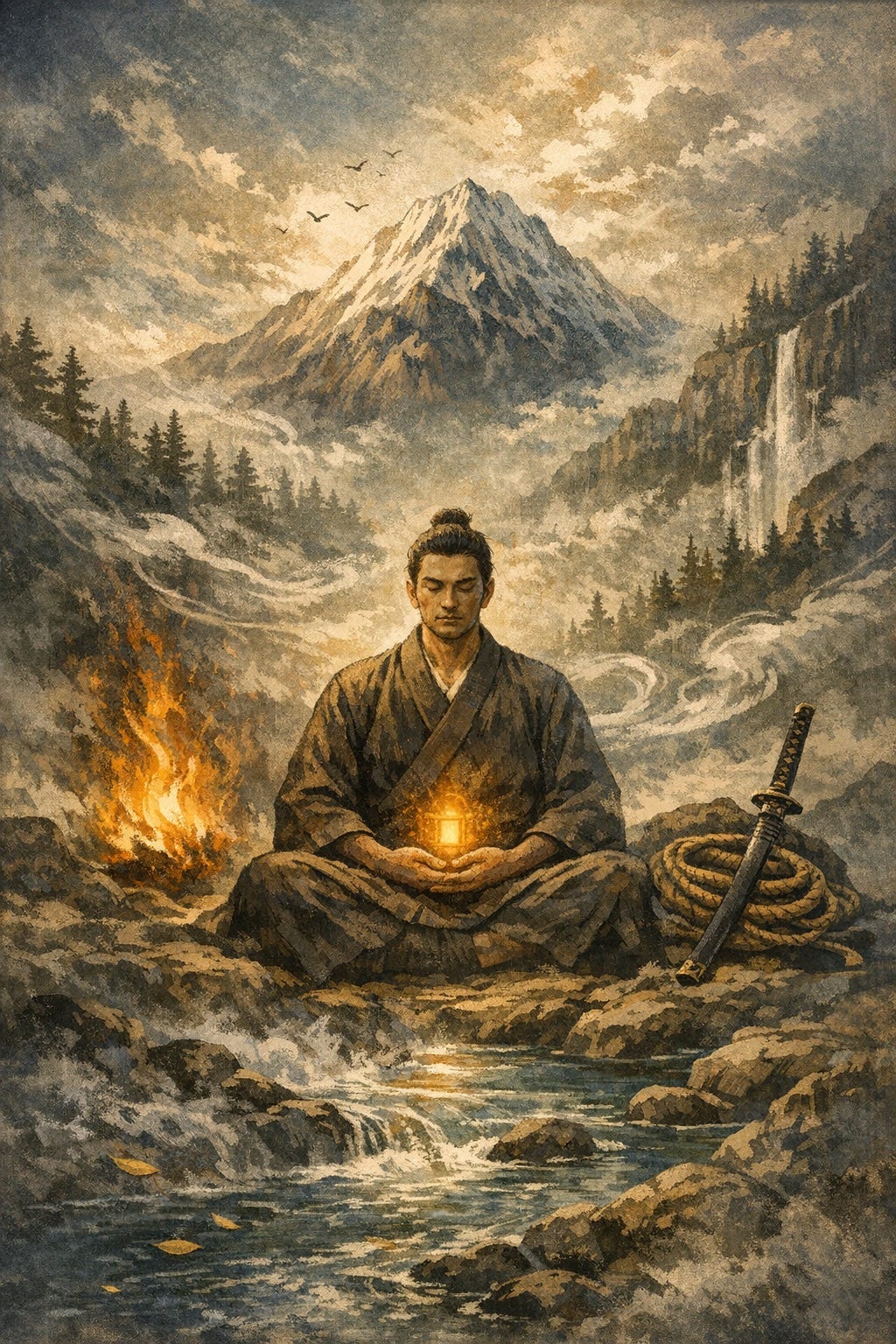
This philosophy is deeply intertwined with Zen Buddhism and a specific warrior ethos, finding its most striking personification in the Shingon Buddhist deity 不動明王, Fudō Myō-ō. As a wrathful guardian, his iconography serves as a roadmap for the practitioner: he carries a sword to cut through the thickets of ignorance and a rope to bind the unruly passions of the ego. He symbolizes an unwavering, compassionate resolve that protects the mind from internal turmoil. This mental fortress is specifically designed to guard against the 四戒, Shikai, or the “Four Sicknesses” of combat and life: Fear, Doubt, Surprise, and Confusion, which is often manifested as a paralyzing Hesitation. Fudōshin acts as the shield that prevents these sicknesses from taking root and clouding one’s judgment.
The 17th century Zen monk 沢庵宗彭, Takuan Sōhō was instrumental in defining this “immovable wisdom” for the warrior class. In his famous treatise for the master swordsman 柳生宗矩, Yagyū Munenori, he described the ideal state as a mind that does not “stop” or fixate on any single object, whether it be an opponent’s blade or one’s own anxiety. Like water that flows freely around an obstacle while reflecting the moon perfectly, Fudōshin allows for instantaneous, appropriate response without the interference of overthinking. This state is intimately linked to 無心, Mushin, or “no-mind.” While Mushin represents the absence of ego and the presence of pure, instinctive action, Fudōshin provides the stable foundation from which that effortless flow can arise. A mind captivated by a single thought is vulnerable, but a mind that is immovable remains free to act.
In the modern world, these principles extend far beyond the martial arts dojo into the complexities of daily life. Cultivating Fudōshin fosters emotional equanimity, teaching a non-reactivity to the shifting winds of external praise or criticism. Just as ancient Buddhist verses advise that the mind should remain “like Mount Sumeru unmoving,” referring to the sacred peak at the center of the universe, the practitioner seeks to remain centered whether encountering gain or loss, compliment or insult. This clarity is invaluable in decision making, allowing one to handle a career crisis without being overwhelmed by surprise or to speak in public without the interference of fear.
The development of such a mind is a disciplined practice rather than an abstract theory. It begins with the physical body, specifically through 呼吸, Kokyū, or meditative breathing. By practicing 腹式呼吸, Fukushiki-kokyū, which is abdominal breathing, one learns to drop the center of gravity into the 腹, Hara, or lower abdomen. Long, steady exhalations signal the nervous system to remain calm even under duress, ensuring that technique and presence emerge without conscious interference. This is reinforced through the disciplined repetition of 基本, Kihon, the fundamental movements of a craft. Whether in martial arts or professional life, deep mastery of fundamentals builds a muscle memory that frees the mind from doubt.
Ultimately, Fudōshin is nurtured through mindful daily activities and mental rehearsal. Whether one is sitting in 坐禅, Zazen, or meditation, observing wandering thoughts without being disturbed by them, or simply washing dishes with focused awareness, the goal remains the same. By visualizing oneself remaining effective in challenging scenarios, the mind is prepared to access composure when real pressure arrives. In essence, Fudōshin is not the elimination of human feeling, but the mastery of response. It is the cultivated inner strength that allows for clarity, compassion, and decisive action even in the heart of chaos.
The Mountain and the River: Entering Fudōshin
a Zen Guided Meditation
Sit in a posture that feels grounded and dignified. Let the spine rise without strain. Let the shoulders soften. Let the hands rest where they naturally fall.
Before the mind can settle, the breath must settle. Bring your awareness to the Hara. Feel the quiet weight of the lower abdomen.
Begin Fukushiki‑kokyū, abdominal breathing.
Inhale through the nose and allow the belly to expand. Exhale slowly and steadily and feel the abdomen draw inward. Let the exhale lengthen until it feels like a gentle release of tension. Let the inhale arrive without force.
With each breath, imagine a warm heaviness gathering in the Hara. A steady glow. A lantern lowered into a deep well. A center that does not waver.
This is the ground of Fudōshin.
* The Mountain within
As the breath deepens, begin to sense a mountain rising inside you. Not a cold or lifeless shape. A mountain with the warmth of sunlit stone. A mountain with the scent of pine and earth. A mountain with the slow patience of untold centuries.
Feel its base in your hips and legs. Feel its height in your spine. Feel its quiet strength in each breath.
Continue Fukushiki‑kokyū:
Inhale and feel the mountain receive the world. Exhale and feel the mountain remain unmoved.
Let the breath fill the mountain with presence. Let the mountain offer the breath its steadiness.
* The Winds of the Four Sicknesses
Now, imagine the air around the mountain beginning to shift. A faint stirring at first. Then a stronger wind that circles the peak.
These winds carry the 四戒, Shikai: Fear. Doubt. Surprise. Confusion.
Do not resist them. Do not brace against them. Simply feel...how they move across the surface of the mountain.
Fear approaches like a sudden cold gust. Exhale and...let it pass.
Doubt drifts in like a low mist. Exhale and...let it thin and dissolve.
Surprise flashes like a sharp change in the weather. Exhale and...let the sky clear.
Confusion swirls like leaves caught in a restless current. Exhale and...let them settle.
Your breath is the rope of Fudō Myō‑ō that binds the unruly passions. Your breath is the sword that cuts through fixation. Your breath is the guardian that keeps the mind from stopping.
* The River of Attention
At the foot of the mountain, a river begins to flow. Clear water. Cool air rising from its surface. The soft sound of movement over smooth stones.
This river is your attention.
It does not cling. It does not freeze. It moves around whatever appears.
Continue Fukushiki‑kokyū:
Inhale and feel the river gather its clarity. Exhale and feel it release downstream.
Thoughts may appear like drifting leaves. Let them float past without reaching for them. Let them pass without pushing or wishing them away.
This is the teaching of Takuan Sōhō. The mind that does not stop remains free.
Mountain below. River around. Breath through.
* Entering Fudōshin
With the breath steady and the senses awake, feel the shift into Fudōshin. A mind that is calm without dullness. A mind that is alert without tension. A mind that is present without grasping.
You are not suppressing emotion. You are not forcing clarity. You are allowing the mind to rest in its natural stance.
Continue Fukushiki‑kokyū:
Inhale into the Hara. Exhale into steadiness.
Each exhale strengthens the inner foundation. Each inhale refreshes the river’s clarity.
* Returning with Resolve
Begin to deepen the breath slightly. Feel the weight of your body. Feel the contact with the ground. Feel the temperature of the air on your skin. Feel the subtle aliveness in your hands.
You are not leaving the mountain. You are carrying it with you.
You are not stepping away from the river. You are learning to move with its flow.
Take one final Fukushiki‑kokyū breath. Inhale into the Hara. Exhale into composure.
When you are ready, open your eyes.
Return to the world as a practitioner of Fudōshin. Rooted at the center. Fluid at the edges. Clear in the heart of change.
Thank you.