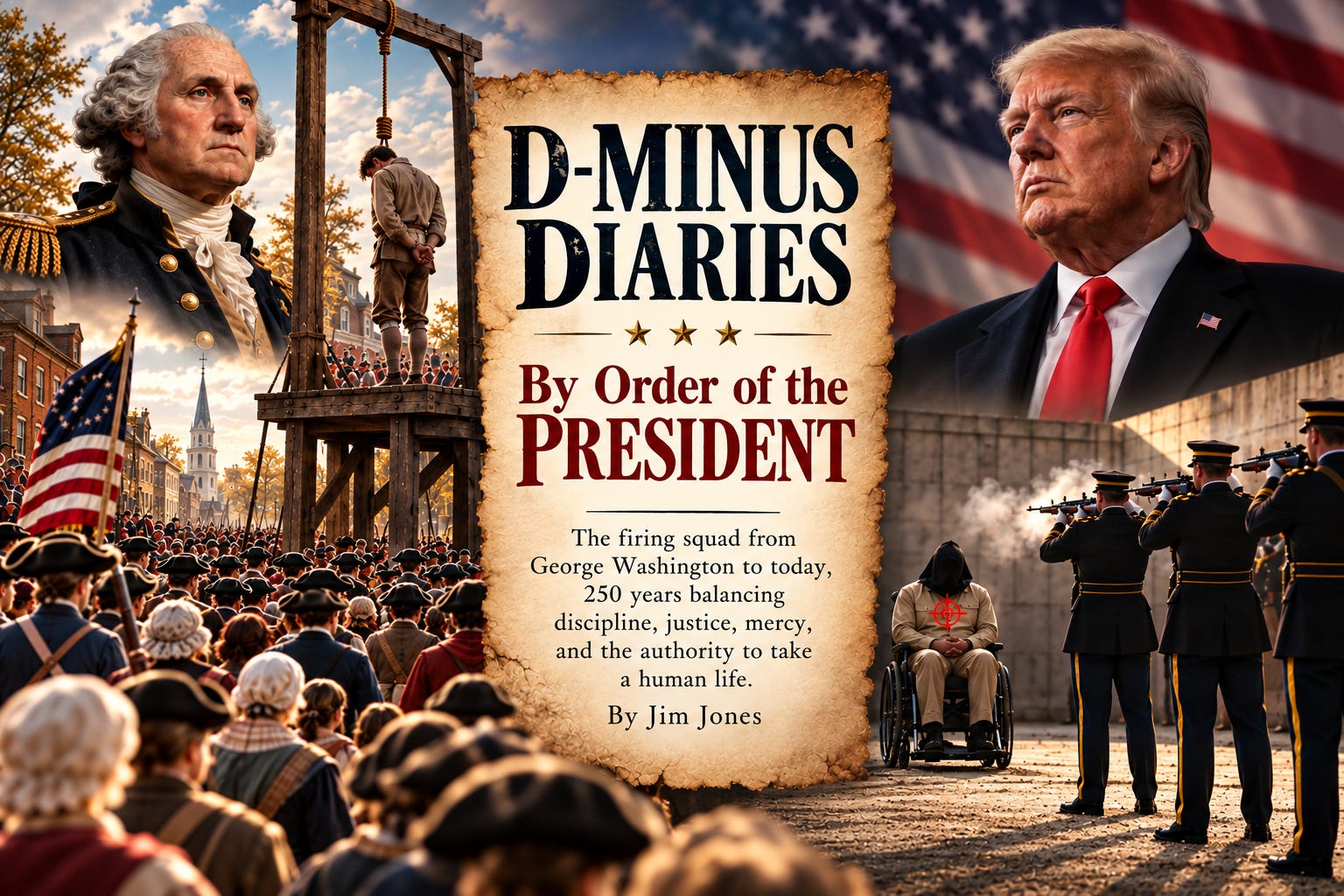
By Jim Jones
I am going to start off with a philosophical question. We say we are a country of laws. In the military you take an oath where actions have consequences. Whether it is a civilian courtroom or military courts-martial if the act is so horrible and the death penalty is given but not executed, have we not undermined the whole process?
In a country where half of the people hate what the other half thinks, it is hard to find peace. Last week it was about a botched execution in Tennessee. This week is about a military officer who by definition became a traitor when he killed his fellow soldiers and military civilian. He was also a doctor who broke his oath “to do no harm”. He was tried, convicted, and sentenced to death by a military court-martial. Once President Trump approved his execution, the Secretary of War said it would be public, which caused outrage among many people. It is my observation that some of the same people in the media and on social media who cheered when President Trump and Charlie Kirk were shot are now outraged by the idea that a murderer would be executed by a firing squad. Unlike the civilian justice system, the military operates under a different court system, where punishments are often harsh. Those punishments are based in law.
In 2011, President Barack Obama reportedly made a startling observation about his administration’s counterterrorism operations. According to the 2013 book Double Down, Obama told advisers, “Turns out I’m really good at killing people.” The remark reportedly came on the same day a U.S. drone strike killed Anwar al-Awlaki, an American citizen, in Yemen. His administration had deliberately targeted an American citizen for death without a criminal trial. Meanwhile, Hasan, who murdered his fellow Americans at Fort Hood, was prosecuted for murder rather than terrorism. Under the Obama administration, it was acceptable to target an American citizen overseas as a terrorist, without a trial, but when an Army major opened fire on his fellow soldiers at home, the Pentagon called it “workplace violence”?
The first soldier executed after a court-martial in George Washington’s Continental Army was Thomas Hickey, a member of Washington’s own guard. A general court-martial convicted him on June 26, 1776, of mutiny, sedition, and treacherous correspondence with the enemy. The next day Washington approved the sentence in his general orders and directed that Hickey be hanged at eleven o’clock the following morning. On June 28, near the Bowery then a rural area on the outskirts of New York City, Hickey was publicly hanged before an estimated 20,000 soldiers and civilians. Washington said he hoped Hickey’s fate would be “a warning to every soldier in the Army.”
From the Commanding General of the Continental Army to the President of the United States, the authority to approve military executions has rested with the nation’s highest military leadership. With the stroke of a pen, he could spare a man’s life or allow the military to take it. No matter how many generals, lawyers, politicians, or polls weighed in, the final decision in those cases rested with the President of the United States.
Here we are, more than 250 years later, preparing to witness another chapter in that long military tradition.
On October 2, 2026, President Donald Trump approved the death sentence of former Army Major Nidal Malik Hasan, the man convicted of the Fort Hood killings. The Army has scheduled his execution for December 3, 2026, and the method will be a firing squad. After President Trump approved Hasan’s execution, Secretary of War Pete Hegseth announced plans to livestream it, sparking controversy. However, President Trump later rejected the livestream, and while victims’ families may be permitted to witness the execution, it remains unclear whether the general public will be allowed to attend.
If the execution proceeds, it will be the first carried out by the United States military in more than 65 years.
Having spent much of my adult life in uniform, I find the history, the regulations, and the traditions surrounding military executions fascinating and sometimes frustrating. Few realize that the President serves as the Commander in Chief and is the final approving authority before a military death sentence can be carried out.
President Lincoln became famous for granting pardons, particularly to young soldiers who had fallen asleep on guard duty or deserted out of fear. He was reportedly troubled by the thought of a boy being shot simply because exhaustion had overcome him. Did you catch that? Just falling asleep could get you killed in the military, but Lincoln was not opposed to every execution.
Lincoln also authorized the execution of Dakota Indians following their war with the United States. In 1862, following the U.S.-Dakota War in Minnesota, a military commission sentenced 303 Dakota men to death. The Dakota men were not U.S. soldiers and were not subject to ordinary U.S. Army courts-martial. They were tried by a military commission, whose jurisdiction and fairness remain subjects of historical criticism. Lincoln ordered the cases reviewed and ultimately approved 39 executions. One man received a reprieve, and on December 26, 1862, 38 Dakota men were hanged at Mankato, Minnesota.
It is a remarkable contradiction. The President remembered for his compassion and the Emancipation Proclamation also authorized the largest mass execution in our nation’s history.
On November 5, 2009, gunfire started at Fort Hood Texas. Army Major Nidal Malik Hasan, a military psychiatrist, started yelling Allah Akbar, and opened fire inside the Soldier Readiness Processing Center, where soldiers were getting medical checks and paperwork before deployment. When it was over, 13 people were dead, and 31 others had been wounded. Hasan was convicted of 13 murders, but one of those victims was pregnant with a 3-month old baby. Court records show that Private Francheska Velez just returned from Iraq and was crying, “my baby, my baby”, and then he shot her. Her unborn child’s death was never separately charged. Note: Military law actually allowed prosecutors to charge Hasan for the unborn child’s death. Article 119a of the Uniform Code of Military Justice specifically provides for a separate offense when an attack causes the death of an unborn child. For reasons that remain unclear, Army prosecutors did not pursue the additional charge.
The rampage stopped when Sergeant Kimberly Munley and Sergeant Mark Todd, both Department of the Army civilian police officers confronted Major Hasan.
Munley initially exchanged gunfire with Hasan and was shot in the hand and leg. She fell to the ground but continued firing until her gun malfunctioned. Hasan came over to her to shoot her again but his gun malfunctioned. He reloaded and continued picking people off.
Sergeant Mark Todd then confronted Hasan and shot him multiple times, ending the attack. Hasan survived but was left paralyzed from the chest down.
He was convicted of 13 murders and 32 counts of attempted murder. Note: 31 people was shot, but he missed one, resulting in 32 counts.
In approximately ten minutes, reports say that Hasan fired 214 rounds and still had 177 rounds available and 16 magazines. He not only shot inside the building but went outside and shot people on the ground as other soldiers were trying to provide first aid before being shot himself.
What followed was another controversy. During the Obama administration, the Department of Defense faced criticism for treating the attack as workplace violence rather than terrorism.
The distinction was more than political terminology. It affected how the victims were recognized and whether they qualified for certain military honors and benefits. Congress eventually changed the eligibility requirements, allowing qualifying victims to receive Purple Hearts.
Most Americans understand that the President is Commander in Chief of the armed forces. We associate that authority with s…