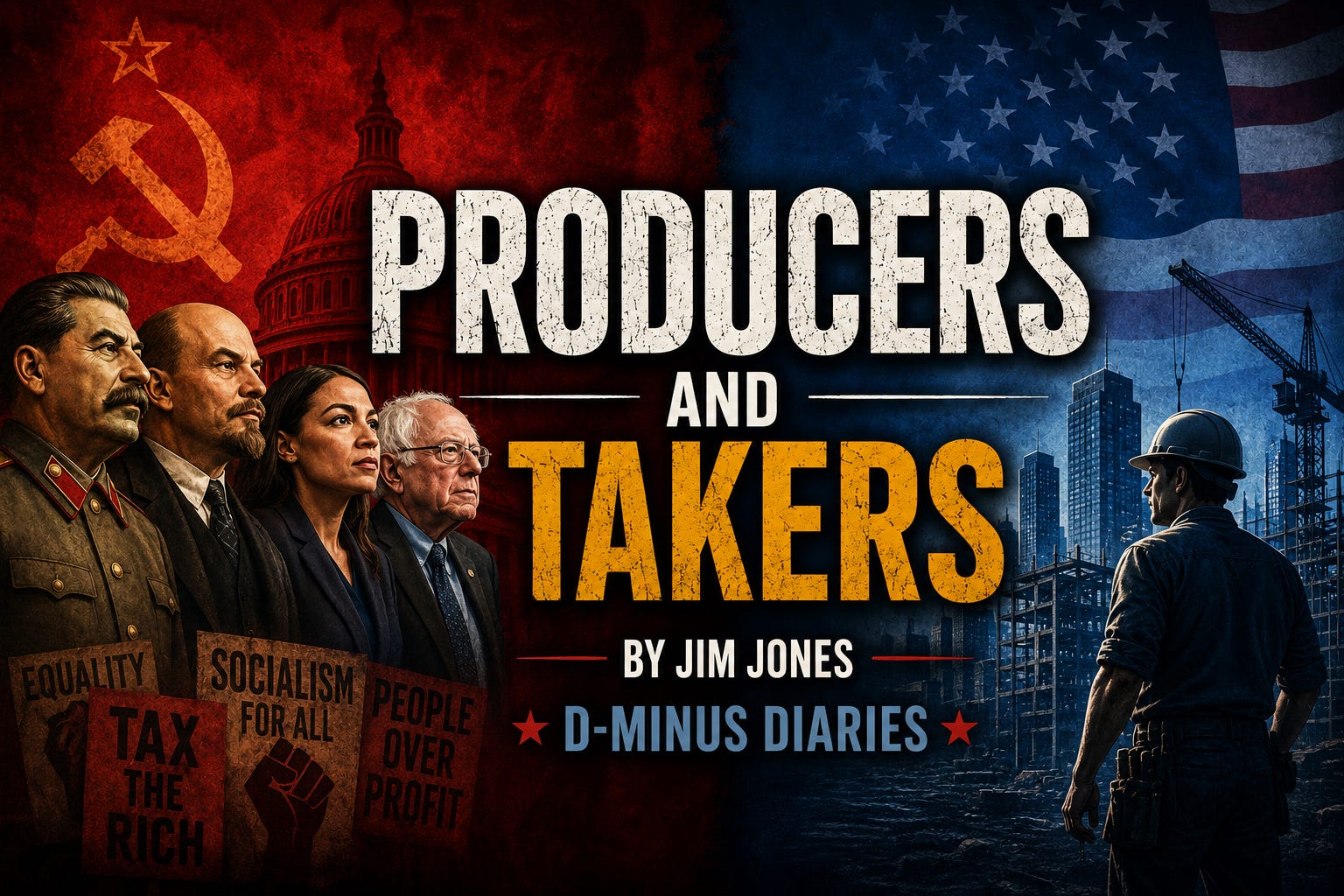
By Jim Jones
I was going to do another recap episode of my “Voting 2026 Style” but was sick this weekend and decided to take it easy. My choice was to either sit here and watch TV or write. So, writing it is.
It is election week. I will release this episode early. I try to do these episodes every Friday, so people have something to listen to on their drive home, but the election is Tuesday and knowledge, or in this case a warning, is power.
“There is no difference between communism and socialism, except in the means of achieving the same ultimate end: communism proposes to enslave men by force, socialism by vote. It is merely the difference between murder and suicide.”
From Ayn Rand’s book, “Capitalism: The Unknown Ideal,”.
For the first time in generations, Americans are hearing major candidates openly embrace the label “democratic socialists.” Whether one sees that as progress or a warning, it represents a significant shift in our political conversation. I personally do not like everything a political party has. If I had a party, it would be called the ‘Individual’. But that is not how the American political system is set up. I’m not even sure “party” is the correct word, because all parties seem to be “our way or the highway” if you disagree with a position.
We have lost what the idea is of what our political system was set up for. It is a representative democracy. That should mean that each community elects people from their community to represent them all the way up to the House and Senate. But that is not how it is. Many representatives are picked and coached, bankrolled down to the lower levels by national groups to reinforce their party’s agenda.
Today, the main players in politics are the Republicans, Democrats, Independents, Libertarians, Progressives, and Democratic Socialists.
Different areas have different lifestyles and beliefs, and the political systems are subdividing the nation, states, communities, families, friends, and job opportunities.
When I was a kid, ‘communist’ was just about the most evil word there was. Unlike Nazi’s or the Gestapo, communism did not have uniforms. The main villain in these times was the Union of Soviet Socialist Republics (USSR). What was the USSR. Well words have meaning and here is the list:
When we talk about the Union of Soviet Socialist Republics, each word in that name means something. “Union” refers to a collection of republics joined together under one central government. “Soviet” comes from the Russian word for “council,” and it originally referred to the workers’, soldiers’, and peasants’ councils that emerged during the 1917 Russian Revolution. “Socialist” points to a government that claimed to be building a socialist society, where the state controlled major industries and resources on behalf of the people. And “Republics” are the individual member states inside that union—places like Russia, Ukraine, Belarus, Kazakhstan, and others.
Life in the USSR was marked by government control over nearly every aspect of daily life. The state owned most businesses, farms, and industries, determined what goods were produced, controlled prices, and often limited what people could buy, leading to frequent shortages and long lines for basic necessities. Citizens received guaranteed jobs, education, and health care, but they also lived under strict censorship, limited freedom of speech, restricted travel, and constant surveillance by the government and secret police. Elections offered little real choice, political dissent could result in imprisonment, and criticism of the Communist Party was dangerous. While many people enjoyed a sense of stability and national pride, especially after World War II, individual freedom and economic opportunity were often sacrificed in exchange for government control and promises of equality.
It unraveled under the weight of decades of economic stagnation, political repression, and an inability to compete with the West. By the 1980s, shortages of food and consumer goods were common, government spending on the military was enormous, and falling oil prices reduced a major source of revenue. When Soviet leader Mikhail Gorbachev introduced reforms known as glasnost (openness) and perestroika (restructuring), he hoped to save the system. Instead, the reforms exposed corruption, encouraged demands for greater freedom, and fueled independence movements across the Soviet republics. A failed hardline communist coup in August 1991 further weakened the government, and by December 1991 the Soviet Union formally dissolved into 15 independent nations. The Russian flag replaced the Soviet flag over the Kremlin, ending nearly 70 years of communist rule.
For much of the twentieth century, socialism was something Americans studied in history books. Today, candidates openly embrace the label ‘democratic socialists,’ arguing that a larger role for government will produce a fairer society. Whether that represents progress or a return to ideas that have struggled elsewhere is now a question voters must answer. But before we do, I think we should realize that the Democratic Socialists are heading in one direction and picking up steam. They are heading right towards Communism, and they are not being shy about it.
On this week’s Real Time with Bill Maher (HBO) show he discusses the perceived shift in the Democratic Party towards more extreme leftist ideologies, particularly influenced by the Democratic Socialists of America (DSA). He highlights concerns about statements and actions from various Democratic figures that suggest a leaning towards communism, referencing quotes from DSA platforms and prominent individuals like New York Mayor Zohran Mamdani and influencer Hasan.
His key points include:
Criticism of the DSA’s alignment with Marxist principles. Concerns about Democratic candidates advocating for policies such as seizing property and abolishing prisons.
He expresses frustration with the Democratic Party’s direction, indicating that their vote is in play due to these shifts.
He notes the lack of support for moderate Democratic values, with only eight out of 212 members signing a pledge affirming capitalism and lawfulness. He argues that the far-left is increasingly influencing party policy, leading to a disconnect with traditional Democratic values. He articulates apprehension about the Democratic Party’s future and the implications of its evolving ideology.
The Democratic Socialists of America’s new program has been summarized as promising that “you work as much as you are able and no more than needed,” echoing Karl Marx’s famous dictum: “From each according to his ability, to each according to his needs.” Tenant organizer Cea Weaver has publicly defended what she called the government’s “sacred right to seize property,” in the context of criticizing private property and homeownership as a weapon of white supremacy, while Darializa Avila Chevalier’s deleted posts included the phrase “seize the means of production.” Within the Democratic Socialists of America, the Marxist Unity Group states that, “in cooperation with the global socialist movement, we will move closer with every passing year to a fully liberated classless society: communism.” And Wisconsin State Representative Francesca Hong has said, “I think that my perfect world would be a world without prisons, right, because we all see the humanity in one another and then we know nobody’s disposable.”
These quotes are important because they are outright telling you they are “communist”. These people are not talking about “freedom”, they are telling you they are “communist” and they are coming for your stuff.
Right, Left, Progressive, or Democratic Socialists should be a concern to Americans.
I do not agree with everything a party believes. However, when it comes to voting in America, we get two parties to vote between. It is either the Democrats or the Republicans, so I vote for the party that is more likely to preserve freedom and support the Constitution.
So, …