A Pig Walks into a Potato Patch…
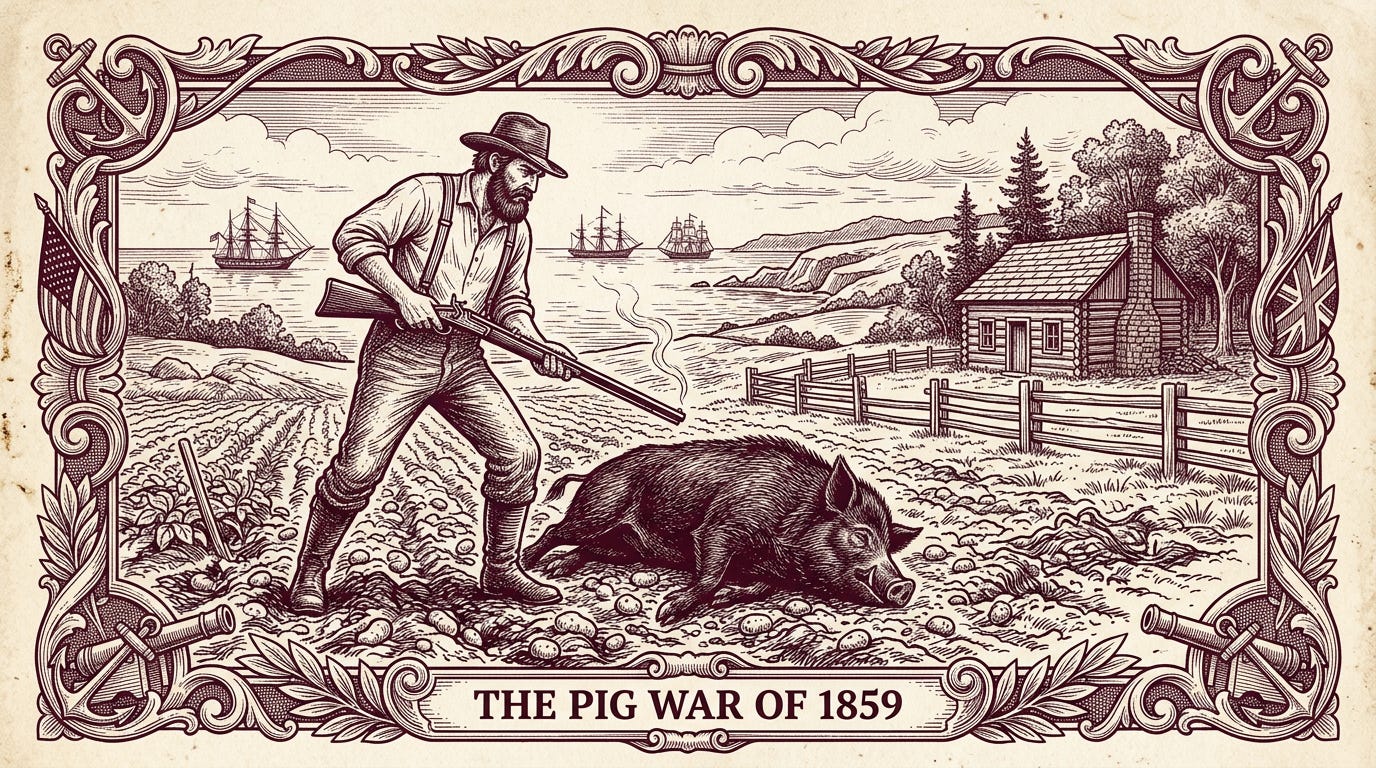
On the morning of June 15th, 1859, an American farmer named Lyman Cutlar walked out of his cabin on San Juan Island. He saw a large black pig rooting around in his potato patch. Again.
This pig had been eating his potatoes for weeks. Cutlar had chased it off. He had complained about it. He had asked the pig’s owner to control it. Nothing worked. The pig kept coming back for the potatoes.
So Cutlar grabbed his rifle and shot the pig.
That single shot almost started a war between the United States and the British Empire. Within weeks, 461 American soldiers and 2,140 British troops would face each other across the island. Five British warships would be anchored offshore. Cannons would be aimed. Orders would be shouted.
All because of one hungry pig and some potatoes.
Welcome to the Show
You’re listening to, Wait! That Actually Happened?, the podcast where we prove history is stranger than fiction. I’m your host, author Daniel P. Douglas, and today we’re heading to the Pacific Northwest in 1859 for the weirdest war that almost happened.
This is the story of the Pig War. A 12-year military standoff between two global superpowers over a single dead hog. It has warships. It has angry generals. It has a kaiser from Germany who had to come settle the whole mess. And it all started with some potatoes and a pig.
How Two Countries Ended Up Sharing an Island
First, let’s figure out where the heck we are.
San Juan Island sits in the Pacific Northwest, tucked between the Washington mainland and Canada’s Vancouver Island. It’s part of an archipelago of over 400 islands and rocks known as the San Juan Islands. Only about 128 of them are named. Only 4 are big enough to get regular ferry service. The whole group sits in the Salish Sea, which is the shared name for the waters between Washington and British Columbia.
Here’s where the geology starts making trouble. These islands are actually the tops of a sunken mountain range. About 17,000 years ago, during the last ice age, a massive glacier called the Vashon covered this whole area. The ice was 4,200 feet thick. As the glacier moved south, it scraped, carved, and gouged out the landscape like a giant bulldozer made of ice.
When the glacier finally melted, it left behind deep canyons that filled with seawater. It left behind a scattered mess of mountain tops poking out of the waves. And it left behind not one, not two, but several different channels running through the islands.
This is the geological headache at the heart of the Pig War. When Britain and the United States later tried to draw a border through “the middle of the channel,” they had a problem. The glacier had carved multiple channels. The two big ones were Haro Strait on the west side of the islands and Rosario Strait on the east side. Either one could reasonably be called the middle channel. There was even a third option running right between the islands themselves.
Whichever channel got picked would decide who owned the islands. Pick Haro Strait? The Americans get them. Pick Rosario Strait? The British get them. Pick the middle option? Everybody gets confused and it goes to court.
So when we say the Pig War started because of a pig, that’s only half true. It really started because of a glacier that carved a mess of channels 17,000 years too early and left two empires with an unsolvable geography problem.
To understand why a dead pig almost triggered a war, we need to back up 13 years.
In 1846, the United States and Great Britain signed the Oregon Treaty. This was supposed to settle a big argument about who owned the Pacific Northwest. Both countries had been arguing over the land for decades. The treaty drew a border along the 49th parallel. That’s the line you see today between Washington State and Canada.
Simple enough, right? Well, no.
The treaty said the border would run west along the 49th parallel, then drop south through the middle of the channel between the mainland and Vancouver Island. But as we just covered, the glaciers had left behind more than one channel to choose from. The treaty writers didn’t specify which one. They probably didn’t even realize the problem existed.
Nobody could agree. So both countries just started acting like they owned the islands.
By the 1850s, the British Hudson’s Bay Company had set up a large sheep farm on San Juan Island called Belle Vue Farm. They had thousands of sheep, plus pigs, cattle, and crops. An Irish man named Charles Griffin ran the whole operation. He let his pigs roam free across the island.
Meanwhile, American settlers started showing up too. Most of them were failed gold miners. They were tired, broke, and looking for free land. One of them was a 27-year-old farmer from Kentucky named Lyman Cutlar.
In April of 1859, Cutlar staked a claim to 160 acres on the island. He built a little cabin. He planted a potato patch. He did not build a fence around that patch. This would turn out to be a problem.
The American settlers and British shepherds lived near each other but mostly ignored each other. Tensions were there, but things were quiet. Everyone was just waiting for their governments to figure out who owned the place.
Then came the pig.
The Shot Heard Round the Potato Patch
Charles Griffin owned several Berkshire boars. These are big, black pigs with short snouts and an enthusiasm for eating whatever they can find. One of them had discovered Lyman Cutlar’s potato patch. And Berkshire boars do not forget a good meal.
The pig kept coming back. Cutlar chased it off with sticks. He yelled at Griffin’s employees. He complained. Nothing changed. The pig kept eating his potatoes.
On the morning of June 15th, 1859, Cutlar walked outside and saw the pig again. Standing in his garden. Rooting up his potatoes. And here’s the detail that really set him off. One of Griffin’s shepherds was nearby. Watching. Laughing.
Cutlar snapped. He grabbed his rifle and shot the pig dead.
Now, Cutlar was not trying to start a war. He immediately walked over to Griffin and admitted what he had done. He offered to pay for the pig. He offered 10 dollars. That’s about 360 dollars in today’s money. Fair price for a pig.
Griffin was not interested in fair. He demanded 100 dollars. That’s 3,600 dollars today. For one pig.
The two men argued. According to one popular story, Cutlar said, “It was eating my potatoes.” Griffin shot back, “It is up to you to keep your potatoes out of my pig.”
Historians aren’t sure if that exact exchange happened, but it captures the spirit of the thing. Neither man was backing down.
Griffin reported Cutlar to British authorities on Vancouver Island. The British threatened to arrest Cutlar and drag him to Victoria to stand trial. The American settlers on the island were furious. They weren’t about to let the British arrest one of their own.
They drew up a petition and sent it to Brigadier General William S. Harney, the U.S. Army commander for the whole Oregon region. Now here’s an important detail. Harney really, really hated the British. Like, more than was professionally appropriate. He had been looking for a reason to stick it to them for years.
When he got the petition, Harney did not consult Washington. He did not send a diplomat. He did not ask for instructions. He sent soldiers.
On July 18th, 1859, Harney ordered Captain George Pickett to take 66 men and occupy San Juan Island. Yes, that Pickett. The same George Pickett who would later lead the disastrous Pickett’s Charge at Gettysburg in the Civil War. Before that, though, he was busy almost starting a different war.
Pickett landed on San Juan Island on July 27th. He announced the island was American territory and that British law did not apply there. The British were stunned.
The governor of Vancouver Island, James Douglas, was a tough old Hudson’s Bay Company man. He was not about to let the Americans just take the island. He ordered Royal Navy Captain Geoffrey Hornby to sail to San Juan and get rid of the Americans.
Hornby showed up with three warships. He had enough firepower to blow Pickett’s tiny force to pieces.
But Pickett said something that became famous. He reportedly told his men he would “make a Bunker Hill of it.” Meaning, he would fight to the last man if he had to. Whether he actually said this is debated, but the sentiment was real. The Americans were not leaving.
Over the next few weeks, both sides sent more troops. The Americans built a camp on the south end of the island with 14 cannons. The British parked five warships offshore with 70 guns between them. By August 10th, there were 461 American soldiers facing 2,140 British sailors and marines.
Everyone was waiting for someone to fire the first shot.
Then a British admiral named Robert Baynes showed up. Baynes outranked Captain Hornby. Governor Douglas ordered Baynes to attack the Americans and remove them from the island. Baynes thought about it for a moment.
Then he said no.
Baynes reportedly told Douglas that he would not “involve two great nations in a war over a squabble about a pig.” He refused to attack. Instead, he told his ships to hold position and wait for orders from London.
That was the turning point. By refusing to fire, Baynes gave diplomats time to catch up with the soldiers.
Twelve Years of Staring at Each Other
When news of the standoff reached Washington D.C., President James Buchanan was horrified. Nobody in his administration wanted a war with Britain over a pig. He sent General Winfield Scott, the commanding general of the entire U.S. Army, to fix the mess.
Scott arrived in October 1859 and met with Governor Douglas. They worked out a deal. Both sides would keep small forces on the island. No more than 100 men each. They would jointly occupy the place until diplomats could sort out who actually owned it.
That arrangement lasted 12 years.
For over a decade, American soldiers camped on the south end of San Juan Island. British Royal Marines camped on the north end. They could see each other’s camps. They could hear each other’s bugles.
And honestly? They got along pretty well.
The two camps visited each other constantly. They held joint parties. They celebrated each other’s holidays. The British threw a big bash every year for the Queen’s birthday. The Americans showed up. The Americans threw parties for the Fourth of July. The British came. Officers on both sides became good friends.
Nobody fired a single shot in anger the entire time.
Then the American Civil War broke out in 1861. Washington had bigger problems than a pig dispute. The whole San Juan situation just sat on the back burner for years.
Finally in 1871, the United States and Britain signed the Treaty of Washington. This dealt with several leftover disputes between the two countries. One of them was San Juan Island. Both sides agreed to let someone else decide who owned the place.
They picked Kaiser Wilhelm I of Germany.
Yes, Germany. A country on the other side of the world, with no stake in the fight, was asked to settle an argument about a Pacific Northwest island. The Kaiser set up a three-judge panel in Geneva, Switzerland. They studied the case for about a year.
On October 21st, 1872, the panel ruled in favor of the United States. San Juan Island was American.
The British Royal Marines packed up and left in November. The American soldiers stayed until 1874, then they packed up too. Both camps were sold off to homesteaders.
So in the end, 13 years after Lyman Cutlar shot that pig, the United States got the island. The total human casualty count was zero.
The final death toll of the Pig War was one pig.
As for the financial cost? Multiple warships, hundreds of troops, 13 years of military pay, a cross-country trip by the top general of the U.S. Army, and a year-long international arbitration in Geneva, Switzerland. The total price tag of a war fought over a $10 pig has never been calculated. But it’s safe to say Cutlar’s original offer would have been a bargain.
When Small Things Become Big Things
The Pig War is a reminder of how fast small incidents can spiral out of control when nobody wants to back down.
Think about it. A single farmer shot a single animal. That should have been the end of the story. Maybe a small claims court case. Some grumbling at the local tavern. Instead, it became a military standoff with troops, warships, and cannons.
Why? Because once the soldiers arrived, everything changed. Nobody wanted to be the side that blinked first. National pride got involved. Politicians got involved. Generals with personal grudges got involved. Suddenly a pig was about the honor of two empires.
We see this pattern all the time in modern conflicts. A drone gets shot down. A ship bumps into another ship. A spy balloon drifts across a border. In a rational world, these things get handled with phone calls. In the real world, they can escalate fast if the wrong people are in charge.
The heroes of the Pig War were the people who refused to escalate. Admiral Baynes, who wouldn’t fire on the Americans. General Scott, who traveled across the country to negotiate a compromise. The three German judges who quietly studied maps for a year instead of picking a side.
Sometimes the most important military decision is the one to not shoot.
And sometimes the most heroic act is just saying, “This is dumb. Let’s go home.”
What If It Happened Today?
Picture this happening in 2026.
An American homesteader shoots a Canadian pig on a disputed island. Within ten minutes, it’s all over TikTok. Someone films the dead pig and adds sad violin music. The video gets 40 million views.
Cable news jumps on it. One network calls it “PIGGATE.” Another goes with “THE BACON INCIDENT.” A third somehow blames it on inflation.
The farmer gets a podcast deal before lunch.
Congress holds emergency hearings. Someone proposes a bill called the PIG Act, which somehow stands for “Protecting Important Gardens.” It’s 800 pages long and has nothing to do with gardens.
Canada issues a strongly worded statement. Then another strongly worded statement. Then they release a very polite YouTube video explaining why they are disappointed.
The Pentagon deploys troops. The Canadians deploy Mounties. Both forces spend most of their time arguing about whose hockey team is better.
Conspiracy theories bloom. The pig was a deep state operative. The potatoes were genetically modified. The whole thing was staged by Big Fence.
One Pig, Two Empires, Zero Casualties
So that’s the Pig War of 1859. The time a hungry pig almost started a real shooting war between the United States and the British Empire. Two countries sent troops to a small island because one farmer got tired of a pig eating his potatoes.
The pig lost. Everybody else won, mostly because the smartest people in the room refused to fight over something so stupid.
The island is now a U.S. National Historical Park. You can visit both the American and British camps. The British Union Jack still flies over the old English Camp every day. It’s the only place in the entire U.S. National Park system where a foreign flag is regularly raised. The flag and the flagpole were gifts from Britain.
Because in the end, the two sides figured out they liked each other just fine.
Be sure to check out my Substack, Intelligence Bulletin from Author Daniel P. Douglas, for more podcast series, written articles, and links to my books.
Subscribe to never miss history’s weirdest moments.
Until next time, remember: truth is stranger than fiction, and history is weirder than you think.
Thanks for listening. Have a memorable day!
Thanks for listening to Wait, That Actually Happened? This podcast is public so feel free to share it.