According to a report released by the Smart Energy Consumer Collaborative earlier this year, 59% of Americans surveyed agreed that “it sometimes seems like parts of their electric bills are written in another language.”
After 20 years of sitting with potential customers and discussing how going solar can save them money, we can confidently say that most home and business owners don’t realize how expensive their energy truly is.
In fact, most don’t know how to read their bill in the first place, and that’sokay. Utility bills are not designed to be easy to read.
Most people pay their electric bill each month without knowing they are billed for electricity in two different ways.
Here are the basics you need to understand about how your bill works:
What Is a Kilowatt-Hour?
Utility companies bill per kilowatt-hour (kWh) for energy. 1 kilowatt equals 1,000 watts.
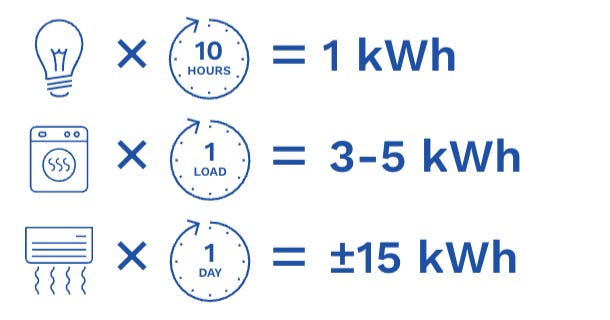
A watt is a measurement of how much electricity something uses at a given moment. A kilowatt-hour is a measurement of how much power is used over time. For example, if you turn on a 100-watt light bulb for 10 hours, you’ll use 1 kilowatt-hour of electricity. Drying laundry can use 3 to 5 kilowatt-hours per load.
To bill you for electricity, your utility adds up all the kilowatt-hours you use during a billing period and multiplies that total by the rates they charge.
But here’s what most people don’t understand:
Every bill includes two charges for the same energy that are assessed separately: supply and delivery.
What’s the Difference Between Supply and Delivery?
Supply is the price you pay for the electricity you use, and delivery is the price you pay to get that electricity to your home.
Think of it like ordering a pizza. Supply is the cost of making the pizza, and delivery is the cost of bringing it to your house. If you paid for pizza the same way you pay for electricity, every receipt would look like this:
* Pizza ingredients and preparation: $10
* Pizza transportation: $10
* Total pizza cost: $20
The bill above shows this clearly. In the “PECO electric delivery” section, it says “692 kWh X 0.09655.” The first number shows that this PECO customer used 692 kWh of electricity in their last billing period.
The second number is the per-kWh rate this person is paying for delivery. In this case, they’re paying $0.09655 per kWh.
Many people see the first number and (if they know that they’re paying per kWh at all) assume that that’s the rate that they’re paying for electricity. But to see how much you’re actually paying for electricity, you need to add together the supply charge and the delivery charge.
Under the “electric supply” section, it says “692 kWh X 0.1249.” That means that this person is paying $0.1249 per kilowatt-hour for supply.
To get the total rate, we have to add the supply rate and the delivery rate.
$0.09655 + $0.1249 = $0.22145. The true rate this person is paying is 22 cents per kilowatt-hour.
Going solar reduces or eliminates both parts of your electric bill. You no longer need to buy supply from the utility, because your electricity is generated right on your roof.
And when your own solar energy powers your home, you avoid delivery costs, since the electricity is traveling from your roof straight into your home instead of on the utility’s poles and lines.
This is why solar energy systems are such a powerful investment. Once you have one, it makes energy for you at a far lower price per kWh than your utility does, at a rate that never goes up.
If you live in Pennsylvania or New Jersey, we’d love to walk you through the numbers for your home in a free consultation.