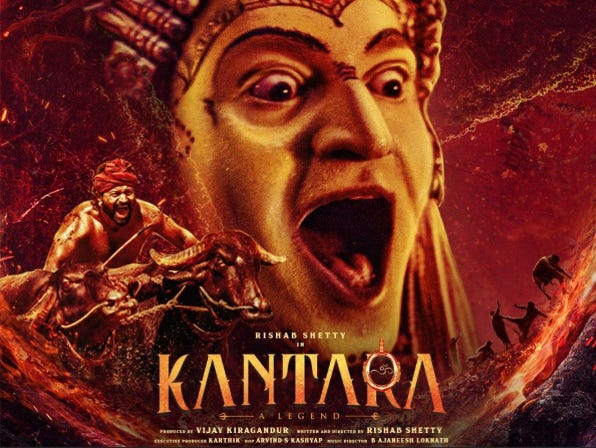
Let me admit up front that I like Rishab Shetty. A lot. I’d probably go see anything he makes, and I wish him well, because he is an actor with terrific presence. To be honest, I was blown away by his performance in Kantara, both as protagonist and director/writer. I had no idea about the bhoota-kola of Tulunadu, although I have seen the similar theyyam of nearby Malabar, and was suitably impressed.
Therefore I was disappointed and underwhelmed by the prequel Kantara Chapter 1, for a variety of reasons. I understand this is not the universal reaction to the prequel: in particular, young people I spoke with liked the esthetics, the special effects, the big budget production, and the expansive canvas of the spice trade, a large kingdom, and good cast including veteran Jayaram as the weary king, and Rukmini Vasanth as a suitably gorgeous but sinister princess.
But to me it came across as an untidy mishmash of various genres, with the principal purpose of creating a franchise: surely we can expect Chapter 2, Chapter 3 and so on. I don’t begrudge Rishab Shetty and his producer their success, especially as the original Kantara was a sleeper success on a tiny budget.
Warning: spoilers ahead.
My problems were manifold. The first was that the original Kantara hit me with the force of a hurricane, when the coming-of-age tale of the wild-boar-hunting-and-carousing Shiva takes a sudden and unexpected turn and he becomes, reluctantly, the bhoota-kola oracle, taking on the role of his father who disappeared, and his cousin who was murdered.
It was a revelation: a moment when a man turns into the Divine, in a wholly believable and entirely autochthonous, Dharmic tradition, a celebration of the presence of benign powers all around, a manifestation of a pantheistic world-view. It was one of the few recent films that powerfully put across a wholly Hindu perspective, which unfortunately is unusual in India.
As a child, I remember devotional and patriotic films in Malayalam, which engendered a certain affection for the traditions of one’s forefathers. And often the story-lines, from well-known literary works, were rooted in the local milieu. Over time, this has been dissipated, and replaced by unremarkable films that are technically quite good, but for lack of a better word, lack ‘soul’.
In general, this has been true of the dominant Hindi/Urdu language films as well: the narrative is some kind of a global, ‘liberal’, westernized, ‘modernized’ and deracinated tale, where in particular Hindus get short shrift. For example, a recent, highly-rated Malayalam film mined Kottarathil Sankunny’s Aithihya-mala, but turned the protagonists into people of other religions. There was another named 19th Century in which the recently-invented (in the 2010s) fiction of a ‘breast-tax’ on lower-caste women was turned into ‘fact’.
This sort of digestion of, and worse, denigration of, native tradition has been true of Hindi/Urdu films for a long time as has been amply and devastatingly recorded by the efforts of ‘Gems of Bollywood’ on twitter. Therefore it is refreshing when a few films offer a Hindu point of view, eg. Kantara, Bahubali, or the shatteringly powerful Baramulla. This is one reason I am loath to criticize Rishab Shetty too much, but I do have my own complaints.
One is that the Kantara Chapter 1 seems like a mish-mash of various ideas, borrowed from various sources. The origin myth of the hero Berme, where he appears as an abandoned child on a bed of leaves (and the presence of the computer-generated white tiger) may be a nod to the Sabarimala legend: Lord Ayyappa is a foundling, and he is sent on an errand to fetch tiger’s milk by the evil queen who hopes that he will die in that quest.
Then there is the battle of the good vs bad, which reminded me of the battle scenes from Bahubali, and indeed the dark-skinned barbarians from that film got a reprise here with the black-cowled evil sorcerer Kadapa tribe. And I wondered in passing if the very name ‘Kadapa’ was a reference to the Telugu stronghold of the proselytizing Christian Reddys.
Then there is the untidy story of the port city that the Kantara folks want access to, so they can sell spices to white people with no middleman. They also dragged in a superfluous white trader. Yes, the West Coast has been trading with the Middle East and points west for millennia via the Spice Route, but that seems irrelevant to the deep-forest-dwelling Kantara villagers.
In addition, there were cliched memes about slavery (of tribals) and exploitation by the rich and powerful. These came across as nods to the prevailing dogma of woke victim narratives. The remarkable thing is that slavery was virtually unknown among Hindus: the first textual and/or epigraphic examples of slavery in India were by a Christian church in Kerala (the Tarisapalli copperplate, 849CE) and during the Muslim invasions.
The characters were also hit and miss. There were the picaresque companions from the original film, including a vidushaka type who was silly in the original, but annoying here; so was the prince’s kinkara. Neither of them added much to the film, and could easily have been written out. The prince was so typecast from the moment you laid eyes on him – clearly a dissolute, useless fellow – that you knew he was going to be dispatched summarily.
I did like the princess. She was apparently born with paralysis in her hands and legs, and she was handed over to the sorcerer Kadapas, who cured her, but also (it is implied) turned her into a wily seductress, whose efforts to distract the hero (Berme) from his quest were, fortunately, futile. The old king was rather good, too. Rishab Shetty impresses as always with his physical presence, as well as his signature primal roar.
I missed the glowing varaha and the superb Varaha-roopam song which was so electric in the original Kantara. (I hear there were some copyright claims from a band in Kerala, but it baffles me that an old traditional song or tune could be copyrighted by some upstart.) There was a little piglet in one scene, but that was not enough. The VFX of the Brahma-rakshas was unsatisfying, and should have been left to the viewer’s imagination.
All in all, the prequel was a disappointment after the original Kantara, which was refreshingly unpretentious: it did not preach, nor did it explain – it just was, and it forced you to accept the reality of the demigods Panjurli and Guliga. In effect, you went into an alternate reality, along with the bhoota-kola dancer. There was no such staggering insight in the prequel Kantara Chapter 1. If you were expecting a spiritual high, as I was, you’d be disappointed.
If on the other hand, you were looking for light entertainment on a big canvas, you’d be just fine.
Thus my dilemma about the prequel: yes, it does tell a Hindu tale, and I once again wish Rishabh Shetty the best, but I wish it had left me feeling spiritually moved as the original did.
1200 words, 16 Nov 2025
The AI-based Malayalam podcast on this by notebookLM from Google.