There’s something appropriate about opening 2026 with a conversation recorded at the very end of 2025.
One year closing, another opening and where you stop debating tactics and start asking more fundamental questions. Not what should we improve, but what are we actually holding onto that no longer works.
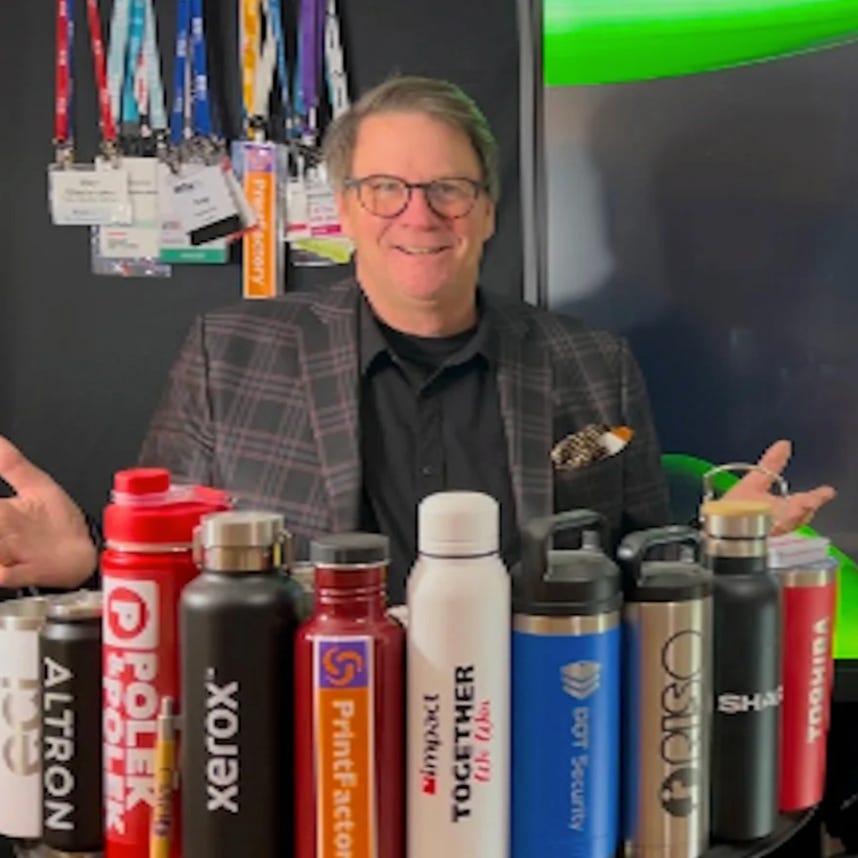
That was very much the spirit of this conversation with Ray Stasieczko, host of End of the Day with Ray on YouTube.
I originally reached out to Ray with a fairly specific question: Why should print service providers be paying attention to what’s happening with the big OEMs?
That question lasted about five minutes.
From there, the discussion expanded quickly into end-user behavior, declining print volumes, AI hype versus data reality, parcels versus mailboxes, and why 2026 may be the year the industry finally runs out of room to postpone hard decisions.
What surprised me most wasn’t disagreement. It was how often Ray and I, despite coming from different vantage points, landed in the same place.
Different Lenses, the Same Conclusion
Ray and I don’t approach the industry the same way.
He tracks the business of print: OEM strategy, dealer economics, capital structures, and where hardware-centric models start to strain. I focus on print volumes and the broader migration of customer communications away from paper and into digital, interactive environments.
Yet despite those differences, we kept circling back to a shared realization:
The industry doesn’t have a value problem. It has a volume problem.
That distinction matters more than most people want to admit. Value arguments are emotional. Volume is structural.
Volume determines:
* Whether presses stay busy
* Whether service contracts make sense
* Whether consumables scale
* Whether labor models hold
* Whether capital investments can be justified
“The industry keeps talking about how valuable print is. The ecosystem doesn’t run on value, it runs on volume.”
As volume declines, even gradually, the entire economic model starts to destabilize. And no amount of optimism changes that math.
The End User Isn’t in the Mailbox Anymore
One of the most revealing moments in the conversation came when we stopped talking about equipment entirely and started talking about behavior.
Ray asked a question that felt almost too simple:
“Who the hell wants to go to their mailbox?”
That question cuts through a lot of industry noise.
People don’t avoid information.They avoid friction.
The modern end user expects communications to show up:
* Where they already are
* When it’s relevant
* In a format that’s easy to act on
That reality is why parcels and packages came up so quickly in the conversation, not as logistics, but as attention moments.
A package gets opened immediately. Mail gets sorted, stacked, ignored or thrown in the bin.
From there, the discussion moved naturally away from printed inserts and toward something much more telling:
“It’s not even going to be a printed material in the box. It’s going to be a QR code in the box.”
That single shift reframes how we should think about direct mail, advertising, and transactional communications. The opportunity isn’t about printing better. It’s about meeting the customer at the moment they’re already engaged.
Stop Dragging the Past Into the Future
A recurring frustration throughout the conversation was how much energy the industry spends trying to preserve familiar models instead of designing new ones.
Ray was direct about it:
“Everybody’s trying to drag outdated processes into the future instead of figuring out how to disrupt themselves.”
That mindset shows up everywhere:
* Digitizing legacy workflows instead of replacing them
* Using AI to automate bad processes
* Treating incremental change as transformation
The industry has become very good at selling reassurance to itself.
But reassurance doesn’t change customer behavior. And it doesn’t reverse declining volumes.
AI Isn’t the Strategy, Data Is
No year-end conversation would be complete without AI coming up, but this one avoided the usual hype entirely.
Ray’s position was clear: AI is not the problem, and it’s not the solution either.
“AI is just going to take your data and digest it. If your data’s screwed up, AI is irrelevant.”
The real issue isn’t intelligence, it’s discipline.
AI doesn’t fix broken data.It exposes it.It accelerates whatever foundation already exists.
For companies hoping AI will magically rescue outdated systems or unclear strategies, that’s a dangerous assumption.
Why 2026 Is Different
When I asked Ray what he sees coming next, his answer wasn’t about features or formats. It was about financial pressure.
“We’re going to see the money look at this industry in a whole different way.”
In Ray’s view, 2026 is when patience runs out.
That means:
* OEM shakeups become unavoidable
* Some industrial print players exit altogether
* Capital markets stop accepting “long-term transition” narratives
* Boards and private equity demand clarity, not comfort
Incrementalism won’t survive that scrutiny.
“You can’t be dragging the past into the future.”
A Personal Note
Before closing, I want to acknowledge that Ray is one of those who encouraged me to just do it, and start a podcast.
Not to wait until it was perfect. (Which is video is not!)Not to over-engineer it.Just to start having the conversations. (The best part!)
That advice stuck. These podcasts may not be polished or beautiful, but they contain something far more important: real experience, honest perspective, and conversations the industry often avoids.
For that encouragement, and for consistently saying the quiet part out loud, I’m grateful and look forward to many future conversations with Ray.
Final Thought
This conversation with Ray wasn’t about being negative on print.
It was about being honest about where communications are going and whether the industry is willing to follow them.
Communications are not disappearing. They’re relocating. Finding a new home in a digital eco-system.
2026 will reward the companies that understand that difference and challenge those that keep defending the output instead of the outcome.
Listen to the full podcast to hear where Ray and I align and what he believes is coming next for OEMs in 2026.