Each night, at bedtime, Atlas comes to find me – Brandin does the bath and tooth-brushing, in an arrangement that we somehow came to unconsciously and now it’s become a routine – and plaintively asks, “mama cuddle?”
It’s a contrived cuteness, and we both know it. He’s five; he can speak in full sentences. But somehow, “mama cuddle?” has become the cue which, upon hearing, indicates that it’s time to go into his room, snuggle up under the covers and cuddle “for one hundred minutes” before he’ll go to sleep.
Sometimes, we cuddle in silence. When the one hundred minutes have passed – sometimes 10, sometimes 20, depending on how sleepy I become, lying there all warm, our bodies pressed up against one another – I kiss him on the cheek and I say “goodnight honey, I’ll see you in the morning”. Depending on how sleepy he’s become, he’ll say “goodnight mama” or, “no, stay” (and I do).
Last night, we snuggled up as usual beneath the covers – him, in his Hanna Andersson x Jon Klassen pyjamas (too cute, and now sold out), the wearing of which necessitates the reading of the book before bed, me in my clothes – and he started to tell me about which dinosaurs are friends, and which are enemies. Which dinosaurs eat one another and which are “herbivores”; which lived one million years ago, and which didn’t live at all, “only in the movie” (case in point: his beloved, and terrifying, D-rex).
Anchor Baby is a reader-supported publication. To receive new posts and support my work, consider becoming a free or paid subscriber.
After about 10 minutes of this, and several “okay, well, it’s time to go to sleep”s from me, I kissed him on the cheek and said goodnight. It’s one thing to snuggle in bed together, it’s another to be forced to endure endless dinosaur facts in the dark.
“No mama,” he said, “stay. Pwease stay.”
Helpless in the face of a cutesy voice – and he knows it, the cad – I acceded, snuggled further down under the covers and then, with a jolt:
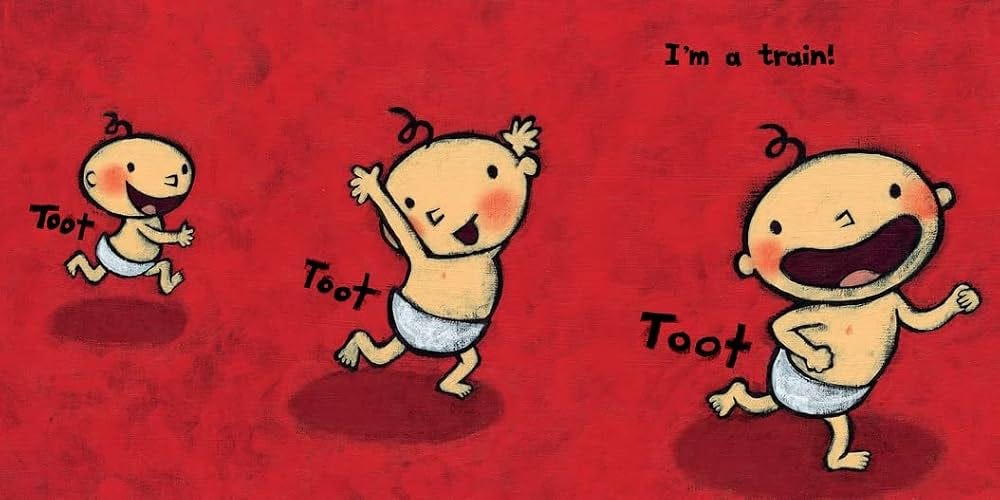
“Atlas,” I asked, “Did you toot?”
“No!” he said, too quickly, and then, laughing, “Yes!” ha, ha, ha
“Hmph,” I said, laughing too, because all toots are funny.
A few minutes later, though, things got less funny.
“Come on,” I said, feeling slightly nauseous, “stop tooting!”
“I can’t!” he said. “Boys just do that.”
It was the first time he’d ever said anything like this: boys do X, or girls do Y. I’d been waiting for it – obviously, because I am nothing if not a feminist killjoy– and wondering what I’d say to him in response. But I’d never thought that gender stereotypes would first rear their ugly heads with him in relation to farts (of all things).
I was momentarily struck dumb.
“You know,” I said to him, “I’m not a boy and I toot all the time!” Both of these things are true. I used to think I had IBS, and maybe I do, but really how it manifests is that, if I eat too much, or too much of something I know is not an ideal thing to eat too much of (any and all deep fried foods, Costco’s dark chocolate salted caramels, tomato-based sauces), my stomach reacts in a dramatic, flatulent way.
“Yeah,” he said, “but boys can’t stop!”
I laughed, then, because I wasn’t quite sure what else to do. And this felt harmless. A harmless, fart-related observation.
But I thought about it a lot last night, as I lay awake with my two-year-old next to me in the bed, a two-year-old who has a cold and is very dramatic about it (they start with the man flu b******t early, let me tell you, and don’t get me started on the manspreading).
My five-year-old may well feel as though he, personally, can’t stop farting – and honestly, that might be to do with the fact that his digestive system is fucked, thanks to his entirely terrible diet of mostly cheese – but is it possible that he’s also absorbed the notion that boys (and, by extension, men) are not responsible for their own impulses and that, some way, somehow, they have less control over how they behave than girls (and, by extension, women) do?
If we think about it on a more general scale, this is, of course, true: that men have less impulse control, less of a sense of “oh no, I can’t do this here / in front of this person / again”, than women do.
But it’s not down to some biological factor, or to some innate impulse that has to do with testosterone or a lack of oestrogen or some combination of the two. It’s to do with the permission that we, as a society, give men, and the forgiveness we extend to them when they somehow act outside of the social norm, behave in some way that is objectively objectionable, break the social contract whether consciously or unconsciously.
It’s a permission we don’t extend to women, at least not in the same way; men are allowed to be angry (“passionate”) and abrupt (“in a rush”) and crass (“funny”) and, yes, sometimes even to fart in public (“slapstick”) when the same behaviours in women would be considered, respectively, hysterical, rude, unladylike, disgusting.
I’m not sure what I can do, as one woman in a five-man household, to counteract these assumptions. I mean, my husband, to be fair to him, will also challenge the types of gender stereotypes kids come out with, about how girls run, or throw a baseball; whether or not girls like a certain type of music; who, exactly, can wear nail polish, and who can’t (when we first met, his nails were painted a kind of lurid blue; he’d gone for a manicure with a friend of his for her birthday).
But children are visual learners. Sometimes aural learners. I wonder if, for Atlas, the best thing I could possibly do is – bear with me here – fart more. Louder. With less restraint.
It feels like the least I could do.
Pity Party 🎉
I got an email from a literary agent last week, saying how much they’d loved my book; did I have representation? Would I be interested in talking to them about my next book? What was I working on?
Quite aside from the fact that I’m not working on anything right now, at least not where writing is concerned – I do have a kernel of an idea that’s been knocking around inside my brain for what feels like years, kind of yearning to get out, but I simply can’t find the time or space to let it – there was something about it that made me suspicious.
It’s very rare, for one thing, for literary agents to reach out to you, the writer. It’s more a case of you reaching out to them, over and over and over again, in the hopes that they’ll (a) read your email, (b) take the time to read your pitch and (c) and this is the real wild card, like what they read.
I spoke to a writer friend about this earlier this week; she’s been applying for fellowships, grants, awards, all of the things that I know I should be applying for. My fear of rejection is less of a fear and more of a great, towering monster; it paralyses me with terror, mostly, I think, that someone will respond to me and identify exactly what I’m most afraid of: that I’ve spent all of this time, since I was a small child, labouring under the misapprehension that I’m a good writer.
More than that: that this has, in some way, been my fate all along (the fact that I don’t believe in fate as a concept is irrelevant; in this instance I do believe in it, very much, for me and me alone); that I’m meant to be a writer, like the narrator in that Abba song, who was a dancer before she could walk. In the tale I tell about myself, I was a storyteller before I could talk; a communicator before I could make a sound.
I wrote to a literary agent in the winter of 2019 – not perhaps entirely coincidentally, I realise now, right after my relationship of five years had fallen apart, mere months before I decided to take a leap and leave Ireland, to “spend a year or two” in America, a place I’d never before wanted to go – to ask if she would read some of my work.
I sent two pieces: one, a selection of essays; the other, the beginning of a novel I’d been working on for a while, inspired, in a way, by the disappearance of Philip Cairns and the ensuing mystery, but reimagining a dramatic event as a rather more pedestrian accident, one covered up not through malice, but through necessity, and love.
“I would love if you could take a few minutes to read them in their very unfinished forms and let me know if they're of any use / where to go with them,” I wrote – and then (very Irish of me), added: “If you have neither the time nor the inclination to read them, I won't be offended.”
It took a while for them to get back to me, but they did, eventually. They wrote:
“these essays follow similar terrain to Emilie Pine, I found Emilie illuminating and stimulating and painfully honest, a requirement for this kind of thing. Yours Rosemary follow a similar terrain, but unfortunately without the insight or the shared experience to make the reader nod along while reading and without the emotional honesty either. I think. There’s one essay about what makes you cry, but without sharing with the reader anything of significance in your own life, or making the reader think, ‘I’ve cried like that’. At one point, you wonder about having it all and feeling depressed, a sentiment that will be shared by many women, but what should be a window into your world, becomes a kind of trite treatise on your therapists. I’m being brutally honest Rosemary to guide you if you are sending to other agents
“Regarding the novel that is ‘loosely based’ on the disappearance of Philip Cairns. As you suggest it marked your life, as it marked all of us who remember. . However, I didn’t find these pages… compelling. There’s only a snippet, but it feels wrong to me tonally, a bit bland, and I just can’t see it working as a piece of fiction. You should check out Bad Day in Blackrock by Kevin Power , it’s really powerful and also based on a true story , the narrative is gripping from the first page..
“I’m so sorry Rosemary I’m clearly the wrong person , but I really appreciate you thinking of me anyway…”
I don’t share this for sympathy, in the hopes that you’ll leave a comment disagreeing with this person – who is a professional in the field, and well regarded, even if I can also say, without too much wishful thinking, that even literary agents have preferences, and perhaps theirs just wasn’t for my work, or style, or both – rather to explain how difficult it can be, to be a writer, or to try to be one, which I feel myself very much to be (trying, rather than being).
It is the fate of a writer (of anyone who creates, based on their own observations of humanity, really) to be an overthinker, to over-analyse everything and everyone, including themselves. As a result, I think a lot of writers feel an intense sort of shame and self-consciousness about their own work.
And so, to curse writers with having to pitch themselves, over and over again, seems an unusually form of irony.
My parents’ house in Kildare was full of books, the occasional magazine and, on a shelf in the study, a handful of copies of National Geographic, one of which I particularly liked because it had a photo essay on African tribes and, as a result, several photographs of bare-chested women, which I found scandalous and titillating.
In that same essay, the journalist had written about the difficulty of photographing specific tribes. There were those who believed that the very act of being photographed took something from the subject; that the photograph itself would then be imbued with some facet of their essence, or soul, and that eventually, one’s soul could be entirely degraded.
I don’t hold this same belief, obviously (RIP my camera roll), but in a way the act of pitching oneself feels to me like more of an erosion of self than anything else. How many times can you draft a carefully worded email essentially begging someone to even consider reading your work – most of which won’t even garner a response – before you run out of confidence, belief in your work, and faith in your own talent or ability?
There are, of course, countless tales told by successful, award-winning, record-breaking authors, of the countless drafts and submissions they had rejected before the submission was accepted. A recent example that comes to mind is Caro Claire Burke, whose debut novel, Yesteryear, sold more than 2.5 million copies in six months.
These stories feel both comforting (it’s not just you! everyone experiences rejection!) and disheartening (if that author was rejected by 35 publishing houses, what makes you think you stand a chance?!). I feel as though the only conclusion to be drawn is that being a successful author is not about talent or hard work, or, at least, not about those things only; it is, above all else, about resilience and determination, and being able to take criticism on the chin and move on.
This is where I start to think… maybe I’m not a writer, after all. I’m too sensitive and too easily disheartened and, ultimately, find it far easier to believe the worst about myself and my work than to believe the best.
I’d love to say I’m working on it, but honestly I’m not sure where I’d even start.
It doesn’t help that the email I’d received – you know the one, from the literary agent who loved my work – was spam. I went to the website of the publishing house to see if they were even actively soliciting submissions and I found a dedicated section of the site addressing my very concern.
We have become aware of individuals impersonating editors and contacting authors, agents and others in the publishing industry. These messages may be sent by email, direct message or messaging apps, and may offer publishing deals or other opportunities.
I deleted the email and, honestly, thought to myself, that tracks.
Podcast Recommendation Corner
I absolutely devoured the first six episodes of In the Dark’s latest season, ‘The Journey’, covering a US case in which a couple was found to have had more than two dozen children via surrogate.
In case, like me, you’re unfamiliar with this story, I won’t say more about the story itself, but I will recommend that you listen to the podcast. I have – you’ll be shocked to hear – a lot of thoughts, and questions, about what went on, but also about surrogacy in general, the safeguards that are in place to protect both children and surrogates, and how we have so quickly commodified something that, on the surface, feels like something we shouldn’t be commodifying.
If you have listened, I’d love to hear your thoughts.