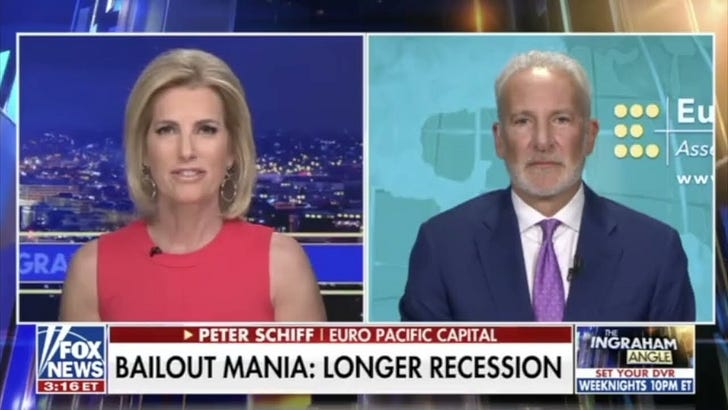
What could be worse than Bank runs? Answer, that would be something called the stinking corpse of the Derivatives Market will it finally implodes and brings the entire Debt based House of cards down with the fall of America. Audio podcast from Tucker Carlson on just how misplaced American priorities in this financial crisis are.
We have covered the Banking Collapse of SVB and Signature Bank in our previous posts for more context. The Bail out that was not a Bail out, but a Back stop will make the problem of Debts bigger and eventually trigger the default of the Derivatives Market. Peter Schiff explains the impossible bind that America’s Economy now faces.
The Financial Crisis has just begun, what happens from now onwards is the issue.
Who were the main actors behind the scenes that caused this entire Order out of Chaos situation? Find out with TruNews about how the Zionist Israeli and Chinese money connections behind the Banking Collapse. The same usual suspects once again, caught with their hands in the cookie jar.
But back to our Problem with Derivatives. What are Derivatives? Answer, below from our friendly ChatGPT Ai Assistant explaining it to a 6th Grader.
Derivatives are like trading cards.
Just like how trading cards are based on something else (such as a movie, sports team, or video game), derivatives are based on something else (such as a stock, bond, or commodity).
The value of the trading card is based on how popular or valuable the thing it's based on is. Similarly, the value of a derivative is based on how valuable the thing it's based on is.
Let's say you have a rare trading card that's based on a popular video game. You could choose to keep the card, hoping that it will become even more valuable in the future, or you could choose to trade the card with someone else who wants it.
In finance, derivatives can be traded just like trading cards. For example, you could buy a derivative based on the value of a stock, and then sell it to someone else if you think the value of the stock is going to go down.
Derivatives can be used for different purposes. Some people use them to protect themselves from risk, like buying an insurance policy to protect themselves from a potential loss. Others use them to try to make a profit by speculating on the future value of an asset, like buying a lottery ticket hoping to win the jackpot.
And what are the Dangers of Derivatives?
Derivatives can be complex financial instruments that can pose a number of risks to investors and to the financial system as a whole. Some of the potential dangers of derivatives include:
Counterparty risk: When you enter into a derivative contract, you are making an agreement with another party. If that party defaults on the contract, you may not receive the money you are owed. This can be particularly dangerous if the counterparty is a large financial institution that is heavily involved in the derivatives market.
Leverage risk: Derivatives allow investors to take on a large position with a relatively small amount of money. While this can increase potential profits, it also increases potential losses. If the underlying asset that the derivative is based on moves in an unexpected direction, the losses can be much greater than the initial investment.
Liquidity risk: Some derivatives are not very liquid, meaning they cannot easily be bought or sold on the market. This can make it difficult to unwind a position in a derivative if market conditions change or if you need to raise cash quickly.
Systemic risk: Because derivatives are often used by large financial institutions to hedge their positions or to speculate on market movements, a large-scale failure or collapse in the derivatives market could have ripple effects throughout the financial system.
Complexity risk: Some derivatives can be very complex, making them difficult to understand and to value. This can lead to misunderstandings and mispricings, which in turn can cause large losses.
Overall, derivatives can be useful tools for managing risk and for speculating on market movements. However, they can also be risky and should be used with caution by investors who fully understand the potential risks and rewards involved.
All of this as background and for the article below from Ellen Brown. She is an expert in that field and explains the Tsunami that now awaits us because of the SVB fallout.
The Looming Quadrillion Dollar Derivatives Tsunami
On Friday, March 10, Silicon Valley Bank (SVB) collapsed and was taken over by federal regulators. SVB was the 16th largest bank in the country and its bankruptcy was the second largest in U.S. history, following Washington Mutual in 2008. Despite its size, SVB was not a “systemically important financial institution” (SIFI) as defined in the Dodd-Frank Act, which requires insolvent SIFIs to “bail in” the money of their creditors to recapitalize themselves.
Technically, the cutoff for SIFIs is $250 billion in assets. However, the reason they are called “systemically important” is not their asset size but the fact that their failure could bring down the whole financial system. That designation comes chiefly from their exposure to derivatives, the global casino that is so highly interconnected that it is a “house of cards.” Pull out one card and the whole house collapses. SVB held $27.7 billion in derivatives, no small sum, but it is only .05% of the $55,387 billion ($55.387 trillion) held by JPMorgan, the largest U.S. derivatives bank.
SVB could be the canary in the coal mine foreshadowing the fate of other over-extended banks, but its collapse is not the sort of “systemic risk” predicted to trigger “contagion.” As reported by CNN:
Despite initial panic on Wall Street, analysts said SVB’s collapse is unlikely to set off the kind of domino effect that gripped the banking industry during the financial crisis.
“The system is as well-capitalized and liquid as it has ever been,” Moody’s chief economist Mark Zandi said. “The banks that are now in trouble are much too small to be a meaningful threat to the broader system.”
No later than Monday morning, all insured depositors will have full access to their insured deposits, according to the FDIC. It will pay uninsured depositors an “advance dividend within the next week.”
The FDIC, Federal Reserve and U.S. Treasury have now agreed on an interim fix that will the subject of another article. Meanwhile, this column focuses on derivatives and is a followup to my Feb. 23 column on the “bail in” provisions of the 2010 Dodd Frank Act, which eliminated taxpayer bailouts by requiring insolvent SIFIs to recapitalize themselves with the funds of their creditors. “Creditors” are defined to include depositors, but deposits under $250,000 are protected by FDIC insurance. However, the FDIC fund is sufficient to cover only about 2% of the $9.6 trillion in U.S. insured deposits. A nationwide crisis triggering bank runs across the country, as happened in the early 1930s, would wipe out the fund. Today, some financial pundits are predicting a crisis of that magnitude in the quadrillion dollar-plus derivatives market, due to rapidly rising interest rates. This column looks at how likely that is and what can be done either to prevent it or dodge out of the way.
“Financial Weapons of Mass Destruction”
In 2002, mega-investor Warren Buffett wrote that derivatives were “financial weapons of mass destruction.” At that time, their total “notional” value (the value of the underlying assets from which the “derivatives” were “derived”) was estimated at $56 trillion. Investopedia reported in May 2022 that the derivatives bubble had reached an estimated $600 trillion according to the Bank for International Settlements (BIS), and that the total is often estimated at over $1 quadrillion. No one knows for sure, because most of the trades are done privately.
As of the third quarter of 2022, according to the “Quarterly Report on Bank Trading and Derivatives Activities” of the Office of the Comptroller of the Cu…