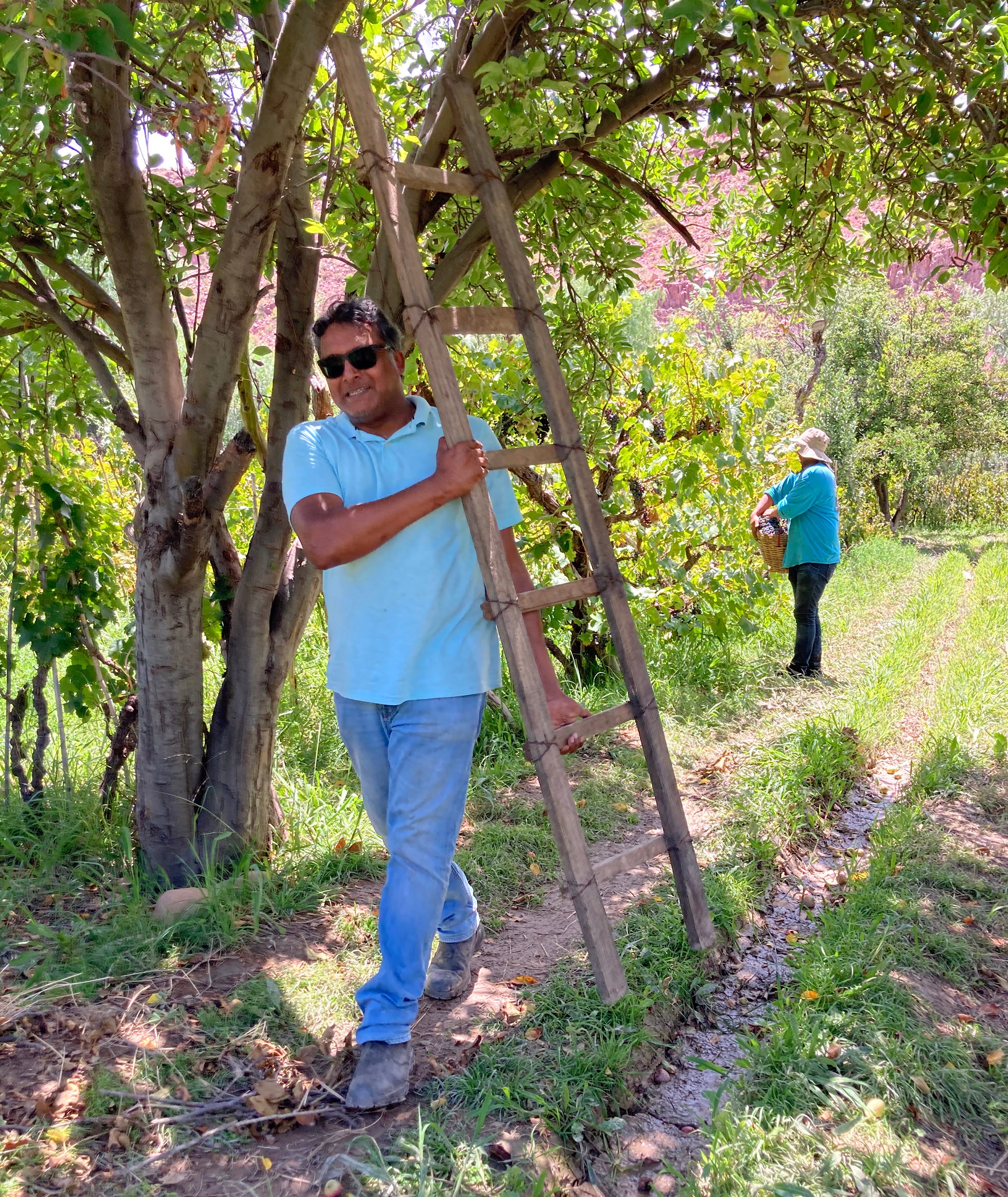
Nayan Gowdais the British born winemaker of Indian descent for Jardín Oculto, which makes wines from grapes grown from ancestral, ungrafted vines in the Cinti Valley of Bolivia. I haven’t met Nayan before, but I’ve wanted to speak with him for a long time and understand how he arrived in Bolivia. He’s a fascinating guy and the wines they are making in this corner of Bolivia, not far from Tarija, are really special. From what I’ve seen, the vineyards look more like a forest. Many are 200-years old and they grow vertically on molle and chañar trees, often more than 3 meters high. They have to be harvested by ladders, that’s how high they are.
I haven’t been to Cinti Valley and even to the Tarija area for many years, so my exposure to Jardin Oculto and other Bolivian wines has mostly been through Gustu in La Paz – which only serves Bolivian wines, not to mention spirits and beers. But it’s a new era emerging in winemaking in the country and Nayan and María Jose Granier, who owns the winery and comes from a well-known Bolivian winemaking family, are at the forefront of it. They are really exploring and experimenting with the country’s criolla grapes – the grape varieties that were developed in the Americas and once dominated, but were eventually displaced by better selling European varieties. Most that grew criolla grapes in recent years have done so for blending into cheap table wines, but winemakers like Nayan and others around the continent are looking at them differently now. It’s opening up new possibilities of wine around the region and it is giving me a lot to write about. - Nicholas Gill
New Worlder is a reader-supported publication. To receive new posts and support my work, consider becoming a free or paid subscriber.
Partial Episode Transcript
On his path to Bolivia and working with criolla varieties
Nayan: “I have a past prior to making wine. I’ve done various things. Project management chef-ing. I used to get bored very, very easily, basically. I ended up being Program Manager for JP Morgan and that allowed me to save up enough money basically to run away to Australia to study winemaking at Adelaide University. That was at the age of 30 or 31 that I decided to reinvent myself as a winemaker.
So, I've been making wine now for the past 18 years, which is quite scary. It makes me feel suddenly very old. Bolivia is a country that I've always wanted to come to. I always wanted to visit. I had friends who traveled around Bolivia and they always raved about it and said it was such an amazing place. I helped run a Facebook group for international winemakers. We've been going since 2007. I think we've got 54,000 active members. It’s massive. And it's a place for people to exchange information. But it's also a place for winemakers to look for jobs internationally and people to advertise roles that they have. So, the end of 2019, María Jose Granier, who founded Jardín Oculto, advertised there. And I noticed the advert to approve it, administrator’s privileges, and basically replied within about five minutes. I was on plane basically in January 2020.”
Nick: “She comes from a family of winemakers, right?”
Nayan: “That's right. The family own Campos de Solana and Casa Real.
Nick: “So there was a traditional growing grapes in the family, and she wanted to do something different?”
Nayan: “Yes. So, she had to she did used to work for Campos and Casa and decided she wants to branch out on her own and do something independent, on a smaller scale, but also primarily focused on the heritage varieties that we have. Grape growing has happened here ever since the Spanish invasion or conquest, depending which way you look at it. And we have grapevines that are in excess of 200 years old and it's a heritage worth preserving and celebrating.”
Nick: “Even before Bolivia, you were kind of traveling around and making wine in places that were non typical regions. I have been looking at your history, and there’s not so much like France and Italy, but more like Ukraine and Kazakhstan. I'm not even sure what else. So, your interest has been in off beat, winemaking destinations.”
Nayan: “I kind of, sort of fell into it. One of the reasons I became a winemaker is that I travel. I used to do a lot of backpacking. In my 20s, I used to basically do a contract or a job and disappear, and then to come back. With winemaking it allows me to immerse myself in a culture for three months or more, to really get to understand a place through people. And it's just something I really enjoy.”
Nick: “I can't say I’ve had a Ukrainian wine or anything from Kazakhstan, but I'm sure there are fascinating grapes there.”
Nayan: “I honestly, most places around the world, they have the so called International varieties. Cabernet sauvignon. Merlot. Cabernet Franc. In Ukraine, we did have a couple of regional grape varieties like saperavi, but Kazakhstan was just purely international.”
Nick: “Anyway, I'm sure the resulting wines that comes out of those landscapes are different no matter what grapes you plant.”
Nayan: “Without a doubt.”
Nick: “So you connect with Maria. And you get to Cinti Valley. Did she already have the vineyards there?”
Nayan: “We don't actually own our own. We work with a series of growers. It's a partnership insofar as obviously we pay them money for them, but also we try to help them with their viticulture. To improve their practices, to reduce the inputs that they need. Part of the long term aim of the project is to try to go to organic as much as we can. We're not there yet, but we've managed to reduce their spraying dramatically, which is a good thing and saves them money.”
Nick: “So, these vines, these 200-year-old vines, in this place… what were they doing with the grapes before?”
Nayan: “Mostly they were just sold to be blended into bulk wine. That was the negra criolla and vischoqueña. They just put it into cheap table wine. So, they actually celebrated for themselves. And in fact, most of the small producers in the Cinti Valley rarely released a single varietal heritage variety. They have started the past few years, but not traditionally.”Nick: “So, before, you wouldn't really see a negra criolla or vischoqueña. I remember ever seeing something like that until like you guys came along?”
Nayan: “Not really. I mean, one of the things that we have done is that we've influenced the other producers and helped give them confidence to release single varietals, which is fantastic.”
Nick: “The interest is there now, but even five years ago, I think wine has changed quite quickly. And in South America in general is really fascinating. The interest in growing criolla varieties, and just people wanting something other than, you know, noble grapes. It's fascinating, and it's exciting. I think we're really just tapping into the future here.”
Nayan: “Also I think, a stylistic thing. As you turn the Nobel grapes, French varieties, the cabernets and the malbecs, and such like, generally they have been made into very big, robust, oaky wines. That's not something you can really do with these criolla varieties. They're just to delicate. So you have to make more delicate, ethereal wines with them. You have to handle them a little more gently in the using new oak. And I think there's definite general global trends to move to these wines, but I think that's starting to build in South America as well, where people are looking for lighter, fresher styles. That's what the criolla vines can give.”
Nick: “It's exciting because in , and Argentina, and even in Peru, it's like there's a whole new range of wine that's opening up. I’m excited every time I'm down there. There's always another wine that I haven't seen before, somebody new coming out with something. It's building and it's growing. And people like you doing something in Bolivian gives other people confidence, as you said, and it's just spreading. There's a lot of good wine that wasn't there before. A lot of new wines and different kinds of wines. And it's fun. …