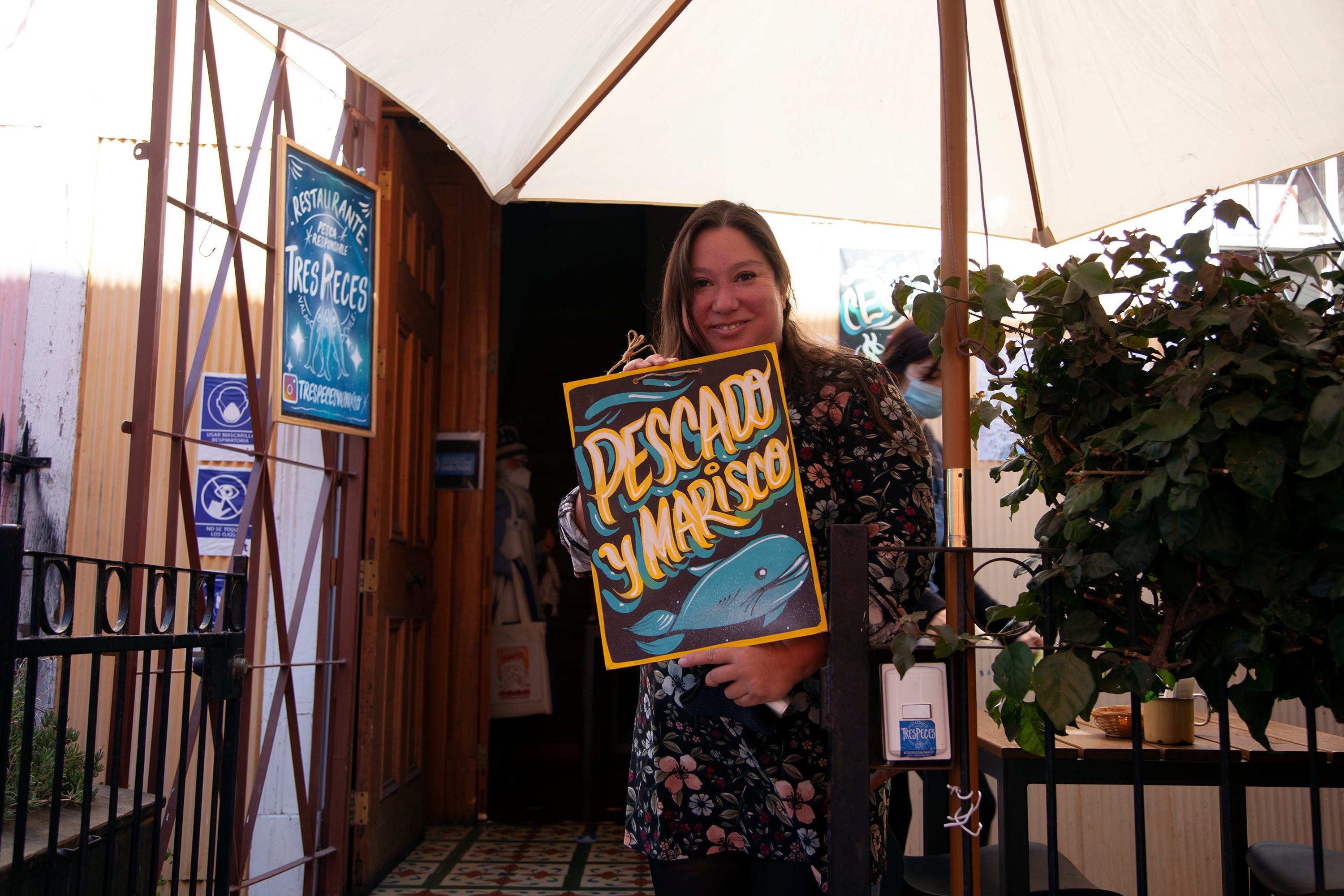
Meyling Tang is one of the founders of Fundación CocinaMar, a non-profit organization based in Chile that promotes the well-being of the country’s fisheries and the people that work within it, as well as the seafood restaurant Tres Peces in the port city of Valparaíso. She is also a journalist, specializing in the research into global fisheries. She is perhaps the best person to speak with regarding seafood in Chile and I have been following her work for probably a decade. She has a lot going on with all of her projects and I’ve had the chance to see many of them up close while traveling in Chile. We speak a lot about her restaurant and how she really is breaking with tradition in terms of sourcing and logistics, opting to work directly with fishermen in a way that is mutually beneficial. We also touch upon this idea of the restaurant as a hub of storytelling, something I think can be incredibly powerful.
New Worlder is a reader-supported publication. To receive new posts and support my work, consider becoming a free or paid subscriber.
Did you know that you can also listen to the New Worlder podcast on Apple Podcasts, Spotify and most other podcast networks?
Partial Episode Transcript
Chileans and their connection to the sea
Meyling: I'm from the south of Chile and I started a career in journalism 20, 25 years ago. When I finished studying, my options were too few. I think in Chile, we have a lot of universities, but little possibilities for work. I was living in Puerto Montt, one of the biggest areas of the salmon farming industry. So, my first job was working as a journalist in a specialized aquaculture magazine. I think for the first three months, I didn't understand what it was that I was writing. I learned a lot about the importance of the sea, the importance of gastronomy to connect to people.
When I was in my 30s, I decided to move to Galicia [Spain], to Santiago Compostela. I was lucky enough to do that. In Galicia, I really connect with what I'm doing right now. In Galicia, in Santiago Compostela, in the northern part of Spain, they really love seafood. They are so proud about the products and about their seafood. If you invite someone to your home, they will offer the best of what they have. Of course, there are mussels, crabs, the best fresh fish…when I returned to Chile, that was 10 years ago, I moved to Valparaiso, which is really close to Santiago and I realized that we didn’t have that connection. Chileans didn't connect with the sea, or the amount of seafood that was available from our ocean. That's why I started to work on fish consumption, to promote fish consumption and to connect fishermen with gastronomic sector.”
Nick: Why do you think that is? Why do you think Chile doesn't have that connection to the sea? I mean, the whole country is coastline. It's 4000 kilometers of coast and you're never far from the ocean. The seas are amazingly rich and diverse. Why don't Chileans have that connection?”
Meyling: “I think there are a lot of reasons, but one is that we are focused on exportation. We have a lot of sea, we have a lot of seafood. We have more than 200 different species that we can capture. And we can farm from the sea. But everything is for export. So, we're not focused on the domestic market. If you think about our government, or the institutions that need to be focused on seafood consumption, no one is focused on food for the domestic market. We are focused on what you can capture from the sea if it's legal or not. The season that you can capture. These are all technical issues, more than the importance of these fish that can come to your home. So for many years, the fisherman in Chile – more than 90,000 people and more than 500 fishing villages in this long coast – didn't have the skills to sell the fish directly, because we didn't care about domestic market.”
Nick: “The fish just stays in the port areas basically, unless it's being exported.”
Meyling: “Yeah. So, you are on the boat. You have the fish at the beach and a truck comes and then the truck goes to another area where the fish can go abroad by airplane or boat. But fisherman haven’t have been involved in this business at all. I think this changed 10 years ago, five years ago, when they started to learn some of these skills and to have different projects. I think one of the biggest tools is Instagram, all this social media, so they can show what they're doing on the boat.”
Nick: “It gives them that direct connection to the consumer. So, I was I was working on a cruise ship recently that was that went along the entire coast, from Arica to Punta Arenas, and we stopped, everywhere along the coast. I've been to all of Chile's coastal cities before, at least most of them, but this was the first time it was all at once. For the first time I could really get a sense of just how rich and how vast Chile's seas are. In every port, there was a lively fishing community, and I could walk into the local market, and there was always something different than that the last port. For me, I always think of when I'm traveling and Chile to eat seafood. That's what I want because I know how rich it is. I know how amazing the products are. But to Chileans, the consumption of seafood it's weirdly low, right?”
Meyling: “It's between 10 kilos per capita, and 18 kilos per capita. Of course, it's different if you're living in a village that is next to the coast. Or if you have some friends that are fishermen, then you will have amazing food as you just said. But still, there's not a political program to increase the local consumption of seafood, and to understand how important it is for health.”
Nick: “I'm trying to think of a seafood market away from the coast, like in Santiago…”
Meyling: “There's only one, the Terminal Pesquero. Of course, they concentrate like 50% of the fish consumption in the area, of course, but we don't have the same thing in the regions, and, as just said, we are 4000 kilometers long. So, we need to connect between the cities, not only centrally. We create a foundation that is called CocinaMar eight years ago. We are four friends that were involved in the fishery sector and we understood that we need to have some channel to show the work that fishermen have been doing for many years, and also to teach the cooks in the restaurants and the community what is available from the sea.
If you visit Chile, you will find no more than 10 options of our seafood in most restaurants. There might be conger, hake, loco, Chilean abalone, machas…that is not all the richness that we have. We have a lot of seaweed, crustaceans, sea urchins. We are the most important sea urchin exporter in the world, but you don't find easily at restaurants so that's something that we need to change. And of course, it depends on the logistic. It depends on many middlemen between the boats and the supermarket and businesses like restaurants.
So, when we started Tres Peces, that is the restaurant we own in Valparaiso, we decided that we will buy directly from artisanal fishermen. This is something that everyone can do. We decided that we will pay at the same day that the fish arrive, and this is not something that is easy for our business. And we decided that the menu should be flexible to change, depending on what is on the boat.”
Nick: “I'm thinking of my travels in Chile and most of the menus are the same 10 fish, as you said. It's definitely not a reflection of how many species are there and being caught. I think people prefer artisanally caught seafood, but I think just prices tend to be high because of all the intermediaries.”
Meyling: “That's right. There are more or less five or six people, middlemen, between the boat and the supermarket. So that's why in Chile seafood is so expensive. But if we try to reduce that, and we have only one, a good one, that can sell you, fresh fish, frozen fish, smoked fish, it changes everything. So that is the thing that we have been doing for the last five years in Tres Peces. Ev…