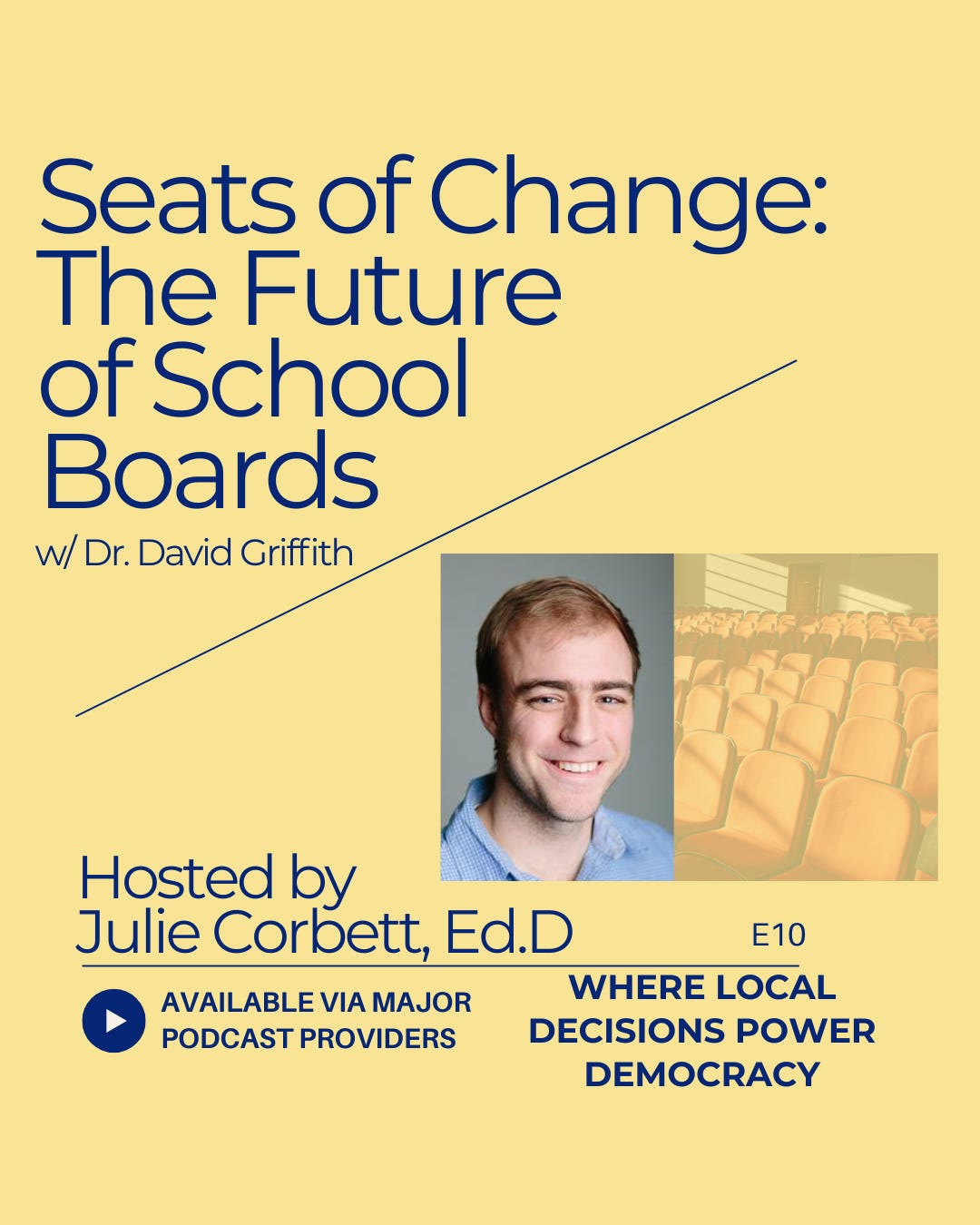
Join us for a conversation with Dr. David Griffith from the Thomas B. Fordham Institute as we explore Fordham’s recent report, Who’s on Board? School boards and political representation in an age of conflict. Our discussion pushes each other’s thinking while addressing the challenging landscape of school board research and possible strategies for structural change. We dive into the specific methodological complexities of studying local education governance while highlighting the significant barriers to racial representation on school boards and connections to the teacher pipeline, and how “we” grade the quality of schools. Find the episode on Apple, Spotify, and Substack under Seats of Change: The Future of School Boards.
Resources:
* Ashley, E. & Douglass, C. (2022). Empty seats at powerful tables: The state of school boards in America.School Board Partners. https://www.emptyseatsreport.com/
* Houston, D. & Hartney, M. (2025). Who’s on Board? School boards and political representation in an age of conflict, Fordham Institute. https://fordhaminstitute.org/national/research/whos-board-school-boards-and-political-representation-age-conflict
* Rogers, John, et al. (2024). The costs of conflict: The fiscal impact of culturally divisive conflict on public schools in the United States.Los Angeles: UCLA Institute for Democracy, Education, and Access, https://idea.gseis.ucla.edu/publications/files/costs-of-conflict-report
* Thomas B. Fordham Institute, https://fordhaminstitute.org/